
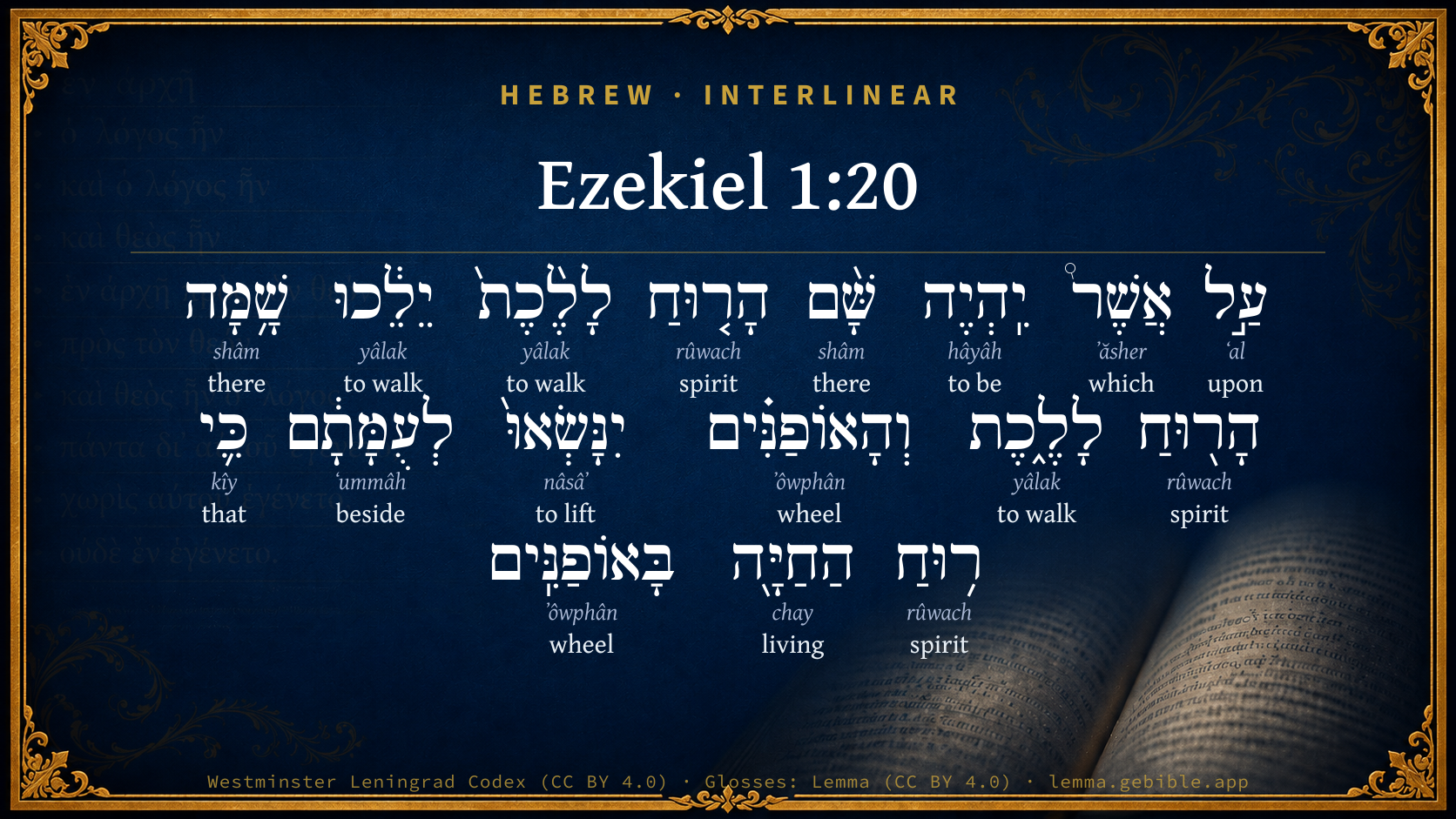
Ezekiel 1:20

Hebrew (Westminster Leningrad Codex) Ezekiel 1:20 appears in the Hebrew Old Testament. The text above is from the Westminster Leningrad Codex. Each word links to its Strong’s number, a concise gloss, and parsing drawn from the Open Scriptures Hebrew Bible morphology. Click any word for its full Brown-Driver-Briggs (BDB) entry.
Download image
Cite this verse

Ezekiel 1:20 (World English Bible). Public Domain. Lemma interlinear Bible study tool, https://lemma.gebible.app/v/ezekiel/1/20.

Show BibTeX & RIS
BibTeX
RIS
English Translation
Wherever the spirit was to go, they went; there was the spirit to go: and the wheels were lifted up beside them; for the spirit of the living creature was in the wheels.
World English Bible · Public Domain
Download a study sheet

One document with this verse’s original text, its word-by-word gloss line, the meaning frame, cross-references with their text, attributed commentary, and full source and license credits — printable, and it pastes into notes with its structure intact.

This verse Autodidact and up

Study sheet (.html) Plain text (.txt)

A passage Seminary Student

Up to 50 verses in one chapter. A passage sheet keeps up to 6 commentary sources and 12 cross-references per verse, in the order this page ranks them, and says so on the sheet whenever that leaves anything out. Ask for a single verse and you get the Autodidact verse sheet above.

Everything on this page stays free to read, with no account — the sheet is a download of what is already on screen, not access to it.

Want to remove ads? Support Godless Engineer
Compare translations 3

The same verse in 3 English versions, stacked beneath the original-language interlinear above. Click any original word for its lexicon entry.

Each is an independent rendering of the whole verse — the interlinear is not word-aligned to these translations.

Highlighted words mark where these versions differ — a whole-verse word diff, not a word-by-word alignment.

  • World English Bible Public Domain
    Wherever the spirit was to go, they went; there was the spirit to go: and the wheels were lifted up beside them; for the spirit of the living creature was in the wheels.
  • King James Version Public Domain
    Whithersoever the spirit was to go, they went, thither was their spirit to go; and the wheels were lifted up over against them: for the spirit of the living creature was in the wheels.
  • unfoldingWord Literal Text CC BY-SA 4.0
    Wherever the Spirit would go, they went, and the wheels rose up beside them, for the spirit of the living creature was in the wheels.

unfoldingWord Literal Text — © unfoldingWord, licensed CC BY-SA 4.0. Word-aligned USFM3 via Door43 (git.door43.org/unfoldingWord/en_ult).

Versions to compare (up to 4)

3 of 4 selected

Show all 18 translations

Every available English version of this verse, each an independent rendering of the whole verse.

  • World English Bible Public Domain
    Wherever the spirit was to go, they went; there was the spirit to go: and the wheels were lifted up beside them; for the spirit of the living creature was in the wheels.
  • Berean Standard Bible Public Domain
    Wherever the spirit would go, they would go, and the wheels would rise alongside them, because the spirit of the living creatures was in the wheels.
  • Majority Standard Bible Public Domain
    Wherever the spirit would go, they would go, and the wheels would rise alongside them, because the spirit of the living creatures was in the wheels.
  • King James Version Public Domain
    Whithersoever the spirit was to go, they went, thither was their spirit to go; and the wheels were lifted up over against them: for the spirit of the living creature was in the wheels.
  • American Standard Version (1901) Public Domain
    Whithersoever the spirit was to go, they went; thither was the spirit to go: and the wheels were lifted up beside them; for the spirit of the living creature was in the wheels.
  • Revised Version (1885) Public Domain
    Whithersoever the spirit was to go, they went; thither was the spirit to go: and the wheels were lifted up beside them; for the spirit of the living creature was in the wheels.
  • Geneva Bible (1599) Public Domain
    Whither the spirit led them, they went, and thither did the spirite of the wheeles leade them, and the wheeles were lifted vp besides them: for the spirit of the beastes was in the wheeles.
  • Douay-Rheims (1899) Public Domain
    Whithersoever the spirit went, thither as the spirit went the wheels also were lifted up withal, and followed it: for the spirit of life was in the wheels.
  • Young's Literal Translation Public Domain
    Whither the spirit is to go, they go, thither the spirit `is' to go, and the wheels are lifted up over-against them, for a living spirit `is' in the wheels.
  • Literal Standard Version CC BY-SA 4.0
    To where the Spirit is to go, they go, there the Spirit [is] to go, and the wheels are lifted up alongside them, for a living spirit [is] in the wheels.
  • Unlocked Literal Bible CC BY-SA 4.0
    Wherever the Spirit would go, they went, and the wheels rose up beside them, for the spirit of the living creature was in the wheels.
  • unfoldingWord Literal Text CC BY-SA 4.0
    Wherever the Spirit would go, they went, and the wheels rose up beside them, for the spirit of the living creature was in the wheels.
  • Darby Bible Public Domain
    Whithersoever the Spirit was to go, they went, thither would [their] spirit go; and the wheels were lifted up along with them: for the spirit of the living creature was in the wheels.
  • World Messianic Bible Public Domain
    Wherever the spirit was to go, they went. The spirit was to go there. The wheels were lifted up beside them; for the spirit of the living creature was in the wheels.
  • Webster's Bible Public Domain
    Whithersoever the spirit was to go, they went, thither was their spirit to go; and the wheels were lifted up over against them: for the spirit of the living creature was in the wheels.
  • Free Bible Version CC BY-SA 4.0
    They would go wherever the Spirit went. The wheels would lift up beside them, because the Spirit of the beings was in the wheels to direct them.
  • Bible in Basic English Public Domain
    Wherever the spirit was to go they went; and the wheels were lifted up by their side: for the spirit of the living beings was in the wheels.
  • JPS Tanakh (1917) Public Domain
    Whithersoever the spirit was to go, as the spirit was to go thither, so they went; and the wheels were lifted up beside them; for the spirit of the living creature was in the wheels.

Literal Standard Version (2020), Covenant Press — licensed CC BY-SA 4.0. Text via the HelloAO Bible API (eBible.org). Unlocked Literal Bible (unfoldingWord) — licensed CC BY-SA 4.0. Text via the HelloAO Bible API (eBible.org). unfoldingWord Literal Text — © unfoldingWord, licensed CC BY-SA 4.0. Word-aligned USFM3 via Door43 (git.door43.org/unfoldingWord/en_ult). Free Bible Version, Dr. Jonathan Gallagher — licensed CC BY-SA 4.0. Text via the HelloAO Bible API (eBible.org).

Word by word

More ways to search: Search by grammar → Find every occurrence → Compare this word →

Practice this passage: Drill this verse → Learn its vocabulary →

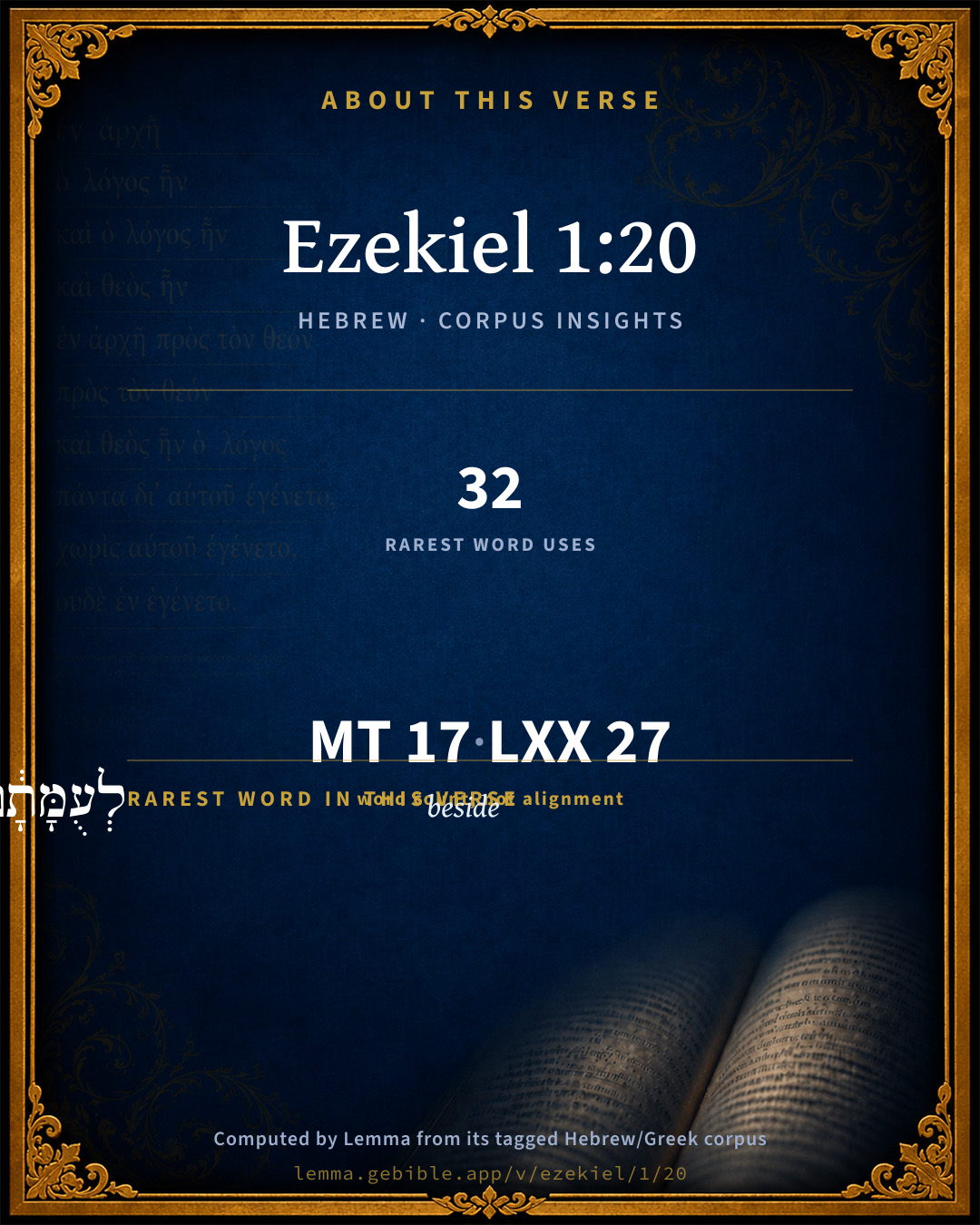
לְעֻמָּתָ֔ם
ʻummâh
H5980
“to/for · beside · their”
Preposition + Noun, Common, Feminine, Singular, Construct + Suffix, Personal, 3rd Person, Masculine, Plural
Part of Speech
Preposition + Noun
Type
Common
Gender
Feminine
Number
Singular
State
Construct
Full BDB Definition

Origin: from H6004

TWOT: 1640f

juxtaposition - used only as a preposition - close by, side by side with, alongside of, parallel with - agreeing with, corresponding to, exactly as, close beside - correspondingly to
  1. עַ֣ל ʻal H5921 “upon” Preposition
  2. אֲשֶׁר֩ ʼăsher H834 “which” Particle, Relative
  3. יִֽהְיֶה hâyâh H1961 “to be” Verb, Qal, Imperfect, 3rd Person, Masculine, Singular
  4. שָּׁ֨ם shâm H8033 “there” Adverb
  5. הָר֤וּחַ rûwach H7307 “the · spirit” Particle, Definite Article + Noun, Common, Both, Singular, Absolute
  6. לָלֶ֨כֶת֙ yâlak H3212 “to walk” Preposition + Verb, Qal, Infinitive Construct
  7. יֵלֵ֔כוּ yâlak H3212 “to walk” Verb, Qal, Imperfect, 3rd Person, Masculine, Plural
  8. שָׁ֥מָּה shâm H8033 “there · toward” Adverb + Suffix, Demonstrative
  9. הָר֖וּחַ rûwach H7307 “the · spirit” Particle, Definite Article + Noun, Common, Both, Singular, Absolute
  10. לָלֶ֑כֶת yâlak H3212 “to walk” Preposition + Verb, Qal, Infinitive Construct
  11. וְהָאוֹפַנִּ֗ים ʼôwphân H212 “and · the · wheels” Conjunction + Particle, Definite Article + Noun, Common, Masculine, Plural, Absolute
  12. יִנָּשְׂאוּ֙ nâsâʼ H5375 “to lift” Verb, Niphal, Imperfect, 3rd Person, Masculine, Plural
  13. כִּ֛י kîy H3588 “that” Conjunction
  14. ר֥וּחַ rûwach H7307 “spirit of” Noun, Common, Both, Singular, Construct
  15. הַחַיָּ֖ה chay H2416 “the · living” Particle, Definite Article + Noun, Common, Feminine, Singular, Absolute
  16. בָּאוֹפַנִּֽים ʼôwphân H212 “in/at the · wheels” Preposition, Determined + Noun, Common, Masculine, Plural, Absolute

About this verse

These counts appear in no published source. They are computed here, from the morphology-tagged text and Lemma’s own curated glosses. What Lemma adds →

17
words
11
distinct lemmas
Prophets
section

Shared distinctive vocabulary

לְעֻמָּתָ֔ם beside H5980 occurs in 28 verses of the Hebrew Bible. Also found in:

Grammatical profile

  • 5 verbs
  • 7 nouns
  • 1 preposition
  • 1 conjunction
  • 2 adverbs
  • 1 particle

Verb forms

  • יִֽהְיֶה Qal · Imperfect
  • לָלֶ֨כֶת֙ Qal · Infinitive Construct
  • יֵלֵ֔כוּ Qal · Imperfect
  • לָלֶ֑כֶת Qal · Infinitive Construct
  • יִנָּשְׂאוּ֙ Niphal · Imperfect

Repetition

Words recur within this verse — often emphatic in Hebrew:

  • הָר֤וּחַ spirit H7307 ×3
  • לָלֶ֨כֶת֙ to walk H3212 ×3
  • שָּׁ֨ם there H8033 ×2
  • וְהָאוֹפַנִּ֗ים wheel H212 ×2

Hebrew & Septuagint length

In English translation the verse runs 33 words from the Hebrew and 31 from the Septuagint (LXX English) — closely comparable.

A rough comparison of the two English renderings, which tokenize alike — not a word-level alignment.

Word counts can differ between the Hebrew and the Greek without any difference in meaning — e.g. the Hebrew direct-object marker אֵת has no separate Greek word, and Greek often adds the article ὁ.

In the original languages it is 17 Hebrew tokens and 27 Greek tokens — but the two are counted differently (Hebrew bundles its prefixes and suffixes into one token; the Greek is in lemma form), so that isn’t a like-for-like length.

Cross-references

4

Topical passages linked to Ezekiel 1:20 in the Treasury of Scripture Knowledge — connected by theme and wording, ordered by reader-vote popularity; previews shown in the World English Bible.

  • Ezekiel 1:12 They went everyone straight forward: where the spirit was to go, they went; they didn't turn when they went.
  • Ezekiel 10:17 When they stood, these stood; and when they mounted up, these mounted up with them: for the spirit of the living creature was in them.
  • 1 Corinthians 14:32 The spirits of the prophets are subject to the prophets,
  • Zechariah 6:1–8 Again I lifted up my eyes, and saw, and, behold, four chariots came out from between two mountains; and the mountains were mountains of brass.

Cross-references courtesy of OpenBible.info (CC BY 4.0).

Hebrew and Greek witnesses Masoretic Hebrew ↔ Greek Septuagint

The same verse in the two great witnesses to the Old Testament, shown verse-for-verse.

These are two independent witnesses, not word-aligned to each other, and the Septuagint is shown in lemma (dictionary) form.

Hebrew Ezekiel 1:20 Masoretic · Westminster Leningrad Codex

עַ֣ל אֲשֶׁר֩ יִֽהְיֶה שָּׁ֨ם הָר֤וּחַ לָלֶ֨כֶת֙ יֵלֵ֔כוּ שָׁ֥מָּה הָר֖וּחַ לָלֶ֑כֶת וְהָאוֹפַנִּ֗ים יִנָּשְׂאוּ֙ לְעֻמָּתָ֔ם כִּ֛י ר֥וּחַ הַחַיָּ֖ה בָּאוֹפַנִּֽים

Wherever the spirit was to go, they went; there was the spirit to go: and the wheels were lifted up beside them; for the spirit of the living creature was in the wheels.

World English Bible · Public Domain

Greek LXX Ezekiel 1:20 Septuagint · lemma form

ὅς ἄν εἰμί ὁ νεφέλη ἐκεῖ ὁ πνεῦμα ὁ πορεύομαι πορεύομαι ὁ ζῷον καί ὁ τροχός καί ἐκαἴρω σύν αὐτός διότι πνεῦμα ζωή εἰμί ἐν ὁ τροχός

Wherever the cloud happened to be, there was the spirit ready to go: the wheels went and were lifted up with them; because the spirit of life was in the wheels.

LXX2012 (modern English Septuagint) · Public Domain

On this verse, The Cambridge Bible for Schools and Colleges discusses the Septuagint’s reading. Read the note in Commentary ↓

Hebrew: Westminster Leningrad Codex (CC BY 4.0). Greek: Septuagint (public domain); English from LXX2012 (modern English Septuagint) (Public Domain). How the Septuagint differs from the Hebrew →

Targum (Aramaic paraphrase)

1

The Targum is the ancient Jewish Aramaic paraphrase of the Hebrew Scriptures — an interpretive translation, not the Hebrew text itself. Onkelos (literal) and Pseudo-Jonathan (expansive) render the Torah, and Jonathan the Prophets. Coverage is partial: where no permissively-licensed English translation exists for a verse, only the Aramaic is shown. This is verse-level text, not a word-by-word alignment to the Hebrew.

  1. Targum Jonathan Prophets (Joshua–Malachi)
    עַל אֲתַר דַהֲוֵי תַמָן רַעֲוָא לְמֵיזַל אָזְלִין לְתַמָן רַעֲוָא לְמֵיזַל וְגַלְגְלַיָא מִתְרְמִין לְקִבְלֵהֶן אֲרֵי כְּרוּחַ בִּרְיָתָא בְּגַלְגְלַיָא:

    (no public-domain English translation for this verse)

    Targum Jonathan — Aramaic: “Mikraot Gedolot” (public domain). English: “Sefaria Community Translation” (CC0 1.0 (public-domain dedication)); “London "Chaldee Paraphrase," 1871” (public domain). Text via Sefaria.

Commentary

Notes on Ezekiel 1:20 from classic Christian and Jewish commentators (each source and its license shown beneath its notes). The classic Christian expositions comment on the surrounding passage and are grouped to its opening verse, so a note may address several verses; the Jewish commentaries on the Tanakh (Rashi and others) are per-verse, so they appear only where the commentator wrote on this verse.

Lemma curates 59 commentaries, every one of them public domain or Creative Commons licensed, each selected and text-cleaned for this edition rather than reprinted as found. About our sources →

Trapp's Complete Commentary

John Trapp

Eze 1:20 Whithersoever the spirit was to go, they went, thither [was their] spirit to go; and the wheels were lifted up over against them: for the spirit of the living creature [was] in the wheels.

Ver. 20. Whithersoever the spirit was to go.] See Eze 1:12; and take notice that whatever the instrument is, or means of this or that occurrence, God is the main agent. It is Christ who by his Spirit, Spiritus vitalis, worketh all in all in his Church. {1Co 12:16 Eph 1:11 Col 3:21} There falleth not a hair from a man’s head, nay, not a bristle from a sow’s back, saith Tertullian, without God.

For the spirit of the living creatures.] Or, Of life. The Divine inspiration was the procreant cause of the wheels’ motion. This is here called haruach, that spirit by an excellence: est Deus in nobis. The spirit is in the wheels, as an invisible but irresistible agent. "The heart of the king is in the hand of the Lord, he turneth it whithersoever he will." {Pro 21:1}

John Trapp, A Commentary or Exposition upon All the Books of the Old and New Testament (1647–1656) — public domain. Text from a community e-Sword module.

The Biblical Illustrator

Joseph S. Exell

Eze_1:20

Whithersoever the Spirit was to go, they went.

The nobility of a devout soul under the Spirits influence

Oh for conquering grace to crush down self. I would be as a grain of dust blown in the summer gale without power to change my course, carried by the irresistible breath of God; forever made willingly unwilling to will anything but the will of my Lord. I would be as a tiny straw borne along by the Gulf Stream, carried wherever the warm love of God shall bear me, self delighting to lie low and see the Lord alone exalted. (C. H. Spurgeon.)

For the spirit of the living creatures was in the wheels.

The unity of Providence

The bosom of Providence is the great moral crucible in which things work, in which they work together. They assimilate, repel, interpenetrate, change each other; and then leave as resultant one grand influence in the main for each character, for each man. All things work together, not in an aimless and capricious manner, for this end and for that, now in one way and now in another, as though a stream should one day flow seaward, and the next back toward its fountain among the hills, but in one volume, along one channel, in one direction, toward one end. (A. Raleigh, D. D.)

The Biblical Illustrator, edited by Joseph S. Exell (c. 1880s–1900s) — public domain. Text from a community e-Sword module.

Jamieson, Fausset & Brown

Robert Jamieson, A. R. Fausset & David Brown

the spirit was to go--that is, their will was for going whithersoever the Spirit was for going.

over against them--rather, beside or in conjunction with them.

spirit of the living creature--put collectively for "the living creatures"; the cherubim. Having first viewed them separately, he next views them in the aggregate as the composite living creature in which the Spirit resided. The life intended is that connected with God, holy, spiritual life, in the plenitude of its active power.

Jamieson, Fausset & Brown — Commentary Critical and Explanatory on the Whole Bible (1871) — public domain (CC PDM 1.0). Text via the HelloAO Bible API.

Adam Clarke's Commentary

Verse 20. The spirit of the living creature was in the wheels.] That is, the wheels were instinct with a vital spirit; the wheels were alive, they also were animals, or endued with animal life, as the creatures were that stood upon them. Here then is the chariot of Jehovah. There are four wheels, on each of which one of the compound animals stands; the four compound animals form the body of the chariot, their wings spread horizontally above, forming the canopy or covering of this chariot; on the top of which, or upon the extended wings of the four living creatures, was the throne, on which was the appearance of a man, Eze 1:26.

Adam Clarke's Commentary on the Bible (1810–1826) — public domain. Text from a community e-Sword/MySword module.

John Calvin's Commentaries

Thus I arrange the clauses, for though others join the first; clause with the second part of the verse, it is too forced. Therefore the Prophet repeats what he had said, though he is rather prolix. Afterwards he adds, that the wheels were raised, taking the word generally for elevated, but not exactly as in the last and next verse. I now add the next verse —

John Calvin's Commentaries (1540-1563) — public domain. Text from the Calvin Translation Society English edition (1840s-50s) via the Christian Classics Ethereal Library (ccel.org). Calvin's coverage is partial (roughly two-thirds of the Bible); uncommented books and verses are honest gaps, never fabricated. The 19th-century editor's footnotes and remarks are omitted so the notes are faithfully Calvin's own voice.

Ellicott's Commentary for English Readers

(20, 21) The spirit of the living creature—Not, as in the margin, “the spirit of life.” The object of Eze_1:19-21 is by every repetition and variety of expression to represent “the living creatures” and “the wheels” as one, animated by one spirit, and moved by one impulse. The word is the same throughout, and there was no “spirit of life” in the wheels independent of that of the living creatures. All formed together one strange, symbolic whole.

The mention in Eze_1:19-21 of the wheels being “lifted up from the earth” simultaneously with the living creatures is not in opposition to the symbolism already explained, of the wheels resting upon the earth. That was to show that God’s purposes are carried out as He wills in this world. This brings out, in addition, the perfect harmony of these purposes, whether relating to earth or to heaven.

A Bible Commentary for English Readers, edited by Charles John Ellicott (1878–1897) — public domain. Text from a community e-Sword module.

The Cambridge Bible for Schools and Colleges

gen. ed. J. J. S. Perowne

20. thither was their spirit to go] Rather, the spirit, i.e. the general spirit moving the whole manifestation. The words are wanting in LXX., and are possibly an accidental repetition of those in the beginning of the verse; or they are a somewhat loose and elliptical repetition attached to “they went,” in which case they should rather be rendered, whither the spirit was to go.

spirit of the living creature] The marg. “spirit of life” is to be deleted. The “living creature” is hardly the complex being formed by the four living creatures; the four were exactly alike, and the term is used generically (Eze_1:22, ch. Eze_10:20) to express the kind of creature.

The Cambridge Bible for Schools and Colleges (gen. ed. J. J. S. Perowne; Cambridge University Press, 1878–1918) — public domain. Text from a community e-Sword module.

John Gill's Exposition

Whithersoever the spirit was to go they went,.... That is, the Spirit of God; wherever that leads and directs, whether in the paths of faith or duty, they follow; they walk not after the flesh, but after the Spirit; he guides their feet in the way of peace, and into all truth; and leads them in a right way to the land of uprightness:

thither was their spirit to go; their spirits or souls being regenerated by the spirit of God, are moved and actuated by him, and readily go where that directs:

and the wheels were lifted up over against them; that is, over against the living creatures; being by their sides going where they go, and being lifted up when they are:

for the spirit of the living creature was in the wheels; the same Spirit of God, which is a spirit of life, a quickening spirit, and a free spirit; which gives motion and liberty in religious exercises; that which is in the ministers of the Gospel is in the churches of God; there is but one Spirit, and ministers and members are actuated and influenced by it; see Eph 4:4.

John Gill's Exposition of the Whole Bible (1746–1763) — public domain (CC PDM 1.0). Text via the HelloAO Bible API.

Albert Barnes' Notes on the Bible

Whithersoever the spirit of the four living creatures was to go, the wheels went - there was the spirit of the wheels to go. All four creatures together with their wheels are here called “the living creature,” because they formed a whole, one in motion, and in will, for one spirit was in them.

Albert Barnes' Notes on the Bible (1834–1885) — public domain. Text from a community e-Sword/MySword module.

Haydock's Catholic Bible Commentary

Life. They were moved like the rest by the whirlwind, or by living creatures. They seemed to be animated, as Homer describes Vulcan’s tripods.

George Leo Haydock (1774–1849), Haydock's Catholic Family Bible and Commentary, 1859 edition — public domain. Excludes Psalms (Douay-Rheims chapter numbering differs from Protestant) and Deuterocanonical books (Catholic canon only).

Matthew Poole's English Annotations

Whithersoever the spirit; either the will and inclination of the living creatures, or rather the Spirit of God which moved the living creatures, gave them motion and guided it; these angels in their ministry punctually observed both the impulse and the conduct of God’s Spirit.

Was to go: of this phrase applied to the Spirit, see Eze 1:12. They went; the wheels, those inferior agents and second causes.

Thither was their spirit to go; the inclination and will of the wheels concurred with the spirit of the living creatures, so that there was a hearty accord between those superior and inferior causes, they agreed in the same design.

And the wheels were lifted up over against them: there seems to be an ellipsis here, the latter part of the speech expressed, and the former implied only; as it was in the progressive motion, so in the motion upward, they accorded, and kept the same order.

For the spirit of the living creatures was in the wheels; one and the same spirit was in both the wheels and living creatures, and so the same inclination and motion too.

Of the living, Heb. of life, the quickening, enlivening Spirit; hence some will have the wheels to be living creatures, but without this it is enough to represent to the prophet what was the frame and course of Providence, and who did preside and manage all. An undiscerned, yet Divine, mighty, wise, just, and holy, and ever-living, Power, Spirit, and Being actuated all, and governed all, to the execution of justice on the wicked, and protection of the godly.

Matthew Poole's English Annotations on the Holy Bible (1683–1685) — public domain. Text from a community e-Sword/MySword module.

Whedon's Commentary on the Bible

Daniel D. Whedon

20, 21. Over against them — That is, beside them.

Daniel D. Whedon (gen. ed.), Commentary on the Old and New Testaments (1874–1909) — public domain. Text from a community e-Sword module.

The Pulpit Commentary

Whithersoever the spirit was to go, etc. The secret of the coincidence of the movements of the "living creatures" and of the "wheels" was found in the fact, which the prophet"s intuition grasped, that the phenomena of life and law had one and the same originating source. For "the spirit of the living creature" (singular, because the four are regarded as one complex whole), the LXX, Vulgate, and Revised Version margin, give "the spirit of life," a rendering tenable in itself, but the contextual meaning of the word is in favour of the Authorized Version and the Revised Version text.

The Pulpit Commentary (1880–1919), ed. H.D.M. Spence-Jones & Joseph S. Exell — public domain. Text from a community e-Sword module.

John Wesley's Explanatory Notes

The spirit - The Spirit of God. These angels in their ministry punctually observed both his impulse and conduct. They - The wheels, inferior agents and second causes. Their spirit - The wheels concurred with the spirit of the living creatures, so that there was an hearty accord between those superior and inferior causes. For - An undiscerned, yet divine, mighty, wise, and ever- living power, spirit, and being, actuated all, and governed all.

John Wesley, Explanatory Notes Upon the Whole Bible (1754–1765) — public domain. Text via the GEBible commentary corpus.

Rashi

Rabbi Shlomo Yitzchaki (Rashi)

the will The will of the Holy One, blessed be He.

there was the will to go It was not necessary to tell them [to go] to this side [or that] because the will of the Holy One, blessed be He, was in the living beings, and the will of the living beings was in the wheels.

Rashi on the Tanakh — English translations: “The Judaica Press complete Tanach with Rashi, translated by A. J. Rosenberg” (CC BY 4.0); “Pentateuch with Rashi's commentary by M. Rosenbaum and A.M. Silbermann, 1929-1934” (public domain); “The Metsudah Tanach series, Lakewood, N.J” (CC BY 4.0); and “The Book of Joshua, Metsudah Publications, 1997” (CC BY 4.0). Text via Sefaria.

Lesson kit

Teaching starters — assembled from the data on this page, not authored interpretation. Every prompt links to the verse data it draws on. Edit before teaching.

Ezekiel, in the Prophets, opens this verse with 17 words (11 distinct Hebrew lemmas). Its most distinctive word is ʻummâh (“beside”). A historical commentator’s framing appears above. Read the whole chapter for the surrounding context.

Discussion questions

  1. How does “beside” (ʻummâh) shape what this verse is saying?
  2. Exodus 25:27 shares the word «beside» with this verse. How do the two illuminate each other?
  3. “spirit” occurs 3× in this one verse. What is the effect of the repetition?
  4. These translations render this verse differently; the difference is in the English rendering, not the original. What questions does that raise?
  5. The verb «יִֽהְיֶה» is Qal Imperfect. How does its form color the action?
  6. Reading how Trapp's Complete Commentary and The Biblical Illustrator read this verse, where do the two commentators agree and where do they part?

Things to notice

Reading settings

Reading text

Shown beneath each verse's original-language words.

Old Testament
Old Testament edition

Read the OT as the Masoretic Hebrew (MT) or the Greek Septuagint (LXX).

English shown for the Greek Septuagint (in the Hebrew ↔ Greek comparison).

Comparing translations? Open the Compare panel on any verse page to stack up to four side by side.