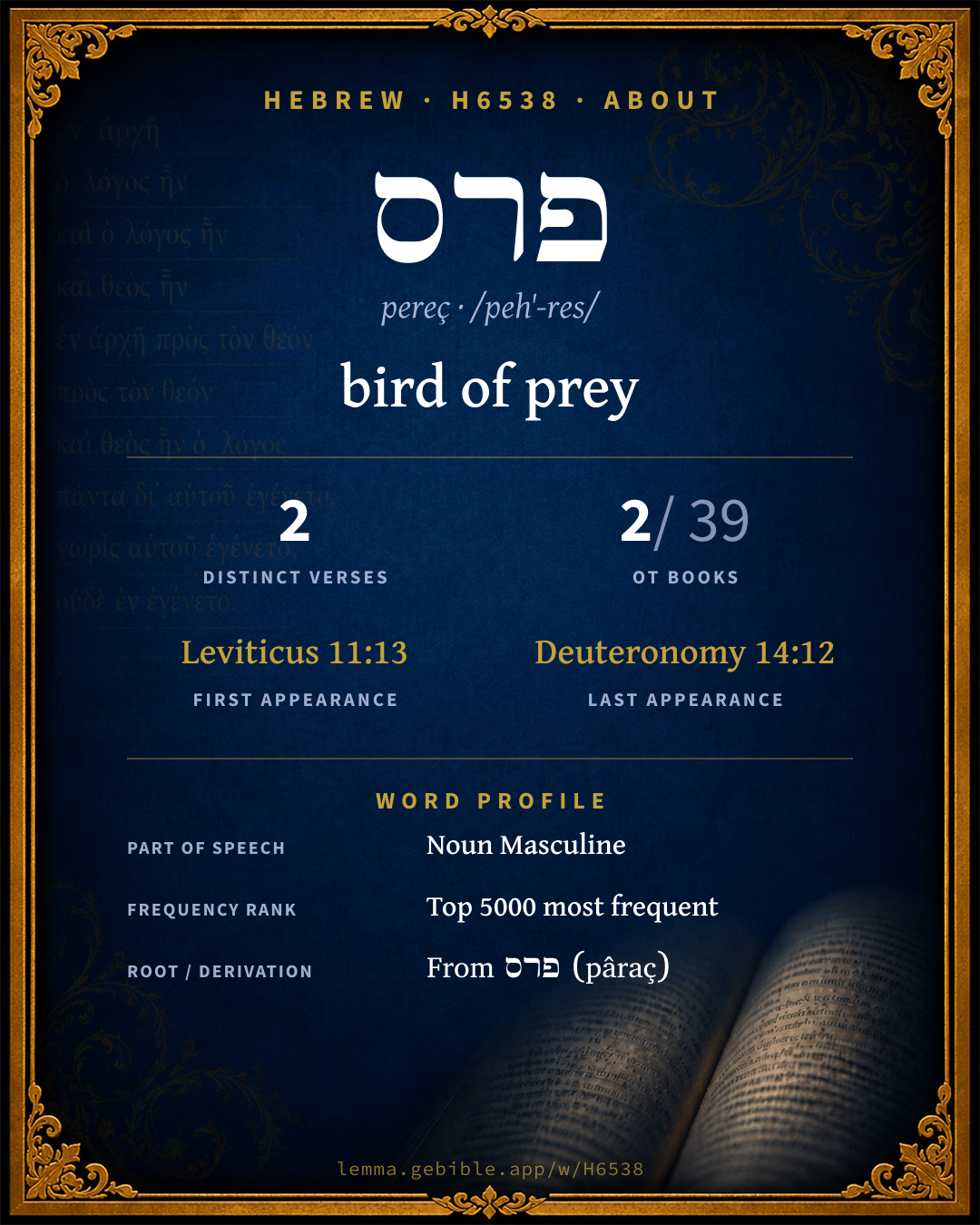
פֶּ֫רֶס
bird of prey
‘bird of prey’ is one of 3 main senses fuller range ↓
Full lexicon entry — Brown-Driver-Briggs (BDB)
From Brown-Driver-Briggs (BDB)
Where this word appears
Grammar key — what these labels mean
Noun type
- Common
- A common noun — a general class of person, place, or thing (“king,” “city,” “water”), not a specific name.
State
- Absolute
- The independent form of a noun, not bound to a following word.
Gender
- Masculine
- Grammatically masculine.
Number
- Singular
- One.
Every verse where H6538 appears — 2 distinct verses across 2 books. Click any verse to open its interlinear word-by-word view. Verse text shown in the World English Bible for context — . Each verse’s Hebrew form is shown with its reference; the English is not keyword-highlighted, since the data carries no word-level English alignment. Use “Compare translations” on any verse to read it across multiple English versions. This concordance covers the Hebrew Bible; Septuagint (Greek Old Testament) occurrences are not indexed here.
Leviticus 1 verse
Deuteronomy 1 verse
About this entry
At a glance — auto-summarized from this page’s data, not written by a person. Every figure links to its source below. This summary describes the numbers; it doesn’t interpret them.
פרס (pereç) is a Hebrew noun most often rendered “bird of prey.” With only 2 verses it sits in the long tail of Hebrew Bible vocabulary. Leviticus dominates its distribution — 1 of 2 verses. It first appears in Leviticus 11:13. Ranging over 3 senses, it is not a single-sense word. The sections below give every sense, occurrence, and version rendering.
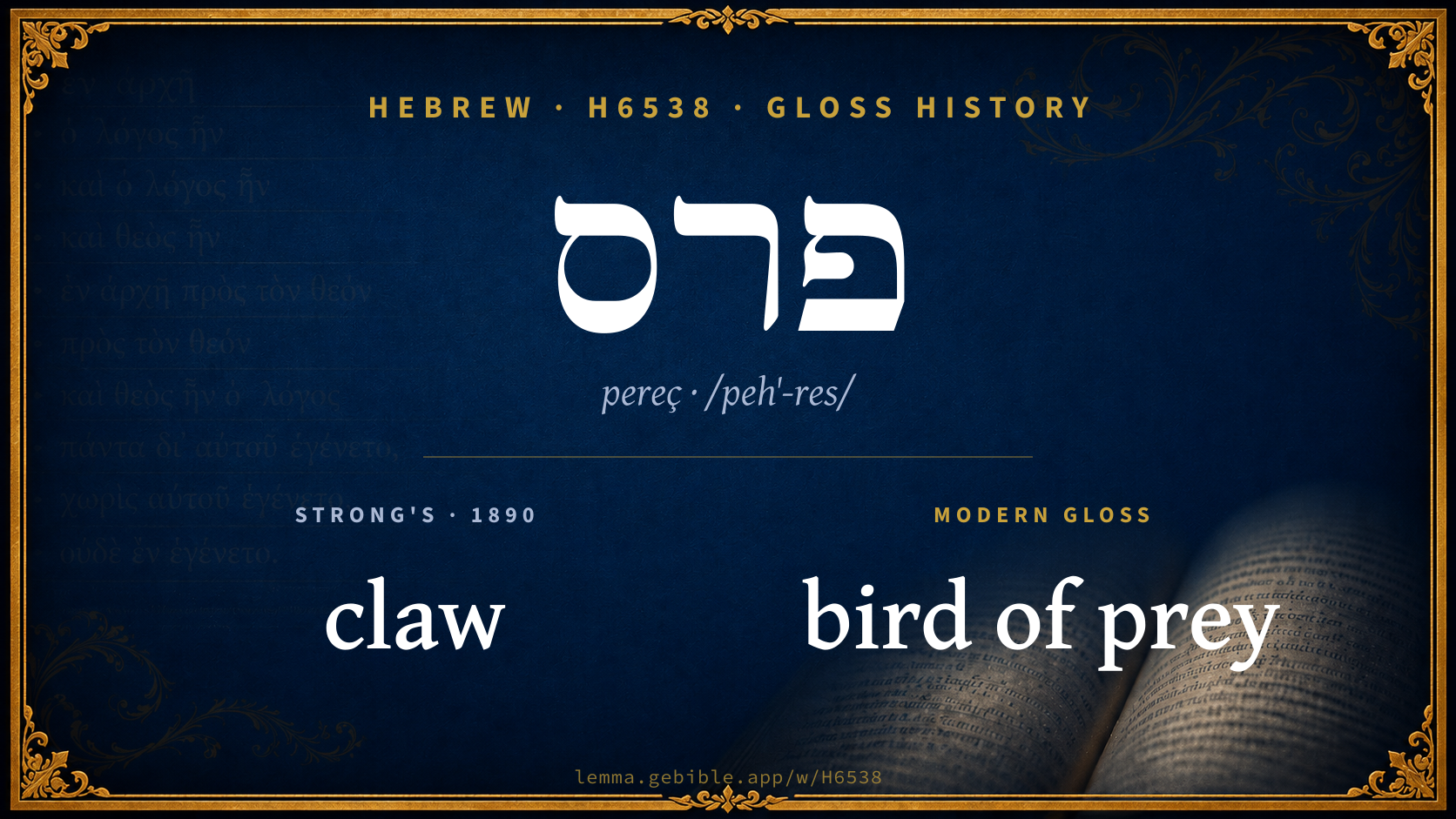
Gloss history
Strong's 1890 vs modern scholarship
About this word
Strong's H6538 catalogs a Hebrew word from the Hebrew Old Testament.
These counts are not copied from any lexicon or concordance. They are computed here, from the morphology-tagged Hebrew Old Testament. What Lemma adds →
- 2
- distinct verses
- The word appears in 2 distinct verses.
- 2 / 39
- OT books
- The word appears in 2 of 39 Old Testament books.
- #4,807
- by frequency
- Top 5000 most frequent Hebrew words (rank 4,807 of 8,640 Hebrew words by occurrence).
View all 2 occurrences in the concordance →
Most concentrated in
- Leviticus 1 verse 50%
- Deuteronomy 1 verse 50%
By section of the Old Testament
By traditional corpus
Conventional, traditional groupings — biblical authorship is debated, so this is a traditional corpus grouping, not an authorship claim. Each share is this word’s portion of its verses in that division of the Hebrew canon. Each figure is a share of the word’s 2 distinct verses.
- Torah (Pentateuch) 2 verses · 100%
How translations render this word
Counts come from each version’s own published word-to-Strong’s tagging or interlinear alignment — an approximate guide to how each version renders this word, not a word-level alignment the data otherwise carries. Because each total is that version’s own tagged count, the per-version totals vary from one another and need not match the appearance or distinct-verse counts above. These counts may also differ from a printed concordance because Lemma counts each distinctly tagged rendering and does not collapse phrase taggings into a single head-word total. This is a fixed set of word-tagged versions (KJV, ASV, BSB, ULT) and does not change with the reading translation you choose elsewhere. Each version’s license is shown beside its name below (and on Sources).
- King James Version: Ossifrage 2×
- American Standard Version: Gier-eagle 2×
- Berean Standard Bible: Bearded vulture 2×
- unfoldingWord Literal Text: Large vulture 1×, Vulture 1×
King James Version Public Domain
Renders H6538 across 2 tagged occurrences — most commonly:
American Standard Version Public Domain
Renders H6538 across 2 tagged occurrences — most commonly:
Berean Standard Bible Public Domain
Renders H6538 across 2 tagged occurrences — most commonly:
unfoldingWord Literal Text CC BY-SA 4.0
Renders H6538 across 2 tagged occurrences — most commonly:
Senses in BDB
The 3 senses BDB distinguishes for this word, in lexicon order (not ranked by frequency or importance). The full entry — with sub-senses — is in the Lexicon Entry tab.
- bird of prey
- perhaps bearded vulture or ossifrage
- perhaps an extinct animal, exact meaning unknown
Word origin
פֶּ֫רֶס n.[m.] a bird of prey, perh. bearded vulture, ‘ ossifrage ’
— Brown-Driver-Briggs (Oxford 1906, public domain), digitized via Sefaria, supplemented by the OpenScriptures HebrewLexicon (CC BY 4.0). See Sources.
Derived from פרס (pâraç) (H6536) — to break.
Jastrow Dictionary
A second Hebrew/Aramaic lexicon for comparison, covering Aramaic and post-biblical (Talmudic, Targumic, Midrashic) usage that the biblical-Hebrew BDB does not. Matched by lemma rather than by Strong’s number, so a lemma may carry more than one Jastrow headword (shown separately below), and the entries cover usage well beyond the Bible.
פָּרַס I
- (b. h.)
- 1. to split, break, esp. (v. בָּצַע) to break bread and say grace. R. Hash. 29ᵇ לא יִפְרוֹס אדם פרוסה וכ׳ a person should not break bread and say grace for his guests, unless he dines with them אבל פּוֹרֵס הוא לבניו וכ׳ but he may do so for his children and his household in order to train them in religious practice. Pes. 37ᵃ; Men. 78ᵇ (expl. מצה הינא) כל שפּוֹרְסָהּ ואין וכ׳ when he breaks it apart, and no cords (of unbaked dough) can be drawn out of it; a. e.—Part. pass. פָּרוּס; f. פְּרוּסָה; pl. פְּרוּסִים, פְּרוּסִין; פְּרוּסוֹת. Lev. R. s. 34 (ref. to פָּרֹס, Is. LVIII, 7) הלא תִפְרוֹשׂ … פָרוּס כבר היא פ׳ וכ׳ it does not read, ‘behold, thou shalt break’, but, ‘behold broken’; it (thy bread) is broken for thee, for from the beginning of the year it is decreed &c. Y. Dem. I, 21ᵈ bot. בפ׳ when it is a broken piece of an eatable, opp. שלם. Y. Ber. VI, 10ᵇ bot. פ׳ של חטים (sub. פת) a broken loaf of wheat bread; a. fr.—V. פְּרוּס, פְּרוּסָה. e.g. Isaiah 58:7
- 2. (cmp. פָּרַץ) to break through; part. pass. as ab. open, plain. Tosef. Kel. B. Mets. V, 4, v. סַוָּאר.
- 3. to spread. Meg. III, 3 (28ᵃ) ואין פּוֹרְשִׂין לתוכו מצודות nor dare you spread traps leading into it (the synagogue in ruins). Yoma III, 4 פָּרְסוּ סדין וכ׳ (Y. ed. פָּרְשׂוּ), v. סָדִין. Num. R. s. 11 הכהנים פּוֹרְשִׂים את כפיהם the priests spread their hands (when blessing). Ex. R. s. 42 אחז … ופ׳ הקב"ה וכ׳ he (Moses) took hold of the divine throne, and the Lord spread his cloak over him. Ib. (ref. to פּ֗ר̇ש̇ז̇, Job XXVI, 9) פ̇' ר̇חום ש̇די ז̇יו וכ׳ the Merciful Almighty spread the splendor of his cloud over him; ib. s. 41 פ׳ והגין עליו הקב"ה the Lord spread (his cloak) over him and protected him; a. fr.—Deut. R. s. 5 היה פוֹרֵשׂ דיאטגמא וכ׳ (not דאטגמא) he spread (published) a decree wherever he conquered &c.—Part. pass. as ab. Ab. III, 16, v. מְצוּדָה; a. e.—פ׳ על שמע (interch. with פ׳ את שמע) to spread a cloak over the head for the recitation of the prayers preceding the Shmʿa (Ḳaddish and Bar’khu), esp. to recite the prayers &c. for the benefit of those who have come too late for the regular service (cmp. Ber. 51ᵃ פריס סודרא, quot. in next w.). Meg. IV, 3 (23ᵇ) אין פורסין על שמע וכ׳ (Mish. ed. את; Mish. Pes. פורשין, v. Rabb. D. S. a. l. note 90) the prayers for the Shmʿa are not read aloud … with less than two persons; [Rashi: to divide the Sh’ma (v. supra), i.e. to read parts of the prayers preceding the Shmʿa;] Y. ib. IV, 75ᵃ bot. פורסין את שמע. Ib. IV, 5 המפטיר … פורס וכ׳, v. פָּטַר. Ib. 6. Lev. R. s. 23 א"ל פְּרוֹס על שמע פ׳ they said to him, recite the prayers for the Shmʿa; he did; Cant. R. to II, 2 (mixed dict.) פְּרוֹס לן את שמע פרוס לון (read: פָּרֵיס); a. fr. e.g. Job 26:9
- to be divided, broken. T’bul Yom III, 1, v. עָרָה II. B. Mets. VII, 7 נִתְפָּרְסוּ עיגוליו if his fig cakes were broken; a. e.
- 1. to assign, give a share, a present. Gen. R. s. 74 end ולא היו מַפְרִיסִים וכ׳ Ar. (ed. מפרינים) they endowed only with their mouth, v. פָּרַן. Yalk. ib. 22 מַפְרִיס והולך, v. פְּרָת.
- 2. (denom. of פַּרְסָה) to part the foot, to have a parted hoof. Sifra Sh’mini, ch. V, Par. 4 משוסע, חזיר מפריס the swine parts its foot and is cloven-footed. Ḥull. 59ᵃ אין לך דבר שמפריס פרסה וכ׳ there is no animal that parts its foot and yet is unclean, except swine; a. e.—Ib. 51ᵇ ה׳ ע"ג קרקע the animal, after its fall, in attempting to rise made an impression of its parted feet on the ground (an evidence of its spine’s being unaffected).—Trnsf. to show the cloven foot (like swine, as if saying, ‘I am clean’, v. Lev. R. s. 13, end), to pretend piety. Gen. R. s. 22 יצא כמפריס וכמרמה וכ׳ (some ed. מפרים, corr. acc.) he went forth like a hypocrite and as one deceiving his Creator; (Yalk. ib. 38; Lev. R. s. 10 כמַעֲרִים, v. עָרַם II).
- 1. to spread. Bekh. 44ᵃ (ref. to Ex. XL, 19) רבינו פֵּירְשׂוֹ Moses our teacher spread it (hence he must have been ten cubits high); Sabb. 92ᵃ פרשו; Yalk. Ex. 372; a. e. e.g. Exodus 40:19
- 2. to put a wrap on, only in פֵּירְסָה נדה she became menstruous. Keth. 2ᵃ. Gen. R. s. 48; a. fr.
פְּרַס I
- 1. to split, divide, break; esp. to break bread and say grace. Targ. II Kings IV, 39 (h. text פלח). Targ. I Sam. IX, 13 פריס על מזונא ed. Lag. (oth. ed. פ׳ מזונא; Ar. יַפְרִיס נכסתא Af.).—Yalk. Prov. 947 פָּרֵיס מנחם ויהיב לאבל the comforter breaks the bread and gives it to the mourner (ref. to Lam. I, 17). Snh. 49ᵃ bot. פריס להו he divided with them, v. מוֹנִינֵי. B. Mets. 40ᵃ פריס ר׳ י׳ שיתא וכ׳ R. J. sold at the rate of six kuzé for &c.; a. e.—Part. pass. פָּרִיס; f. פְּרִיסָא. Pes. 37ᵇ והכא כמאן דפ׳ דמיא and here it has the appearance of being broken; Men. 78ᵇ (not דמי). Bekh. 40ᵃ דשפיד ופריס (ed. ופרוס, Hebr. form) when the mouth is pointed and (the lip) parted (like that of swine); a. e. e.g. Lamentations 1:17
- 2. to divide, arrange; (= h. העריך, סדר) to arbitrate, value. Targ. O. Lev. XXVII, 8; a. fr.—Denom. פּוּרְסָא, פּוֹרָסָא, פּוּרְסָנָא.
- 3. to distribute, spread; to publish. Targ. Job XXXVI, 30. Targ. II Sam. XVII, 19 ופַרְסַת (not ופֵ׳). Targ. Prov. XXIX, 5; a. fr.—Part. pass. פָּרִיס; f. פְּרִיסָא; pl. פְּרִיסִין; פְּרִיסַן. Targ. Ex. XXV, 20 (Bxt. פָּרְסִין); a. fr.—Targ. II Esth. IV, 8 פָּרִיס published.—Ber. 55ᵇ בעידנא דפַרְסֵי וכ׳ when they (the priests) spread their hands (to bless). Y. Sabb. XX, beg. 17ᶜ הוון פָּרְסִין קילעיה וכ׳ they spread the curtains on the day before up to four cubits, and the next day they spread them entirely. Ber. 51ᵃ (expl. עיטוף) ר׳ אסי פָרֵיס סודרא וכ׳ R. A. used to spread a cloth over his head (before taking up the cup of benediction). Sabb. 48ᵃ. Y. ib. XVII, end, 15ᵈ, v. גְּדִישָׁא; a. fr.
- 1. to spread. Targ. Lam. I, 17; a. e.
- 2. (Pali) פַּרְסִי (v. P. Sm. 3276) to publish, divulge. Targ. Y. II, Gen. XXXVIII, 25 מפרסיא (Y. I מפרסמא).
- 1. to distribute, arrange. Targ. I Sam. IX, 13 Ar. (v. supra).
- 2. to spread forth. Targ. Is. XXV, 11.
- 3. (v. preced.Hif.) to set the foot. Targ. II Esth. I, 2.
- to be spread, published. Ib. III, 15; VIII, 13, sq. אתפרסת Ar. s. v. דיטגמא (ed. אתפרסמת).—Lam. R. to II, 2 ולא תִתְפַּרְסִין וכ׳ (fr. פַּרְסִי) rather than that the secrets of the government be divulged.
פָּרַס II
- (b. h.) pr. n. Persia. Esth. R. to I, 3 כשהמלכות במדי פ׳ טפילה לה כשהמלכות בפ׳ וכ׳ when the government is in Media, Persia is named as an attachment to it, and when the government is in Persia, Media is &c. Ib. למה קרין אותה פ׳ וכ׳ why is it called Paras?, v. פְּרוּסָה; a. fr.—[Deut. R. s. 10, a. e. פ׳, a censorial change, for רומי.].—Targ. II Chr. XXXVI, 20; 22; a. e.
פְּרָס
- (פָּרַס)
- 1. part, half, v. פְּרוּס.
- 2. a piece, esp. a certain quantity of bread. Neg. XIII, 9 כדי אכילת פ׳ פת חטין וכ׳ as much time as is required for eating a piece, that is, a piece of wheat bread &c. Ib. 10. Tosef. ib. VII, 10 וכמה הוא פ׳ חצי וכ׳ and how much is a p’ras? Half a loaf, of which three make a Kab; Tosef. Mikv. VII (VIII), 6; Erub. 83ᵃ; a. fr.—Pl. פְּרָסִים; Du. פְּרָסַיִים. Y. Sabb. I, 2ᵇ bot. אכילת פ׳ eating two p’rasim (with interruption); ib. כמה זתים בכמה פ׳ several olive sizes of eatables eaten within a time required for eating several pieces; Y. Hor. III, 47ᵇ bot.—Trnsf. the fare received by members of a household, or by slaves. Erub. 72ᵇ במקבלי פ׳ שנו the Mishnah speaking of brothers eating at their father’s table means those receiving, each his separate fare, at the hands of their father. Ib. 73ᵃ מי שיש לו … מקבלות פ׳ וכ׳ if a man has five wives (occupying separate dwellings in one court) receiving their fare at the hands of their husband, and five slaves receiving &c. Y. Taan. I, beg. 63ᶜ הוא תובע פְּרָסוֹ ממנו he (the slave) begs him for his fare; (ib. פרנסתו). Ib. סמוך לפרסו near the period when his fare is due. Ab. I, 3, v. עֶבֶד; a. fr.
- 3. P’ras, half a Maneh (מָנֶה). Eduy. III, 3 מנה ופ׳ each weighing one Maneh and a half. Peah VIII, 5; a. fr.—מנה בן פ׳, v. מָנֶה.
- 4. P’ras, half the length of a furrow (v. infra); בית (ה)פ׳ an area of a square P’ras, esp. a field, of a square P’ras, declared unclean on account of crushed bones carried over it from a ploughed grave. M. Kat. 5ᵇ החורש את הקבר הרי הוא עושה בית פ׳ וכמה הוא עושה חצי מענה וכ׳ Ms. M. a. Rashi (ed. מלא מענה, v. Rabb. D. S. a. l. note) he who ploughs over a grave, makes a beth-p’ras (an unclean field), and how much of it does he make unclean? Half the length of a furrow of one hundred cubits; Ohol. XVII, 1 החורש … עושה בית פ׳ … מאה אמה בית ארבעה סאים he who ploughs &c.; how far does he make it unclean? (Half) the size of a furrow of a hundred cubits (in all directions), which is a square of the capacity of four S’ahs of seed; Nidd. 57ᵃ; Tosef. Ohol. XVII, 1. Ohol. XVII, 2 בית פ׳ עושה בית פ׳ an unclean field may create another unclean field (if the plough passes over and beyond it). Tosef. ib. XVII, 4 אבל עולה הוא כמדת הפ׳ (read: במדת; R. S. to Ohol. XVII, 3 כמדת בית הפ׳) but it is counted in so as to complete the measure of a beth-p’ras; a. fr.—Pl. בית פְּרָסוֹת. Ohol. XVIII, 2 (M. Kat. 5ᵇ בית פרס). [Maim. explains בית הפ׳, by ref. to פָּרַס to extend, the area of extension; Rashi, by ref. to פָּרַס to break, an area of bone splinters.]
פְּרַס II
- as preced. 2, the slave’s or serf’s fare. Targ. II Sam. VIII, 2; 6 עבדין נטלי פ׳ serfs working for their fare (h. text נושאי מנחה); Targ. I Chr. XVIII, 2 נטלי פ׳ מקרבי דורון; ib. 6 נטלי פ׳ מסקי מסין (combining two interpretations).
פָּרָס
- (פָּרַס)
- 1. curtain, canopy, baldachin. Num. R. s. 10 כמין פ׳ שטחה לו וכ׳ she (Pharaoh’s daughter) spread over him (Solomon) a sort of baldachin in which were fixed precious stones &c.—Pl. פָּרָסִין. Y’lamd. to Num. XV, 37 quot. in Ar., v. קִיטָּי.
- 2. net. Tosef. Bets. III, 1 (ה)מעלה את פְּרָסוֹ וכ׳ (Var. כל שפרסוהו) if one puts up his net on the eve of the Holy Day, and, coming in on the Holy Day, finds it disturbed.
A Dictionary of the Targumim, the Talmud Babli and Yerushalmi, and the Midrashic Literature (Marcus Jastrow; London, Luzac, 1903) — Public Domain. Digitized via Sefaria. Digitized via Sefaria. Full attribution on Sources.
Forms in the corpus
The 2 distinct written forms H6538 takes in the Hebrew Bible, most frequent first — each parse links to that state’s occurrences in the concordance. Hebrew forms include their vowel points and cantillation, so a single lemma takes many written forms.
| Form | Parsing | Example | Uses |
|---|---|---|---|
| הַ/פֶּ֔רֶס | Noun, Common, Masculine, Singular, Absolute | Leviticus 11:13 | 1 |
| וְ/הַ/פֶּ֖רֶס | Noun, Common, Masculine, Singular, Absolute | Deuteronomy 14:12 | 1 |
Same root — word family
Other BDB entries built from the same root as H6538, grouped by Strong’s listed origin. These share a root / origin per the lexicon — not necessarily a shared meaning. Each links to that word’s own entry.
Derives from
Shares the same root
Derived from this word
Compare all same-root words → They share a root, not necessarily a meaning.
Septuagint verse parallels
This word appears in 2 verses that also exist in the Greek Old Testament (Septuagint), out of the 2 Hebrew verses it occurs in. You can read those verses in Greek by switching the Old Testament edition to the Septuagint.
Read these verses in the Septuagint
This is a verse-level parallel only — the same verses exist in both the Hebrew and Greek Old Testaments. No word-level Hebrew↔Greek correspondence is claimed: the data carries no such alignment, so no Greek word is shown as this Hebrew word’s translation. Coverage is not total — the Septuagint omits the deuterocanon and renumbers the Psalms, so some Hebrew verses have no direct Greek parallel.