
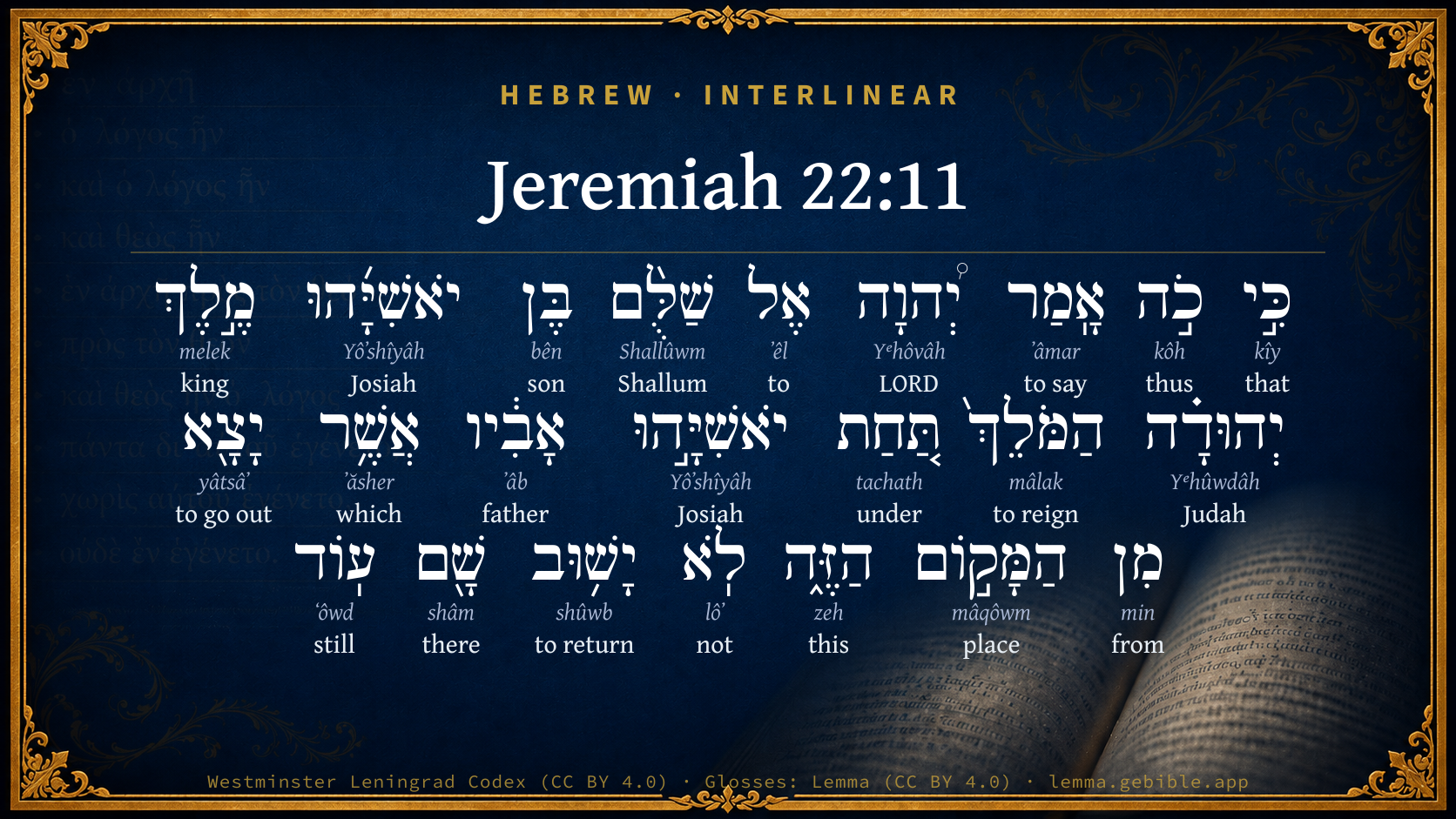
Jeremiah 22:11

Hebrew (Westminster Leningrad Codex) Jeremiah 22:11 appears in the Hebrew Old Testament. The text above is from the Westminster Leningrad Codex. Each word links to its Strong’s number, a concise gloss, and parsing drawn from the Open Scriptures Hebrew Bible morphology. Click any word for its full Brown-Driver-Briggs (BDB) entry.
Download image
Cite this verse

Jeremiah 22:11 (World English Bible). Public Domain. Lemma interlinear Bible study tool, https://lemma.gebible.app/v/jeremiah/22/11.

Show BibTeX & RIS
BibTeX
RIS
English Translation
For thus says Yahweh touching Shallum the son of Josiah, king of Judah, who reigned instead of Josiah his father, [and] who went forth out of this place: He shall not return there any more.
World English Bible · Public Domain
Download a study sheet

One document with this verse’s original text, its word-by-word gloss line, the meaning frame, cross-references with their text, attributed commentary, and full source and license credits — printable, and it pastes into notes with its structure intact.

This verse Autodidact and up

Study sheet (.html) Plain text (.txt)

A passage Seminary Student

Up to 50 verses in one chapter. A passage sheet keeps up to 6 commentary sources and 12 cross-references per verse, in the order this page ranks them, and says so on the sheet whenever that leaves anything out. Ask for a single verse and you get the Autodidact verse sheet above.

Everything on this page stays free to read, with no account — the sheet is a download of what is already on screen, not access to it.

Want to remove ads? Support Godless Engineer
Compare translations 3

The same verse in 3 English versions, stacked beneath the original-language interlinear above. Click any original word for its lexicon entry.

Each is an independent rendering of the whole verse — the interlinear is not word-aligned to these translations.

Highlighted words mark where these versions differ — a whole-verse word diff, not a word-by-word alignment.

  • World English Bible Public Domain
    For thus says Yahweh touching Shallum the son of Josiah, king of Judah, who reigned instead of Josiah his father, [and] who went forth out of this place: He shall not return there any more.
  • King James Version Public Domain
    For thus saith the LORD touching Shallum the son of Josiah king of Judah, which reigned instead of Josiah his father, which went forth out of this place; He shall not return thither any more:
  • unfoldingWord Literal Text CC BY-SA 4.0
    For thus says Yahweh concerning Shallum the son of Josiah, king of Judah, the one reigning in the place of Josiah his father, who went out from this place: “He will not return there again.

unfoldingWord Literal Text — © unfoldingWord, licensed CC BY-SA 4.0. Word-aligned USFM3 via Door43 (git.door43.org/unfoldingWord/en_ult).

Versions to compare (up to 4)

3 of 4 selected

Show all 18 translations

Every available English version of this verse, each an independent rendering of the whole verse.

  • World English Bible Public Domain
    For thus says Yahweh touching Shallum the son of Josiah, king of Judah, who reigned instead of Josiah his father, [and] who went forth out of this place: He shall not return there any more.
  • Berean Standard Bible Public Domain
    For this is what the LORD says concerning Shallum son of Josiah, king of Judah, who succeeded his father Josiah but has gone forth from this place: “He will never return,
  • Majority Standard Bible Public Domain
    For this is what the LORD says concerning Shallum son of Josiah, king of Judah, who succeeded his father Josiah but has gone forth from this place: “He will never return,
  • King James Version Public Domain
    For thus saith the LORD touching Shallum the son of Josiah king of Judah, which reigned instead of Josiah his father, which went forth out of this place; He shall not return thither any more:
  • American Standard Version (1901) Public Domain
    For thus saith Jehovah touching Shallum the son of Josiah, king of Judah, who reigned instead of Josiah his father, `and' who went forth out of this place: He shall not return thither any more.
  • Revised Version (1885) Public Domain
    For thus saith the LORD touching Shallum the son of Josiah, king of Judah, which reigned instead of Josiah his father, which went forth out of this place: He shall not return thither any more;
  • Geneva Bible (1599) Public Domain
    For thus saith ye Lord, As touching Shallum the sonne of Iosiah King of Iudah, which reigned for Iosiah his father, which went out of this place, he shall not returne thither,
  • Douay-Rheims (1899) Public Domain
    For thus saith the Lord to Sellum the son of Josias the king of Juda, who reigned instead of his father, who went forth out of this place: He shall return hither no more:
  • Young's Literal Translation Public Domain
    For thus said Jehovah concerning Shallum son of Josiah king of Judah, who is reigning instead of Josiah his father, who hath gone forth from this place: He doth not turn back hither again;
  • Literal Standard Version CC BY-SA 4.0
    For thus said YHWH concerning Shallum son of Josiah king of Judah, who is reigning instead of his father Josiah, who has gone forth from this place: “He does not return here again;
  • Unlocked Literal Bible CC BY-SA 4.0
    For Yahweh says this about Jehoahaz son of Josiah king of Judah, who served as king instead of Josiah his father, 'He has gone from this place and will not come back.
  • unfoldingWord Literal Text CC BY-SA 4.0
    For thus says Yahweh concerning Shallum the son of Josiah, king of Judah, the one reigning in the place of Josiah his father, who went out from this place: “He will not return there again.
  • Darby Bible Public Domain
    For thus saith Jehovah concerning Shallum the son of Josiah, the king of Judah, who reigned instead of Josiah his father, who went forth out of this place: He shall not return thither any more;
  • World Messianic Bible Public Domain
    For the LORD says touching Shallum the son of Josiah, king of Judah, who reigned instead of Josiah his father, and who went out of this place: “He won’t return there any more.
  • Webster's Bible Public Domain
    For thus saith the LORD concerning Shallum the son of Josiah king of Judah, who reigned instead of Josiah his father, who went forth from this place; He shall not return thither any more:
  • Free Bible Version CC BY-SA 4.0
    This is what the Lord says about Jehoahaz of Josiah, king of Judah. He succeeded his father Josiah but was taken away. He will never return.
  • Bible in Basic English Public Domain
    For this is what the Lord has said about Shallum, the son of Josiah, king of Judah, who became king in place of Josiah his father, who went out from this place: He will never come back there again:
  • JPS Tanakh (1917) Public Domain
    For thus saith the LORD touching Shallum the son of Josiah, king of Judah, who reigned instead of Josiah his father, and who went forth out of this place: He shall not return thither any more;

Literal Standard Version (2020), Covenant Press — licensed CC BY-SA 4.0. Text via the HelloAO Bible API (eBible.org). Unlocked Literal Bible (unfoldingWord) — licensed CC BY-SA 4.0. Text via the HelloAO Bible API (eBible.org). unfoldingWord Literal Text — © unfoldingWord, licensed CC BY-SA 4.0. Word-aligned USFM3 via Door43 (git.door43.org/unfoldingWord/en_ult). Free Bible Version, Dr. Jonathan Gallagher — licensed CC BY-SA 4.0. Text via the HelloAO Bible API (eBible.org).

Word by word

More ways to search: Search by grammar → Find every occurrence → Compare this word →

Practice this passage: Drill this verse → Learn its vocabulary →

שַׁלֻּ֨ם
Shallûwm
H7967
“Shallum”
Noun, Proper
Part of Speech
Noun
Type
Proper
Full BDB Definition

Origin: the same as H7966

TWOT: None

Shallum = "retribution" - son of Jabesh, conspirator and slayer of king Zachariah of the northern kingdom of Israel ending the dynasty of Jehu; assumed the throne and became the 15th king of the northern kingdom; reigned for one month and was killed by Menahem - the 3rd son of king Josiah of Judah and subsequent king of Judah; reigned for 3 months before he was taken captive to Egypt where he was placed in chains and later died - also 'Jehoahaz' - husband of Huldah the prophetess in the reign of king Josiah of Judah. Maybe the same as 4 - uncle of Jeremiah the prophet. Maybe the same as 3 - a Simeonite, son of Shaul and grandson of Simeon - a Judaite, son of Sisamai and father of Jekamiah in the family of Jerahmeel - an Ephraimite, father of Jehizkiah - a son of Naphtali - a Korahite Levite, chief of a family of gatekeepers for the east gate of the temple - maybe same as 13 - son of Halohesh and ruler of a district of Jerusalem; also repairer of the wall of Jerusalem in the time of Nehemiah - a priest, of the family of Eleazar, son of Zadok and father of Hilkiah in the family line of Ezra - a Korahite Levite, son of Kore, father of Maaseiah, and in charge of the work of the service. Maybe same as 9 - a Levite gatekeeper who had a foreign wife in the time of Ezra - a Levite and descendant of Bani who had a foreign wife in the time of Ezra
  1. כִּ֣י kîy H3588 “that” Conjunction
  2. כֹ֣ה kôh H3541 “thus” Adverb
  3. אָֽמַר ʼâmar H559 “to say” Verb, Qal, Perfect, 3rd Person, Masculine, Singular
  4. יְ֠הוָה Yᵉhôvâh H3068 “LORD” Noun, Proper
  5. אֶל ʼêl H413 “to” Preposition
  6. בֶּן bên H1121 “son of” Noun, Common, Masculine, Singular, Construct
  7. יֹאשִׁיָּ֜הוּ Yôʼshîyâh H2977 “Josiah” Noun, Proper
  8. מֶ֣לֶךְ melek H4428 “king of” Noun, Common, Masculine, Singular, Construct
  9. יְהוּדָ֗ה Yᵉhûwdâh H3063 “Judah” Noun, Proper
  10. הַמֹּלֵךְ֙ mâlak H4427 “the · reigning” Particle, Definite Article + Verb, Qal, Participle Active, Masculine, Singular, Absolute
  11. תַּ֚חַת tachath H8478 “under” Preposition
  12. יֹאשִׁיָּ֣הוּ Yôʼshîyâh H2977 “Josiah” Noun, Proper
  13. אָבִ֔יו ʼâb H1 “father · his” Noun, Common, Masculine, Singular, Construct + Suffix, Personal, 3rd Person, Masculine, Singular
  14. אֲשֶׁ֥ר ʼăsher H834 “which” Particle, Relative
  15. יָצָ֖א yâtsâʼ H3318 “to go out” Verb, Qal, Perfect, 3rd Person, Masculine, Singular
  16. מִן min H4480 “from” Preposition
  17. הַמָּק֣וֹם mâqôwm H4725 “the · place” Particle, Definite Article + Noun, Common, Masculine, Singular, Absolute
  18. הַזֶּ֑ה zeh H2088 “the · this” Particle, Definite Article + Pronoun, Demonstrative, Masculine, Singular
  19. לֹֽא lôʼ H3808 “not” Particle, Negative
  20. יָשׁ֥וּב shûwb H7725 “to return” Verb, Qal, Imperfect, 3rd Person, Masculine, Singular
  21. שָׁ֖ם shâm H8033 “there” Adverb
  22. עֽוֹד ʻôwd H5750 “still” Adverb

About this verse

These counts appear in no published source. They are computed here, from the morphology-tagged text and Lemma’s own curated glosses. What Lemma adds →

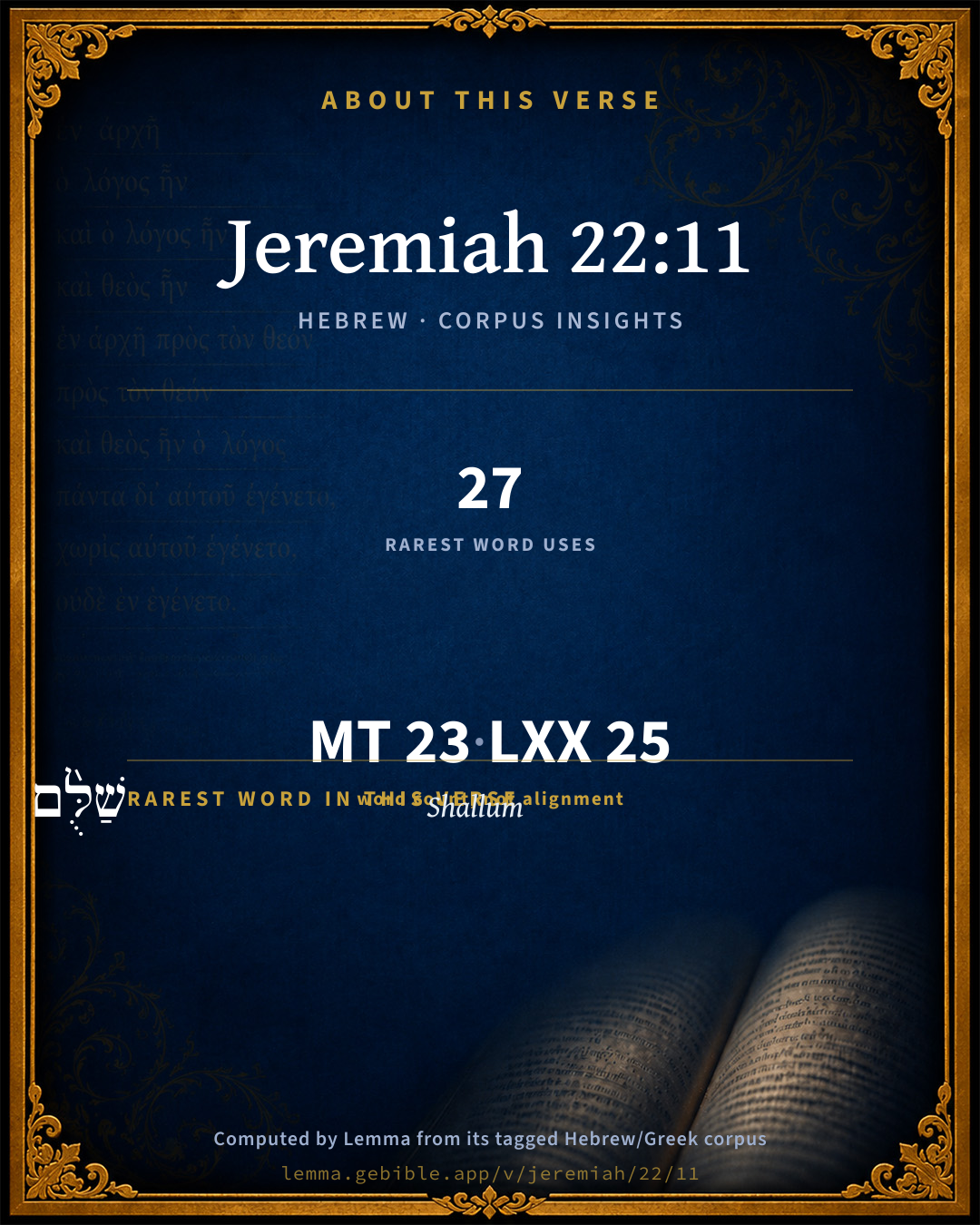
23
words
22
distinct lemmas
Prophets
section

Shared distinctive vocabulary

שַׁלֻּ֨ם Shallum H7967 occurs in 26 verses of the Hebrew Bible. Also found in:

Grammatical profile

  • 4 verbs
  • 9 nouns
  • 1 pronoun
  • 3 prepositions
  • 1 conjunction
  • 3 adverbs
  • 2 particles

Verb forms

  • אָֽמַר Qal · Perfect
  • הַמֹּלֵךְ֙ Qal · Participle Active
  • יָצָ֖א Qal · Perfect
  • יָשׁ֥וּב Qal · Imperfect

Repetition

A word recurs within this verse — often emphatic in Hebrew:

  • יֹאשִׁיָּ֜הוּ Josiah H2977 ×2

Hebrew & Septuagint length

In the original languages it is 23 Hebrew tokens and 25 Greek tokens — but the two are counted differently (Hebrew bundles its prefixes and suffixes into one token; the Greek is in lemma form), so that isn’t a like-for-like length.

Cross-references

6

Topical passages linked to Jeremiah 22:11 in the Treasury of Scripture Knowledge — connected by theme and wording, ordered by reader-vote popularity; previews shown in the World English Bible.

  • 1 Chronicles 3:15 The sons of Josiah: the firstborn Johanan, the second Jehoiakim, the third Zedekiah, the fourth Shallum.
  • 2 Kings 23:34 Pharaoh Necoh made Eliakim the son of Josiah king in the room of Josiah his father, and changed his name to Jehoiakim: but he took Jehoahaz away; and he came to Egypt, and died there.
  • 2 Chronicles 36:1–4 Then the people of the land took Jehoahaz the son of Josiah, and made him king in his father's place in Jerusalem.
  • 2 Kings 23:31 Jehoahaz was twenty-three years old when he began to reign; and he reigned three months in Jerusalem: and his mother's name was Hamutal the daughter of Jeremiah of Libnah.
  • 2 Chronicles 28:12 Then certain of the heads of the children of Ephraim, Azariah the son of Johanan, Berechiah the son of Meshillemoth, and Jehizkiah the son of Shallum, and Amasa the son of Hadlai, stood up against those who came from the war,
  • 2 Chronicles 34:22 So Hilkiah, and they whom the king [had commanded], went to Huldah the prophetess, the wife of Shallum the son of Tokhath, the son of Hasrah, keeper of the wardrobe; (now she lived in Jerusalem in the second quarter;) and they spoke to her to that effect.

Cross-references courtesy of OpenBible.info (CC BY 4.0).

Hebrew and Greek witnesses Masoretic Hebrew ↔ Greek Septuagint

The same verse in the two great witnesses to the Old Testament, shown verse-for-verse.

These are two independent witnesses, not word-aligned to each other, and the Septuagint is shown in lemma (dictionary) form.

Hebrew Jeremiah 22:11 Masoretic · Westminster Leningrad Codex

כִּ֣י כֹ֣ה אָֽמַר יְ֠הוָה אֶל שַׁלֻּ֨ם בֶּן יֹאשִׁיָּ֜הוּ מֶ֣לֶךְ יְהוּדָ֗ה הַמֹּלֵךְ֙ תַּ֚חַת יֹאשִׁיָּ֣הוּ אָבִ֔יו אֲשֶׁ֥ר יָצָ֖א מִן הַמָּק֣וֹם הַזֶּ֑ה לֹֽא יָשׁ֥וּב שָׁ֖ם עֽוֹד

For thus says Yahweh touching Shallum the son of Josiah, king of Judah, who reigned instead of Josiah his father, [and] who went forth out of this place: He shall not return there any more.

World English Bible · Public Domain

Greek LXX Structure differs

In the Septuagint, Jeremiah is about an eighth shorter than the Hebrew and arranges its material differently — the Oracles Against the Nations (Hebrew chapters 46–51) appear in the middle of the Greek book, after 25:13. Because the chapter and verse boundaries do not line up, a verse-for-verse comparison with the Hebrew is not shown.

A verse-for-verse comparison isn’t shown here because the chapters and verses don’t line up. Switch to the LXX edition with the MT / LXX toggle above to read the Greek directly.

Hebrew: Westminster Leningrad Codex (CC BY 4.0). Greek: Septuagint (public domain); English from a public-domain English Septuagint. How the Septuagint differs from the Hebrew →

Targum (Aramaic paraphrase)

1

The Targum is the ancient Jewish Aramaic paraphrase of the Hebrew Scriptures — an interpretive translation, not the Hebrew text itself. Onkelos (literal) and Pseudo-Jonathan (expansive) render the Torah, and Jonathan the Prophets. Coverage is partial: where no permissively-licensed English translation exists for a verse, only the Aramaic is shown. This is verse-level text, not a word-by-word alignment to the Hebrew.

  1. Targum Jonathan Prophets (Joshua–Malachi)
    אֲרֵי כִּדְנַן אֲמַר יְיָ עַל שַׁלוּם בַּר יֹאשִׁיָה מְלַךְ שִׁבְטָא דְבֵית יְהוּדָה דִמְלַךְ תְּחוֹת יֹאשִׁיָה אֲבוּהִי דִגְלָא מִן אַתְרָא הָדֵין לָא יְתוּב לְתַמָן עוֹד:

    (no public-domain English translation for this verse)

    Targum Jonathan — Aramaic: “Mikraot Gedolot” (public domain). English: “Sefaria Community Translation” (CC0 1.0 (public-domain dedication)); “London "Chaldee Paraphrase," 1871” (public domain). Text via Sefaria.

Commentary

Notes on Jeremiah 22:11 from classic Christian and Jewish commentators (each source and its license shown beneath its notes). The classic Christian expositions comment on the surrounding passage and are grouped to its opening verse, so a note may address several verses; the Jewish commentaries on the Tanakh (Rashi and others) are per-verse, so they appear only where the commentator wrote on this verse.

Lemma curates 59 commentaries, every one of them public domain or Creative Commons licensed, each selected and text-cleaned for this edition rather than reprinted as found. About our sources →

Trapp's Complete Commentary

John Trapp

Jer 22:11 For thus saith the LORD touching Shallum the son of Josiah king of Judah, which reigned instead of Josiah his father, which went forth out of this place; He shall not return thither any more:

Ver. 11. Which reigned instead of Josiah his father.] But was too hasty, stepping into the throne before his elder brother Jehoiakim; and therefore soon after dethroned, carried down to Egypt, and, as some say, there put to death. See 2Ki 23:33 2Ch 36:2. {See Trapp on "2Ki 23:33"} {See Trapp on "2Ch 36:2"}

John Trapp, A Commentary or Exposition upon All the Books of the Old and New Testament (1647–1656) — public domain. Text from a community e-Sword module.

Geneva Bible (1599)

Geneva Bible translators

Whom some think to be Jehoiachin, and that Josiah was his grandfather: but as seemeth, this was Jehoiakim, as verse 18.

Geneva Bible (1599) marginal notes — public domain. Text via Bolls.life.

John Calvin's Commentaries

What he had before said generally he now applies distinctly and especially to the person of the king, that the people in general might know that they could not escape that punishment from which even the king would not be exempt. They, no doubt, when they heard that such a hard and bitter lot would happen to a king, regarded it as a thing incredible; but Jeremiah intended to shew in his person that what we have just seen was nigh them all, that is, that it would be better for them at once to die than to pine away for a long time.

We must at the same time notice, that what these two verses contain respecting the king is not said as though it applied to him alone, but rather that every one might apply it to himself what the Prophet said of the king alone.

As to the word Shallum, it is thought that Jehoiakim was so called, who had also the name of Jeconiah, and who had of his own accord given up the kingdom and died in exile. But as he is called the son of Josiah, a doubt has arisen. But if we duly consider what sacred history relates, the probable conjecture is, that he was not his son but his grandson, for the chosen successor of his father was Jehoiakim, called also Eliakim. Yet Matthew calls him the son of Josiah, and that he was born to him together with his brethren. (Matthew 1:11.) But we know that it was a common thing with the Hebrews to call descendants sons, especially when the family of David was spoken of; that the order of succession might be preserved, those who next followed their predecessors were called sons. Thus, according to this custom, Elialdm might have been deemed his son, who was really his brother. As, then, he was the successor of Josiah, he is called his son.

There is yet no doubt but that God shews here that a pious king would not be a patronizer either to his own son, or to his grandson, or to others; for hypocrites are wont to form a defense for themselves from the holiness of their fathers. And as king Josiah had faithfully served God, his sons thought that God was in a manner bound to themselves, as though all this had not proceeded from the mere bounty of God, that Josiah had been so sincerely religious. But hypocrites, as I have just said, seek ever to render God bound to them. Hence the Prophet checks this false confidence, and declares that though Josiah was approved of God, yet his memory would not be of such an account as to shield his posterity from punishment. God, indeed, promises in his Law to be merciful to the thousandth generation, even to them who love him, (Exodus 20:6) but the ungodly very absurdly lay hold on this, as though they held God bound to them; for they thus imagine that they can deprive him of his power, and judgment, and authority over the world. The meaning then is, that Shallum in vain promised safety to himself because he had descended from the holy king Josiah, who had been a patron of eminent piety, for this could not be the means of lessening his punishment, inasmuch as he had degenerated from his father, whom he ought to have imitated, knowing that he was approved by God. And this also was the reason for the repetition, for he not only calls him the son of Josiah, but also adds, that he reigned instead of his father Josiah. Though, then, he succeeded so pious a king, he yet became degenerated and departed from the example of his father.

When he shall have gone forth from this place, he shall not return here any more As, then, the king was precluded from returning, what would become of the common people and the dregs of society? Could their condition be better? How then could the Jews dare flatter themselves when they perceived so dreadful an evidence of God’s wrath in the king himself, on whom depended their safety? A confirmation follows, For he shall die in the place to which they shall have led him away He intimates that he was to be by force carried away; he doubtless did not surrender himself until he saw that he was under the necessity of yielding. Then the Prophet in effect says that he would be a miserable exile, driven into banishment against his own will. It is then added, that he would see no more the land of his nativity, so that his lot would be nothing better than that of any one of the common people. It follows, —

John Calvin's Commentaries (1540-1563) — public domain. Text from the Calvin Translation Society English edition (1840s-50s) via the Christian Classics Ethereal Library (ccel.org). Calvin's coverage is partial (roughly two-thirds of the Bible); uncommented books and verses are honest gaps, never fabricated. The 19th-century editor's footnotes and remarks are omitted so the notes are faithfully Calvin's own voice.

Ellicott's Commentary for English Readers

(11) Shallum.—Josiah’s successor appears in the historical books as Jehoahaz (“Jehovah sustains,” meant as a nomen et omen), the latter being probably the name assumed on his succession to the throne. Such changes were common at the time, as in the case of Jehoiakim and Zedekiah (2Ki_23:34; 2Ki_24:17). Shallum (= retribution) might probably have seemed a name of evil augury. In 1Ch_3:15 a Shallum appears as the fourth son of Josiah, Jehoiakim being the second, and one otherwise unknown, Johanan, the eldest. This may have been the same as the one now referred to (the order of the last two names being in some way inverted), or there may have been two brothers bearing the same name. The short and disastrous reign of Shallum, and the meaning of the word probably account for the prophet’s using the private rather than the kingly name. The fact that the name had been borne by one of the later kings of Israel whose reign lasted but for a single month (2Ki_15:13) may have given a further point to its use, as being full of disastrous memories that made it ominous of evil. The title “king of Judah” belongs grammatically to Shallum, not to Josiah.

A Bible Commentary for English Readers, edited by Charles John Ellicott (1878–1897) — public domain. Text from a community e-Sword module.

The Cambridge Bible for Schools and Colleges

gen. ed. J. J. S. Perowne

11. Shallum] See lntr. p. xiv. Shallum was probably the name which he bore before his accession. Other hypotheses to account for the name being here given to Jehoahaz are unlikely, e.g. (i) that it had reference to the shortness of his reign, as alluding to Shallum king of Israel, who was king for one month (2Ki_15:13), or (ii) that it means the requited one (from the sense of the Hebrew root), him whom God had marked out for punishment.

Jehoahaz had represented the anti-Egyptian policy, which Jeremiah had always urged. This adds point to the prophet’s lament for him.

The Cambridge Bible for Schools and Colleges (gen. ed. J. J. S. Perowne; Cambridge University Press, 1878–1918) — public domain. Text from a community e-Sword module.

John Gill's Exposition

For thus saith the Lord touching Shallum,.... Not Shallum the fourth son of Josiah, Ch1 3:15; for it is not likely that he should immediately succeed his father; nor Zedekiah, as Jarchi; nor Jeconiah, as Kimchi; but Jehoahaz, as Aben Ezra; who seems to have had several names, as Johanan, Ch1 3:15; and Shallum here:

the son of Josiah king of Judah, which reigned instead of Josiah his father; the same is said of Jehoahaz, Ch2 36:1;

which went forth out of this place; out of Jerusalem, being put down there from his throne by Pharaohnecho, and carried by him into Egypt, Ch2 36:3;

he shall not return thither any more; he died in Egypt, or however out of his own land; but was alive when this prophecy was delivered out, which was in the reign of his brother Jehoiakim, as some following verses show.

John Gill's Exposition of the Whole Bible (1746–1763) — public domain (CC PDM 1.0). Text via the HelloAO Bible API.

Matthew Poole's English Annotations

Who this

Shallum was is a little doubted. Some think it was Jehoahaz the son of Josiah, 1Ch 3:15, called Johanan: there is also mentioned one Shallum, but he is there mentioned as the fourth son of Josiah. In the Book of Kings we read only of three sons which Josiah had, viz. Jehoahaz, Jehoiakim, and Zedekiah. Most think that this Shallum was Jehoahaz, or Johanan, (as he is called, 1Ch 3:15) who was indeed the second son of Josiah; for it is plain, from 2Ki 23:31,36, that Jehoiakim was two years older, otherwise he could not have been twenty-five years old when he began to reign after Jehoahaz, who began to reign at twenty-three years of age, and reigned but three months; but, 1Ch 3:15, he is called Josiah’s first-born, because he was first made king; and here he is called Shallum, for the shortness of his reign, in derision to the Jews, who so called him, upon the account of their good hopes of prosperity under him; and in allusion to Shallum the son of Jabesh, one of the last kings of the ten tribes, mentioned 2Ki 15:13, who reigned but a month: for this, as some think, could not be that Shallum mentioned after Zedekiah, as the fourth son of Josiah, 1Ch 3:15, for that Shallum, they say, never reigned; this, as the text saith, did reign three months

instead of Josiah his father; which phrase seemeth also to conclude that he immediately succeeded his father Josiah.

Which went forth out of this place; he was carried away from Jerusalem presently after he was set up, 2Ki 23:31,33, imprisoned at Riblah, and, 2Ki 23:34, died in Egypt.

Matthew Poole's English Annotations on the Holy Bible (1683–1685) — public domain. Text from a community e-Sword/MySword module.

Whedon's Commentary on the Bible

Daniel D. Whedon

11. Shallum — Attention is at once arrested by this name, which is applied to Josiah’s son and successor, Jehoiakim. In one other place (2Ch_3:15,) he is so called: in other passages his name is Jehoahaz. Why is he here called Shallum? Some say,

1) Because, from the brevity of his reign, he so much resembles Shallum of Israel. See 2Ki_15:12, (Graf, Hitzig, et al.) This is fanciful in the extreme. Jeremiah does not write in this way.

2) To mark him as the man whom the Lord had requited for his evil doings. (SHALLUM: the requited — Hengstenberg.) But this explanation is untenable, inasmuch as the name Shallum appears in the genealogical table, 1Ch_3:15.

3) We are forced to conclude that Shallum was probably the original name of this man, and that he took the name Jehoahaz (Jehovah holds) on ascending the throne. Here, however, as the meaning of the old name is specially appropriate, Jeremiah employs it.

Daniel D. Whedon (gen. ed.), Commentary on the Old and New Testaments (1874–1909) — public domain. Text from a community e-Sword module.

John Wesley's Explanatory Notes

Shallum - Most think that this Shallum was Jehoahaz. Went forth - He was carried away from Jerusalem presently after he was set up, imprisoned at Riblah, and died in Egypt.

John Wesley, Explanatory Notes Upon the Whole Bible (1754–1765) — public domain. Text via the GEBible commentary corpus.

unfoldingWord translationNotes

Door43 World Missions Community

Jehoahaz

The name in Hebrew is "Shallum," but he is better known as Jehoahaz. (See: How to Translate Names)

who served as king instead of Josiah his father

"who became king when his father, Josiah, died"

translationWords

Josiah

servant

exile

unfoldingWord translationNotes — © Distant Shores Media and the Door43 World Missions Community, licensed CC BY-SA 4.0. Source: git.door43.org/Door43/en_tn.

Rashi

Rabbi Shlomo Yitzchaki (Rashi)

concerning Shallum That is Zedekiah, and that is what he was called in I Chron. (3:14): “the fourth Shallum.” And he called him the Fourth, meaning the fourth to assume the kingship of Josiah’s sons, for first Jehoaha, reigned, then Jehoiakim, and after him Jehoiachin, and after him Zedekiah.

who left Even though he hadn’t left yet, he prophesied as if he had already left.

Rashi on the Tanakh — English translations: “The Judaica Press complete Tanach with Rashi, translated by A. J. Rosenberg” (CC BY 4.0); “Pentateuch with Rashi's commentary by M. Rosenbaum and A.M. Silbermann, 1929-1934” (public domain); “The Metsudah Tanach series, Lakewood, N.J” (CC BY 4.0); and “The Book of Joshua, Metsudah Publications, 1997” (CC BY 4.0). Text via Sefaria.

Lesson kit

Teaching starters — assembled from the data on this page, not authored interpretation. Every prompt links to the verse data it draws on. Edit before teaching.

Jeremiah, in the Prophets, opens this verse with 23 words (22 distinct Hebrew lemmas). Its most distinctive word is Shallûwm (“Shallum”). A historical commentator’s framing appears above. Read the whole chapter for the surrounding context.

Discussion questions

  1. What does “Shallum” (Shallûwm) contribute to the verse as a whole?
  2. How does 2 Kings 15:10, which shares the word «Shallum», read alongside this verse?
  3. What does the repetition of “Josiah” (2× in this one verse) do in this verse?
  4. The translations on this page render this verse differently — a whole-verse word diff, not a word-by-word alignment. What might account for the different wordings?
  5. «אָֽמַר» is a Qal Perfect verb. How does that grammatical form shape the action described?
  6. Compare how Trapp's Complete Commentary and Geneva Bible (1599) read this verse. Where do they agree or differ?

Things to notice

Reading settings

Reading text

Shown beneath each verse's original-language words.

Old Testament
Old Testament edition

Read the OT as the Masoretic Hebrew (MT) or the Greek Septuagint (LXX).

English shown for the Greek Septuagint (in the Hebrew ↔ Greek comparison).

Comparing translations? Open the Compare panel on any verse page to stack up to four side by side.