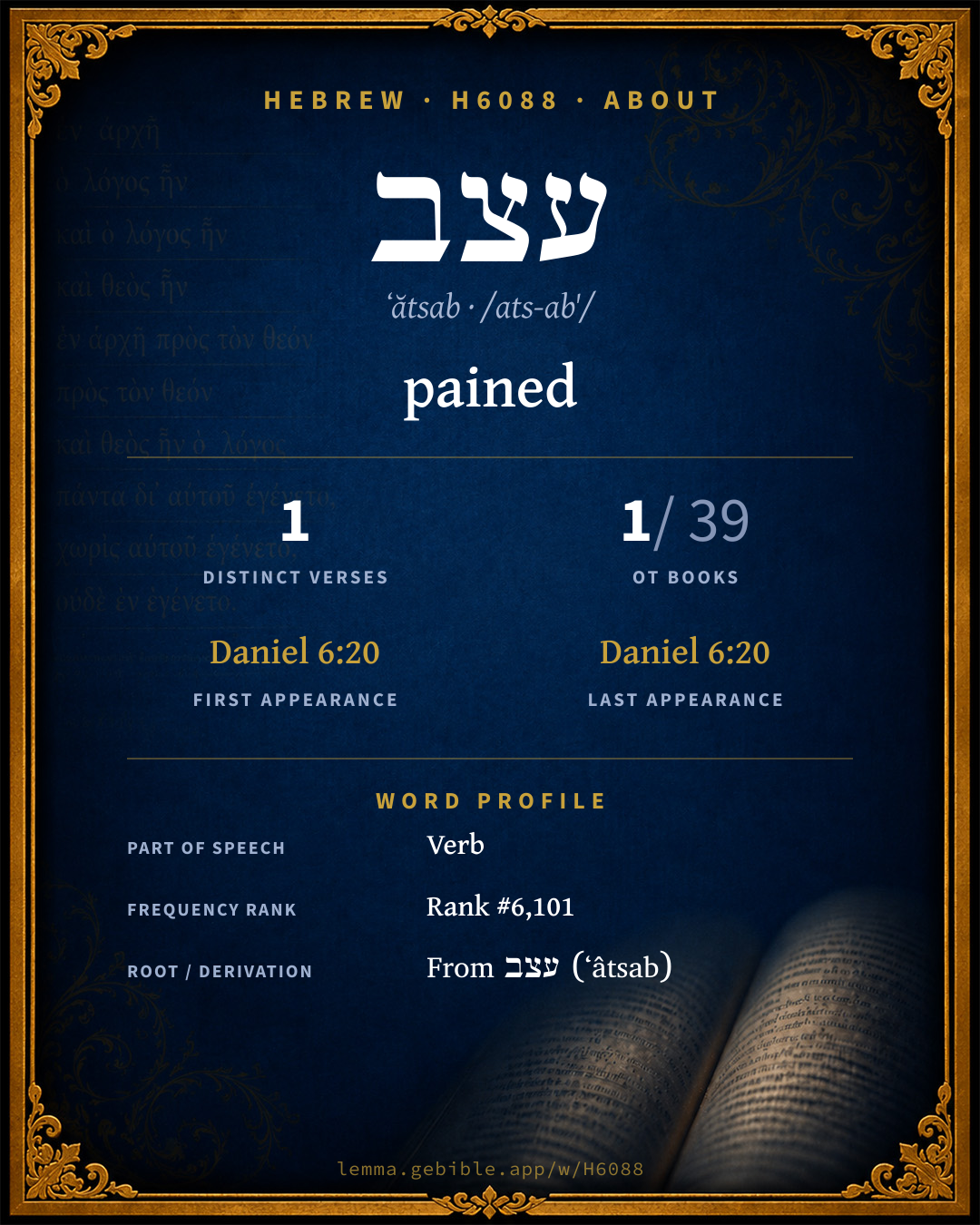
עֲצַב
pained
‘pained’ is one of 2 main senses fuller range ↓
Full lexicon entry — Brown-Driver-Briggs (BDB)
From Brown-Driver-Briggs (BDB)
Where this word appears
Grammar key — what these labels mean
Part of speech
- Adjective
- A word that describes or qualifies a noun.
State
- Absolute
- The independent form of a noun, not bound to a following word.
Gender
- Masculine
- Grammatically masculine.
Number
- Singular
- One.
Every verse where H6088 appears — 1 distinct verse across 1 book. Click any verse to open its interlinear word-by-word view. Verse text shown in the World English Bible for context — . Each verse’s Hebrew form is shown with its reference; the English is not keyword-highlighted, since the data carries no word-level English alignment. Use “Compare translations” on any verse to read it across multiple English versions. This concordance covers the Hebrew Bible; Septuagint (Greek Old Testament) occurrences are not indexed here.
Daniel 1 verse
About this entry
At a glance — auto-summarized from this page’s data, not written by a person. Every figure links to its source below. This summary describes the numbers; it doesn’t interpret them.
“pained” is the headline sense of the Hebrew verb עצב (ʻătsab). A scarce word — 1 verse in all of the Hebrew Bible. It clusters heavily in Daniel, which alone accounts for 100% of its uses. A true hapax — its single appearance is Daniel 6:20. Lexicons map it across 2 senses. See the sense tree, 1-verse concordance, and the renderings breakdown below.
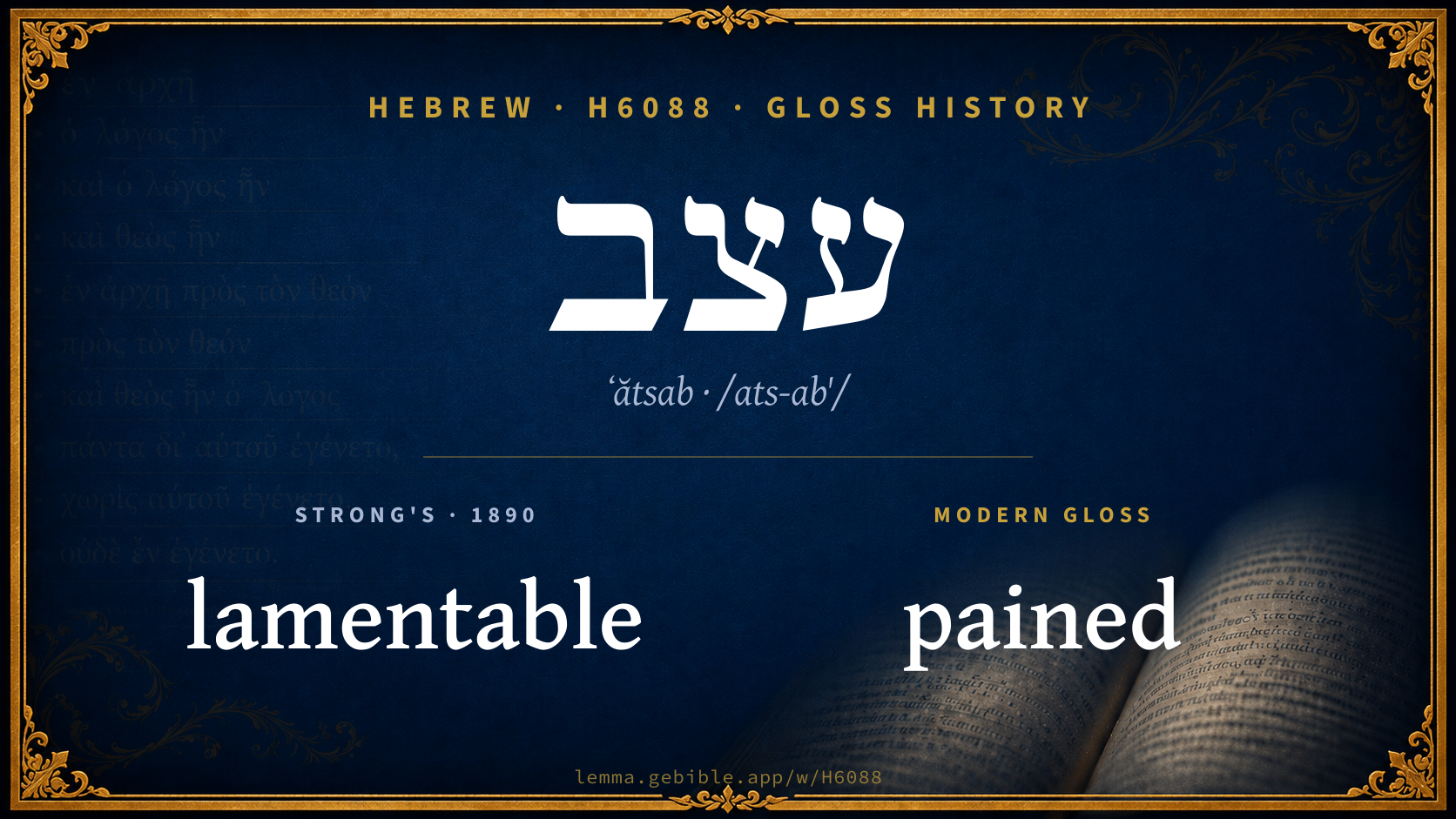
Gloss history
Strong's 1890 vs modern scholarship
About this word
Strong's H6088 catalogs a Hebrew word from the Hebrew Old Testament.
These counts are not copied from any lexicon or concordance. They are computed here, from the morphology-tagged Hebrew Old Testament. What Lemma adds →
- 1
- distinct verses
- The word appears in 1 distinct verse.
- 1 / 39
- OT books
- The word appears in 1 of 39 Old Testament books.
- #6,101
- by frequency
- Rank #6,101 (rank 6,101 of 8,640 Hebrew words by occurrence).
View all 1 occurrence in the concordance →
Most concentrated in
- Daniel 1 verse 100%
By section of the Old Testament
By traditional corpus
Conventional, traditional groupings — biblical authorship is debated, so this is a traditional corpus grouping, not an authorship claim. Each share is this word’s portion of its verses in that division of the Hebrew canon. Each figure is a share of the word’s 1 distinct verse.
- Writings (Ketuvim) 1 verse · 100%
How translations render this word
Counts come from each version’s own published word-to-Strong’s tagging or interlinear alignment — an approximate guide to how each version renders this word, not a word-level alignment the data otherwise carries. Because each total is that version’s own tagged count, the per-version totals vary from one another and need not match the appearance or distinct-verse counts above. These counts may also differ from a printed concordance because Lemma counts each distinctly tagged rendering and does not collapse phrase taggings into a single head-word total. This is a fixed set of word-tagged versions (KJV, ASV, BSB, ULT) and does not change with the reading translation you choose elsewhere. Each version’s license is shown beside its name below (and on Sources).
- King James Version: Lamentable 1×
- American Standard Version: Lamentable 1×
- Berean Standard Bible: Anguish 1×
- unfoldingWord Literal Text: Troubled 1×
King James Version Public Domain
Renders H6088 across 1 tagged occurrence — most commonly:
American Standard Version Public Domain
Renders H6088 across 1 tagged occurrence — most commonly:
Berean Standard Bible Public Domain
Renders H6088 across 1 tagged occurrence — most commonly:
unfoldingWord Literal Text CC BY-SA 4.0
Renders H6088 across 1 tagged occurrence — most commonly:
Senses in BDB
The 2 senses BDB distinguishes for this word, in lexicon order (not ranked by frequency or importance). The full entry — with sub-senses — is in the Lexicon Entry tab.
- to pain, grieve
- (Peal) pained (participle)
Word origin
[ עֲצַב ] vb. pain, grieve;— Pe. Dn 6:21
— Brown-Driver-Briggs (Oxford 1906, public domain), digitized via Sefaria, supplemented by the OpenScriptures HebrewLexicon (CC BY 4.0). See Sources.
Derived from עצב (ʻâtsab) (H6087) — to pain.
Jastrow Dictionary
A second Hebrew/Aramaic lexicon for comparison, covering Aramaic and post-biblical (Talmudic, Targumic, Midrashic) usage that the biblical-Hebrew BDB does not. Matched by lemma rather than by Strong’s number, so a lemma may carry more than one Jastrow headword (shown separately below), and the entries cover usage well beyond the Bible.
עָצַב
- (b. h.)
- 1. to cut, form, shape.
- 2. (cmp. יָגָה a. יָגוֹן) to cut, grieve, pain.
- to shape, handle, esp. to straighten an infant’s body by manipulation. Sabb. XXII, 6 אין מְעַצְּבִין את הקטן you must not manipulate a child (on the Sabbath), expl. ib. 147ᵇ בחומרי שדרה straightening the vertebra (v. לְפַף). Tosef. Kel. B. Mets. II, 9 שהוא מְעַצֵּב עליה וכ׳ because he (the surgeon) manipulates children thereon.
- to grieve. Gen. R. s. 44 (ref. to Ps. CXXXIX, 24) אם עתיד … (ו)להַעֲצִיבְךָ וכ׳ if it be my destiny to rear children who are to grieve thee, it is better that thou shouldst lead me in the way of the world (death); (Yalk. Ps. 888 ולהכעיסך). e.g. Psalms 139:24
- to be grieved, mourn. Snh. 38ᵇ שמח בתורתו ונ׳ במיתתו he rejoiced over his (R. ‘Ăkiba’s) learning, and mourned over his death (predestined martyrdom).
עֲצַב
- ; (intr.) to be grieved. Targ. Ps. XXXIV, 6 (v. חֲסַד II).—Part. pass. עָצֵב, עָצִיב; f. עֲצִיבָא; pl. עֲצִיבֵי grieved, sad. Targ. Esth. IV, 1; Targ. Y. Ex. XII, 31 קל ע׳ the voice of a mourner.—Bets. 16ᵇ חזייה דהוה ע׳ he saw that he looked down-hearted; אמאי עֲצִיבַת why art thou grieved? Taan. 25ᵃ. Ib. 22ᵃ מבדחינן ע׳, v. בָּדוֹחָא; a. fr.
- to be grieved. Ber. 31ᵃ ואִעֲצִיבוּ and they grew sad; Yalk. Ps. 881 ואִיעֲ׳.
עָצָב
- 1. form, esp. idol.—Pl. עֲצַבִּים. Sifra K’dosh., beg. ע׳ על שם שנעשו פרקים פרקים idols are called ‘forms’, because they are made limb by limb; Mekh. Mishp. s. 20; Ab. d’R. N. ch. XXXIV.—Snh. 63ᵇ ועושין דמות עֲצַבֵּיהֶם (not עצבים, v. Rabb. D. S. a. l. note 1) they made an image of their (the rich men’s) figures; Yalk. Hos. 529.
עֶצֶב
- 2. trouble, toil; that which is acquired through toil.—Pl. עֲצָבִים. Num. R. s. 9 (ref. to ועצביך, Prov. V, 10) אין עֲצָבֶיךָ אלא בנים (ed. Wil. עֲצִיבָה וכ׳) ‘thy toils’ means thy children (with ref. to Gen. III, 16); ע׳ זו יגיעת הארץ ‘thy toils’ means painful labor in the field (with ref. to ib. 17). e.g. Proverbs 5:10
עָצֵב
- preced.) sad, grief-stricken. Pes. 119ᵃ מלך בו"ד מנצחין אותו וע׳ וכ׳ a human King grieves when he is defeated, but the Lord &c.; (Midr. Till. to Ps. IV כועס), v. נָצַח. Ber. 5ᵃ מוכר ע׳ ולוקח שמח the seller grieves (because he has to part with a dear possession), and the buyer is glad; a. e.—Pl. עֲצֵבִים, עֲצֵבִין; עֲצֵבוֹת, עֲצֵי׳. Yoma 21ᵇ. Ib. 67ᵃ; a. e.—Trnsf. (of the fingers of the hand) pressed together, narrow, opp. שׂוֹחֵק. Erub. 3ᵇ, a. e., v. אַמָּה.
עָצֵב ²
- ch., v. עֲצַב
A Dictionary of the Targumim, the Talmud Babli and Yerushalmi, and the Midrashic Literature (Marcus Jastrow; London, Luzac, 1903) — Public Domain. Digitized via Sefaria. Digitized via Sefaria. Full attribution on Sources.
Same root — word family
Other BDB entries built from the same root as H6088, grouped by Strong’s listed origin. These share a root / origin per the lexicon — not necessarily a shared meaning. Each links to that word’s own entry.
Derives from
Shares the same root
- מעצבה maʻătsêbâh H4620 place of grief
- עצב ʻetseb H6089 pain
- עצב ʻâtsâb H6091 idol
- עצב ʻâtsêb H6092 labourer
- עצבון ʻitstsâbôwn H6093 toil
- עצבת ʻatstsebeth H6094 sorrow
Compare all same-root words → Showing 4 of 8 — not the complete family. They share a root, not necessarily a meaning.
Septuagint verse parallels
This word appears in 1 verse that also exists in the Greek Old Testament (Septuagint), out of the 1 Hebrew verse it occurs in. You can read those verses in Greek by switching the Old Testament edition to the Septuagint.
Read these verses in the Septuagint
This is a verse-level parallel only — the same verses exist in both the Hebrew and Greek Old Testaments. No word-level Hebrew↔Greek correspondence is claimed: the data carries no such alignment, so no Greek word is shown as this Hebrew word’s translation. Coverage is not total — the Septuagint omits the deuterocanon and renumbers the Psalms, so some Hebrew verses have no direct Greek parallel.