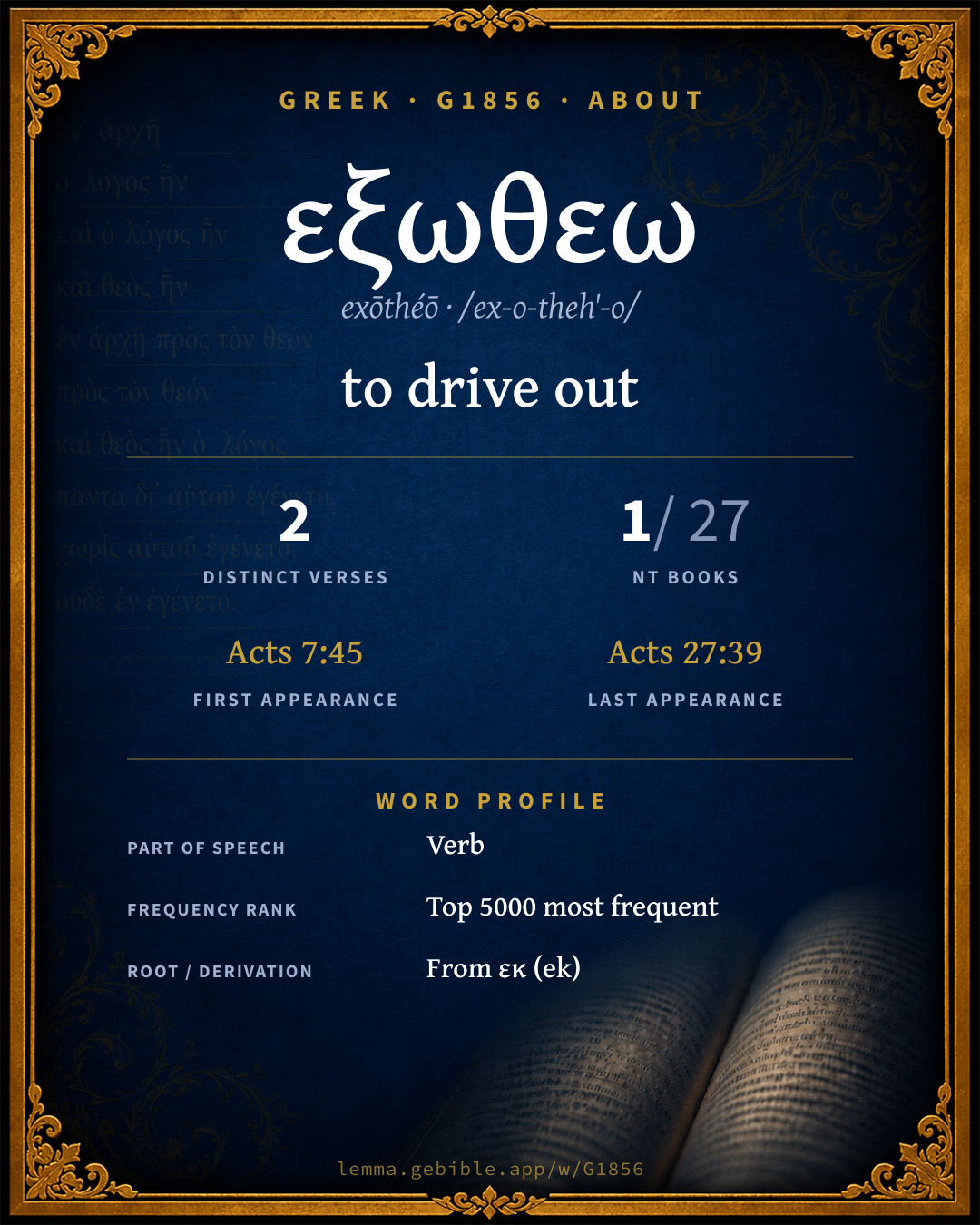
εξωθεω
to drive out
Full lexicon entry — Thayer's Greek Lexicon
From Thayer's Greek Lexicon
Where this word appears
Grammar key — what these labels mean
Part of speech
- Verb
- An action or state-of-being word.
Tense
- Aorist
- Action viewed as a simple whole, without regard to duration — often past (perfective aspect).
Voice
- Active
- The subject performs the action.
Mood
- Indicative
- States a fact or asks a factual question (the mood of reality).
- Infinitive
- A verbal noun (“to write”), unmarked for person or number.
Person
- 3rd person
- The one spoken about (“he / she / it / they”).
Number
- Singular
- One.
Grammatical forms
- Verb, Aorist, Active, Indicative, 3rd person, Singular 1 time (50%)
- Verb, Aorist, Active, Infinitive 1 time (50%)
Parsed forms decoded from the imported morphology (Robinson–Tischendorf, public domain), counted across 2 parsed occurrences — not distinct verses.
Every verse where G1856 appears — 2 distinct verses across 1 book. Click any verse to open its interlinear word-by-word view. Verse text shown in the World English Bible for context — . Each verse’s Greek form is shown with its reference; the English is not keyword-highlighted, since the data carries no word-level English alignment. Use “Compare translations” on any verse to read it across multiple English versions. This concordance covers the Greek New Testament; Septuagint (Greek Old Testament) occurrences of this word are not indexed here.
Acts 2 verses
- Acts 7:45 ἐξῶσεν aor act ind 3sg which also our fathers, in their turn, brought in with Joshua when they entered into the possession of the nations, whom God drove out before the face of our fathers, to the days of David,
- Acts 27:39 ἐξῶσαι aor act inf When it was day, they didn't recognize the land, but they noticed a certain bay with a beach, and they decided to try to drive the ship onto it.
About this entry
At a glance — auto-summarized from this page’s data, not written by a person. Every figure links to its source below. This summary describes the numbers; it doesn’t interpret them.
The Greek verb εξωθεω centers on the idea of “to drive out.” It occurs a mere 2 verses across Scripture. Acts dominates its distribution — 2 of 2 verses. Its earliest occurrence is Acts 7:45. Related forms include εκ, εκβαλλω and εκβασις. Dig into 2-verse concordance and the renderings breakdown below.
Gloss history
Strong's 1890 vs modern scholarship
About this word
Strong's G1856 catalogs a Greek word from the Greek New Testament.
These counts are not copied from any lexicon or concordance. They are computed here, from the morphology-tagged Greek New Testament. What Lemma adds →
- 2
- distinct verses
- The word appears in 2 distinct verses.
- 1 / 27
- NT books
- The word appears in 1 of 27 New Testament books.
- #2,678
- by frequency
- Top 5000 most frequent Greek words (rank 2,678 of 5,347 Greek words by occurrence).
View all 2 occurrences in the concordance →
Most concentrated in
- Acts 2 verses 100%
By section of the New Testament
By traditional corpus
Conventional, traditional groupings — biblical authorship is debated, so this is a traditional corpus grouping, not an authorship claim. Some books belong to more than one corpus (Luke is in both the Gospels and the Lukan corpus, and so on), so these shares overlap and need not total 100%. Each figure is a share of the word’s 2 distinct verses.
- Lukan (Luke–Acts) 2 verses · 100%
How translations render this word
Counts come from each version’s own published word-to-Strong’s tagging or interlinear alignment — an approximate guide to how each version renders this word, not a word-level alignment the data otherwise carries. Because each total is that version’s own tagged count, the per-version totals vary from one another and need not match the appearance or distinct-verse counts above. These counts may also differ from a printed concordance because Lemma counts each distinctly tagged rendering and does not collapse phrase taggings into a single head-word total. This is a fixed set of word-tagged versions (KJV, ASV, BSB, ULT) and does not change with the reading translation you choose elsewhere. Each version’s license is shown beside its name below (and on Sources).
- King James Version: Drave out 1×, Thrust in 1×
- American Standard Version: Drive 1×, Thrust out 1×
- Berean Standard Bible: Drove out 1×, Run 1×
- unfoldingWord Literal Text: Drive 1×, Drove out 1×
King James Version Public Domain
Renders G1856 across 2 tagged occurrences — most commonly:
American Standard Version Public Domain
Renders G1856 across 2 tagged occurrences — most commonly:
Berean Standard Bible Public Domain
Renders G1856 across 2 tagged occurrences — most commonly:
unfoldingWord Literal Text CC BY-SA 4.0
Renders G1856 across 2 tagged occurrences — most commonly:
Word origin
Derived from εκ (ek) (G1537) — from.
From G1537 and ὠθέω ō theō (to push ); to expel ; by implication to propel : - drive out thrust in.
— Strong’s Exhaustive Concordance (1890), public domain.
Forms in the corpus
The 2 distinct written forms G1856 takes in the Greek New Testament, most frequent first — each parse links to that tense’s occurrences in the concordance.
| Form | Parsing | Example | Uses |
|---|---|---|---|
| ἐξῶσαι exō̂sai | Verb, Aorist, Active, Infinitive | Acts 27:39 | 1 |
| ἐξῶσεν exō̂sen | Verb, Aorist, Active, Indicative, 3rd person, Singular | Acts 7:45 | 1 |
Same root — word family
Other Thayer's entries built from the same root as G1856, grouped by Strong’s listed origin. These share a root / origin per the lexicon — not necessarily a shared meaning. Each links to that word’s own entry.
Derives from
Shares the same root
- εκβαλλω ekbállō G1544 to cast out
- εκβασις ékbasis G1545 exit
- εκγαμιζω ekgamízō G1547 to give in marriage
- εκγαμισκω ekgamískō G1548 to give in marriage
- εκγονον ékgonon G1549 offspring
- εκδαπαναω ekdapanáō G1550 to spend
- εκδεχομαι ekdéchomai G1551 to receive
- εκδηλος ékdēlos G1552 evident
- εκδημεω ekdēméō G1553 to depart
- εκδιδωμι ekdídōmi G1554 to give out
- εκδιηγεομαι ekdiēgéomai G1555 to relate
- εκδικος ékdikos G1558 without justice
- εκδιωκω ekdiṓkō G1559 to banish
- εκδοτος ékdotos G1560 delivered up
- εκδυω ekdýō G1562 to put off
- εκζητεω ekzētéō G1567 to seek out
- εκθαμβος ékthambos G1569 astonished
- εκθετος ékthetos G1570 exposed
- εκκαθαιρω ekkathaírō G1571 to cleanse
- εκκαιω ekkaíō G1572 to burn
- εκκακεω ekkakéō G1573 to be exhausted
- εκκεντεω ekkentéō G1574 to pierce
- εκκλαω ekkláō G1575 to cut off
- εκκλειω ekkleíō G1576 to shut out
+88 more words share this root (not shown).
Compare all same-root words → Showing 4 of 114 — not the complete family. They share a root, not necessarily a meaning.
Septuagint usage
The same Greek word εξωθεω appears 26 times in the Greek Old Testament (Septuagint), across 25 verses in 10 books.
- 26
- LXX occurrences
- Tagged occurrences of this Greek word in the Septuagint.
- 25
- verses
- Distinct Septuagint verses containing this word.
- 10 / 39
- OT books
- The word appears in 10 of the 39 Old Testament books.
Sample Septuagint occurrences
- Deuteronomy 13:6 ἐκὠθέω
- 2 Samuel 14:13 ἐκὠθέω
- 2 Kings 17:21 ἐκὠθέω
- Psalms 5:11 ἐκὠθέω
- Proverbs 2:22 ἐκὠθέω
- Isaiah 41:2 ἐκὠθέω
- Jeremiah 8:3 ἐκὠθέω
- Daniel 11:30 ἐκὠθέω
- Joel 2:20 ἐκὠθέω
- Micah 2:9 ἐκὠθέω
Septuagint occurrences (same lexeme)
Every verse where the same Strong’s number (G1856) appears in the Greek Septuagint. Verse text shown in the World English Bible for context; the Greek form is the matched word — the English is not keyword-highlighted.
- Deuteronomy 13:6 ἐκὠθέω If your brother, the son of your mother, or your son, or your daughter, or the wife of your bosom, or your friend, who is as your own soul, entice you secretly, saying, Let us go and serve other gods, which you have not known, you, nor your fathers;
- 2 Samuel 14:13 ἐκὠθέω The woman said, Why then have you devised such a thing against the people of God? for in speaking this word the king is as one who is guilty, in that the king does not bring home again his banished one.
- 2 Samuel 14:14 ἐκὠθέω For we must needs die, and are as water split on the ground, which can't be gathered up again; neither does God take away life, but devises means, that he who is banished not be an outcast from him.
- 2 Samuel 15:14 ἐκὠθέω David said to all his servants who were with him at Jerusalem, Arise, and let us flee; for else none of us shall escape from Absalom: make speed to depart, lest he overtake us quickly, and bring down evil on us, and strike the city with the edge of the sword.
- 2 Samuel 23:6 ἐκὠθέω But the ungodly shall be all of them as thorns to be thrust away, Because they can't be taken with the hand
- 2 Kings 17:21 ἐκὠθέω For he tore Israel from the house of David; and they made Jeroboam the son of Nebat king: and Jeroboam drove Israel from following Yahweh, and made them sin a great sin.
- Psalms 5:11 ἐκὠθέω But let all those who take refuge in you rejoice, Let them always shout for joy, because you defend them. Let them also who love your name be joyful in you.
- Proverbs 2:22 ἐκὠθέω But the wicked will be cut off from the land. The treacherous will be rooted out of it.
- Isaiah 41:2 ἐκὠθέω Who has raised up one from the east, whom he calls in righteousness to his foot? he gives nations before him, and makes him rule over kings; he gives them as the dust to his sword, as the driven stubble to his bow.
- Jeremiah 8:3 ἐκὠθέω Death shall be chosen rather than life by all the residue that remain of this evil family, that remain in all the places where I have driven them, says Yahweh of Hosts.
- Jeremiah 16:15 ἐκὠθέω but, As Yahweh lives, who brought up the children of Israel from the land of the north, and from all the countries where he had driven them. I will bring them again into their land that I gave to their fathers.
- Jeremiah 23:2 ἐκὠθέω Therefore thus says Yahweh, the God of Israel, against the shepherds who feed my people: You have scattered my flock, and driven them away, and have not visited them; behold, I will visit on you the evil of your doings, says Yahweh.
- Jeremiah 23:3 ἐκὠθέω I will gather the remnant of my flock out of all the countries where I have driven them, and will bring them again to their folds; and they shall be fruitful and multiply.
- Jeremiah 23:8 ἐκὠθέω but, As Yahweh lives, who brought up and who led the seed of the house of Israel out of the north country, and from all the countries where I had driven them. They shall dwell in their own land.
- Jeremiah 24:9 ἐκὠθέω I will even give them up to be tossed back and forth among all the kingdoms of the earth for evil; to be a reproach and a proverb, a taunt and a curse, in all places where I shall drive them.
- Jeremiah 25:16 ἐκὠθέω They shall drink, and reel back and forth, and be mad, because of the sword that I will send among them.
- Jeremiah 26:28 ἐκὠθέω
- Jeremiah 27:6 ἐκὠθέω Now have I given all these lands into the hand of Nebuchadnezzar the king of Babylon, my servant; and the animals of the field also have I given him to serve him.
- Jeremiah 27:17 ἐκὠθέω Don't listen to them; serve the king of Babylon, and live: why should this city become a desolation?
- Jeremiah 28:34 ἐκὠθέω
- Daniel 11:30 ἐκὠθέω For ships of Kittim shall come against him; therefore he shall be grieved, and shall return, and have indignation against the holy covenant, and shall do [his pleasure]: he shall even return, and have regard to those who forsake the holy covenant.
- Joel 2:20 ἐκὠθέω But I will remove the northern army far away from you, And will drive it into a barren and desolate land, Its front into the eastern sea, And its back into the western sea; And its stench will come up, And its bad smell will rise." Surely he has done great things.
- Joel 4:6 ἐκὠθέω
- Micah 2:9 ἐκὠθέω You drive the women of my people out from their pleasant houses; From their young children you take away my blessing forever.
- Micah 4:6 ἐκὠθέω "In that day," says Yahweh, "I will assemble that which is lame, And I will gather that which is driven away, And that which I have afflicted;
These are occurrences of the same Greek lexeme (G1856) in the Septuagint — not a translation of any one Hebrew word. The store carries no word-level Hebrew↔Greek alignment, so no Hebrew original is asserted here. Counts come from the recovered LXX Strong's tagging — high-frequency vocabulary is well covered, while rare or late forms may be untagged — so they reflect tagged occurrences and may slightly undercount.