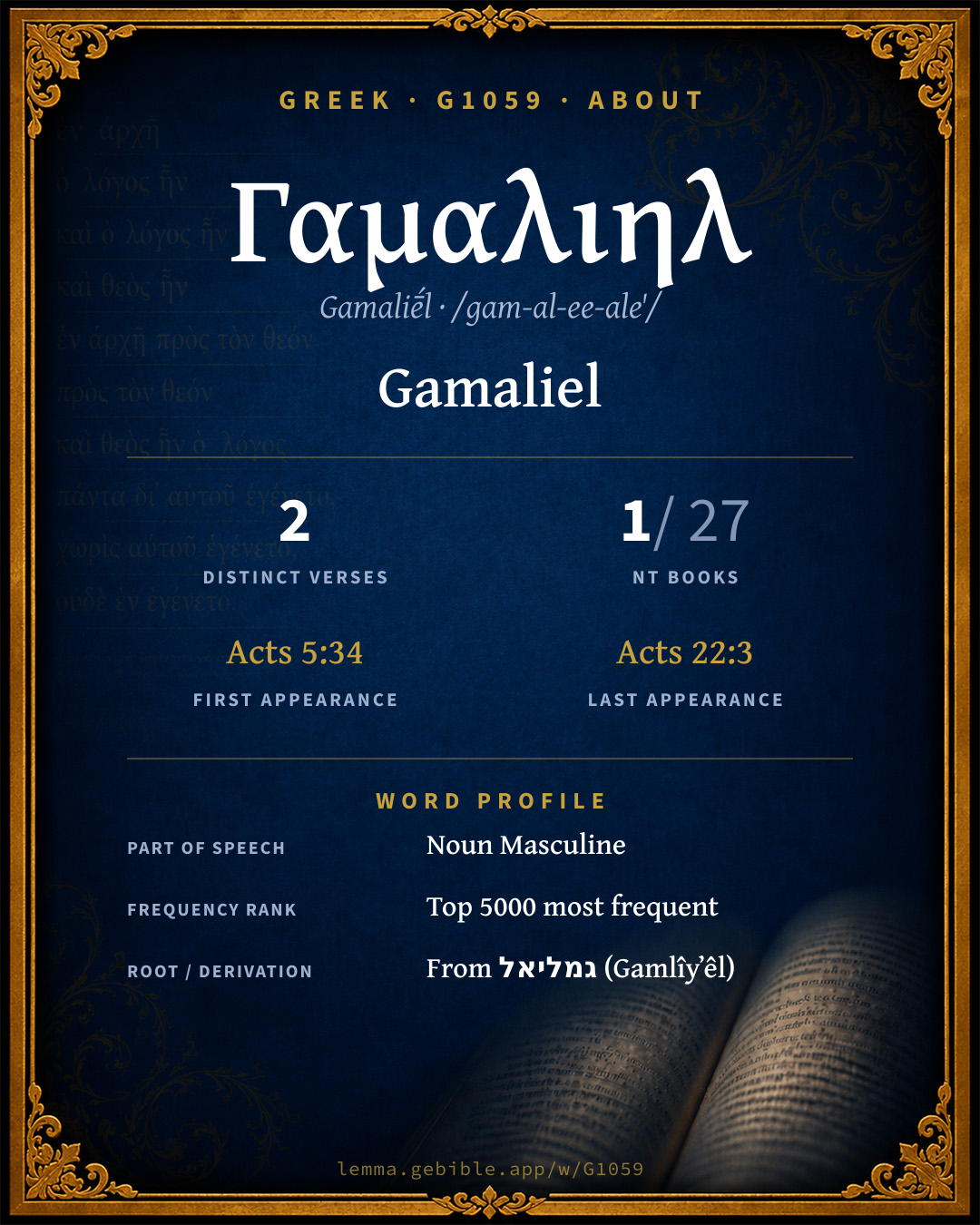
Γαμαλιήλ
Gamaliel
Thayer's lists 2 entries for ‘Gamaliel’ fuller range ↓
Full lexicon entry — Thayer's Greek Lexicon
From Thayer's Greek Lexicon
Where this word appears
Every verse where G1059 appears — 2 distinct verses across 1 book. Click any verse to open its interlinear word-by-word view. Verse text shown in the World English Bible for context — . Each verse’s Greek form is shown with its reference; the English is not keyword-highlighted, since the data carries no word-level English alignment. Use “Compare translations” on any verse to read it across multiple English versions. This concordance covers the Greek New Testament; Septuagint (Greek Old Testament) occurrences of this word are not indexed here.
Acts 2 verses
- Acts 5:34 Γαμαλιήλ n proper indecl But one stood up in the council, a Pharisee named Gamaliel, a teacher of the law, honored by all the people, and commanded to put the apostles out for a little while.
- Acts 22:3 Γαμαλιὴλ n proper indecl "I am indeed a Jew, born in Tarsus of Cilicia, but brought up in this city at the feet of Gamaliel, instructed according to the strict manner of the law of our fathers, being zealous for God, even as you all are this day.
About this entry
At a glance — auto-summarized from this page’s data, not written by a person. Every figure links to its source below. This summary describes the numbers; it doesn’t interpret them.
“Gamaliel” is the headline sense of the Greek name Γαμαλιηλ (Gamaliḗl). It is rare — just 2 verses in the entire Greek New Testament. It clusters heavily in Acts, which alone accounts for 100% of its uses. Scripture first uses it in Acts 5:34. The sections below give every occurrence and version rendering.
Gloss history
Strong's 1890 vs modern scholarship
About this word
Strong's G1059 catalogs a Greek word from the Greek New Testament.
These counts are not copied from any lexicon or concordance. They are computed here, from the morphology-tagged Greek New Testament. What Lemma adds →
- 2
- distinct verses
- The word appears in 2 distinct verses.
- 1 / 27
- NT books
- The word appears in 1 of 27 New Testament books.
- #2,678
- by frequency
- Top 5000 most frequent Greek words (rank 2,678 of 5,347 Greek words by occurrence).
View all 2 occurrences in the concordance →
Most concentrated in
- Acts 2 verses 100%
By section of the New Testament
By traditional corpus
Conventional, traditional groupings — biblical authorship is debated, so this is a traditional corpus grouping, not an authorship claim. Some books belong to more than one corpus (Luke is in both the Gospels and the Lukan corpus, and so on), so these shares overlap and need not total 100%. Each figure is a share of the word’s 2 distinct verses.
- Lukan (Luke–Acts) 2 verses · 100%
How translations render this word
Counts come from each version’s own published word-to-Strong’s tagging or interlinear alignment — an approximate guide to how each version renders this word, not a word-level alignment the data otherwise carries. Because each total is that version’s own tagged count, the per-version totals vary from one another and need not match the appearance or distinct-verse counts above. These counts may also differ from a printed concordance because Lemma counts each distinctly tagged rendering and does not collapse phrase taggings into a single head-word total. This is a fixed set of word-tagged versions (KJV, ASV, BSB, ULT) and does not change with the reading translation you choose elsewhere. Each version’s license is shown beside its name below (and on Sources).
- King James Version: Gamaliel 2×
- American Standard Version: Gamaliel 2×
- Berean Standard Bible: Gamaliel 2×
- unfoldingWord Literal Text: Gamaliel 2×
King James Version Public Domain
Renders G1059 across 2 tagged occurrences — most commonly:
American Standard Version Public Domain
Renders G1059 across 2 tagged occurrences — most commonly:
Berean Standard Bible Public Domain
Renders G1059 across 2 tagged occurrences — most commonly:
unfoldingWord Literal Text CC BY-SA 4.0
Renders G1059 across 2 tagged occurrences — most commonly:
Senses in Thayer's
The 2 senses Thayer's distinguishes for this word, in lexicon order (not ranked by frequency or importance). The full entry — with sub-senses — is in the Lexicon Entry tab.
- Gamaliel = "my recompenser is God"
- a Pharisee and celebrated doctor of the law…
Word origin
Derived from גמליאל (Gamlîyʼêl) (H1583) — Gamaliel.
Of hebrew origin [ H1583 ]; Gamaliel (that is Gamliel ) an Israelite : - Gamaliel.
— Strong’s Exhaustive Concordance (1890), public domain.
Forms in the corpus
Bible dictionary
Public-domain dictionary articles matched to this entry by name (Gamaliel). A biblical name can be shared by more than one person or place, so an article may treat several.
Easton's Bible Dictionary · M. G. Easton, 1897
Reward of God. (1.) A chief of the tribe of Manasseh at the census at Sinai (Num. 1:10; 2:20; 7:54, 59).
(2.) The son of rabbi Simeon, and grandson of the famous rabbi Hillel. He was a Pharisse, and therefore the opponent of the party of the Sadducees. He was noted for his learning, and was president of the Sanhedrim during the regins of Tiberius, Caligula, and Claudius, and died, it is said, about eighteen years before the destruction of Jerusalem.
When the apostles were brought before the council, charged with preaching the resurrection of Jesus, as a zealous Pharisee Gamaliel councelled moderation and calmness. By a reference to well-known events, he advised them to "refrain from these men." If their work or counsel was of man, it would come to nothing; but if it was of God, they could not destroy it, and therefore ought to be on their guard lest they should be "found fighting against God" (Acts 5:34-40). Paul was one of his disciples (22:3).
Smith's Bible Dictionary · William Smith, 1863
(recompense of God).
+ Son of Pedahzur; prince or captain of the tribe of Manasseh at the census at Sinai, (Numbers 1:10; 20:20; 7:54,59) and at starting on the march through the wilderness. ch. (Numbers 10:23) (B.C. 1490.) + A pharisee and celebrated doctor of the law, who gave prudent worldly advice in the Sanhedrin respecting the treatment of the followers of Jesus of Nazareth. (Acts 5:34) ff. (A.D. 29.) We learn from (Acts 22:3) that he was the preceptor of St. Paul. He is generally identified with the very celebrated Jewish doctor Gamaliel, grandson of Hillel, and who is referred to as authority in the Jewish Mishna.
Hitchcock's Bible Names Dictionary · Roswell D. Hitchcock, 1869
recompense of God; camel of God
Classic public-domain reference works; full attribution on Sources.
Septuagint usage
The same Greek word Γαμαλιηλ appears 5 times in the Greek Old Testament (Septuagint), across 5 verses in 1 book.
- 5
- LXX occurrences
- Tagged occurrences of this Greek word in the Septuagint.
- 5
- verses
- Distinct Septuagint verses containing this word.
- 1 / 39
- OT books
- The word appears in 1 of the 39 Old Testament books.
Sample Septuagint occurrences
- Numbers 1:10 γαμαλιηλ
Septuagint occurrences (same lexeme)
Every verse where the same Strong’s number (G1059) appears in the Greek Septuagint. Verse text shown in the World English Bible for context; the Greek form is the matched word — the English is not keyword-highlighted.
- Numbers 1:10 γαμαλιηλ Of the children of Joseph: Of Ephraim: Elishama the son of Ammihud. Of Manasseh: Gamaliel the son of Pedahzur.
- Numbers 2:20 γαμαλιηλ "Next to him shall be the tribe of Manasseh: and the prince of the children of Manasseh shall be Gamaliel the son of Pedahzur.
- Numbers 7:54 γαμαλιηλ On the eighth day Gamaliel the son of Pedahzur, prince of the children of Manasseh
- Numbers 7:59 γαμαλιηλ and for the sacrifice of peace offerings, two oxen, five rams, five male goats, and five male lambs a year old. This was the offering of Gamaliel the son of Pedahzur.
- Numbers 10:23 γαμαλιηλ Over the host of the tribe of the children of Manasseh was Gamaliel the son of Pedahzur.
These are occurrences of the same Greek lexeme (G1059) in the Septuagint — not a translation of any one Hebrew word. The store carries no word-level Hebrew↔Greek alignment, so no Hebrew original is asserted here. Counts come from the recovered LXX Strong's tagging — high-frequency vocabulary is well covered, while rare or late forms may be untagged — so they reflect tagged occurrences and may slightly undercount.