Acts 14:24

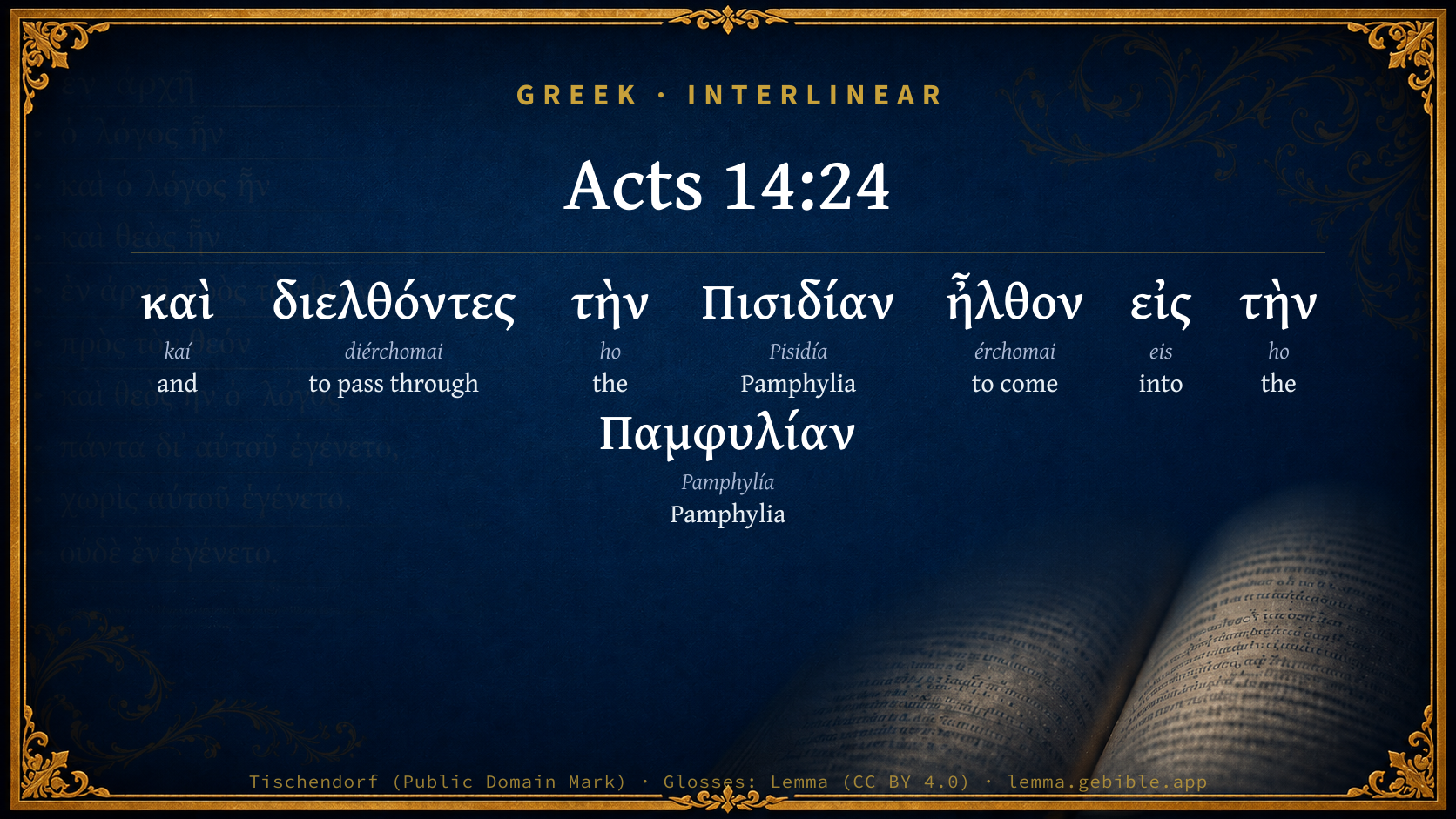
Greek (Tischendorf 8th ed.) Acts 14:24 appears in the Greek New Testament. The text above is from the Tischendorf 8th edition. Each word links to its Strong’s number and a concise gloss. Click any word for its full Thayer’s Greek Lexicon entry.
Download image
Cite this verse

Acts 14:24 (World English Bible). Public Domain. Lemma interlinear Bible study tool, https://lemma.gebible.app/v/acts/14/24.

Show BibTeX & RIS
BibTeX
RIS
English Translation
They passed through Pisidia, and came to Pamphylia.
World English Bible · Public Domain
Download a study sheet

One document with this verse’s original text, its word-by-word gloss line, the meaning frame, cross-references with their text, attributed commentary, and full source and license credits — printable, and it pastes into notes with its structure intact.

This verse Autodidact and up

Study sheet (.html) Plain text (.txt)

A passage Seminary Student

Up to 50 verses in one chapter. A passage sheet keeps up to 6 commentary sources and 12 cross-references per verse, in the order this page ranks them, and says so on the sheet whenever that leaves anything out. Ask for a single verse and you get the Autodidact verse sheet above.

Everything on this page stays free to read, with no account — the sheet is a download of what is already on screen, not access to it.

Want to remove ads? Support Godless Engineer
Compare translations 3

The same verse in 3 English versions, stacked beneath the original-language interlinear above. Click any original word for its lexicon entry.

Each is an independent rendering of the whole verse — the interlinear is not word-aligned to these translations.

Highlighted words mark where these versions differ — a whole-verse word diff, not a word-by-word alignment.

  • World English Bible Public Domain
    They passed through Pisidia, and came to Pamphylia.
  • King James Version Public Domain
    And after they had passed throughout Pisidia, they came to Pamphylia.
  • unfoldingWord Literal Text CC BY-SA 4.0
    And having passed through Pisidia, they came to Pamphylia.

unfoldingWord Literal Text — © unfoldingWord, licensed CC BY-SA 4.0. Word-aligned USFM3 via Door43 (git.door43.org/unfoldingWord/en_ult).

Versions to compare (up to 4)

3 of 4 selected

Show all 19 translations

Every available English version of this verse, each an independent rendering of the whole verse.

  • World English Bible Public Domain
    They passed through Pisidia, and came to Pamphylia.
  • Berean Standard Bible Public Domain
    After passing through Pisidia, they came to Pamphylia.
  • Majority Standard Bible Public Domain
    After passing through Pisidia, they came to Pamphylia.
  • King James Version Public Domain
    And after they had passed throughout Pisidia, they came to Pamphylia.
  • American Standard Version (1901) Public Domain
    And they passed through Pisidia, and came to Pamphylia.
  • Revised Version (1885) Public Domain
    And they passed through Pisidia, and came to Pamphylia.
  • Geneva Bible (1599) Public Domain
    Thus they went throughout Pisidia, and came to Pamphylia.
  • Douay-Rheims (1899) Public Domain
    And having spoken the word of the Lord in Perge, they went down into Attalia:
  • Young's Literal Translation Public Domain
    And having passed through Pisidia, they came to Pamphylia,
  • Literal Standard Version CC BY-SA 4.0
    And having passed through Pisidia, they came to Pamphylia,
  • Unlocked Literal Bible CC BY-SA 4.0
    Then they passed through Pisidia and came to Pamphylia.
  • unfoldingWord Literal Text CC BY-SA 4.0
    And having passed through Pisidia, they came to Pamphylia.
  • Darby Bible Public Domain
    And having passed through Pisidia they came to Pamphylia,
  • World Messianic Bible Public Domain
    They passed through Pisidia and came to Pamphylia.
  • Webster's Bible Public Domain
    And after they had passed throughout Pisidia, they came to Pamphylia.
  • Free Bible Version CC BY-SA 4.0
    They passed through Pisidia, and arrived in Pamphylia.
  • Bible in Basic English Public Domain
    And they went through Pisidia and came to Pamphylia.
  • Text-Critical English NT CC BY 4.0
    After passing through Pisidia, they came to Pamphylia,
  • Tyndale New Testament (1534) Public Domain
    And they went thorow out Pisidia and came into Paphilia

Literal Standard Version (2020), Covenant Press — licensed CC BY-SA 4.0. Text via the HelloAO Bible API (eBible.org). Unlocked Literal Bible (unfoldingWord) — licensed CC BY-SA 4.0. Text via the HelloAO Bible API (eBible.org). unfoldingWord Literal Text — © unfoldingWord, licensed CC BY-SA 4.0. Word-aligned USFM3 via Door43 (git.door43.org/unfoldingWord/en_ult). Free Bible Version, Dr. Jonathan Gallagher — licensed CC BY-SA 4.0. Text via the HelloAO Bible API (eBible.org).

Word by word

More ways to search: Search by grammar → Find every occurrence → Compare this word →

Practice this passage: Drill this verse → Learn its vocabulary →

About this verse

These counts appear in no published source. They are computed here, from the morphology-tagged text and Lemma’s own curated glosses. What Lemma adds →

8
words
7
distinct lemmas
Acts
section

Notable vocabulary

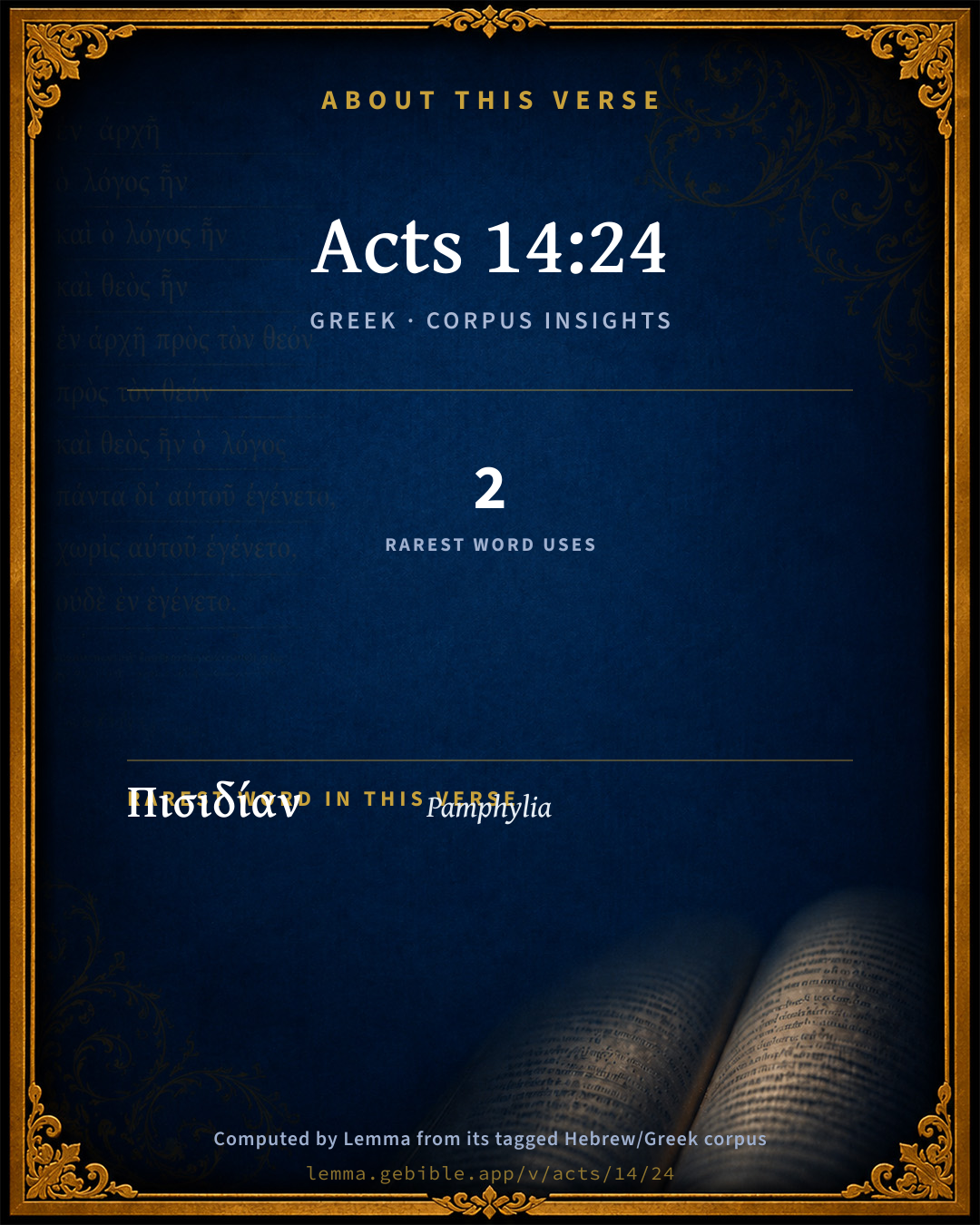
The rarest word here is Πισιδίαν Pamphylia G4099 — appearing just 2 times in the whole Greek New Testament.

Shared distinctive vocabulary

Πισιδίαν Pamphylia G4099 occurs in 2 verses of the Greek New Testament. Also found in:

Repetition

A word recurs within this verse:

Cross-references

2

Topical passages linked to Acts 14:24 in the Treasury of Scripture Knowledge — connected by theme and wording, ordered by reader-vote popularity; previews shown in the World English Bible.

  • Acts 13:13–14 Now Paul and his company set sail from Paphos, and came to Perga in Pamphylia. John departed from them and returned to Jerusalem.
  • Acts 15:38 But Paul didn't think that it was a good idea to take with them someone who had withdrawn from them in Pamphylia, and didn't go with them to do the work.

Cross-references courtesy of OpenBible.info (CC BY 4.0).

Commentary

Notes on Acts 14:24 from classic Christian and Jewish commentators (each source and its license shown beneath its notes). The classic Christian expositions comment on the surrounding passage and are grouped to its opening verse, so a note may address several verses; the Jewish commentaries on the Tanakh (Rashi and others) are per-verse, so they appear only where the commentator wrote on this verse.

Lemma curates 59 commentaries, every one of them public domain or Creative Commons licensed, each selected and text-cleaned for this edition rather than reprinted as found. About our sources →

Joseph Benson's Commentary

Act 14:24-26. After they had passed through Pisidia, &c. — Paul and Barnabas having, on their return from Phrygia and Galatia, visited all the cities of Lycaonia and Pisidia, where they had formerly planted churches, they came at length to Perga, in Pamphylia — Where they spent some time in preaching the word; probably because they had remained there but a short space formerly. And having thus revisited all those cities, and given the churches in them their due form; they came down to Attalia — A sea- port town below Perga; and thence sailed to Antioch — In Syria; from whence they had — By the divine appointment; been recommended — In a very solemn manner; (Act 13:2-3;) to the grace of God — To his favour, aid, and blessing; for the work which they had fulfilled — And where, therefore, they were very desirous both of rendering a particular account of their ministry to their brethren in that church, and also of returning their grateful acknowledgments with them to the divine providence and grace, to which they owed their safety amidst so many extreme dangers, and their success in such difficult labours.

Joseph Benson's Commentary on the Old and New Testaments (1811–1818) — public domain. Text from a community e-Sword module.

Bengel's Gnomon

Johann Albrecht Bengel

Act 14:24. Παμφυλίαν, Pamphylia) The region, to which belonged the cities Perga and Attalia, towards the sea.

Bengel's Gnomon of the New Testament — English translation (T&T Clark, Edinburgh, 1860) — public domain. Text from a community e-Sword module.

Expositor's Greek Testament

ed. W. Robertson Nicoll

Act 14:24 . διελ . τὴν Π . “having made a missionary journey through Pisidia,” see above on Act 13:6 . Here it seems clearly implied that Pisidian Antioch was not in Pisidia, see above on Act 13:14 , and Ramsay, St. Paul , p. 124.

The Expositor's Greek Testament, edited by W. Robertson Nicoll (1897–1910) — public domain. Text from a community e-Sword module.

Geneva Bible (1599)

Geneva Bible translators

Paul and Barnabas having made an end of their peregrination, and being returned to Antioch, do render an account to the Congregation or Church.

Geneva Bible (1599) marginal notes — public domain. Text via Bolls.life.

Adam Clarke's Commentary

Verse 24. Passed throughout Pisidia, they came to Pamphylia.] See Clarke on Ac 13:13.

Adam Clarke's Commentary on the Bible (1810–1826) — public domain. Text from a community e-Sword/MySword module.

John Calvin's Commentaries

24. Passing through Pisidia. We have already said that Paul and Barnabas came to Antioch of Pisidia. Being now about to return to Antioch of Syria, whence they were sent away, they go through Pamphylia, which is the middle region toward the mount Taurus. And Perga and Attalia are cities lying near together. And whereas Luke saith, that they preach the Word in the one only, we may thereby guess that they had not opportunity offered them everywhere to teach, which they were wont to neglect or let pass nowhere.

John Calvin's Commentaries (1540-1563) — public domain. Text from the Calvin Translation Society English edition (1840s-50s) via the Christian Classics Ethereal Library (ccel.org). Calvin's coverage is partial (roughly two-thirds of the Bible); uncommented books and verses are honest gaps, never fabricated. The 19th-century editor's footnotes and remarks are omitted so the notes are faithfully Calvin's own voice.

John Gill's Exposition

And after they had passed throughout Pisidia,.... The country where Antioch, the last place mentioned, was; see Act 13:14 they came to Pamphylia; See Gill on Act 13:13, Act 2:10

Acts 14:25

act 14:25

act 14:25

act 14:25And when they had preached the word in Perga,.... A city in Pamphylia, Act 13:13. The Alexandrian copy, and others, and three manuscripts of Beza's, read, "the word of the Lord"; as do the Vulgate Latin and Syriac versions: they went down into "Attalia"; not Italia or Italy, as some Latin copies, and as the Syriac, Arabic, and Ethiopic versions read; but a city in Pamphylia, bordering on the sea, as Ptolomy writes (b); as this place did, as appears by what follows. So Jerom says (c), that Attalia is a city of Pamphylia, on the sea coast; it was formerly the metropolis of it: it is now in the hands of the Turks, and is called Sattalia; near it is a bay, called Golfo di Sattalia, where there is a considerable mart for the whole country: it is famous for tapestry, which is made in it: it had its name from Attalus, king of Pergamus, the first founder of it. Beza's ancient copy here adds, "preaching the Gospel to them"; to the inhabitants of Attalia, and doubtless with success, though no mention is made of it here, nor elsewhere, nor of any church in this place; nor do we read of any in ecclesiastical history until the "sixth" century, when Dionysius, bishop of Attalia, is said to be present in the fifth synod at Rome (d); unless Attalia, called a city of Lycia, can be thought to be the same with this, of which another Dionysius was bishop in the fifth century; and assisted at the council of Chalcedon (e).

(b) Geograh. l. 5, c. 5. (c) De locis Hebraicis. fol. 95. K. (d) Magdeburg. Hist. Eccles. cent. 6. c. 2. p. 4. (e) Ib. cent. 5. c. 10. p. 589.

John Gill's Exposition of the Whole Bible (1746–1763) — public domain (CC PDM 1.0). Text via the HelloAO Bible API.

Trapp's Complete Commentary

John Trapp

24 And after they had passed throughout Pisidia, they came to Pamphylia.

Ver. 24. And after they had passed through Pisidia] At Antioch in this country they had planted a Church before. {See Act 13:14-15, &c.} Now being to return to the other Antioch in Syria (whence they had been sent out at first), they pass through Pamphylia, a country that lay toward the mountain Taurus.

John Trapp, A Commentary or Exposition upon All the Books of the Old and New Testament (1647–1656) — public domain. Text from a community e-Sword module.

Albert Barnes' Notes on the Bible

Throughout Pisidia - See the note at Act 13:14.

They came to Pamphylia - See the notes on Act 13:13. These places they had visited before.

Albert Barnes' Notes on the Bible (1834–1885) — public domain. Text from a community e-Sword/MySword module.

Haydock's Catholic Bible Commentary

This Antioch was a sea-port in Pamphylia. (Bible de Vence)

George Leo Haydock (1774–1849), Haydock's Catholic Family Bible and Commentary, 1859 edition — public domain. Excludes Psalms (Douay-Rheims chapter numbering differs from Protestant) and Deuterocanonical books (Catholic canon only).

Matthew Poole's English Annotations

Going the same way back which they had come, as appear by Act 13:13,14.

Matthew Poole's English Annotations on the Holy Bible (1683–1685) — public domain. Text from a community e-Sword/MySword module.

Whedon's Commentary on the Bible

Daniel D. Whedon

24. Throughout Pisidia—They passed through the province southward.

Pamphylia—(See note on Act_13:13.)

Daniel D. Whedon (gen. ed.), Commentary on the Old and New Testaments (1874–1909) — public domain. Text from a community e-Sword module.

The Pulpit Commentary

Vers. 24, 25. They passed through for after they had passed throughout, A.V.; and for they, A.V.; spoken for preached, A.V.; to for into, A.V. Paul and Barnabas had come from Cyprus to Perga. (see Act_13:13, note) Thence to Antioch, Iconium, Lystra, and Derbe. They now returned from Derbe by Lystra, Iconium, Antioch, Perga. But, instead of taking ship at Perga, after preaching the Word there they went down to Attalia, now Adalia or Satalia, the chief seaport of Pamphylia, some miles west of the month of the Cestrus, probably hearing that a ship was about to sail thence to Antioch. It does not appear that they made any converts or even preached at Attalia.

Vers. 24-28. The work of God.

This first famous missionary tour had some features quite peculiar to itself and is, in some respects, inimitable by us. Bat in other aspects it may be regarded as a typical work of God.

I IT was BEGUN IN GOD. It was

(1) prompted by his Spirit; (Act_13:2, Act_13:4)

(2) entered upon after seeking Divine guidance (ver. 26). Paul and Barnabas went forth, the conscious workmen of God himself. They felt that what would be done through their instrumentality would be done "by God with them." All was, as all should ever be, "begun in him.

II IN HIS STRENGTH IT WAS CARRIED ON AND COMPLETED. In his strength. The entire account, from beginning to end, conveys the idea that the apostles sought and found their strength in a Divine source; indeed, nothing less would have sustained them under the difficulties and sufferings of their mission. It was carried on and completed. It was a work which they fulfilled

(1) spite of Mark"s discouraging defection; (Act_13:13)

(2) notwithstanding the physical difficulties of traveling and the active animosity of the Jews;

(3) though every personal consideration would have led them to conclude it earlier (ver. 21). Undeterred by any checks, untempted by any inducements, they went quite through their work God"s work and did not cease to toil and to endure until everything was done they could do, not only to introduce but to establish the Christian faith in the heart of the heathen land they visited. Well is it for the Christian workman when it can be said of him that he "fulfilled" or finished his work. Sometimes

(1) weariness, or

(2) timidity, or

(3) dissatisfaction, or

(4) dissension overtakes the laborer even in the field of holy love, and he lays down his weapon and forsakes his work. Not his is the crown and the Well done!" at the hand and the lips of the Lord.

III IT WAS CROWNED BY A RECITAL TO THOSE WHOM THEY REPRESENTED. Paul and Barnabas were undoubtedly sent of God; but they also went as members of the Church at Antioch. That Church regarded them as its representatives, followed them with its sympathies, sustained them by its prayers, and received them back with its warmest welcome. And to that Church, gathered together for the purpose, they recounted" all that God had done with them a most suitable crown to a noble work. With eager, sympathetic, rejoicing spirits the assembly must have received the narrative. How grateful must have been the psalms, how fervent the prayers, how heartfelt the congratulations, that followed! A work is not crowned until its story has been told to those who had a real and living part in its initiation and its procedure.

IV IT WAS FOLLOWED BY INVIGORATING REST (ver. 28) the rest of

(1) happy human fellowship and

(2) appreciated service. C.

The Pulpit Commentary (1880–1919), ed. H.D.M. Spence-Jones & Joseph S. Exell — public domain. Text from a community e-Sword module.

Kretzmann's Popular Commentary

Paul E. Kretzmann

The last part of the return journey:

v. 24. And after they had passed through out Pisidia, they came to Pamphylia.

v. 25. And when they had preached the Word in Perga, they went down into Attalia,

v. 26. and thence sailed to Antioch, from whence they had been recommended to the grace of God for the work which they fulfilled.

v. 27. And when they were come, and had gathered the church together, they rehearsed all that God had done with them, and how he had opened the, door of faith unto the Gentiles.

v. 28. And there they abode long time with the disciples.

It was impossible for Paul to be inactive in the service of his Lord while he was traveling back to Syria. So he and Barnabas made a missionary trip through Pisidia, the province adjoining Roman Galatia on the south. Thus they reached Pamphylia and now took time to speak the Word of God in Perga, where they do not seem to have stopped on the journey to the upper country, chap. 13:13. Incidentally they seem to have waited for an opportunity of setting sail for Syria. But when no chance offered, they went down to the seacoast, to the harbor of Attalia, in Lycia, whence they sailed to Antioch. In this city they had been appointed to their office as missionaries and committed to the grace of God for the work which they had now finished. They had enjoyed the singular, merciful blessing of God on their journey, and had, above all, received abundant assurance that it is the grace of God which enables a man to do work in the Gospel. Eph 3:8. So it was with a heart full of thankfulness that they returned to the congregation at Antioch, just as soon after their arrival as it could be arranged, there was an assembly of the congregation, in which the two missionaries reported in full on the success of their labors, as they stated it, how many and how great things God had done with them as the instruments of His grace, and also on their behalf, in being with them and aiding them, both in performing the work of their calling and in enduring the persecutions that had come upon them. It is God who must give the increase whenever and wherever the Gospel is preached. It was He that had opened to the Gentiles the door of faith, making their hearts willing, and giving them free access to the salvation of Jesus Christ. Note: It is altogether well-pleasing to God if the missionaries at home and abroad make reports of their work to the congregations that have sent them forth, thus showing that God is with the work, and that He opens the doors to the preaching of the Gospel. After this, Paul and Barnabas both spent a long time with the disciples of Antioch, probably more than a year, busy with their work of preaching and gaining new members for the congregation of Christ.

Summary

Paul and Barnabas preach the Gospel at Iconium, at Lystra, and at Derbe, enduring persecution for the sake of the Lord, and then retrace their steps for the sake of strengthening the brethren, continue their work in Pisidia and Pamphylia, finally returning to Antioch, in Syria

Paul E. Kretzmann, Popular Commentary of the Bible (1921–1924) — public domain. Text from a community e-Sword module.

Burkitt's Expository Notes on the New Testament

William Burkitt

This last paragraph of the chapter acquaints us with the return of Paul and Barnabas to Antioch in Syria, from whence they set out two years before, and where they were by the prayers of the church most affectionately recommended to the grace and assistance of God, for carrying on of that great work, to wit, the conversion of the Gentiles; which God had abundantly succeeded them in.

Learn thence, That the best provision and preparation for any business, especially any business of importance, wherein the glory of God is concerned, is fervent prayer. Thus the apostles here, being sent out from Antioch with prayer, they return with praise; the Lord granted them both safety and success; safety as to their persons, and success as to their labours.

Observe farther, Being returned to Antioch, they call the church together, and declare the great things which God had done with them and by them; to the intent, no doubt, the church might join with them in their praises and thanksgivings, who had before assisted them with their prayers and supplications: They rehearsed all that God had done with them, that he might have the entire praise and glory from them.

Observe lastly, The subject matter of that report which they joyfully made to the church of Antioch; namely, how God had opened the door of faith to the Gentiles; that is, given them an opportunity to know, nd ability to believe, the gospel, which like a door was formerly shut to them, but now mercifully opened; and which was the far greater mercy yet, Almighty God did not only open the door of the gospel to them, by bringing his word amongst them, but he opened the door of their hearts to receive it, and entertain it when brought. The opening the heart and mind of sinners effectually to receive the truths of the gospel, is the special work of the Holy Spirit of God.

Lord! how insufficient are all external means, how excellent soever in themselves, to operate savingly upon men’s minds, unless the Holy Spirit opens the understanding, as well as the ministers open the scripture! He that opened the door of faith to the Gentiles, opened the Gentiles’ hearts to receive the doctrine of faith, and inclined their wills to the obedience of faith.

Eternally praised be God for the gracious illuminations, the sanctifying impressions, the powerful assistances, and the quickening influences, of the Holy Ghost, which worketh in us both to will and to do of his good pleasure.

William Burkitt's Expository Notes on the New Testament (1700–1703) — public domain. Text from a community e-Sword module.

Godbey's Commentary on the New Testament

William B. Godbey

24-28. Now the apostles take a circuitous route through Pisidia, Pamphylia and Italia, arriving back at Syrian Antioch, whence they set out on this great evangelistic tour. Convening the church, they are received with delight by all the saints, who are spellbound and electrified by their rehearsals of the mighty works of God through their humble instrumentality in the various heathen lands of their long and perilous peregrinations.

William B. Godbey, Commentary on the New Testament (1896–1900) — public domain. Text from a community e-Sword module.

McGarvey & Pendleton's Commentaries

J. W. McGarvey

24-26. Leaving Antioch of Pisidia, the apostles returned as far as the sea-coast by the same route through which they had gone up into Pisidia. (24) " And passing through Pisidia, they came into Pamphylia; (25) and having spoken the word in Perga, they went down to Attalia. (26) Thence they sailed to Antioch, whence they had been commended to the favor of God for the work which they had performed. " Perga, on the river Cestrus, a few miles above its mouth, was the point at which they had disembarked on their first arrival from Cyprus. They had made no delay there at first, but now we are told that they "spoke the word in Perga." Luke's silence in reference to the result of this effort is an indication that it was not very decided. It is probable that their design was simply to usefully employ an interval during which they were waiting for a vessel bound to Antioch. This conjecture is confirmed by the fact that they finally left Perga by land, and walked down to Attalia on the sea-coast, where they would be likely to meet with a vessel without so long delay. They were not disappointed; for "thence they sailed to Antioch."

J. W. McGarvey (with Philip Y. Pendleton), Commentaries on the New Testament (The Fourfold Gospel, 1914; Acts; and the epistles) — public domain. Text from a community e-Sword/MySword module.

The People's New Testament

B. W. Johnson

24–28. Preached the word in Perga. Here they had landed early in this missionary journey, but did not then, from some cause, pause to preach the gospel. See 13:13, 14. Went down into Attalia. A seaport not far from Perga.

Thence they sailed to Antioch. The Syrian Antioch, the first Gentile church, the mother church of Gentile missions, the church that sent them forth several years before (13:1, 3). Exactly how long a time had been occupied in this missionary tour cannot be ascertained, but it is almost certain that the visit to Jerusalem, recorded in Acts 11:29, 30 and 12:25, took place in a.d. 44, while that mentioned in 15:2 took place in a.d. 51, there being six or seven years between. This time was occupied with the missionary journey and the stay at Antioch. The first probably extended over three or four years.

They rehearsed all that God had done with them. They very properly made a report to the church that had sent them forth. It was a very cheering report. The gospel had been planted in the great island of Cyprus, received by the proconsul, Sergius Paulus, and extended through Pamphylia, Pisidia and Lycaonia, strong churches having been planted in their principal cities.

Abode there a long time. As near as we can learn about two years, no doubt busy all the time preaching in the great city.

B. W. Johnson's The People's New Testament with Notes (1889–1891) — public domain. Electronic text from the Christian Classics Ethereal Library (CCEL) ThML edition.

Lesson kit

Teaching starters — assembled from the data on this page, not authored interpretation. Every prompt links to the verse data it draws on. Edit before teaching.

Acts, in the Acts, opens this verse with 8 words (7 distinct Greek lemmas). Its most distinctive word is Pisidía (“Pamphylia”). A historical commentator’s framing appears above. Read the whole chapter for the surrounding context.

Discussion questions

  1. The word Pisidía carries the sense “Pamphylia.” How does it shape the verse?
  2. Acts 13:14 shares the word «Pamphylia» with this verse. How do the two illuminate each other?
  3. “the” occurs 2× in this one verse. What is the effect of the repetition?
  4. These translations render this verse differently; the difference is in the English rendering, not the original. What questions does that raise?
  5. Reading how Joseph Benson's Commentary and Bengel's Gnomon read this verse, where do the two commentators agree and where do they part?

Things to notice

  • These translations choose different wording for 5 words in this verse.
  • “the” occurs 2× in this single verse.
  • 7 distinct Greek lemmas span 8 words in this verse.

Reading settings

Reading text

Shown beneath each verse's original-language words.

Old Testament
Old Testament edition

Read the OT as the Masoretic Hebrew (MT) or the Greek Septuagint (LXX).

English shown for the Greek Septuagint (in the Hebrew ↔ Greek comparison).

Comparing translations? Open the Compare panel on any verse page to stack up to four side by side.