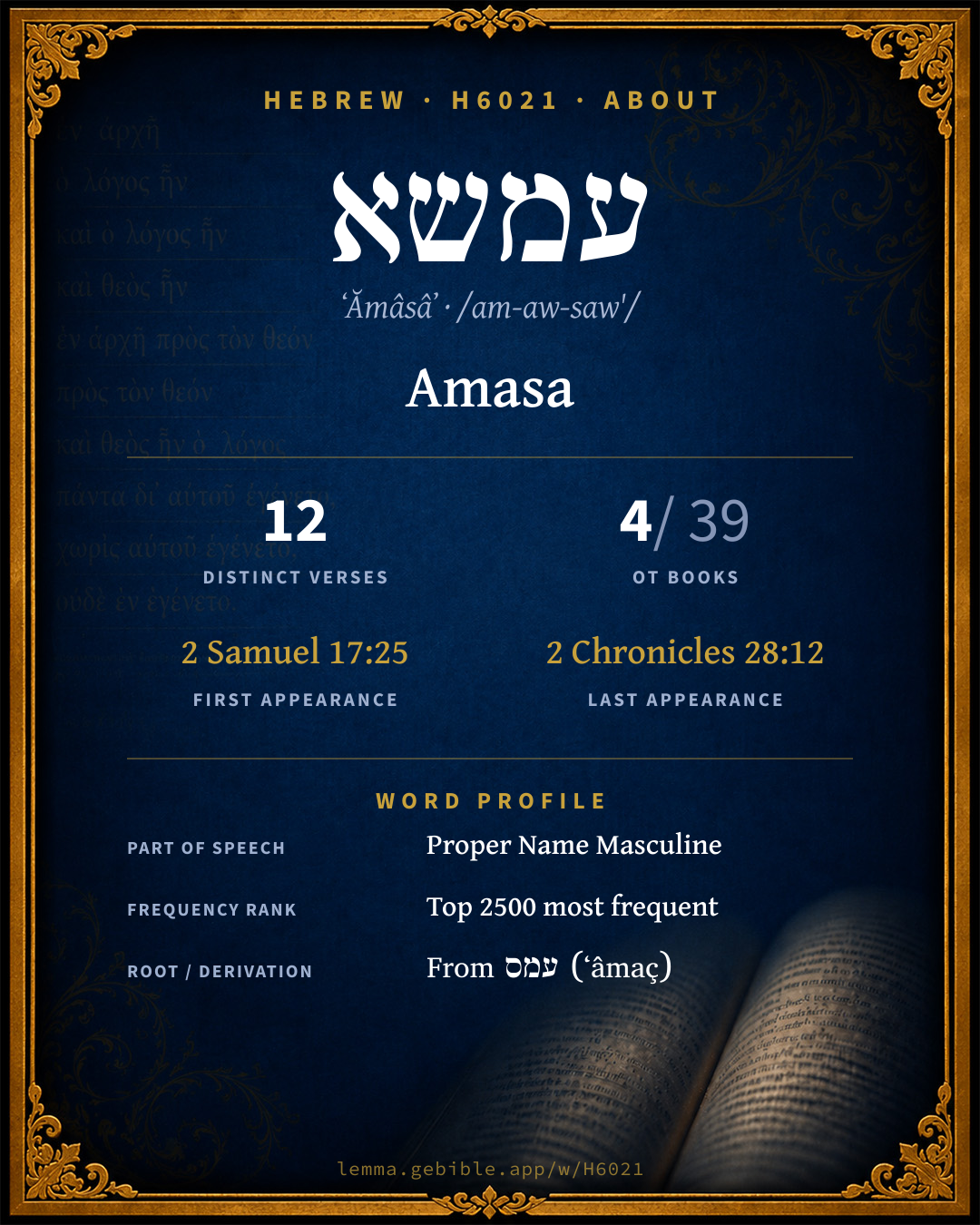
עֲמָשָׂא
Amasa
BDB lists 3 entries for ‘Amasa’ fuller range ↓
Full lexicon entry — Brown-Driver-Briggs (BDB)
From Brown-Driver-Briggs (BDB)
Where this word appears
Grammar key — what these labels mean
Part of speech
- Noun
- A naming word — a person, place, thing, or idea.
Noun type
- Proper
- A name of a specific person, place, or people (e.g. Abraham, Zion, Israel).
Every verse where H6021 appears — 12 distinct verses across 4 books. Click any verse to open its interlinear word-by-word view. Verse text shown in the World English Bible for context — . Each verse’s Hebrew form is shown with its reference; the English is not keyword-highlighted, since the data carries no word-level English alignment. Use “Compare translations” on any verse to read it across multiple English versions. This concordance covers the Hebrew Bible; Septuagint (Greek Old Testament) occurrences are not indexed here.
2 Samuel 8 verses
- 2 Samuel 17:25 עֲמָשָׂ֗א וַ/עֲמָשָׂ֣א n Proper conj + n Proper Absalom set Amasa over the host instead of Joab. Now Amasa was the son of a man, whose name was Ithra the Israelite, who went in to Abigail the daughter of Nahash, sister to Zeruiah, Joab's mother.
- 2 Samuel 19:13 וְ/לַֽ/עֲמָשָׂא֙ conj + prep + n Proper Say you to Amasa, Aren't you my bone and my flesh? God do so to me, and more also, if you aren't captain of the host before me continually in the room of Joab.
- 2 Samuel 20:4 עֲמָשָׂ֔א n Proper Then said the king to Amasa, Call me the men of Judah together within three days, and be here present.
- 2 Samuel 20:5 עֲמָשָׂ֖א n Proper So Amasa went to call [the men of] Judah together; but he stayed longer than the set time which he had appointed him.
- 2 Samuel 20:8 וַ/עֲמָשָׂ֖א conj + n Proper When they were at the great stone which is in Gibeon, Amasa came to meet them. Joab was girded with his apparel of war that he had put on, and thereon was a sash with a sword fastened on his loins in the sheath of it; and as he went forth it fell out.
- 2 Samuel 20:9 לַ/עֲמָשָׂ֔א עֲמָשָׂ֖א prep + n Proper n Proper Joab said to Amasa, Is it well with you, my brother? Joab took Amasa by the beard with his right hand to kiss him.
- 2 Samuel 20:10 וַ/עֲמָשָׂ֨א conj + n Proper But Amasa took no heed to the sword that was in Joab's hand: so he struck him therewith in the body, and shed out his bowels to the ground, and didn't strike him again; and he died. Joab and Abishai his brother pursued after Sheba the son of Bichri.
- 2 Samuel 20:12 וַ/עֲמָשָׂ֛א עֲמָשָׂ֨א conj + n Proper n Proper Amasa lay wallowing in his blood in the midst of the highway. When the man saw that all the people stood still, he carried Amasa out of the highway into the field, and cast a garment over him, when he saw that everyone who came by him stood still.
1 Kings 2 verses
- 1 Kings 2:5 וְ/לַ/עֲמָשָׂ֤א conj + prep + n Proper Moreover you know also what Joab the son of Zeruiah did to me, even what he did to the two captains of the hosts of Israel, to Abner the son of Ner, and to Amasa the son of Jether, whom he killed, and shed the blood of war in peace, and put the blood of war on his sash that was about his loins, and in his shoes that were on his feet.
- 1 Kings 2:32 עֲמָשָׂ֥א n Proper Yahweh will return his blood on his own head, because he fell on two men more righteous and better than he, and killed them with the sword, and my father David didn't know it, [to wit], Abner the son of Ner, captain of the host of Israel, and Amasa the son of Jether, captain of the host of Judah.
1 Chronicles 1 verse
2 Chronicles 1 verse
About this entry
At a glance — auto-summarized from this page’s data, not written by a person. Every figure links to its source below. This summary describes the numbers; it doesn’t interpret them.
עמשא — transliterated ʻĂmâsâʼ — is a Hebrew name carrying the sense “Amasa.” Its uses cluster heavily in 2 Samuel (67% of all occurrences). With 12 verses in 4 books, it is an uncommon word in the Hebrew Bible. Debuting at 2 Samuel 17:25, it then recurs through the corpus. See 12-verse concordance and the renderings breakdown below.
Gloss history
Strong's 1890 vs modern scholarship
About this word
Strong's H6021 catalogs a Hebrew word from the Hebrew Old Testament.
These counts are not copied from any lexicon or concordance. They are computed here, from the morphology-tagged Hebrew Old Testament. What Lemma adds →
- 12
- distinct verses
- The word appears in 12 distinct verses.
- 4 / 39
- OT books
- The word appears in 4 of 39 Old Testament books.
- #1,752
- by frequency
- Top 2500 most frequent Hebrew words (rank 1,752 of 8,640 Hebrew words by occurrence).
View all 12 occurrences in the concordance →
Most concentrated in
- 2 Samuel 8 verses 67%
- 1 Kings 2 verses 17%
- 1 Chronicles 1 verse 8%
By section of the Old Testament
By traditional corpus
Conventional, traditional groupings — biblical authorship is debated, so this is a traditional corpus grouping, not an authorship claim. Each share is this word’s portion of its verses in that division of the Hebrew canon. Each figure is a share of the word’s 12 distinct verses.
- Prophets (Nevi'im) 10 verses · 83%
- Writings (Ketuvim) 2 verses · 17%
How translations render this word
Counts come from each version’s own published word-to-Strong’s tagging or interlinear alignment — an approximate guide to how each version renders this word, not a word-level alignment the data otherwise carries. Because each total is that version’s own tagged count, the per-version totals vary from one another and need not match the appearance or distinct-verse counts above. These counts may also differ from a printed concordance because Lemma counts each distinctly tagged rendering and does not collapse phrase taggings into a single head-word total. This is a fixed set of word-tagged versions (KJV, ASV, BSB, ULT) and does not change with the reading translation you choose elsewhere. Each version’s license is shown beside its name below (and on Sources).
- King James Version: Amasa 15×
- American Standard Version: Amasa 14×
- Berean Standard Bible: Amasa 14×
- unfoldingWord Literal Text: Amasa 14×, Now amasa 2×
King James Version Public Domain
Renders H6021 across 16 tagged occurrences — most commonly:
Plus 1 rendering that appears only once — usually multi-word phrases or single function words the recovered tagging swept in, not distinct renderings.
American Standard Version Public Domain
Renders H6021 across 16 tagged occurrences — most commonly:
Plus 2 renderings that appear only once — usually multi-word phrases or single function words the recovered tagging swept in, not distinct renderings.
Berean Standard Bible Public Domain
Renders H6021 across 15 tagged occurrences — most commonly:
Plus 1 rendering that appears only once — usually multi-word phrases or single function words the recovered tagging swept in, not distinct renderings. Not rendered by a distinct English word in 1 further occurrence.
unfoldingWord Literal Text CC BY-SA 4.0
Renders H6021 across 17 tagged occurrences — most commonly:
Plus 1 rendering that appears only once — usually multi-word phrases or single function words the recovered tagging swept in, not distinct renderings.
Senses in the full BDB
What do BDB’s symbols mean?
BDB uses these scholarly abbreviations:
| Symbol | Meaning |
|---|---|
| 𝔊 | the Septuagint (the ancient Greek translation, LXX) |
| 𝔙 | the Vulgate (the Latin translation) |
| 𝔖 | the Syriac version (the Peshitta) |
| 𝔗 | the Targum (the Aramaic translation) |
| ψ | the Psalms |
| √ | root (the underlying root or stem) |
| ‖ | parallel passage (a synonymous or contrasted parallel) |
| † | the dagger: every passage where the word occurs is cited |
The 2 senses and sub-senses the full Brown-Driver-Briggs lexicon distinguishes for this word, in lexicon order (not ranked by frequency), with BDB’s own verbatim wording and sub-sense lettering. Shown in Hebrew script with BDB’s own scholarly abbreviations. The condensed entry is in the Lexicon Entry tab. See also the Forms in the corpus table below.
- 1. Absalom’s general
- 2. Ephraimite
Senses from the full Brown-Driver-Briggs lexicon (Brown, Driver, Briggs; Oxford 1906 — public domain), digitized via Sefaria, supplemented by the OpenScriptures HebrewLexicon (CC BY 4.0). Full attribution on Sources.
Word origin
Derived from עמס (ʻâmaç) (H6006) — to load.
Forms in the corpus
The 13 distinct written forms H6021 takes in the Hebrew Bible, most frequent first — each parse links to that state’s occurrences in the concordance. Hebrew forms include their vowel points and cantillation, so a single lemma takes many written forms.
| Form | Parsing | Example | Uses |
|---|---|---|---|
| וַ/עֲמָשָׂ֖א | Noun, Proper | 2 Chronicles 28:12 | 2 |
| עֲמָשָׂ֔א | Noun, Proper | 1 Chronicles 2:17 | 2 |
| עֲמָשָׂ֖א | Noun, Proper | 2 Samuel 20:5 | 2 |
| וְ/לַ/עֲמָשָׂ֤א | Noun, Proper | 1 Kings 2:5 | 1 |
| וְ/לַֽ/עֲמָשָׂא֙ | Noun, Proper | 2 Samuel 19:13 | 1 |
| וַ/עֲמָשָׂ֛א | Noun, Proper | 2 Samuel 20:12 | 1 |
| וַ/עֲמָשָׂ֣א | Noun, Proper | 2 Samuel 17:25 | 1 |
| וַ/עֲמָשָׂ֨א | Noun, Proper | 2 Samuel 20:10 | 1 |
| לַ/עֲמָשָׂ֔א | Noun, Proper | 2 Samuel 20:9 | 1 |
| עֲמָשָׂ֑א | Noun, Proper | 1 Chronicles 2:17 | 1 |
| עֲמָשָׂ֗א | Noun, Proper | 2 Samuel 17:25 | 1 |
| עֲמָשָׂ֥א | Noun, Proper | 1 Kings 2:32 | 1 |
| עֲמָשָׂ֨א | Noun, Proper | 2 Samuel 20:12 | 1 |
Same root — word family
Other BDB entries built from the same root as H6021, grouped by Strong’s listed origin. These share a root / origin per the lexicon — not necessarily a shared meaning. Each links to that word’s own entry.
Derives from
Shares the same root
Proper names from this root
People and places named from this root — a name, not an additional meaning of the word.
- עמוס ʻÂmôwç H5986 Amos
- עמסיה ʻĂmaçyâh H6007 Amasiah
- עמשי ʻĂmâsay H6022 Amasai
- עמשסי ʻĂmashçay H6023 Amashai
Compare all same-root words → Showing 4 of 7 — not the complete family. 4 of the same-root words are proper names (people or places). They share a root, not necessarily a meaning.
Bible dictionary
Public-domain dictionary articles matched to this entry by name (Amasa). A biblical name can be shared by more than one person or place, so an article may treat several.
Easton's Bible Dictionary · M. G. Easton, 1897
Burden. (1.) The son of Abigail, a sister of king David (1 Chr. 2:17; 2 Sam. 17:25). He was appointed by David to command the army in room of his cousin Joab (2 Sam. 19:13), who afterwards treacherously put him to death as a dangerous rival (2 Sam. 20:4-12).
(2.) A son of Hadlai, and chief of Ephraim (2 Chr. 28:12) in the reign of Ahaz.
Smith's Bible Dictionary · William Smith, 1863
(a burden).
+ Son of Ithra, or Jether, by Abigail, David's sister. (2 Samuel 17:25) He joined in Absalom's rebellion, B.C. 1023, was appointed commander-in-chief and suffered defeat by Joab. (2 Samuel 18:6) David, incensed against Joab for killing Absalom, forgave Amasa and appointed him Joab's successor. (2 Samuel 19:13) Joab afterwards, when they were both in pursuit of the rebel Sheba, pretending to salute Amasa stabbed him with his sword. (2 Samuel 20:10) + A prince of Ephraim, son of Hadlai, in the reign of Ahaz. (2 Chronicles 28:12)
Hitchcock's Bible Names Dictionary · Roswell D. Hitchcock, 1869
sparing the people
Classic public-domain reference works; full attribution on Sources.
Septuagint verse parallels
This word appears in 12 verses that also exist in the Greek Old Testament (Septuagint), out of the 12 Hebrew verses it occurs in. You can read those verses in Greek by switching the Old Testament edition to the Septuagint.
Read these verses in the Septuagint
This is a verse-level parallel only — the same verses exist in both the Hebrew and Greek Old Testaments. No word-level Hebrew↔Greek correspondence is claimed: the data carries no such alignment, so no Greek word is shown as this Hebrew word’s translation. Coverage is not total — the Septuagint omits the deuterocanon and renumbers the Psalms, so some Hebrew verses have no direct Greek parallel.