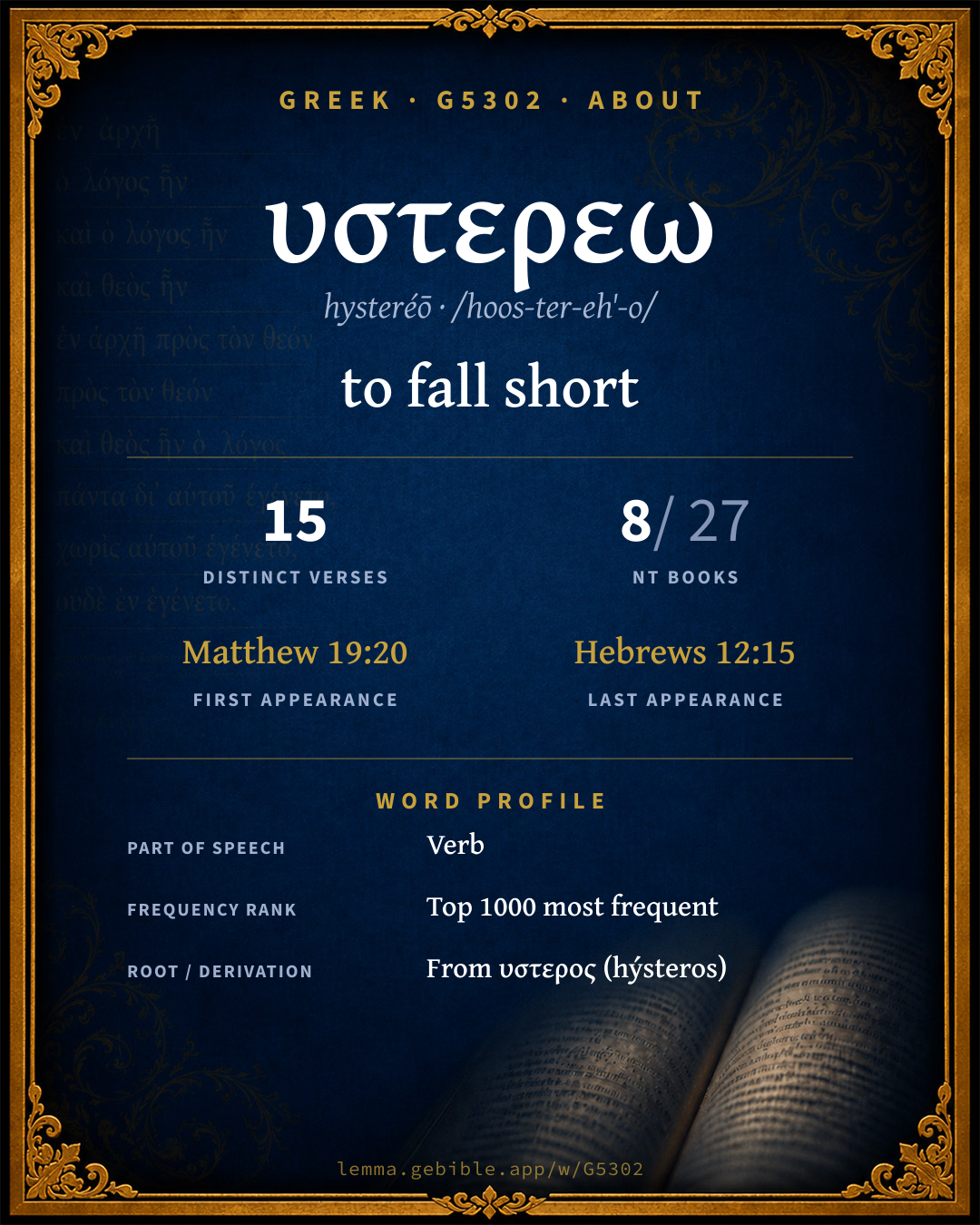
ὑστερέω
to fall short
‘to fall short’ is one of 2 main senses fuller range ↓
Full lexicon entry — Thayer's Greek Lexicon
From Thayer's Greek Lexicon
Where this word appears
See every Present-tense verb in the Greek New Testament →
Grammar key — what these labels mean
Part of speech
- Verb
- An action or state-of-being word.
Tense
- Present
- Ongoing or general action in present time (imperfective aspect).
- Perfect
- A completed past action with continuing present results.
- Aorist
- Action viewed as a simple whole, without regard to duration — often past (perfective aspect).
Voice
- Passive
- The subject receives the action.
- Active
- The subject performs the action.
Mood
- Infinitive
- A verbal noun (“to write”), unmarked for person or number.
- Indicative
- States a fact or asks a factual question (the mood of reality).
- Participle
- A verbal adjective (“writing,” “having written”).
Case
- Nominative
- The case of the subject (and the predicate nominative).
- Dative
- The case of the indirect object, means, or location — “to / for / with / in.”
Person
- 1st person
- The speaker (“I / we”).
- 2nd person
- The one addressed (“you”).
- 3rd person
- The one spoken about (“he / she / it / they”).
Gender
- Masculine
- Grammatically masculine.
Number
- Singular
- One.
- Plural
- More than one.
Grammatical forms 12 distinct
- Verb, Present, Passive, Infinitive 3 times (20%)
- Verb, Perfect, Active, Infinitive 2 times (13%)
- Verb, Aorist, Active, Indicative, 1st person, Singular 1 time (7%)
- Verb, Aorist, Active, Indicative, 2nd person, Plural 1 time (7%)
- Verb, Aorist, Passive, Participle, Nominative, Singular, Masculine 1 time (7%)
- Verb, Present, Active, Indicative, 1st person, Singular 1 time (7%)
- Verb, Present, Active, Indicative, 3rd person, Singular 1 time (7%)
- Verb, Present, Active, Participle, Nominative, Singular, Masculine 1 time (7%)
+4 more forms (4 occurrences)
Parsed forms decoded from the imported morphology (Robinson–Tischendorf, public domain), counted across 15 parsed occurrences — not distinct verses.
Every verse where G5302 appears — 15 distinct verses across 8 books. Click any verse to open its interlinear word-by-word view. Verse text shown in the World English Bible for context — . Each verse’s Greek form is shown with its reference; the English is not keyword-highlighted, since the data carries no word-level English alignment. Use “Compare translations” on any verse to read it across multiple English versions. This concordance covers the Greek New Testament; Septuagint (Greek Old Testament) occurrences of this word are not indexed here.
Matthew 1 verse
Mark 1 verse
Luke 2 verses
Romans 1 verse
1 Corinthians 3 verses
- 1 Corinthians 1:7 ὑστερεῖσθαι pres pass inf so that you come behind in no gift; waiting for the revelation of our Lord Jesus Christ;
- 1 Corinthians 8:8 ὑστερούμεθα pres pass ind 1pl But food will not commend us to God. For neither, if we don't eat, are we the worse; nor, if we eat, are we the better.
- 1 Corinthians 12:24 ὑστερουμένῳ pres pass ptcp dat sg masc whereas our presentable parts have no such need. But God composed the body together, giving more abundant honor to the inferior part,
2 Corinthians 3 verses
- 2 Corinthians 11:5 ὑστερηκέναι perf act inf For I reckon that I am not at all behind the very best apostles.
- 2 Corinthians 11:8 ὑστερηθεὶς aor pass ptcp nom sg masc I robbed other assemblies, taking wages from them that I might serve you.
- 2 Corinthians 12:11 ὑστέρησα aor act ind 1sg I have become foolish in boasting. You compelled me, for I ought to have been commended by you, for in nothing was I inferior to the very best apostles, though I am nothing.
Philippians 1 verse
Hebrews 3 verses
- Hebrews 4:1 ὑστερηκέναι perf act inf Let us fear therefore, lest perhaps a promise being left of entering into his rest, anyone of you should seem to have come short of it.
- Hebrews 11:37 ὑστερούμενοι pres pass ptcp nom pl masc They were stoned. They were sawn apart. They were tempted. They were slain with the sword. They went around in sheep skins and in goat skins; being destitute, afflicted, ill-treated
- Hebrews 12:15 ὑστερῶν pres act ptcp nom sg masc looking carefully lest there be any man who falls short of the grace of God; lest any root of bitterness springing up trouble you, and thereby the many be defiled;
About this entry
At a glance — auto-summarized from this page’s data, not written by a person. Every figure links to its source below. This summary describes the numbers; it doesn’t interpret them.
The Greek verb υστερεω centers on the idea of “to fall short.” Its earliest occurrence is Matthew 19:20. Spanning 15 verses in 8 books, it ranks among the uncommon words of the Greek New Testament. Lexicons map it across 2 senses. Related forms include υστερος, υστερον and υστερημα. For the data behind this summary, explore the sense tree and the renderings breakdown below.
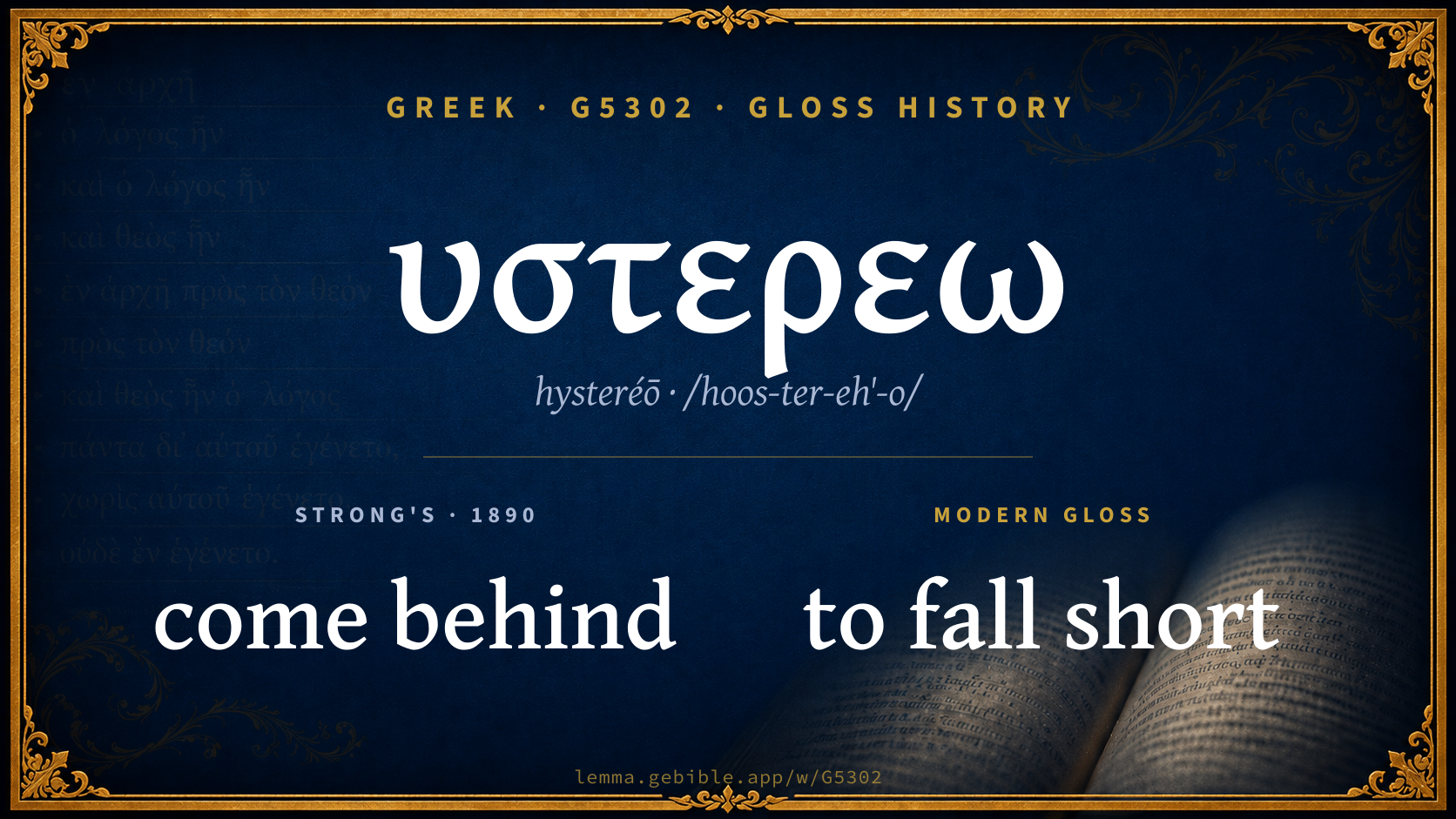
Gloss history
Strong's 1890 vs modern scholarship
About this word
Strong's G5302 catalogs a Greek word from the Greek New Testament.
These counts are not copied from any lexicon or concordance. They are computed here, from the morphology-tagged Greek New Testament. What Lemma adds →
- 15
- distinct verses
- The word appears in 15 distinct verses.
- 8 / 27
- NT books
- The word appears in 8 of 27 New Testament books.
- #768
- by frequency
- Top 1000 most frequent Greek words (rank 768 of 5,347 Greek words by occurrence).
View all 15 occurrences in the concordance →
Most concentrated in
- 1 Corinthians 3 verses 20%
- 2 Corinthians 3 verses 20%
- Hebrews 3 verses 20%
By section of the New Testament
By traditional corpus
Conventional, traditional groupings — biblical authorship is debated, so this is a traditional corpus grouping, not an authorship claim. Some books belong to more than one corpus (Luke is in both the Gospels and the Lukan corpus, and so on), so these shares overlap and need not total 100%. Each figure is a share of the word’s 15 distinct verses.
- Pauline corpus 8 verses · 53%
- Gospels 4 verses · 27%
- Hebrews 3 verses · 20%
- Lukan (Luke–Acts) 2 verses · 13%
How translations render this word
Counts come from each version’s own published word-to-Strong’s tagging or interlinear alignment — an approximate guide to how each version renders this word, not a word-level alignment the data otherwise carries. Because each total is that version’s own tagged count, the per-version totals vary from one another and need not match the appearance or distinct-verse counts above. These counts may also differ from a printed concordance because Lemma counts each distinctly tagged rendering and does not collapse phrase taggings into a single head-word total. This is a fixed set of word-tagged versions (KJV, ASV, BSB, ULT) and does not change with the reading translation you choose elsewhere. Each version’s license is shown beside its name below (and on Sources).
- King James Version: Am i behind 1×, Are we the worse 1×, Be in want 1×
- American Standard Version: Be in want 2×
- Berean Standard Bible: Be in need 1×, Destitute 1×, Did you lack 1×
- unfoldingWord Literal Text: Lack 4×, Be in need 2×, Fall short 2×
King James Version Public Domain
Renders G5302 across 17 tagged occurrences — most commonly:
Plus other, less common renderings.
American Standard Version Public Domain
Renders G5302 across 16 tagged occurrences — most commonly:
Plus 14 renderings that appear only once — usually multi-word phrases or single function words the recovered tagging swept in, not distinct renderings.
Berean Standard Bible Public Domain
Renders G5302 across 16 tagged occurrences — most commonly:
Plus other, less common renderings.
unfoldingWord Literal Text CC BY-SA 4.0
Renders G5302 across 21 tagged occurrences — most commonly:
Plus 13 renderings that appear only once — usually multi-word phrases or single function words the recovered tagging swept in, not distinct renderings.
Senses in Thayer's
The 2 senses Thayer's distinguishes for this word, in lexicon order (not ranked by frequency or importance). The full entry — with sub-senses — is in the Lexicon Entry tab.
- behind
- to suffer want, to be devoid of, to lack (be inferior) in excellence, worth
Word origin
Derived from υστερος (hýsteros) (G5306) — latter.
From G5306 ; to be later that is (by implication) to be inferior ; genitively to fall short ( be deficient ): - come behind (short) be destitute fall lack suffer need (be in) want be the worse.
— Strong’s Exhaustive Concordance (1890), public domain.
Forms in the corpus
The 12 distinct written forms G5302 takes in the Greek New Testament, most frequent first — each parse links to that tense’s occurrences in the concordance.
Same root — word family
Other Thayer's entries built from the same root as G5302, grouped by Strong’s listed origin. These share a root / origin per the lexicon — not necessarily a shared meaning. Each links to that word’s own entry.
Derives from
Shares the same root
Derived from this word
Compare all same-root words → Showing 4 of 5 — not the complete family. They share a root, not necessarily a meaning.
Septuagint usage
The same Greek word υστερεω appears 12 times in the Greek Old Testament (Septuagint), across 12 verses in 8 books.
- 12
- LXX occurrences
- Tagged occurrences of this Greek word in the Septuagint.
- 12
- verses
- Distinct Septuagint verses containing this word.
- 8 / 39
- OT books
- The word appears in 8 of the 39 Old Testament books.
Sample Septuagint occurrences
- Numbers 9:7 ὑστερέω
- Ezra 19:21 ὑστερέω
- Job 36:17 ὑστερέω
- Psalms 22:1 ὑστερέω
- Ecclesiastes 6:2 ὑστερέω
- Song of Solomon 7:3 ὑστερέω
- Daniel 4:26 ὑστερέω
- Habakkuk 2:3 ὑστερέω
Septuagint occurrences (same lexeme)
Every verse where the same Strong’s number (G5302) appears in the Greek Septuagint. Verse text shown in the World English Bible for context; the Greek form is the matched word — the English is not keyword-highlighted.
- Numbers 9:7 ὑστερέω Those men said to him, "We are unclean because of the dead body of a man. Why are we kept back, that we may not offer the offering of Yahweh in its appointed season among the children of Israel?"
- Numbers 9:13 ὑστερέω But the man who is clean, and is not on a journey, and fails to keep the Passover, that soul shall be cut off from his people. Because he didn't offer the offering of Yahweh in its appointed season, that man shall bear his sin.
- Ezra 19:21 ὑστερέω
- Job 36:17 ὑστερέω "But you are full of the judgment of the wicked. Judgment and justice take hold of you.
- Psalms 22:1 ὑστερέω My God, my God, why have you forsaken me? Why are you so far from helping me, and from the words of my groaning?
- Psalms 38:5 ὑστερέω My wounds are loathsome and corrupt, Because of my foolishness.
- Ecclesiastes 6:2 ὑστερέω a man to whom God gives riches, wealth, and honor, so that he lacks nothing for his soul of all that he desires, yet God gives him no power to eat of it, but an alien eats it. This is vanity, and it is an evil disease.
- Ecclesiastes 9:8 ὑστερέω Let your garments be always white, and don't let your head lack oil.
- Ecclesiastes 10:3 ὑστερέω Yes also, when the fool walks by the way, his understanding fails him, and he says to everyone that he is a fool.
- Song of Solomon 7:3 ὑστερέω Your two breasts are like two fawns, That are twins of a roe.
- Daniel 4:26 ὑστερέω Whereas they commanded to leave the stump of the roots of the tree; your kingdom shall be sure to you, after that you shall have known that the heavens do rule.
- Habakkuk 2:3 ὑστερέω For the vision is yet for the appointed time, and it hurries toward the end, and won't prove false. Though it takes time, wait for it; because it will surely come. It won't delay.
These are occurrences of the same Greek lexeme (G5302) in the Septuagint — not a translation of any one Hebrew word. The store carries no word-level Hebrew↔Greek alignment, so no Hebrew original is asserted here. Counts come from the recovered LXX Strong's tagging — high-frequency vocabulary is well covered, while rare or late forms may be untagged — so they reflect tagged occurrences and may slightly undercount.