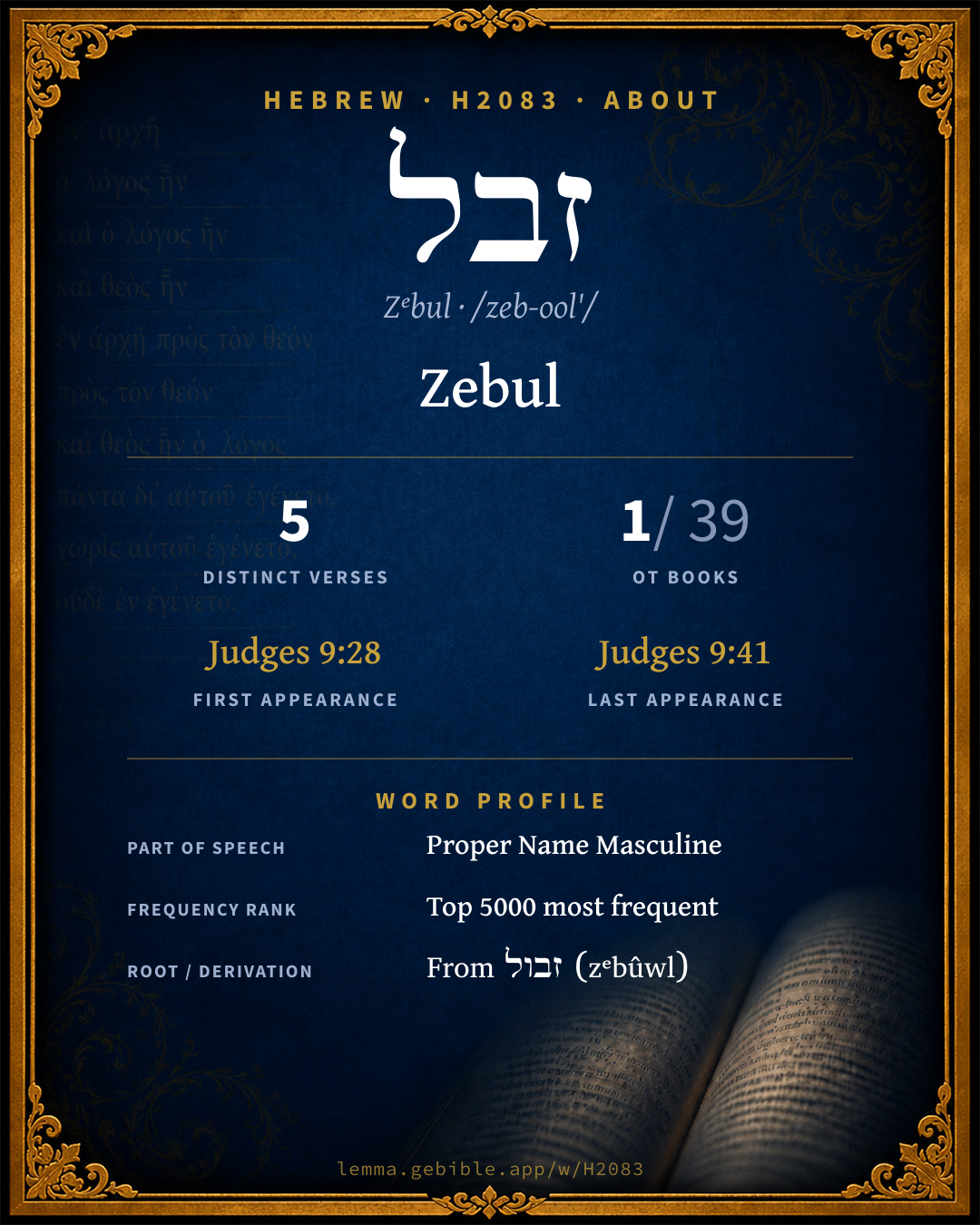
זְבֻל
Zebul
BDB lists 2 entries for ‘Zebul’ fuller range ↓
Full lexicon entry — Brown-Driver-Briggs (BDB)
From Brown-Driver-Briggs (BDB)
Where this word appears
Grammar key — what these labels mean
Part of speech
- Noun
- A naming word — a person, place, thing, or idea.
Noun type
- Proper
- A name of a specific person, place, or people (e.g. Abraham, Zion, Israel).
Every verse where H2083 appears — 5 distinct verses across 1 book. Click any verse to open its interlinear word-by-word view. Verse text shown in the World English Bible for context — . Each verse’s Hebrew form is shown with its reference; the English is not keyword-highlighted, since the data carries no word-level English alignment. Use “Compare translations” on any verse to read it across multiple English versions. This concordance covers the Hebrew Bible; Septuagint (Greek Old Testament) occurrences are not indexed here.
Judges 5 verses
- Judges 9:28 וּ/זְבֻ֣ל conj + n Proper Gaal the son of Ebed said, Who is Abimelech, and who is Shechem, that we should serve him? Isn't he the son of Jerubbaal? and Zebul his officer? serve you the men of Hamor the father of Shechem: but why should we serve him?
- Judges 9:30 זְבֻל֙ n Proper When Zebul the ruler of the city heard the words of Gaal the son of Ebed, his anger was kindled.
- Judges 9:36 זְבֻ֔ל זְבֻ֔ל n Proper n Proper When Gaal saw the people, he said to Zebul, Behold, there come people down from the tops of the mountains. Zebul said to him, You see the shadow of the mountains as if they were men.
- Judges 9:38 זְבֻ֗ל n Proper Then said Zebul to him, Where is now your mouth, that you said, Who is Abimelech, that we should serve him? is not this the people that you have despised? go out now, I pray, and fight with them.
- Judges 9:41 זְבֻ֛ל n Proper Abimelech lived at Arumah: and Zebul drove out Gaal and his brothers, that they should not dwell in Shechem.
About this entry
At a glance — auto-summarized from this page’s data, not written by a person. Every figure links to its source below. This summary describes the numbers; it doesn’t interpret them.
“Zebul” is the headline sense of the Hebrew name זבל (Zᵉbul). It occurs a mere 5 verses across Scripture. More than three-quarters of its appearances fall in Judges. Its earliest occurrence is Judges 9:28. The sections below give every occurrence and version rendering.
Gloss history
Strong's 1890 vs modern scholarship
About this word
Strong's H2083 catalogs a Hebrew word from the Hebrew Old Testament.
These counts are not copied from any lexicon or concordance. They are computed here, from the morphology-tagged Hebrew Old Testament. What Lemma adds →
- 5
- distinct verses
- The word appears in 5 distinct verses.
- 1 / 39
- OT books
- The word appears in 1 of 39 Old Testament books.
- #3,040
- by frequency
- Top 5000 most frequent Hebrew words (rank 3,040 of 8,640 Hebrew words by occurrence).
View all 5 occurrences in the concordance →
Most concentrated in
- Judges 5 verses 100%
By section of the Old Testament
By traditional corpus
Conventional, traditional groupings — biblical authorship is debated, so this is a traditional corpus grouping, not an authorship claim. Each share is this word’s portion of its verses in that division of the Hebrew canon. Each figure is a share of the word’s 5 distinct verses.
- Prophets (Nevi'im) 5 verses · 100%
How translations render this word
Counts come from each version’s own published word-to-Strong’s tagging or interlinear alignment — an approximate guide to how each version renders this word, not a word-level alignment the data otherwise carries. Because each total is that version’s own tagged count, the per-version totals vary from one another and need not match the appearance or distinct-verse counts above. These counts may also differ from a printed concordance because Lemma counts each distinctly tagged rendering and does not collapse phrase taggings into a single head-word total. This is a fixed set of word-tagged versions (KJV, ASV, BSB, ULT) and does not change with the reading translation you choose elsewhere. Each version’s license is shown beside its name below (and on Sources).
BDB lists this Strong’s number as 2 distinct words (homographs). Each count above pools all of them and is not split by sense — see the Senses section below. A low-frequency rendering may belong to a different one of those words, not the primary meaning.
- King James Version†: Zebul 6×
- American Standard Version†: Zebul 6×
- Berean Standard Bible†: Zebul 5×
- unfoldingWord Literal Text†: Zebul 5×
King James Version Public Domain
Renders H2083 across 6† tagged occurrences — most commonly:
American Standard Version Public Domain
Renders H2083 across 6† tagged occurrences — most commonly:
Berean Standard Bible Public Domain
Renders H2083 across 6† tagged occurrences — most commonly:
Plus 1 rendering that appears only once — usually multi-word phrases or single function words the recovered tagging swept in, not distinct renderings.
unfoldingWord Literal Text CC BY-SA 4.0
Renders H2083 across 7† tagged occurrences — most commonly:
Plus 2 renderings that appear only once — usually multi-word phrases or single function words the recovered tagging swept in, not distinct renderings.
Senses in the full BDB
What do BDB’s symbols mean?
BDB uses these scholarly abbreviations:
| Symbol | Meaning |
|---|---|
| 𝔊 | the Septuagint (the ancient Greek translation, LXX) |
| 𝔙 | the Vulgate (the Latin translation) |
| 𝔖 | the Syriac version (the Peshitta) |
| 𝔗 | the Targum (the Aramaic translation) |
| ψ | the Psalms |
| √ | root (the underlying root or stem) |
| ‖ | parallel passage (a synonymous or contrasted parallel) |
| † | the dagger: every passage where the word occurs is cited |
The 0 senses and sub-senses the full Brown-Driver-Briggs lexicon distinguishes for this word, in lexicon order (not ranked by frequency), with BDB’s own verbatim wording and sub-sense lettering. Shown in Hebrew script with BDB’s own scholarly abbreviations. The condensed entry is in the Lexicon Entry tab. See also the Forms in the corpus table below.
זבל I [m.] elevation, height, lofty abode (NH זְבוּל temple)
זבל II m. an officer of Abimelech Ju 9
Senses from the full Brown-Driver-Briggs lexicon (Brown, Driver, Briggs; Oxford 1906 — public domain), digitized via Sefaria, supplemented by the OpenScriptures HebrewLexicon (CC BY 4.0). Full attribution on Sources.
Word origin
I. n.[m.] elevation, height, lofty abode (NH זְבוּל temple);—בָּנוֹ בָּנִיתִי בֵּית זְבֻל לָ֑ךְ 1 K 8:13 = 2 Ch 6:2 (poet.; prob. from book of Jashar, cf. 𝔊 WeComp. 271 DrIntr. 182; on בֵּית־זְבֻל = Assyrian bît zabal, lofty house cf. COT 1 K 8:13 DlPr 62 f.); לְבַלּוֹת שְׁאוֹל מִזְּבֻל לוֹ ψ 49:15 text dub.; Ew Hi Ri Now read מַזְבּוּל (or מִזְבּוֹל, Ew) as n. = dwelling; Che prop. for מִזְּבֻל, [לְעוֹלָ]ם ז׳ Checrit. n.; זְבֻל קָדְשְׁךָ Is 63:15 (‖ שָׁמַיִם) the high abode of thy holiness (cf. Checrit. n.); of the lofty abode of sun and moon: שֶׁמֶשׁ יָרֵחַ עָמַד זְבֻ֑לָה Hb 3:11.
II. n.pr.m. an officer of Abimelech Ju 9:28, 30, 36(×2), 38, 41.
— Brown-Driver-Briggs (Oxford 1906, public domain), digitized via Sefaria, supplemented by the OpenScriptures HebrewLexicon (CC BY 4.0). See Sources.
Derived from זבול (zᵉbûwl) (H2073) — height.
Jastrow Dictionary
A second Hebrew/Aramaic lexicon for comparison, covering Aramaic and post-biblical (Talmudic, Targumic, Midrashic) usage that the biblical-Hebrew BDB does not. Matched by lemma rather than by Strong’s number, so a lemma may carry more than one Jastrow headword (shown separately below), and the entries cover usage well beyond the Bible.
זָבַל I
- to entertain liberally.—Denom. זְבוּל.
- (cmp. זבח) to offer to idols, make merry with idolatrous ceremonies. Ab. Zar. 18ᵇ שמְזַבְּלִין שם וכ׳ because they have there (in their theatres) idolatrous entertainments; Tosef. ib. II, 5 (ed. Zuck. מזבחין). Y. Ber. IX, 13ᵇ bot. if one sees people מז׳ לע"ז engaged in idolatrous services; a. fr.
זָבַל II
- , Pi. זִבֵּל (denom. of זֶבֶל) to deposit foliage in the field for manure, to manure. Shebi. III, 2 עד כמה מְזַבְּלִין how many piles may be deposited? Ib. II, 2 מְזָבְּלִין וכ׳ you may manure &c. Keth. 10ᵇ the rain waters ומְזַבֵּל and softens (corresp. to מוג, Ps. LXV, 11, cmp. בּוּל II). Cant. R. to I, 1 אנחנו לא נְזַבֵּל וכ׳ (not נזבלים) should we not improve (our minds) even as those carrying out foliage and straw?; a. fr.—Part. pass. מְזוּבָּל manured. Y. M. Kat. I, 80ᵇ e.g. Psalms 65:11
- , Nithpa. נִזְדַּבֵּל to be manured. Midr. Sam. ch. IV.—Ab. Zar. 49ᵃ שדה שנִזְדַּבְּלָה וכ׳ a field which has been manured with material connected with idolatry (foliage from a worshipped tree &c.).
זְבַל
- —Ithpa. אִיזְדַּבֵּל to be manured. Ab. Zar. 49ᵃ (read אִזְדַּבְּלָא).
זֶבֶל
- (cmp. Assyr. zabâlu, KAT2, p. 550; cmp. צָבַר) [heaped up,] esp. foliage piled up for forming manure, manure, deposits. Sabb. IV, 1 you must not keep dishes warm for the Sabbath בז׳ וכ׳ in foliage … whether dry or moist. Ab. Zar. III, 8 (48ᵇ) והוָֹה להן לז׳ and serves for them as manure. Yoma V, 6 נמכרין … לז׳ is sold to the gardeners for forming manure. Tosef. B. Mets. XI, 8 זִיבְלוֹ his heaped-up foliage. B. Mets. V, 7 (72ᵇ) עד שיהיה לו ז׳ באשפתו Ms. M. (ed. אלא א"כ היתה וכ׳) unless he has manure piled up; a. fr.—Pl. זְבָלִים. Shebi. III, 1 מאימתי מוציאין ז׳ וכ׳ when may deposits of foliage be carried out for piling up in the fields.—Gen. R. s. 31 לז׳ (Snh. 108ᵇ sing.) for deposits of excrements &c.—Tosef. B. Mets. l. c. שעת הז׳ the season for carrying out foliage; a. fr.—בית הז׳ a field dependent on manuring. Men. VIII, 3 (85ᵃ).
זַבָּל
- (preced.) one carrying foliage for making dung.—Pl. זַבָּלִים. Cant. R. to I, 1 ז׳ ותבנים carriers of foliage and of straw.
A Dictionary of the Targumim, the Talmud Babli and Yerushalmi, and the Midrashic Literature (Marcus Jastrow; London, Luzac, 1903) — Public Domain. Digitized via Sefaria. Digitized via Sefaria. Full attribution on Sources.
Forms in the corpus
The 5 distinct written forms H2083 takes in the Hebrew Bible, most frequent first — each parse links to that state’s occurrences in the concordance. Hebrew forms include their vowel points and cantillation, so a single lemma takes many written forms.
| Form | Parsing | Example | Uses |
|---|---|---|---|
| זְבֻ֔ל | Noun, Proper | Judges 9:36 | 2 |
| וּ/זְבֻ֣ל | Noun, Proper | Judges 9:28 | 1 |
| זְבֻ֗ל | Noun, Proper | Judges 9:38 | 1 |
| זְבֻ֛ל | Noun, Proper | Judges 9:41 | 1 |
| זְבֻל֙ | Noun, Proper | Judges 9:30 | 1 |
Bible dictionary
Public-domain dictionary articles matched to this entry by name (Zebul). A biblical name can be shared by more than one person or place, so an article may treat several.
Easton's Bible Dictionary · M. G. Easton, 1897
Habitation, the governor of Shechem under Abimelech (Judg. 9:28, 30, 36). He informed his master of the intention of the people of Shechem to transfer their allegiance to the Hivite tribe of Hamor. This led to Abimelech's destroying the city, when he put its entire population to the sword, and sowed the ruins with salt (Judg. 9:28-45).
Smith's Bible Dictionary · William Smith, 1863
(habitation), chief man (Authorized Version "ruler") of the city of Shechem at the time of the contest between Abimelech and the native Canaanites. (Judges 9:28,30,36,41) (B.C. 1209.)
Hitchcock's Bible Names Dictionary · Roswell D. Hitchcock, 1869
a habitation
Classic public-domain reference works; full attribution on Sources.
Septuagint verse parallels
This word appears in 5 verses that also exist in the Greek Old Testament (Septuagint), out of the 5 Hebrew verses it occurs in. You can read those verses in Greek by switching the Old Testament edition to the Septuagint.
Read these verses in the Septuagint
This is a verse-level parallel only — the same verses exist in both the Hebrew and Greek Old Testaments. No word-level Hebrew↔Greek correspondence is claimed: the data carries no such alignment, so no Greek word is shown as this Hebrew word’s translation. Coverage is not total — the Septuagint omits the deuterocanon and renumbers the Psalms, so some Hebrew verses have no direct Greek parallel.