
Song of Solomon 5:11

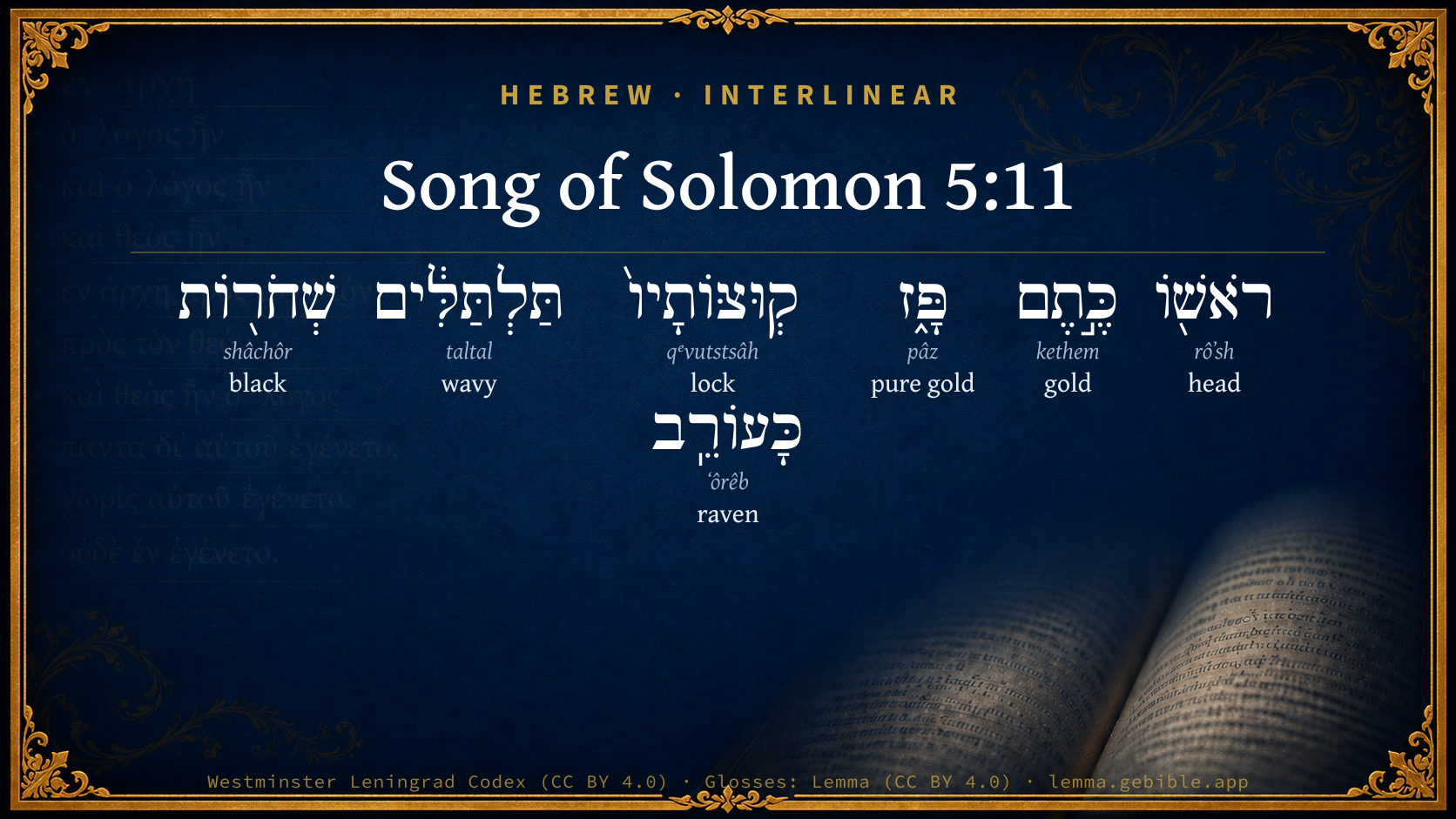
Hebrew (Westminster Leningrad Codex) Song of Solomon 5:11 appears in the Hebrew Old Testament. The text above is from the Westminster Leningrad Codex. Each word links to its Strong’s number, a concise gloss, and parsing drawn from the Open Scriptures Hebrew Bible morphology. Click any word for its full Brown-Driver-Briggs (BDB) entry.
Download image
Cite this verse

Song of Solomon 5:11 (World English Bible). Public Domain. Lemma interlinear Bible study tool, https://lemma.gebible.app/v/song-of-solomon/5/11.

Show BibTeX & RIS
BibTeX
RIS
English Translation
His head is like the purest gold. His hair is bushy, black as a raven.
World English Bible · Public Domain
Highlights
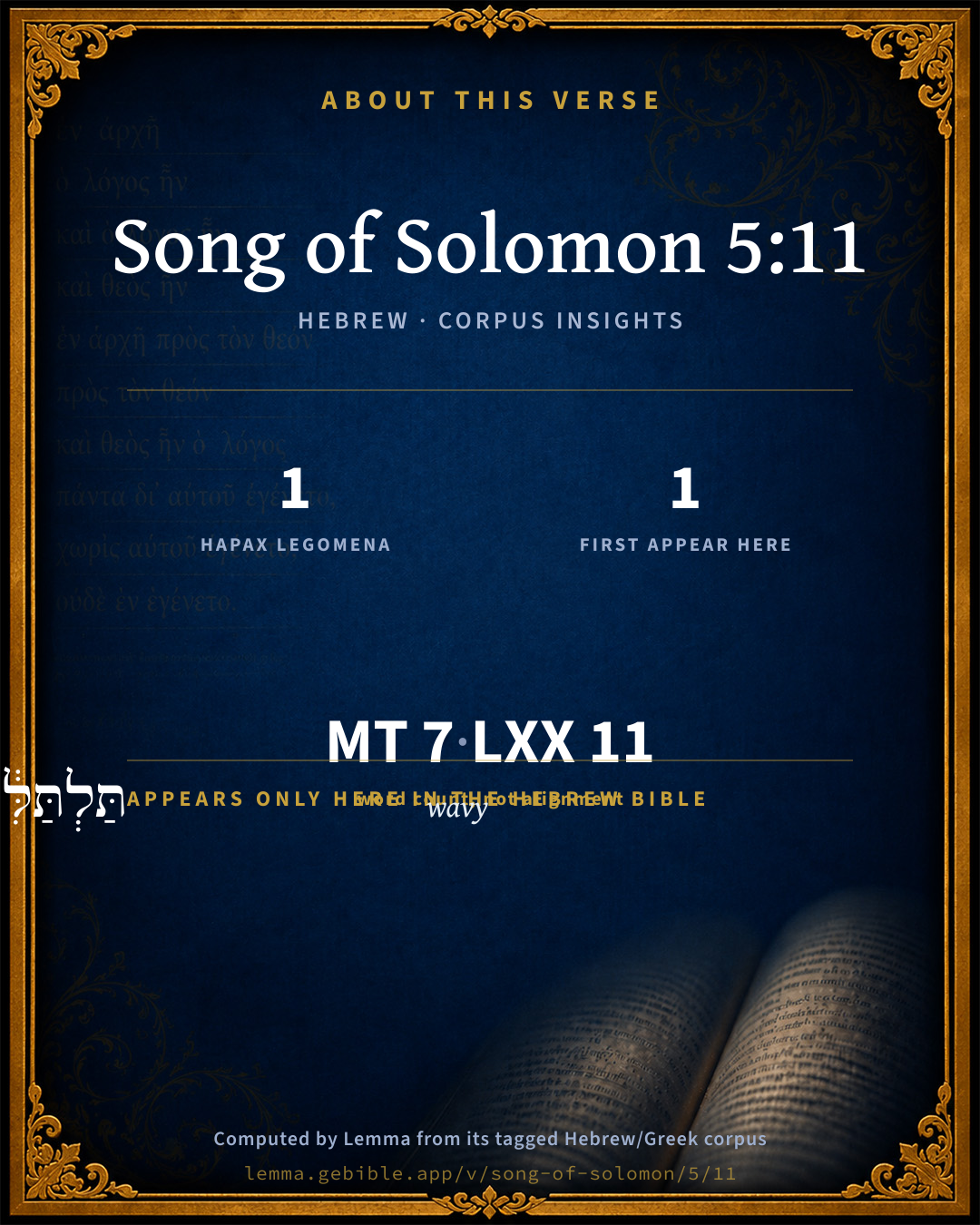
  • 1 hapax legomenon — only here in the Hebrew Bible
  • 1 first appearance in the Hebrew Bible
Full analysis ↓
Download a study sheet

One document with this verse’s original text, its word-by-word gloss line, the meaning frame, cross-references with their text, attributed commentary, and full source and license credits — printable, and it pastes into notes with its structure intact.

This verse Autodidact and up

Study sheet (.html) Plain text (.txt)

A passage Seminary Student

Up to 50 verses in one chapter. A passage sheet keeps up to 6 commentary sources and 12 cross-references per verse, in the order this page ranks them, and says so on the sheet whenever that leaves anything out. Ask for a single verse and you get the Autodidact verse sheet above.

Everything on this page stays free to read, with no account — the sheet is a download of what is already on screen, not access to it.

Want to remove ads? Support Godless Engineer
Compare translations 3

The same verse in 3 English versions, stacked beneath the original-language interlinear above. Click any original word for its lexicon entry.

Each is an independent rendering of the whole verse — the interlinear is not word-aligned to these translations.

Highlighted words mark where these versions differ — a whole-verse word diff, not a word-by-word alignment.

  • World English Bible Public Domain
    His head is like the purest gold. His hair is bushy, black as a raven.
  • King James Version Public Domain
    His head is as the most fine gold, his locks are bushy, and black as a raven.
  • unfoldingWord Literal Text CC BY-SA 4.0
    His head gold, refined gold; his hairs wavy, black like the raven.

unfoldingWord Literal Text — © unfoldingWord, licensed CC BY-SA 4.0. Word-aligned USFM3 via Door43 (git.door43.org/unfoldingWord/en_ult).

Versions to compare (up to 4)

3 of 4 selected

Show all 18 translations

Every available English version of this verse, each an independent rendering of the whole verse.

  • World English Bible Public Domain
    His head is like the purest gold. His hair is bushy, black as a raven.
  • Berean Standard Bible Public Domain
    His head is purest gold; his hair is wavy and black as a raven.
  • Majority Standard Bible Public Domain
    His head is purest gold; his hair is wavy and black as a raven.
  • King James Version Public Domain
    His head is as the most fine gold, his locks are bushy, and black as a raven.
  • American Standard Version (1901) Public Domain
    His head is `as' the most fine gold; His locks are bushy, `and' black as a raven.
  • Revised Version (1885) Public Domain
    His head is as the most fine gold, his locks are bushy, and black as a raven.
  • Geneva Bible (1599) Public Domain
    His head is as fine golde, his lockes curled, and blacke as a rauen.
  • Douay-Rheims (1899) Public Domain
    His head is as the finest gold: his locks as branches of palm trees, black as a raven.
  • Young's Literal Translation Public Domain
    His head `is' pure gold -- fine gold, His locks flowing, dark as a raven,
  • Literal Standard Version CC BY-SA 4.0
    His head [is] pure gold—fine gold, || His locks flowing, dark as a raven,
  • Unlocked Literal Bible CC BY-SA 4.0
    His head is the purest gold; his hair is curly and as black as a raven.
  • unfoldingWord Literal Text CC BY-SA 4.0
    His head gold, refined gold; his hairs wavy, black like the raven.
  • Darby Bible Public Domain
    His head is [as] the finest gold; His locks are flowing, black as the raven;
  • World Messianic Bible Public Domain
    His head is like the purest gold. His hair is bushy, black as a raven.
  • Webster's Bible Public Domain
    His head is as the most fine gold, his locks are bushy, and black as a raven.
  • Free Bible Version CC BY-SA 4.0
    His head is like the finest gold, his hair is wavy and black as the raven.
  • Bible in Basic English Public Domain
    His head is as the most delicate gold; his hair is thick, and black as a raven.
  • JPS Tanakh (1917) Public Domain
    His head is as the most fine gold, his locks are curled, and black as a raven.

Literal Standard Version (2020), Covenant Press — licensed CC BY-SA 4.0. Text via the HelloAO Bible API (eBible.org). Unlocked Literal Bible (unfoldingWord) — licensed CC BY-SA 4.0. Text via the HelloAO Bible API (eBible.org). unfoldingWord Literal Text — © unfoldingWord, licensed CC BY-SA 4.0. Word-aligned USFM3 via Door43 (git.door43.org/unfoldingWord/en_ult). Free Bible Version, Dr. Jonathan Gallagher — licensed CC BY-SA 4.0. Text via the HelloAO Bible API (eBible.org).

Word by word

More ways to search: Search by grammar → Find every occurrence → Compare this word →

Practice this passage: Drill this verse → Learn its vocabulary →

About this verse

These counts appear in no published source. They are computed here, from the morphology-tagged text and Lemma’s own curated glosses. What Lemma adds →

7
words
7
distinct lemmas
Wisdom
section

Notable vocabulary

1 hapax legomenon — a word that appears only here in the entire Hebrew Bible:

  • תַּלְתַּלִּ֔ים wavy H8534

First appearance in Scripture

This word makes its first canonical appearance in the Hebrew Bible here:

  • תַּלְתַּלִּ֔ים wavy H8534

Shared distinctive vocabulary

קְוּצּוֹתָיו֙ lock H6977 occurs in 2 verses of the Hebrew Bible. Also found in:

Grammatical profile

  • 6 nouns
  • 1 adjective

Hebrew & Septuagint length

In English translation the verse runs 15 words from the Hebrew and 15 from the Septuagint (LXX English) — the same length.

A rough comparison of the two English renderings, which tokenize alike — not a word-level alignment.

Word counts can differ between the Hebrew and the Greek without any difference in meaning — e.g. the Hebrew direct-object marker אֵת has no separate Greek word, and Greek often adds the article ὁ.

In the original languages it is 7 Hebrew tokens and 11 Greek tokens — but the two are counted differently (Hebrew bundles its prefixes and suffixes into one token; the Greek is in lemma form), so that isn’t a like-for-like length.

Cross-references

6

Topical passages linked to Song of Solomon 5:11 in the Treasury of Scripture Knowledge — connected by theme and wording, ordered by reader-vote popularity; previews shown in the World English Bible.

  • Song of Solomon 5:2 I was asleep, but my heart was awake. It is the voice of my beloved who knocks: Open to me, my sister, my love, my dove, my undefiled; For my head is filled with dew, My hair with the dampness of the night.
  • Song of Solomon 7:5 Your head on you is like Carmel, The hair of your head like purple; The king is held captive in its tresses.
  • Daniel 7:9 I saw until thrones were placed, and one who was ancient of days sat: his clothing was white as snow, and the hair of his head like pure wool; his throne was fiery flames, [and] the wheels of it burning fire.
  • Ephesians 1:21–22 far above all rule, and authority, and power, and dominion, and every name that is named, not only in this age, but also in that which is to come.
  • Revelation 1:14 His head and his hair were white as white wool, like snow. His eyes were like a flame of fire.
  • Daniel 2:37–38 You, O king, are king of kings, to whom the God of heaven has given the kingdom, the power, and the strength, and the glory;

Cross-references courtesy of OpenBible.info (CC BY 4.0).

Hebrew and Greek witnesses Masoretic Hebrew ↔ Greek Septuagint

The same verse in the two great witnesses to the Old Testament, shown verse-for-verse.

These are two independent witnesses, not word-aligned to each other, and the Septuagint is shown in lemma (dictionary) form.

Hebrew Song of Solomon 5:11 Masoretic · Westminster Leningrad Codex

רֹאשׁ֖וֹ כֶּ֣תֶם פָּ֑ז קְוּצּוֹתָיו֙ תַּלְתַּלִּ֔ים שְׁחֹר֖וֹת כָּעוֹרֵֽב

His head is like the purest gold. His hair is bushy, black as a raven.

World English Bible · Public Domain

Greek LXX Song of Solomon 5:11 Septuagint · lemma form

κεφαλή αὐτός χρυσίον καί φαζ βόστρυχος αὐτός ἐλάτη μέλας ὡς κόραξ

His head is as very fine gold, his locks are flowing, black as a raven.

LXX2012 (modern English Septuagint) · Public Domain

On this verse, Ellicott's Commentary for English Readers discusses the Septuagint’s reading. Read the note in Commentary ↓

Hebrew: Westminster Leningrad Codex (CC BY 4.0). Greek: Septuagint (public domain); English from LXX2012 (modern English Septuagint) (Public Domain). How the Septuagint differs from the Hebrew →

Commentary

Notes on Song of Solomon 5:11 from classic Christian and Jewish commentators (each source and its license shown beneath its notes). The classic Christian expositions comment on the surrounding passage and are grouped to its opening verse, so a note may address several verses; the Jewish commentaries on the Tanakh (Rashi and others) are per-verse, so they appear only where the commentator wrote on this verse.

Lemma curates 59 commentaries, every one of them public domain or Creative Commons licensed, each selected and text-cleaned for this edition rather than reprinted as found. About our sources →

Trapp's Complete Commentary

John Trapp

Son 5:11 His head [is as] the most fine gold, his locks [are] bushy, [and] black as a raven.

Ver. 11. His head is as the most fine gold.] Here she begins her particular praise of his various parts; and here she may seem to speak with the tongues of men and of angels, performing, as lovers used to do, that for him which he had done for her before, {Son 4:1-4, &c.} though all she could say falleth far short of him; and well she might say after all, as Nazianzen sometime said of Basil, ‘There wants but his own tongue to commend him with’; Loquimur de Deo non quantum debemus, sed quantum possumus. In speaking of Christ’s excellencies, men may speak what they can; they cannot possibly speak so much as they ought, they cannot hyperbolise. If any shall think the Church doth here, he must needs be of those that either know him not, or are not able to judge aright of his worth, as once Cicero {a} said of Crassus and Antony, the orators. Nusquam Origines non ardet, sed nusquam est ardentior, &c., saith Erasmus. {b} Origen is never but earnest; howbeit he is never more earnest than when he discourseth about Christ; in other things he may seem to excel others, but in this he excelleth himself. The same we may well say of the Church in this place, in setting forth the surpassing purity and perfection of her spouse: Quem manibus propriis finxit cordata Minerva. And first she makes his head to be of the finest and firmest gold - Fess- gold, so the Arabic, from the Hebrew, calleth it; and the land of Fess seemeth to be named of such gold there. David’s Michtam, or Golden Psalm, comes from one of the words here used; for in the original thus it is, "His head is most glistering gold, yea, most solid gold"; {c} that is, his deity which dwells in him is most pure and glorious - for "the head of Christ is God" {1Co 11:3} - and that fulness of grace which is communicated to his human nature is wondrously beautiful, and so sets it forth as black curled locks do a fresh countenance.

“ Spectandus nigris oculis, nigroque capillo est. ”

{a} Tull. de Orator.

{b} Erasmus in Praef. ad Orig. Opera.

{c} Or, He is the gold of gold, as Athens was the Greece of Greece.

John Trapp, A Commentary or Exposition upon All the Books of the Old and New Testament (1647–1656) — public domain. Text from a community e-Sword module.

Matthew Poole's English Annotations

His head is as the most fine gold; it shines like gold, not in respect of the hair, which is black, as it followeth, but by reason of his crown of pure gold upon his head, Rev 14:14; whereby she implies that her Bridegroom was a King, which she declared above, Son 5:11.

His locks; in which a part of man’s beauty consists. I shall not trouble my reader with a distinct application of this and the following particulars unto some special part or excellency of Christ, because such things are mere conjectures without any solid grounds, and the only design of this description seems to be this, to set forth the beauty of Christ under the notion of a most complete and amiable person, in whom there is no defect nor blemish, from the crown of his head to the sole of his feet.

Black as a raven; which is mentioned, partly because this was esteemed a beauty, and partly because it was an evidence of his youth and rigour, as grey hairs are characters of age and infirmity, Hos 7:9.

Matthew Poole's English Annotations on the Holy Bible (1683–1685) — public domain. Text from a community e-Sword/MySword module.

Tyndale Open Study Notes

Tyndale Open Resources

5:11-15 The woman describes the man as a statue made of gold, ivory, lapis lazuli, and marble pillars, suggesting that he is god-like in appearance, since statues of deities were composed of such precious metals in antiquity (Exod 32:1-4; 1 Kgs 12:28; Dan 2:32-33; 3:1).

Tyndale Open Study Notes — © Tyndale Open Resources, licensed CC BY-SA 4.0. Text via the HelloAO Bible API.

Geneva Bible (1599)

Geneva Bible translators

She describeth Christ to be of perfect beauty and comeliness.

Geneva Bible (1599) marginal notes — public domain. Text via Bolls.life.

Adam Clarke's Commentary

Verse 11. His head is as the most fine gold] He has the most beautiful head, fine and majestic. Gold is here used to express excellence.

His locks are bushy] Crisped or curled. This may refer to his mustachios.

Black as a raven.] His hair is black and glossy.

Adam Clarke's Commentary on the Bible (1810–1826) — public domain. Text from a community e-Sword/MySword module.

Ellicott's Commentary for English Readers

(11) Bushy.—Marg., curled; Heb., taltallîm=flowing in curls, or heaped up, i.e., thick, bushy, according as we derive from talah or tel. The LXX. (followed by the Vulg.) take taltallîm for another form of zalzallîm (Isa_18:5, sprigs of the vine), and render palm-leaves.

A Bible Commentary for English Readers, edited by Charles John Ellicott (1878–1897) — public domain. Text from a community e-Sword module.

The Cambridge Bible for Schools and Colleges

gen. ed. J. J. S. Perowne

11. bushy] Heb. taltallîm occurs in the O.T. only here, and is a derivative from tâlal or tal = ‘to hang loosely down,’ and then ‘to throw down,’ but its exact meaning is uncertain. The A.V. margin gives the translation ‘curled’ or ‘curling,’ but it probably represents the view that the word means ‘hills’ or ‘undulations,’ as some Rabbinical writers understand it. (Cp. Midrash Rabba on Levit. § 19, and Talmud, Tract. Nedarim, fol. 9 b.) In that case the meaning would be, that his locks were undulating. The LXX however translate ἐλάται = ‘palm buds,’ or the sheaths of the palm bud, which Schleusner says denotes “curls like those which the spathes of the palm form when they burst to let the fruit appear,” when they hang down in ringlets. Others get the same meaning by taking taltallîm for the pendant parts of the vine, the tendrils.

The Cambridge Bible for Schools and Colleges (gen. ed. J. J. S. Perowne; Cambridge University Press, 1878–1918) — public domain. Text from a community e-Sword module.

Albert Barnes' Notes on the Bible

His head is as the most fine gold - Perhaps in the sense of noble and precious as the finest gold. Lam 4:2.

Bushy - Waving like branches of the palm.

Albert Barnes' Notes on the Bible (1834–1885) — public domain. Text from a community e-Sword/MySword module.

Haydock's Catholic Bible Commentary

Gold. God is the head of Christ, (1 Corinthians xi. 3.) and is most pure. (N.[Menochius?]) --- The guards of Solomon were powdered with gold dust. (Josephus, Antiquities) --- Branches. Elatæ, or fruits of the male palm-tree. (Theodoret) (Pliny, [Natural History?] xiii. 4.)

George Leo Haydock (1774–1849), Haydock's Catholic Family Bible and Commentary, 1859 edition — public domain. Excludes Psalms (Douay-Rheims chapter numbering differs from Protestant) and Deuterocanonical books (Catholic canon only).

Whedon's Commentary on the Bible

Daniel D. Whedon

11. His head, etc. — Literally, His head is gold, gold; the repetition of the original giving emphasis. The idea is, that his head is among men as gold among metals, kingly and grand.

His locks — Literally, his curls. A pure, soft, black hair was much admired by ancient poets next to the colour of sunbeams, the gold-yellow hair of Moses and Apollo, “the rare gift of the gods.” A beautiful woman is called “a bird of raven wing and snowy breast.”

Daniel D. Whedon (gen. ed.), Commentary on the Old and New Testaments (1874–1909) — public domain. Text from a community e-Sword module.

The Pulpit Commentary

Vers. 11-16. His head is as the most fine gold, his locks are bushy, and black as a raven. His eyes are like doves beside the water brooks; washed with milk and fitly set. His cheeks are as a bed of spices, as banks of sweet herbs; his lips are as lilies, dropping liquid myrrh. His hands are as rings of gold set with beryl; his body is as ivory work overlaid with sapphires. His legs are as pillars of marble set upon sockets of fine gold. His aspect is like Lebanon, excellent as the cedars. His mouth is most sweet: yea, he is altogether lovely. This is my beloved, and this is my friend, O daughters of Jerusalem.

This description, which is complete in itself, is best regarded in its unbroken perfection. We must not expect to find a meaning for each separate part of it. There are ten corporeal excellences enumerated. We naturally recall the descriptions in Daniel and in the Apocalypse, which certainly have reference to this, and manifestly combine the attributes of greatness and beauty in the Son of man. Solomon, no doubt, as the son of Bathsheba, was distinguished by his personal attractions. Some of the details of description are differently rendered by different commentators. Delitzsch regards the description of the hair in ver. 11 as compared to a hill or hilly range" his locks hill upon hill," i.e. "his hair, seen from his neck upwards, forms in undulating lines hill upon hill." The black colour is no doubt mentioned as a contrast with the fair, white complexion. The eyes are not only pure and clear, but with a glancing moistness in them which expresses feeling and devotion. So Plutarch has urothv twn ommatwn to denote a languishing look, and we find the same figure in the "Gitagovinda " and Hafiz, and in Ossian. So Luther, "Und stehen in der Falle." The pureness of the white of the eye is represented in the bathing or washing in milk. They are full and large, "fine in their setting," referring no doubt to the steady, strong look of fine eyes. "The cheeks" are compared to towers of plants; that is, there is a soft elevation in them. LXX, quousai mureqika : Jerome, Sicut areolae aromatum consitae a pigmentariis. The Targum says, "Like the rows of a garden of aromatic plants, which produce deep, penetrating essences, even as a (magnificent) garden aromatic plants perhaps referring to the "flos juventae," the hair on the face, the growth of the beard. "The lips" are described as the organs of speech as well as inviting to embrace. They drop words like liquid fragrance. "The bands" may be differently described according as they are viewed. Delitzsch says, "His hands form cylinders, fitted in with stones of Tarshish." Gesenius thinks the comparison is of the closed hand and the stained nails, but that seems farfetched. Surely it is the outstretched hands that are meant. The form of the fingers is seen and admired; they are full, round, fleshy like bars of gold. The word "Tarshish" may mean clay white, as in the Greek versions; that is, topaz, called Tarshish from Tartessus in Spain, where it is found. The description of the body is of the outward appearance and figure only, though the word itself signifies "inward parts." The comparison with ivory work refers to the glancing and perfect smoothness and symmetry as of a beautiful ivory statue, the work of the highest artistic excellence. The sapphire covering tempers the white. The beautiful blue veins appear through the skin and give a lovely tint to the body. So in the description of the legs we have the combination of white and gold, the white marble setting forth greatness and purity, and the gold sublimity and nobleness; intended, no doubt, to suggest that in the royal bridegroom there was personal beauty united with kingly majesty, as in the following description of his general aspect, which, like the splendours of the mountains, was awe-inspiring and yet elevating and delightful. (cf. Psa_80:11 Jer_22:7 Isa_37:24) His mouth, or palate, is sweetness itself; that is, when he speaks his words are full of winning love. (cf. Pro_16:4 Psa_55:16) We may compare with the whole description that given of Absalom, Solomon"s brother, in 2Sa_14:25, 2Sa_14:26. It has been truly remarked by Zockler that "the mention of the legs, and just before of the body, could only be regarded as unbecoming or improper by an overstrained prudishness, because the description which is here given avoids all libidinous details, and is so strictly general as not even to imply that she had ever seen the parts of the body in question in a nude condition." It merely serves to complete the delineation of her lover, which Shulamith sketches by a gradual descent from head to foot, and, moreover, is to be laid to the account of the poet rather than to that of Shulamith, who is in everything else so chaste and delicate in her feelings. Certainly it would be much less delicate regarded as the description of a shepherd lover who is seeking to obtain possession of the maiden taken from him, than of the royal bridegroom to whom Shulamith is at all events affianced, if not already married. The highest spiritual feelings of loving adoration of the Saviour have welcomed some parts of this description, and adopted them into the language of "spiritual songs." To some minds, no doubt, it is repellent; to those to whom it is not so, the warmth and glow of Eastern language is by no means too realistic for the feelings of delight in the Lord which express themselves in rapturous music.

The Pulpit Commentary (1880–1919), ed. H.D.M. Spence-Jones & Joseph S. Exell — public domain. Text from a community e-Sword module.

John Wesley's Explanatory Notes

As gold - It shines like gold, by reason of the crown of pure gold upon his head. We need not aim at a distinct application of this and the following particulars, unto some special excellency of Christ, because such things are mere conjectures, and the only design of this description is, to set forth the beauty of Christ under the notion of a most amiable person, in whom there is no defect or blemish, from the crown of his head to the sole of his feet.

John Wesley, Explanatory Notes Upon the Whole Bible (1754–1765) — public domain. Text via the GEBible commentary corpus.

Rashi

Rabbi Shlomo Yitzchaki (Rashi)

His head glistens like the finest gold. כֶּתֶם is a term referring to the treasures of kings which they store in their treasure houses, and similarly, (Lam. 4:1): “[How] changed is the fine gold jewelry (הַכֶּתֶם),” and similarly, (Job 31:24): “and to jewelry (לַכֶּתֶם) I said, ‘My confidence,’” and similarly, (Prov. 25:12): “and jewelry of finest gold (כָתֶם).”

his locks are curled Heb. תַּלְתַּלִים, an expression of hanging (תְּלוּיִים), pendeloys in Old French, (locks of hair) hanging.

black as a raven All these are beauty for a young man.

Rashi on the Tanakh — English translations: “The Judaica Press complete Tanach with Rashi, translated by A. J. Rosenberg” (CC BY 4.0); “Pentateuch with Rashi's commentary by M. Rosenbaum and A.M. Silbermann, 1929-1934” (public domain); “The Metsudah Tanach series, Lakewood, N.J” (CC BY 4.0); and “The Book of Joshua, Metsudah Publications, 1997” (CC BY 4.0). Text via Sefaria.

Lesson kit

Teaching starters — assembled from the data on this page, not authored interpretation. Every prompt links to the verse data it draws on. Edit before teaching.

Song of Solomon, in the Wisdom, opens this verse with 7 words (7 distinct Hebrew lemmas). Its most distinctive word is taltal (“wavy”). A historical commentator’s framing appears above. Read the whole chapter for the surrounding context.

Discussion questions

  1. How does “wavy” (taltal) shape what this verse is saying?
  2. This verse holds 1 word here found nowhere else in the Hebrew Bible. What might the rare word draw attention to?
  3. The word “wavy” first appears here in Scripture. What is being introduced at this debut?
  4. Song of Solomon 5:2 shares the word «lock» with this verse. How do the two illuminate each other?
  5. The translations on this page render this verse differently — a whole-verse word diff, not a word-by-word alignment. What might account for the different wordings?
  6. Reading how Trapp's Complete Commentary and Matthew Poole's English Annotations read this verse, where do the two commentators agree and where do they part?

Things to notice

Reading settings

Reading text

Shown beneath each verse's original-language words.

Old Testament
Old Testament edition

Read the OT as the Masoretic Hebrew (MT) or the Greek Septuagint (LXX).

English shown for the Greek Septuagint (in the Hebrew ↔ Greek comparison).

Comparing translations? Open the Compare panel on any verse page to stack up to four side by side.