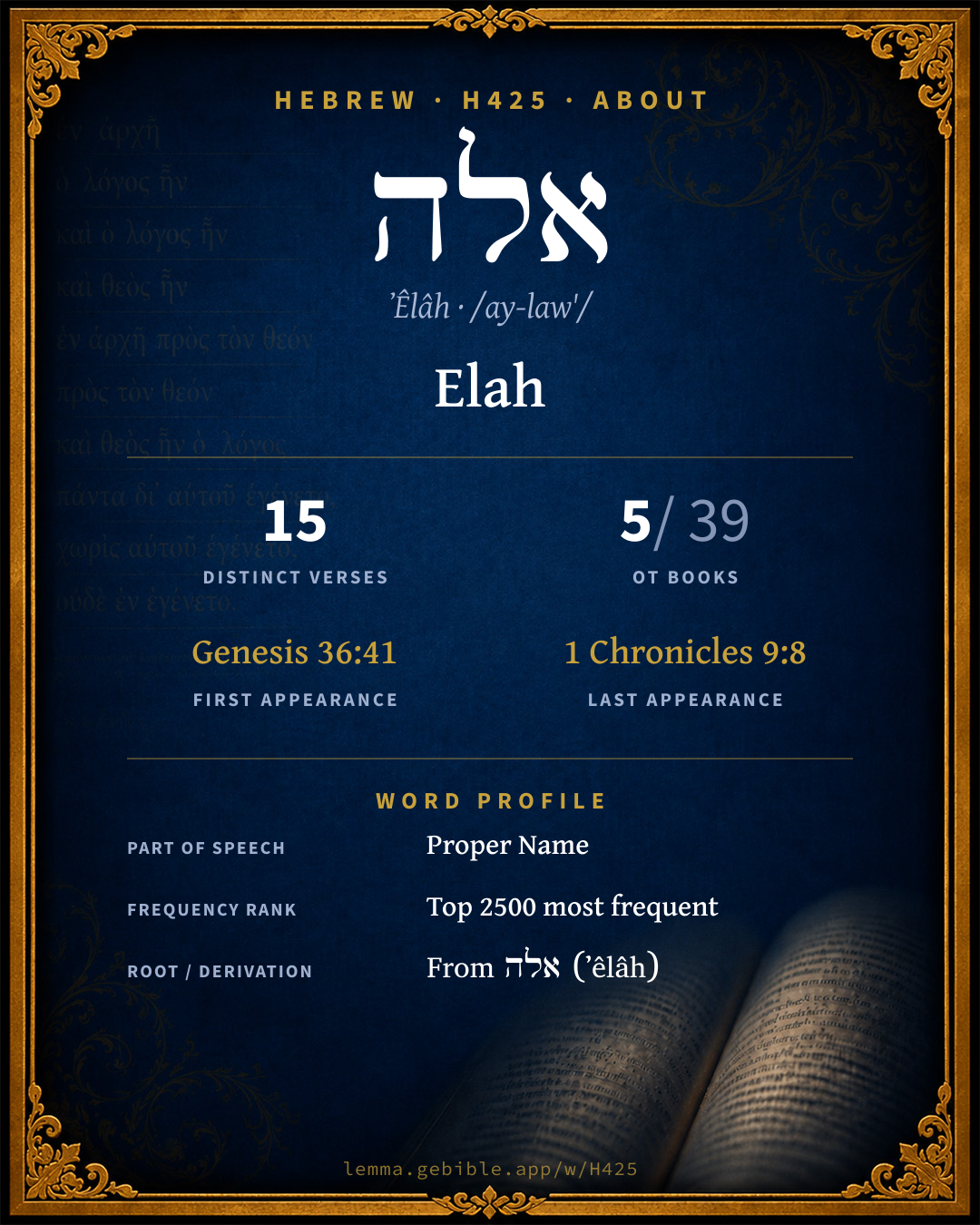
אֵלָה
Elah
BDB lists 6 entries for ‘Elah’ fuller range ↓
Full lexicon entry — Brown-Driver-Briggs (BDB)
From Brown-Driver-Briggs (BDB)
Where this word appears
Grammar key — what these labels mean
Part of speech
- Noun
- A naming word — a person, place, thing, or idea.
Noun type
- Proper
- A name of a specific person, place, or people (e.g. Abraham, Zion, Israel).
Every verse where H425 appears — 15 distinct verses across 5 books. Click any verse to open its interlinear word-by-word view. Verse text shown in the World English Bible for context — . Each verse’s Hebrew form is shown with its reference; the English is not keyword-highlighted, since the data carries no word-level English alignment. Use “Compare translations” on any verse to read it across multiple English versions. This concordance covers the Hebrew Bible; Septuagint (Greek Old Testament) occurrences are not indexed here.
Genesis 1 verse
1 Samuel 3 verses
- 1 Samuel 17:2 הָאֵלָ֑ה n Proper Saul and the men of Israel were gathered together, and encamped in the valley of Elah, and set the battle in array against the Philistines.
- 1 Samuel 17:19 הָֽאֵלָ֑ה n Proper Now Saul, and they, and all the men of Israel, were in the valley of Elah, fighting with the Philistines.
- 1 Samuel 21:9 הָאֵלָ֗ה n Proper The priest said, The sword of Goliath the Philistine, whom you killed in the valley of Elah, behold, it is here wrapped in a cloth behind the ephod: if you will take that, take it; for there is no other except that here. David said, There is none like that; give it me.
1 Kings 4 verses
- 1 Kings 16:6 אֵלָ֥ה n Proper Baasha slept with his fathers, and was buried in Tirzah; and Elah his son reigned in his place.
- 1 Kings 16:8 אֵלָ֨ה n Proper In the twenty-sixth year of Asa king of Judah began Elah the son of Baasha to reign over Israel in Tirzah, [and reigned] two years.
- 1 Kings 16:13 אֵלָ֣ה n Proper for all the sins of Baasha, and the sins of Elah his son, which they sinned, and with which they made Israel to sin, to provoke Yahweh, the God of Israel, to anger with their vanities.
- 1 Kings 16:14 אֵלָ֖ה n Proper Now the rest of the acts of Elah, and all that he did, aren't they written in the book of the chronicles of the kings of Israel?
2 Kings 4 verses
- 2 Kings 15:30 אֵלָ֗ה n Proper Hoshea the son of Elah made a conspiracy against Pekah the son of Remaliah, and struck him, and killed him, and reigned in his place, in the twentieth year of Jotham the son of Uzziah.
- 2 Kings 17:1 אֵלָ֧ה n Proper In the twelfth year of Ahaz king of Judah began Hoshea the son of Elah to reign in Samaria over Israel, [and reigned] nine years.
- 2 Kings 18:1 אֵלָ֖ה n Proper Now it happened in the third year of Hoshea son of Elah king of Israel, that Hezekiah the son of Ahaz king of Judah began to reign.
- 2 Kings 18:9 אֵלָ֖ה n Proper It happened in the fourth year of king Hezekiah, which was the seventh year of Hoshea son of Elah king of Israel, that Shalmaneser king of Assyria came up against Samaria, and besieged it.
1 Chronicles 3 verses
- 1 Chronicles 1:52 אֵלָ֖ה n Proper chief Oholibamah, chief Elah, chief Pinon,
- 1 Chronicles 4:15 אֵלָ֖ה אֵלָ֖ה n Proper n Proper The sons of Caleb the son of Jephunneh: Iru, Elah, and Naam; and the sons of Elah; and Kenaz.
- 1 Chronicles 9:8 וְ/אֵלָ֥ה conj + n Proper and Ibneiah the son of Jeroham, and Elah the son of Uzzi, the son of Michri, and Meshullam the son of Shephatiah, the son of Reuel, the son of Ibnijah;
About this entry
At a glance — auto-summarized from this page’s data, not written by a person. Every figure links to its source below. This summary describes the numbers; it doesn’t interpret them.
At its core, אלה (ʼÊlâh) means “Elah.” First canonically at Genesis 36:41, it enters the text early. It appears 15 verses across 5 books of the Hebrew Bible, among its uncommon vocabulary. The word gravitates to 1 Kings (27%), then 2 Kings and 1 Samuel. Dig into 15-verse concordance and the renderings breakdown below.
Gloss history
Strong's 1890 vs modern scholarship
About this word
Strong's H425 catalogs a Hebrew word from the Hebrew Old Testament.
These counts are not copied from any lexicon or concordance. They are computed here, from the morphology-tagged Hebrew Old Testament. What Lemma adds →
- 15
- distinct verses
- The word appears in 15 distinct verses.
- 5 / 39
- OT books
- The word appears in 5 of 39 Old Testament books.
- #1,752
- by frequency
- Top 2500 most frequent Hebrew words (rank 1,752 of 8,640 Hebrew words by occurrence).
View all 15 occurrences in the concordance →
By section of the Old Testament
By traditional corpus
Conventional, traditional groupings — biblical authorship is debated, so this is a traditional corpus grouping, not an authorship claim. Each share is this word’s portion of its verses in that division of the Hebrew canon. Each figure is a share of the word’s 15 distinct verses.
- Prophets (Nevi'im) 11 verses · 73%
- Writings (Ketuvim) 3 verses · 20%
- Torah (Pentateuch) 1 verse · 7%
How translations render this word
Counts come from each version’s own published word-to-Strong’s tagging or interlinear alignment — an approximate guide to how each version renders this word, not a word-level alignment the data otherwise carries. Because each total is that version’s own tagged count, the per-version totals vary from one another and need not match the appearance or distinct-verse counts above. These counts may also differ from a printed concordance because Lemma counts each distinctly tagged rendering and does not collapse phrase taggings into a single head-word total. This is a fixed set of word-tagged versions (KJV, ASV, BSB, ULT) and does not change with the reading translation you choose elsewhere. Each version’s license is shown beside its name below (and on Sources).
BDB lists this Strong’s number as 3 distinct words (homographs). Each count above pools all of them and is not split by sense — see the Senses section below. A low-frequency rendering may belong to a different one of those words, not the primary meaning.
- King James Version†: Elah 15×
- American Standard Version†: Elah 15×
- Berean Standard Bible†: Elah 16×
- unfoldingWord Literal Text†: Elah 16×
King James Version Public Domain
Renders H425 across 16† tagged occurrences — most commonly:
Plus 1 rendering that appears only once — usually multi-word phrases or single function words the recovered tagging swept in, not distinct renderings.
American Standard Version Public Domain
Renders H425 across 16† tagged occurrences — most commonly:
Plus 1 rendering that appears only once — usually multi-word phrases or single function words the recovered tagging swept in, not distinct renderings.
Berean Standard Bible Public Domain
Renders H425 across 16† tagged occurrences — most commonly:
unfoldingWord Literal Text CC BY-SA 4.0
Renders H425 across 16† tagged occurrences — most commonly:
Senses in the full BDB
What do BDB’s symbols mean?
BDB uses these scholarly abbreviations:
| Symbol | Meaning |
|---|---|
| 𝔊 | the Septuagint (the ancient Greek translation, LXX) |
| 𝔙 | the Vulgate (the Latin translation) |
| 𝔖 | the Syriac version (the Peshitta) |
| 𝔗 | the Targum (the Aramaic translation) |
| ψ | the Psalms |
| √ | root (the underlying root or stem) |
| ‖ | parallel passage (a synonymous or contrasted parallel) |
| † | the dagger: every passage where the word occurs is cited |
The 5 senses and sub-senses the full Brown-Driver-Briggs lexicon distinguishes for this word, in lexicon order (not ranked by frequency), with BDB’s own verbatim wording and sub-sense lettering. Shown in Hebrew script with BDB’s own scholarly abbreviations. The condensed entry is in the Lexicon Entry tab. See also the Forms in the corpus table below.
אלה I terebinth (= אֵילָה (?) v. iv. איל > StaGesch. 455 wh. derives from אֵל = divine
אלה II m. (terebinth, cf. Gn 49
- 1. a chief of Edom Gn 36:41 = 1 Ch 1:52 (= אֵילַת n.pr.loc.? v. Di) e.g. Genesis 36:41
- 2. son of Baasha; reigned two years in Isr. 1 K 16:6, 8, 13, 14. e.g. 1 Kings 16:6
- 3. father of Hoshea who was last king of Isr. 2 K 15:30; 17:1; 18:1, 9. e.g. 2 Kings 15:30
- 4. a son of Caleb 1 Ch 4:15(×2). e.g. 1 Chronicles 4:15
- 5. a son of Uzzi 1 Ch 9:8. e.g. 1 Chronicles 9:8
Senses from the full Brown-Driver-Briggs lexicon (Brown, Driver, Briggs; Oxford 1906 — public domain), digitized via Sefaria, supplemented by the OpenScriptures HebrewLexicon (CC BY 4.0). Full attribution on Sources.
Word origin
I. n.f. terebinth (= אֵילָה (?) v. iv. איל > StaGesch. 455 wh. derives from אֵל = divine; but cf. ib. on lack of clear distinction betw. אֵלָה, אֵלוֹן & אַלּוֹן)—Gn 35:4 + 15 times + אֵילָה Gn 49:21 (for MT אַיָּלָה v. infr.)—terebinth = Pistacia terebinthus, Linn, a deciduous tree with pinnate leaves & red berries; occasional in Palestine; grows to great age; always of single tree; near Shechem Gn 35:4 (E) cf. †אַלָּה Jos 24:26 (E, read אֵלָה?), Ophrah Ju 6:11, 19; in Jabesh 1 Ch 10:12; tree in which Absalom was caught 2 S 18:9(×2), 10, 14; v. also 1 K 13:14; expressly of idol-shrine Ho 4:13 (‖ אַלּוֹן, לִבְנֶה) Ez 6:13; as fading, withering, sim. of Judah Is 1:30; as hewn down, sim. id. 6:13 (‖ אַלּוֹן); fig. of Naphtali אֵילָה שְׁלֻחָה Gn 49:21 (𝔊 Ew Ol Di > MT אַיָּלָה hind q.v.) a slender terebinth, v. Di & cf. ii. אֵלָה; in topogr. designat. עֵמֶק הָא׳ 1 S 17:2, 19; 21:10 (v. עֵמֶק).
II. n.pr.m. (terebinth, cf. Gn 49:21 sub i. אֵלָה)
— Brown-Driver-Briggs (Oxford 1906, public domain), digitized via Sefaria, supplemented by the OpenScriptures HebrewLexicon (CC BY 4.0). See Sources.
Derived from אלה (ʼêlâh) (H424) — terebinth.
Jastrow Dictionary
A second Hebrew/Aramaic lexicon for comparison, covering Aramaic and post-biblical (Talmudic, Targumic, Midrashic) usage that the biblical-Hebrew BDB does not. Matched by lemma rather than by Strong’s number, so a lemma may carry more than one Jastrow headword (shown separately below), and the entries cover usage well beyond the Bible.
אָלָה
- to curse, v. אלי.
אָלָה ²
- imprecation, curse. Sot. II, 5 (17ᵃ); a. fr.—Pl. אָלוֹת. Ib. a. e.
אֵלֶּה
- c. pl. (b. h.; v. preced.) these, those (cmp. הרי). Ex. R. s. 30 v’elleh (and this) adds to the preceding (continues), elleh (these) restricts. V. אֵלּוּ.
אֵלָה
- v. preced. ws.) terebinth. Shebi. VII, 5.
אלה
- Sabb. 90ᵃ Ar., v. אֵילָא 3.
אַלָּה
- Josh. XXIV, 26; v. אַלָּתָא) [pointed, prominent] e.g. Joshua 24:26
- 1. lance, fork. Kel. XVI, 8 חפוי הא׳, v. חִפּוּי. Pes. 57ᵃ אוי לי מֵאַלָּתָן woe to me (I am afraid) of their fork (weapon). Sabb. VI, 3 (63ᵃ) ed. (Ms. אלא); Y. ibid. 8ᵇ (expl. דייקרן).
- 2. sign-pole, used in the barn as a mark. Ib.; Y. Maasr. I, 49ᵃ bot.; Tosef. Ter. III, 11 משתיעקר הא׳ (ed. Zuck. משיתעשר, corr. acc.) as soon as the sign-pole (fork) is removed (indicating that the grain is ready for use and priestly gifts).
אֱלָהּ
- (= h. אֱלוֹהַּ) God. Dan. III, 28; a. fr.—Targ. O. Deut. XXXIII, 26; a. fr.—Lev. R. s. 5, end את אלה רב Ar. (ed. אלוה). Y. B. Mets. II, 8ᶜ אלההון דיהודאי the God of the Jews. Y. Snh. X, 28ᵇ.—Pl. (also plur. majest.) אֱלָהִין. Dan. II, 11; a. e.—אֱלָהַיָּא. Jer. X, 11. Targ. Ps. CXXXVI, 2 אלהי אלהיא the God of gods. [Gen. R. s. 26 כומריא גנבו א׳ וכ׳ (read אלהון) when priests rob—who would swear by their god?] Ib. (ref. to Gen. VI, 2).—Lev. R. s. 33 תמן קריין … אֱלָהַיָּיא there (in Rome) they call their kings gods. e.g. Daniel 3:28
אלי I
- to curse. Sifré Num. 18 (ref. to Num. XVIII, 21) לאלה שיהו אָלִין בה וכ׳ ‘as a curse’ means that people shall curse by her (pointing to her), ‘may happen unto thee what happened to …’. e.g. Numbers 18:21
A Dictionary of the Targumim, the Talmud Babli and Yerushalmi, and the Midrashic Literature (Marcus Jastrow; London, Luzac, 1903) — Public Domain. Digitized via Sefaria. Digitized via Sefaria. Full attribution on Sources.
Forms in the corpus
The 10 distinct written forms H425 takes in the Hebrew Bible, most frequent first — each parse links to that state’s occurrences in the concordance. Hebrew forms include their vowel points and cantillation, so a single lemma takes many written forms.
| Form | Parsing | Example | Uses |
|---|---|---|---|
| אֵלָ֖ה | Noun, Proper | Genesis 36:41 | 7 |
| אֵלָ֗ה | Noun, Proper | 2 Kings 15:30 | 1 |
| אֵלָ֣ה | Noun, Proper | 1 Kings 16:13 | 1 |
| אֵלָ֥ה | Noun, Proper | 1 Kings 16:6 | 1 |
| אֵלָ֧ה | Noun, Proper | 2 Kings 17:1 | 1 |
| אֵלָ֨ה | Noun, Proper | 1 Kings 16:8 | 1 |
| הָֽאֵלָ֑ה | Noun, Proper | 1 Samuel 17:19 | 1 |
| הָאֵלָ֑ה | Noun, Proper | 1 Samuel 17:2 | 1 |
| הָאֵלָ֗ה | Noun, Proper | 1 Samuel 21:9 | 1 |
| וְ/אֵלָ֥ה | Noun, Proper | 1 Chronicles 9:8 | 1 |
Same root — word family
Other BDB entries built from the same root as H425, grouped by Strong’s listed origin. These share a root / origin per the lexicon — not necessarily a shared meaning. Each links to that word’s own entry.
Derives from
Shares the same root
Proper names from this root
People and places named from this root — a name, not an additional meaning of the word.
Compare all same-root words → 1 of the same-root words is a proper name (a person or place). They share a root, not necessarily a meaning.
Bible dictionary
Public-domain dictionary articles matched to this entry by name (Elah). A biblical name can be shared by more than one person or place, so an article may treat several.
Easton's Bible Dictionary · M. G. Easton, 1897
Terebinth or oak. (1.) Valley of, where the Israelites were encamped when David killed Goliath (1 Sam. 17:2, 19). It was near Shochoh of Judah and Azekah (17:1). It is the modern Wady es-Sunt, i.e., "valley of the acacia." "The terebinths from which the valley of Elah takes its name still cling to their ancient soil. On the west side of the valley, near Shochoh, there is a very large and ancient tree of this kind known as the 'terebinth of Wady Sur,' 55 feet in height, its trunk 17 feet in circumference, and the breadth of its shade no less than 75 feet. It marks the upper end of the Elah valley, and forms a noted object, being one of the largest terebinths in Palestine." Geikie's, The Holy Land, etc.
(2.) One of the Edomite chiefs or "dukes" of Mount Seir (Gen. 36:41).
(3.) The second of the three sons of Caleb, the son of Jephunneh (1 Chr. 4:15).
(4.) The son and successor of Baasha, king of Israel (1 Kings 16:8-10). He was killed while drunk by Zimri, one of the captains of his chariots, and was the last king of the line of Baasha. Thus was fullfilled the prophecy of Jehu (6, 7, 11-14).
(5.) The father of Hoshea, the last king of Israel (2 Kings 15:30; 17:1).
Smith's Bible Dictionary · William Smith, 1863
+ One of the dukes of Edom. (Genesis 36:41; 1 Chronicles 1:52) + Shimei ben-Elah was Solomon's commissariat officer in Benjamin. (1 Kings 4:18) (B.C. 1013.) + A son of Caleb the son of Jephuneh. (1 Chronicles 4:15) (B.C. 1450.) + Son of Uzzi, a Benjamite, (1 Chronicles 9:8) s, and one of the chiefs of the tribe at the settlement of the country. (B.C. 536.)
(an oak, strength).
+ The son and successor of Baasha king of Israel. (1 Kings 16:8-10) His reign laster for little more than a year; comp. ver. 8 with 10. (B.C. 928-7.) He was killed while drunk, by Zimri, in the house of his steward Azra, who was probably a confederate in the plot. + Father of Hoshea, the last king of Israel. (2 Kings 15:30; 17:1) (B.C. 729 or before.).
Hitchcock's Bible Names Dictionary · Roswell D. Hitchcock, 1869
an oak; a curse; perjury
Classic public-domain reference works; full attribution on Sources.
Septuagint verse parallels
This word appears in 14 verses that also exist in the Greek Old Testament (Septuagint), out of the 15 Hebrew verses it occurs in. You can read those verses in Greek by switching the Old Testament edition to the Septuagint.
Read these verses in the Septuagint
This is a verse-level parallel only — the same verses exist in both the Hebrew and Greek Old Testaments. No word-level Hebrew↔Greek correspondence is claimed: the data carries no such alignment, so no Greek word is shown as this Hebrew word’s translation. Coverage is not total — the Septuagint omits the deuterocanon and renumbers the Psalms, so some Hebrew verses have no direct Greek parallel.