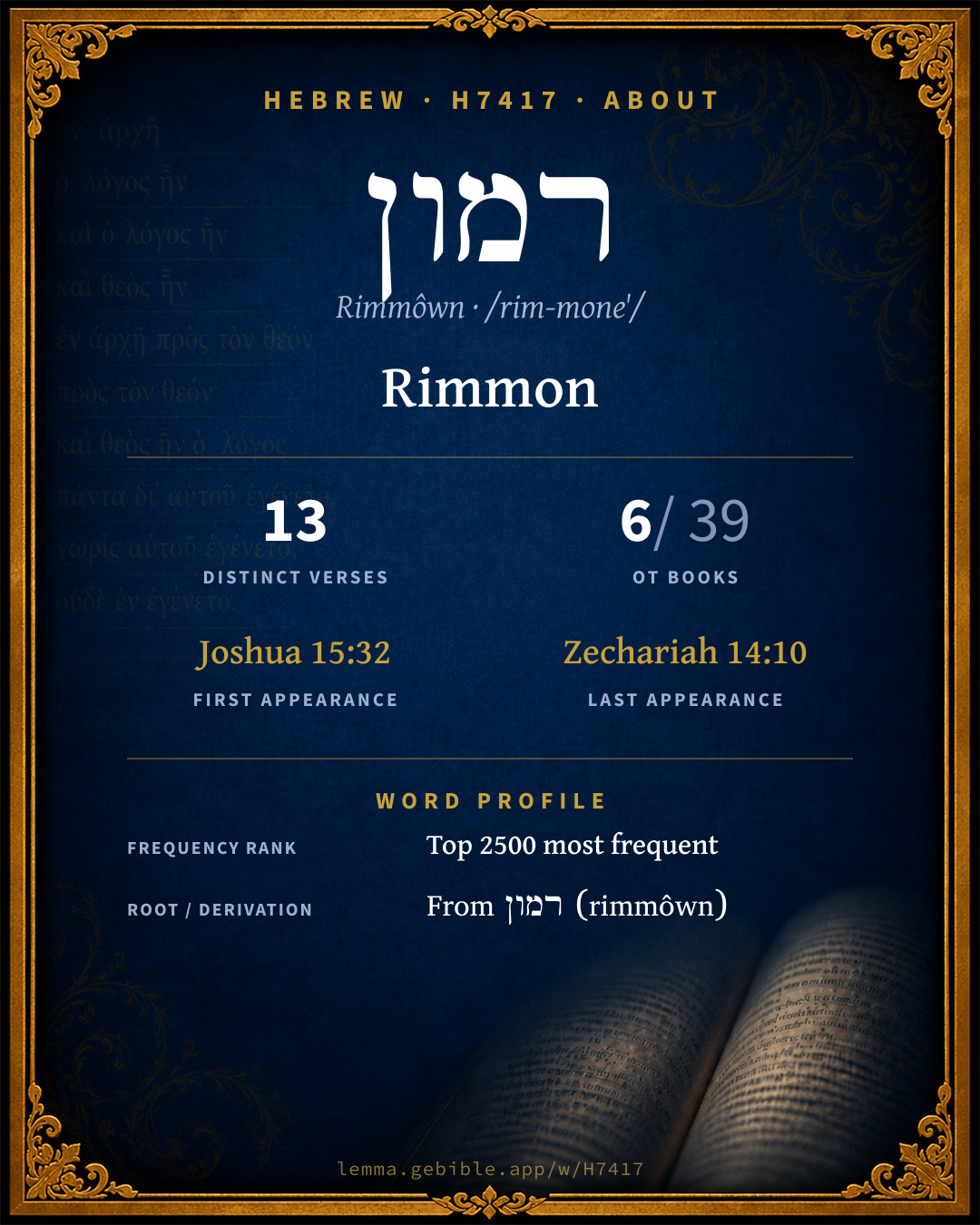
רִמּוֹן
Rimmon
BDB lists 6 entries for ‘Rimmon’ fuller range ↓
Full lexicon entry — Brown-Driver-Briggs (BDB)
From Brown-Driver-Briggs (BDB)
Where this word appears
Grammar key — what these labels mean
Part of speech
- Noun
- A naming word — a person, place, thing, or idea.
Noun type
- Proper
- A name of a specific person, place, or people (e.g. Abraham, Zion, Israel).
Every verse where H7417 appears — 13 distinct verses across 6 books. Click any verse to open its interlinear word-by-word view. Verse text shown in the World English Bible for context — . Each verse’s Hebrew form is shown with its reference; the English is not keyword-highlighted, since the data carries no word-level English alignment. Use “Compare translations” on any verse to read it across multiple English versions. This concordance covers the Hebrew Bible; Septuagint (Greek Old Testament) occurrences are not indexed here.
Joshua 3 verses
- Joshua 15:32 וְ/רִמּ֑וֹן conj + n Proper and Lebaoth, and Shilhim, and Ain, and Rimmon: all the cities are twenty-nine, with their villages.
- Joshua 19:7 רִמּ֖וֹן n Proper Ain, Rimmon, and Ether, and Ashan; four cities with their villages:
- Joshua 19:13 רִמּ֥וֹן n Proper and from there it passed along eastward to Gath Hepher, to Eth-kazin; and it went out at Rimmon which stretches to Neah;
Judges 3 verses
- Judges 20:45 הָֽ/רִמּ֔וֹן ptcl def.art + n Proper They turned and fled toward the wilderness to the rock of Rimmon: and they gleaned of them in the highways five thousand men, and followed hard after them to Gidom, and struck of them two thousand men.
- Judges 20:47 הָֽ/רִמּ֔וֹן רִמּ֔וֹן ptcl def.art + n Proper n Proper But six hundred men turned and fled toward the wilderness to the rock of Rimmon, and abode in the rock of Rimmon four months.
- Judges 21:13 רִמּ֑וֹן n Proper The whole congregation sent and spoke to the children of Benjamin who were in the rock of Rimmon, and proclaimed peace to them.
2 Samuel 3 verses
- 2 Samuel 4:2 רִמּ֥וֹן n Proper [Ish-bosheth], Saul's son, [had] two men who were captains of bands: the name of the one was Baanah, and the name of the other Rechab, the sons of Rimmon the Beerothite, of the children of Benjamin (for Beeroth also is reckoned to Benjamin:
- 2 Samuel 4:5 רִמּ֤וֹן n Proper The sons of Rimmon the Beerothite, Rechab and Baanah, went, and came about the heat of the day to the house of Ish-bosheth, as he took his rest at noon.
- 2 Samuel 4:9 רִמּ֥וֹן n Proper David answered Rechab and Baanah his brother, the sons of Rimmon the Beerothite, and said to them, As Yahweh lives, who has redeemed my soul out of all adversity,
2 Kings 1 verse
1 Chronicles 2 verses
Zechariah 1 verse
About this entry
At a glance — auto-summarized from this page’s data, not written by a person. Every figure links to its source below. This summary describes the numbers; it doesn’t interpret them.
“Rimmon” is the headline sense of the Hebrew name רמון (Rimmôwn). First canonically at Joshua 15:32, it enters the text early. The Hebrew Bible uses it across 13 verses — uncommon. The sections below give every occurrence and version rendering.
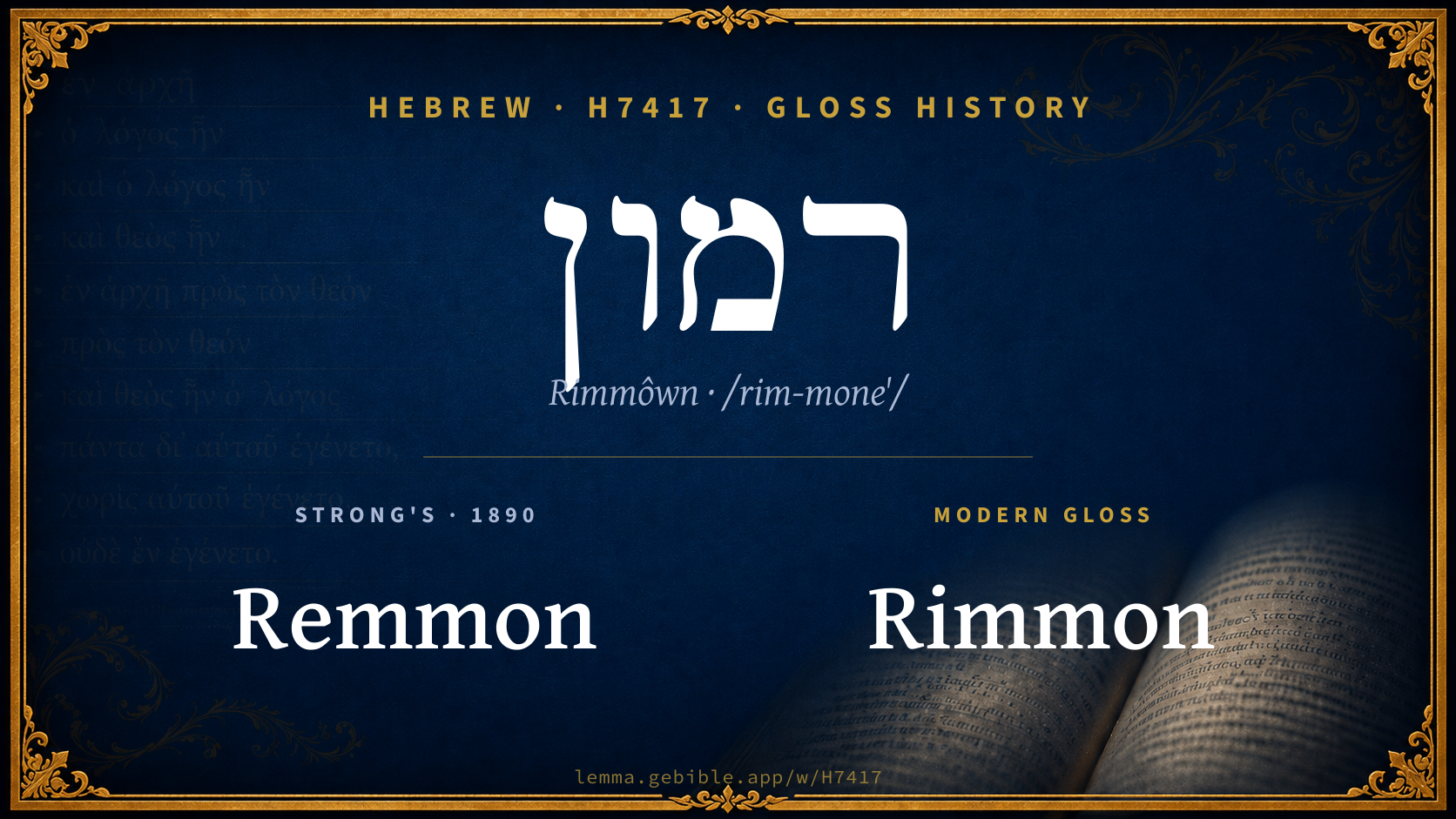
Gloss history
Strong's 1890 vs modern scholarship
About this word
Strong's H7417 catalogs a Hebrew word from the Hebrew Old Testament.
These counts are not copied from any lexicon or concordance. They are computed here, from the morphology-tagged Hebrew Old Testament. What Lemma adds →
- 13
- distinct verses
- The word appears in 13 distinct verses.
- 6 / 39
- OT books
- The word appears in 6 of 39 Old Testament books.
- #1,752
- by frequency
- Top 2500 most frequent Hebrew words (rank 1,752 of 8,640 Hebrew words by occurrence).
View all 13 occurrences in the concordance →
By section of the Old Testament
By traditional corpus
Conventional, traditional groupings — biblical authorship is debated, so this is a traditional corpus grouping, not an authorship claim. Each share is this word’s portion of its verses in that division of the Hebrew canon. Each figure is a share of the word’s 13 distinct verses.
- Prophets (Nevi'im) 11 verses · 85%
- Writings (Ketuvim) 2 verses · 15%
How translations render this word
Counts come from each version’s own published word-to-Strong’s tagging or interlinear alignment — an approximate guide to how each version renders this word, not a word-level alignment the data otherwise carries. Because each total is that version’s own tagged count, the per-version totals vary from one another and need not match the appearance or distinct-verse counts above. These counts may also differ from a printed concordance because Lemma counts each distinctly tagged rendering and does not collapse phrase taggings into a single head-word total. This is a fixed set of word-tagged versions (KJV, ASV, BSB, ULT) and does not change with the reading translation you choose elsewhere. Each version’s license is shown beside its name below (and on Sources).
BDB lists this Strong’s number as 5 distinct words (homographs). Each count above pools all of them and is not split by sense — see the Senses section below. A low-frequency rendering may belong to a different one of those words, not the primary meaning.
- King James Version†: Rimmon 14×
- American Standard Version†: Rimmon 15×
- Berean Standard Bible†: Rimmon 13×
- unfoldingWord Literal Text†: Rimmon 15×
King James Version Public Domain
Renders H7417 across 16† tagged occurrences — most commonly:
Plus 2 renderings that appear only once — usually multi-word phrases or single function words the recovered tagging swept in, not distinct renderings.
American Standard Version Public Domain
Renders H7417 across 16† tagged occurrences — most commonly:
Plus 1 rendering that appears only once — usually multi-word phrases or single function words the recovered tagging swept in, not distinct renderings.
Berean Standard Bible Public Domain
Renders H7417 across 14† tagged occurrences — most commonly:
Plus 1 rendering that appears only once — usually multi-word phrases or single function words the recovered tagging swept in, not distinct renderings. Not rendered by a distinct English word in 2 further occurrences.
unfoldingWord Literal Text CC BY-SA 4.0
Renders H7417 across 16† tagged occurrences — most commonly:
Plus 1 rendering that appears only once — usually multi-word phrases or single function words the recovered tagging swept in, not distinct renderings.
Senses in the full BDB
What do BDB’s symbols mean?
BDB uses these scholarly abbreviations:
| Symbol | Meaning |
|---|---|
| 𝔊 | the Septuagint (the ancient Greek translation, LXX) |
| 𝔙 | the Vulgate (the Latin translation) |
| 𝔖 | the Syriac version (the Peshitta) |
| 𝔗 | the Targum (the Aramaic translation) |
| ψ | the Psalms |
| √ | root (the underlying root or stem) |
| ‖ | parallel passage (a synonymous or contrasted parallel) |
| † | the dagger: every passage where the word occurs is cited |
The 6 senses and sub-senses the full Brown-Driver-Briggs lexicon distinguishes for this word, in lexicon order (not ranked by frequency), with BDB’s own verbatim wording and sub-sense lettering. Shown in Hebrew script with BDB’s own scholarly abbreviations. The condensed entry is in the Lexicon Entry tab. See also the Forms in the corpus table below.
רמון I
- 1. tree 1 S 14:2, often + גֶּפֶן, תְּאֵנָה, etc., Nu 20:5 (JE), Dt 8:8; Hg 2:19; Jo 1:12; Ct 4:13; 6:11; 7:13. e.g. 1 Samuel 14:2
- 2. fruit Nu 13:23 (JE; + עֲנָבִים, תְּאֵנִים); עֲסִיס ר׳ Ct 8:2, פֶּלַח הָר׳ (in sim.) 4:3; 6:7. e.g. Numbers 13:23
- 3. ornaments in temple, shaped like pomegranates (cf. رُمَّانَة in mod. Syria = epaulet, AlmkvistKl. Beiträge zur Lexicogr., etc. NesMarg. 12), 1 K 7:18 (on text cf. StaZAW iii (1883), 154 f. Kit Benz), v 20, 42(×2) ‖ 2 Ch 3:16; 4:13(×2) 2 K 25:17 = Je 52:22; Je 52:22, 23(×2); so in tabernacle, Ex 28:33, 34(×2); 39:24, 25(×2), 26(×2). e.g. 1 Kings 7:18
רמון II dei, in Aramaic (Old Aramaic רמן in n.pr. Lzb 369 Cook 108
רמון III m. in Benj., 2 S 4
רמון IV loc.
- 1. in סֶלַע הָרִמּוֹן cliff of R. Ju 20:45, 47, ס׳ רִמּוֹן v 47 21:13; Ρεμμων; = mod. cliff Rammôn, E. from Bethel, BuhlG 100, cf. GFM Ju 20:45. e.g. Judges 20:45
- 2. in S. Judah, עַיִן וְר׳ Jos 15:32; עַיִן ר׳ 19:7 (both P), 1 Ch 4:32; = ר׳ Zc 14:10; Ρεμμων[θ], etc.; v. iii. עַיִן 2, p. 745, and עֵין רִמּוֹן. e.g. Joshua 15:32
- 3. in Zebulun Jos 19:13 (Ρεμμωνα(μ)), = רִמּוֹנוֹ 1 Ch 6:62 (Ρεμμων); + Jos 21:35 (read רִמֹּנָה for דִּמְנָה, Di Benn Steuern); mod. Rummâne, c. 6 miles E. of N. from Nazareth (BuhlG 221). e.g. Joshua 19:13
Senses from the full Brown-Driver-Briggs lexicon (Brown, Driver, Briggs; Oxford 1906 — public domain), digitized via Sefaria, supplemented by the OpenScriptures HebrewLexicon (CC BY 4.0). Full attribution on Sources.
Word origin
I. n.m. Je 52:23 pomegranate (foreign word of doubtful origin, cf. LöwNo. 310 HomA. u. A. 97 ff.; Aramaic רִימּוֹנָא, רוּמָּנָא, ܪܽܘܡܳܢܳܐ, Mand. רומאנא NöM. 123; Arabic رُمَّانٌ (Aramaic loan-word, Frä 142), Ethiopic ሮማን: );—abs. ר׳ 1 S 14:2 +, רִמֹּן Ex 39:26, 26; sf. רִמֹּנִי Ct 8:2; pl. רִמּוֹנִים 1 K 7:20 +, etc.;—pomegranate:
II. n.pr. dei, in Aramaic (Old Aramaic רמן in n.pr. Lzb 369 Cook 108; Assyrian Rammânu, god of wind, rain and storm (Schr COT 2 K 5, 18 Zim KAT 3, 442 ff. Muss-ArnoltJBL xi (1892), 172 JastrRel. Bab. 156 ff.); Sab. רמן (CISiv, no. 140, 209 H. Derenb in Kohut-Studies120 ff.); etym. dub.; √ רעם thunder Schr; √ ramâmu, roar DlHWB 624 and most; = i. רִמּוֹן HomA. u. A. 98);—בֵּית ר׳ 2 K 5:18, בֵּית רִמֹּן v 18(×2); Ρεμμαν[θ];—v. also הֲדַדְרִמּוֹן p. 213, טַבְרִמּוֹן p. 372.
III. n.pr.m. in Benj., 2 S 4:2, 5, 9; Ρεμμων.
I. 1 Ch 6:62 see iv. רִמּוֹן 3.
— Brown-Driver-Briggs (Oxford 1906, public domain), digitized via Sefaria, supplemented by the OpenScriptures HebrewLexicon (CC BY 4.0). See Sources.
Derived from רמון (rimmôwn) (H7416) — pomegranate.
Jastrow Dictionary
A second Hebrew/Aramaic lexicon for comparison, covering Aramaic and post-biblical (Talmudic, Targumic, Midrashic) usage that the biblical-Hebrew BDB does not. Matched by lemma rather than by Strong’s number, so a lemma may carry more than one Jastrow headword (shown separately below), and the entries cover usage well beyond the Bible.
רִמּוֹן
- , v. רִמָּה) [crowded with seeds, cmp. רָחַשׁ,] pomegranate. Cant. R. to IV, 4 כר׳ הזה, v. רֵיקָן. ib. to VIII, 2 (ref. to עסיס רמני, Ib.) אלו ההגדות שטעמן כר׳ that means the homiletic interpretations whose taste is like that of the pomegranate; a. fr.—Pl. רִמֹּונִים, רִמֹּונִין. Peah I, 5; a. e.
רִמֹּון
- Targ. Cant. IV, 3. Targ. Ex. XXVIII, 34; a. fr.—Ber. 36ᵇ שקלוה לנץ דר׳ ויביש ר׳ they took off the blossom of a pomegranate, and the pomegranate dried up. Lev. R. s. 12 רמונא מתקרי רמון the pomegranate (tree) is also called pomegranate; a. e.—Pl. רִמּוֹנִין, רִמֹּונַיָּא, רִי׳. Targ. O. Ex. XXVIII, 33. Targ. Cant. IV, 13. Targ. Hag. II, 19; a. fr.—V. רוּמָּנָא.
A Dictionary of the Targumim, the Talmud Babli and Yerushalmi, and the Midrashic Literature (Marcus Jastrow; London, Luzac, 1903) — Public Domain. Digitized via Sefaria. Digitized via Sefaria. Full attribution on Sources.
Forms in the corpus
The 11 distinct written forms H7417 takes in the Hebrew Bible, most frequent first — each parse links to that state’s occurrences in the concordance. Hebrew forms include their vowel points and cantillation, so a single lemma takes many written forms.
| Form | Parsing | Example | Uses |
|---|---|---|---|
| רִמּ֥וֹן | Noun, Proper | 1 Chronicles 4:32 | 4 |
| הָֽ/רִמּ֔וֹן | Noun, Proper | Judges 20:45 | 2 |
| רִמֹּ֔ן | Noun, Proper | 2 Kings 5:18 | 2 |
| וְ/רִמּ֑וֹן | Noun, Proper | Joshua 15:32 | 1 |
| לְ/רִמּ֔וֹן | Noun, Proper | Zechariah 14:10 | 1 |
| רִמּ֑וֹן | Noun, Proper | Judges 21:13 | 1 |
| רִמּ֔וֹן | Noun, Proper | Judges 20:47 | 1 |
| רִמּ֖וֹן | Noun, Proper | Joshua 19:7 | 1 |
| רִמּ֤וֹן | Noun, Proper | 2 Samuel 4:5 | 1 |
| רִמּוֹן֩ | Noun, Proper | 2 Kings 5:18 | 1 |
| רִמּוֹנ֖וֹ | Noun, Proper | 1 Chronicles 6:77 | 1 |
Same root — word family
Other BDB entries built from the same root as H7417, grouped by Strong’s listed origin. These share a root / origin per the lexicon — not necessarily a shared meaning. Each links to that word’s own entry.
Derives from
Proper names from this root
People and places named from this root — a name, not an additional meaning of the word.
Compare all same-root words → 1 of the same-root words is a proper name (a person or place). They share a root, not necessarily a meaning.
Bible dictionary
Public-domain dictionary articles matched to this entry by name (Rimmon). A biblical name can be shared by more than one person or place, so an article may treat several.
Easton's Bible Dictionary · M. G. Easton, 1897
Pomegranate. (1.) A man of Beeroth (2 Sam. 4:2), one of the four Gibeonite cities. (See Josh. 9:17.)
(2.) A Syrian idol, mentioned only in 2 Kings 5:18.
(3.) One of the "uttermost cities" of Judah, afterwards given to Simeon (Josh. 15:21, 32; 19:7; 1 Chr. 4:32). In Josh. 15:32 Ain and Rimmon are mentioned separately, but in 19:7 and 1 Chr. 4:32 (comp. Neh. 11:29) the two words are probably to be combined, as forming together the name of one place, Ain-Rimmon=the spring of the pomegranate. It has been identified with Um er-Rumamin, about 13 miles south-west of Hebron.
(4.) "Rock of," to which the Benjamites fled (Judg. 20:45, 47; 21:13), and where they maintained themselves for four months after the fearful battle at Gibeah, in which they were almost exterminated, 600 only surviving out of about 27,000. It is the present village of Rummon, "on the very edge of the hill country, with a precipitous descent toward the Jordan valley," supposed to be the site of Ai.
Smith's Bible Dictionary · William Smith, 1863
a deity worshipped by the Syrians of Damascus, where there was a temple or house of Rimmon. (2 Kings 5:18) Rimmon is perhaps the abbreviated form of Hadad-rimmon, Hadad being the sun-god of the Syrians. Combining this with the pomegranate which was his symbol, Hadad-rimmon would then he the sun-god of the late summer, who ripens the pomegranate and other fruits.
(pomegranate) the name of several towns.
+ A city of Zebulun (1 Chronicles 6:77; Nehemiah 11:29) a Levitical city, the present Rummaneh, six miles north of Nazareth. + A town in the southern portion of Judah, (Joshua 15:3) allotted to Simeon, (Joshua 19:7; 1 Chronicles 4:32) probably 13 miles southwest of Hebron. + Rimmon-parez (pomegranate of the breach), the name of a march-station in the wilderness. (Numbers 33:19,20) No place now known has been identified with it. + Rimmon the Rock, a cliff or inaccessible natural fastness, in which the six hundred Benjamites who escaped the slaughter of Gibeah took refuge. (Judges 20:45,47; 21:13) In the wild country which lies on the east of the central highlands of Benjamin the name is still found attached to a village perched on the summit of a conical chalky hill, visible in all directions, and commanding the whole country. + A Benjamite of Beeroth, the father of Rechab and Baanah, the murderers of Ish-bosheth. (2 Samuel 4:2,5,9)
Hitchcock's Bible Names Dictionary · Roswell D. Hitchcock, 1869
exalted; pomegranate
Classic public-domain reference works; full attribution on Sources.
Septuagint verse parallels
This word appears in 12 verses that also exist in the Greek Old Testament (Septuagint), out of the 13 Hebrew verses it occurs in. You can read those verses in Greek by switching the Old Testament edition to the Septuagint.
Read these verses in the Septuagint
This is a verse-level parallel only — the same verses exist in both the Hebrew and Greek Old Testaments. No word-level Hebrew↔Greek correspondence is claimed: the data carries no such alignment, so no Greek word is shown as this Hebrew word’s translation. Coverage is not total — the Septuagint omits the deuterocanon and renumbers the Psalms, so some Hebrew verses have no direct Greek parallel.