1 Kings 13:7

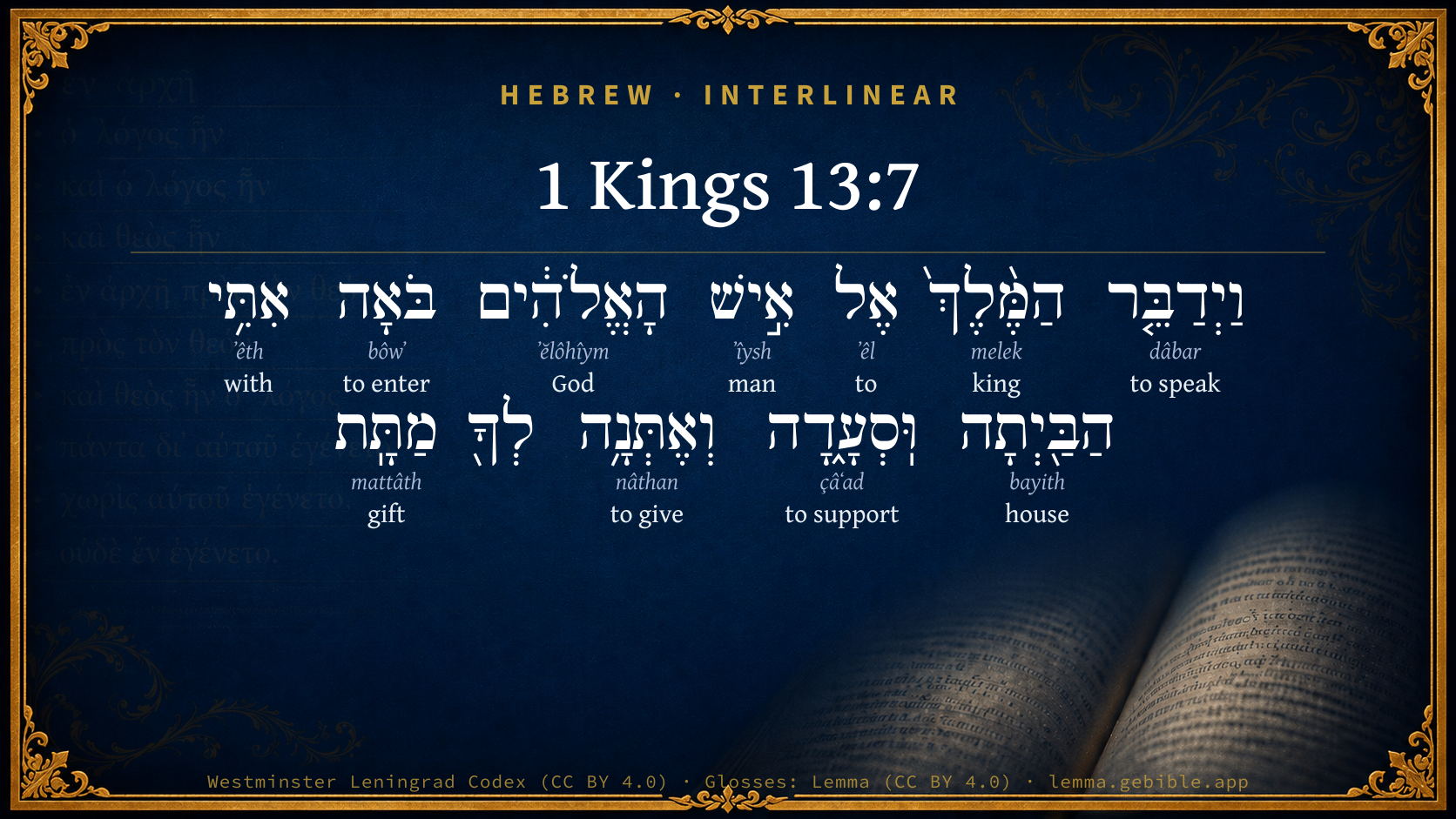
Hebrew (Westminster Leningrad Codex) 1 Kings 13:7 appears in the Hebrew Old Testament. The text above is from the Westminster Leningrad Codex. Each word links to its Strong’s number, a concise gloss, and parsing drawn from the Open Scriptures Hebrew Bible morphology. Click any word for its full Brown-Driver-Briggs (BDB) entry.
Download image
Cite this verse

1 Kings 13:7 (World English Bible). Public Domain. Lemma interlinear Bible study tool, https://lemma.gebible.app/v/1-kings/13/7.

Show BibTeX & RIS
BibTeX
RIS
English Translation
The king said to the man of God, Come home with me, and refresh yourself, and I will give you a reward.
World English Bible · Public Domain
Highlights
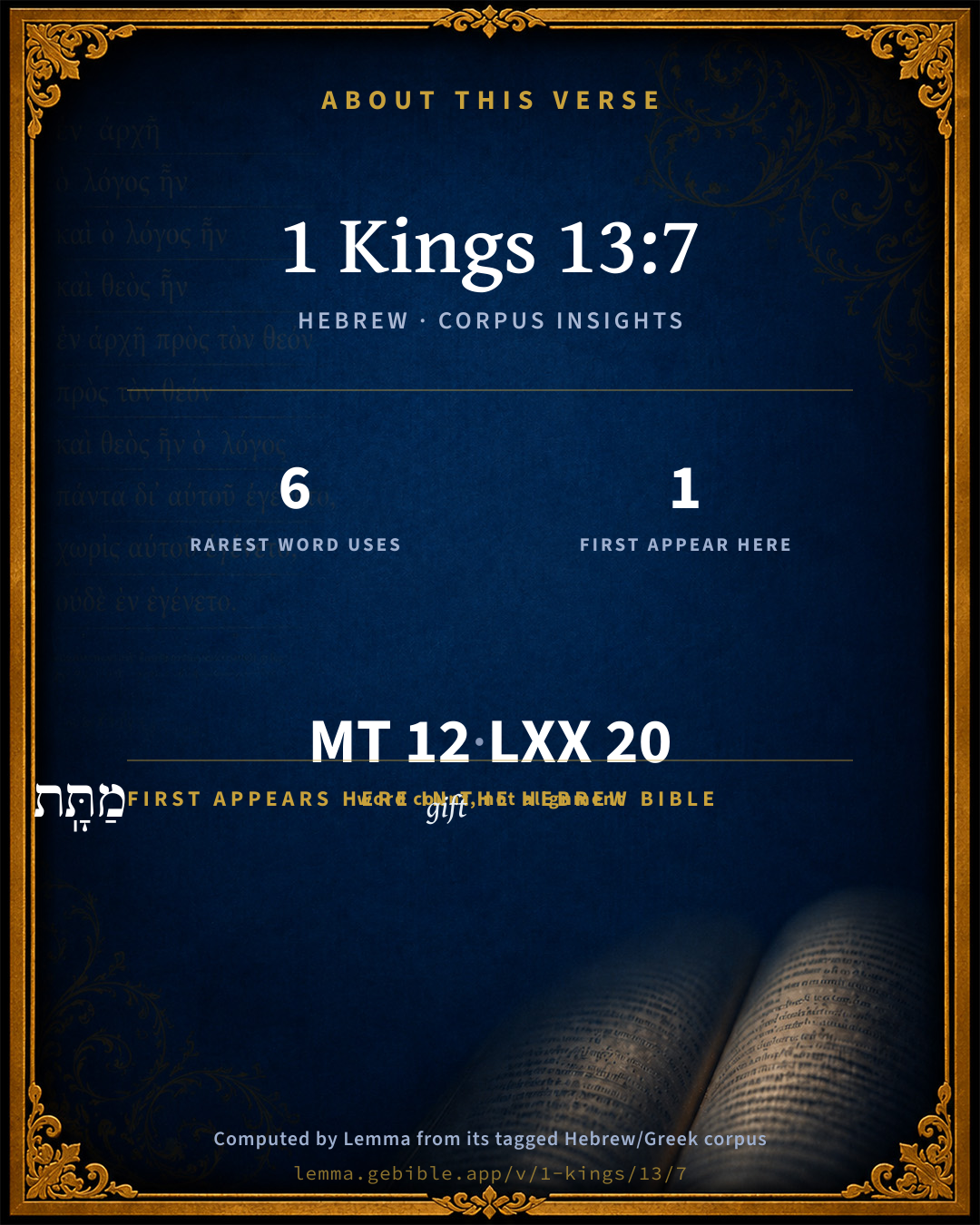
  • 1 first appearance in the Hebrew Bible
Full analysis ↓
Download a study sheet

One document with this verse’s original text, its word-by-word gloss line, the meaning frame, cross-references with their text, attributed commentary, and full source and license credits — printable, and it pastes into notes with its structure intact.

This verse Autodidact and up

Study sheet (.html) Plain text (.txt)

A passage Seminary Student

Up to 50 verses in one chapter. A passage sheet keeps up to 6 commentary sources and 12 cross-references per verse, in the order this page ranks them, and says so on the sheet whenever that leaves anything out. Ask for a single verse and you get the Autodidact verse sheet above.

Everything on this page stays free to read, with no account — the sheet is a download of what is already on screen, not access to it.

Want to remove ads? Support Godless Engineer
Compare translations 3

The same verse in 3 English versions, stacked beneath the original-language interlinear above. Click any original word for its lexicon entry.

Each is an independent rendering of the whole verse — the interlinear is not word-aligned to these translations.

Highlighted words mark where these versions differ — a whole-verse word diff, not a word-by-word alignment.

  • World English Bible Public Domain
    The king said to the man of God, Come home with me, and refresh yourself, and I will give you a reward.
  • King James Version Public Domain
    And the king said unto the man of God, Come home with me, and refresh thyself, and I will give thee a reward.
  • unfoldingWord Literal Text CC BY-SA 4.0
    And the king spoke to the man of God, “Come with me to the house and refresh yourself, and I will give a gift to you.”

unfoldingWord Literal Text — © unfoldingWord, licensed CC BY-SA 4.0. Word-aligned USFM3 via Door43 (git.door43.org/unfoldingWord/en_ult).

Versions to compare (up to 4)

3 of 4 selected

Show all 18 translations

Every available English version of this verse, each an independent rendering of the whole verse.

  • World English Bible Public Domain
    The king said to the man of God, Come home with me, and refresh yourself, and I will give you a reward.
  • Berean Standard Bible Public Domain
    Then the king said to the man of God, “Come home with me and refresh yourself, and I will give you a reward.”
  • Majority Standard Bible Public Domain
    Then the king said to the man of God, “Come home with me and refresh yourself, and I will give you a reward.”
  • King James Version Public Domain
    And the king said unto the man of God, Come home with me, and refresh thyself, and I will give thee a reward.
  • American Standard Version (1901) Public Domain
    And the king said unto the man of God, Come home with me, and refresh thyself, and I will give thee a reward.
  • Revised Version (1885) Public Domain
    And the king said unto the man of God, Come home with me, and refresh thyself, and I will give thee a reward.
  • Geneva Bible (1599) Public Domain
    Then the King sayde vnto the man of God, Come home with mee, that thou mayest dyne, and I will giue thee a reward.
  • Douay-Rheims (1899) Public Domain
    And the king said to the man of God: Come home with me to dine, and I will make thee presents.
  • Young's Literal Translation Public Domain
    And the king speaketh unto the man of God, `Come in with me to the house, and refresh thyself, and I give to thee a gift.'
  • Literal Standard Version CC BY-SA 4.0
    And the king speaks to the man of God, “Come in with me to the house, and refresh yourself, and I give a gift to you.”
  • Unlocked Literal Bible CC BY-SA 4.0
    The king said to the man of God, “Come home with me and refresh yourself, and I will give you a reward.”
  • unfoldingWord Literal Text CC BY-SA 4.0
    And the king spoke to the man of God, “Come with me to the house and refresh yourself, and I will give a gift to you.”
  • Darby Bible Public Domain
    And the king said to the man of God, Come home with me, and refresh thyself, and I will give thee a present.
  • World Messianic Bible Public Domain
    The king said to the man of God, “Come home with me and refresh yourself, and I will give you a reward.”
  • Webster's Bible Public Domain
    And the king said to the man of God, Come home with me, and refresh thyself, and I will give thee a reward.
  • Free Bible Version CC BY-SA 4.0
    Then the king said to the man of God, “Come to my home and have a meal so I can give you a present.”
  • Bible in Basic English Public Domain
    And the king said to the man of God, Come with me to my house for food and rest, and I will give you a reward.
  • JPS Tanakh (1917) Public Domain
    And the king said unto the man of God: 'Come home with me, and refresh thyself, and I will give thee a reward.'

Literal Standard Version (2020), Covenant Press — licensed CC BY-SA 4.0. Text via the HelloAO Bible API (eBible.org). Unlocked Literal Bible (unfoldingWord) — licensed CC BY-SA 4.0. Text via the HelloAO Bible API (eBible.org). unfoldingWord Literal Text — © unfoldingWord, licensed CC BY-SA 4.0. Word-aligned USFM3 via Door43 (git.door43.org/unfoldingWord/en_ult). Free Bible Version, Dr. Jonathan Gallagher — licensed CC BY-SA 4.0. Text via the HelloAO Bible API (eBible.org).

Word by word

More ways to search: Search by grammar → Find every occurrence → Compare this word →

Practice this passage: Drill this verse → Learn its vocabulary →

מַתָּֽת
mattâth
H4991
“gift”
Noun, Common, Feminine, Singular, Absolute
Part of Speech
Noun
Type
Common
Gender
Feminine
Number
Singular
State
Absolute
Full BDB Definition

Origin: from H4976 abbrev. form

TWOT: 1443d

gift, reward
  1. וַיְדַבֵּ֤ר dâbar H1696 “and · to speak” Conjunction + Verb, Piel, Sequential Imperfect, 3rd Person, Masculine, Singular
  2. הַמֶּ֨לֶךְ֙ melek H4428 “the · king” Particle, Definite Article + Noun, Common, Masculine, Singular, Absolute
  3. אֶל ʼêl H413 “to” Preposition
  4. אִ֣ישׁ ʼîysh H376 “man of” Noun, Common, Masculine, Singular, Construct
  5. הָאֱלֹהִ֔ים ʼĕlôhîym H430 “the · God(s)” Particle, Definite Article + Noun, Common, Masculine, Plural, Absolute
  6. בֹּאָה bôwʼ H935 “enter” Verb, Qal, Imperative, 2nd Person, Masculine, Singular + Suffix, h
  7. אִתִּ֥י ʼêth H854 “with · me” Preposition + Suffix, Personal, 1st Person, Common, Singular
  8. הַבַּ֖יְתָה bayith H1004 “the · house · toward” Particle, Definite Article + Noun, Common, Masculine, Singular, Absolute + Suffix, Demonstrative
  9. וּֽסְעָ֑דָה çâʻad H5582 “and · support” Conjunction + Verb, Qal, Imperative, 2nd Person, Masculine, Singular + Suffix, h
  10. וְאֶתְּנָ֥ה nâthan H5414 “and · to give” Conjunction + Verb, Qal, Cohortative, 1st Person, Common, Singular

About this verse

These counts appear in no published source. They are computed here, from the morphology-tagged text and Lemma’s own curated glosses. What Lemma adds →

12
words
11
distinct lemmas
Historical
section

Notable vocabulary

The rarest word here is מַתָּֽת gift H4991 — appearing just 6 times in the whole Hebrew Bible.

First appearance in Scripture

This word makes its first canonical appearance in the Hebrew Bible here:

  • מַתָּֽת gift H4991

Shared distinctive vocabulary

מַתָּֽת gift H4991 occurs in 6 verses of the Hebrew Bible. Also found in:

Grammatical profile

  • 4 verbs
  • 5 nouns
  • 3 prepositions

Verb forms

  • וַיְדַבֵּ֤ר Piel · Sequential Imperfect
  • בֹּאָה Qal · Imperative
  • וּֽסְעָ֑דָה Qal · Imperative
  • וְאֶתְּנָ֥ה Qal · Cohortative

Hebrew & Septuagint length

In English translation the verse runs 22 words from the Hebrew and 24 from the Septuagint (LXX English) — closely comparable.

A rough comparison of the two English renderings, which tokenize alike — not a word-level alignment.

Word counts can differ between the Hebrew and the Greek without any difference in meaning — e.g. the Hebrew direct-object marker אֵת has no separate Greek word, and Greek often adds the article ὁ.

In the original languages it is 12 Hebrew tokens and 20 Greek tokens — but the two are counted differently (Hebrew bundles its prefixes and suffixes into one token; the Greek is in lemma form), so that isn’t a like-for-like length.

Cross-references

9

Topical passages linked to 1 Kings 13:7 in the Treasury of Scripture Knowledge — connected by theme and wording, ordered by reader-vote popularity; previews shown in the World English Bible.

  • 2 Kings 5:15 He returned to the man of God, he and all his company, and came, and stood before him; and he said, See now, I know that there is no God in all the earth, but in Israel: now therefore, please take a present from your servant.
  • 1 Samuel 9:7–8 Then said Saul to his servant, But, behold, if we go, what shall we bring the man? for the bread is spent in our vessels, and there is not a present to bring to the man of God: what have we?
  • Genesis 18:5 I will get a morsel of bread so you can refresh your heart. After that you may go your way, now that you have come to your servant." They said, "Very well, do as you have said."
  • Judges 13:15 Manoah said to the angel of Yahweh, I pray you, let us detain you, that we may make ready a kid for you.
  • Judges 19:21 So he brought him into his house, and gave the donkeys fodder; and they washed their feet, and ate and drink.
  • Jeremiah 40:5 Now while he was not yet gone back, Go back then, [said he], to Gedaliah the son of Ahikam, the son of Shaphan, whom the king of Babylon has made governor over the cities of Judah, and dwell with him among the people; or go wherever it seems right to you to go. So the captain of the guard gave him food and a present, and let him go.
  • Malachi 1:10 "Oh that there were one among you who would shut the doors, that you might not kindle fire on my altar in vain! I have no pleasure in you," says Yahweh of hosts, "neither will I accept an offering at your hand.
  • Acts 8:18–20 Now when Simon saw that the Holy Spirit was given through the laying on of the apostles' hands, he offered them money,
  • 1 Peter 5:2 Shepherd the flock of God which is among you, exercising the oversight, not under compulsion, but voluntarily, not for dishonest gain, but willingly;

Cross-references courtesy of OpenBible.info (CC BY 4.0).

Hebrew and Greek witnesses Masoretic Hebrew ↔ Greek Septuagint

The same verse in the two great witnesses to the Old Testament, shown verse-for-verse.

These are two independent witnesses, not word-aligned to each other, and the Septuagint is shown in lemma (dictionary) form.

Hebrew 1 Kings 13:7 Masoretic · Westminster Leningrad Codex

וַיְדַבֵּ֤ר הַמֶּ֨לֶךְ֙ אֶל אִ֣ישׁ הָאֱלֹהִ֔ים בֹּאָה אִתִּ֥י הַבַּ֖יְתָה וּֽסְעָ֑דָה וְאֶתְּנָ֥ה לְךָ֖ מַתָּֽת

The king said to the man of God, Come home with me, and refresh yourself, and I will give you a reward.

World English Bible · Public Domain

Greek LXX 1 Kings 13:7 Septuagint · lemma form

καί λαλέω ὁ βασιλεύς πρός ὁ ἄνθρωπος ὁ θεός εἰςἔρχομαι μετά ἐγώ εἰς οἶκος καί ἀριστέω καί δίδωμι σύ δόμα

And the king said to the man of God, Enter with me into the house, and dine, and I will give you a gift.

LXX2012 (modern English Septuagint) · Public Domain

Hebrew: Westminster Leningrad Codex (CC BY 4.0). Greek: Septuagint (public domain); English from LXX2012 (modern English Septuagint) (Public Domain). How the Septuagint differs from the Hebrew →

Targum (Aramaic paraphrase)

1

The Targum is the ancient Jewish Aramaic paraphrase of the Hebrew Scriptures — an interpretive translation, not the Hebrew text itself. Onkelos (literal) and Pseudo-Jonathan (expansive) render the Torah, and Jonathan the Prophets. Coverage is partial: where no permissively-licensed English translation exists for a verse, only the Aramaic is shown. This is verse-level text, not a word-by-word alignment to the Hebrew.

  1. Targum Jonathan Prophets (Joshua–Malachi)
    וּמַלֵיל מַלְכָּא עִם נְבִיָא דַייָ עוּל עִמִי לְבֵיתָא וּסְעוֹד וְאֶתֵּן לָךְ מַתְּנָא:

    (no public-domain English translation for this verse)

    Targum Jonathan — Aramaic: “Mikraot Gedolot” (public domain). English: “Sefaria Community Translation” (CC0 1.0 (public-domain dedication)); “London "Chaldee Paraphrase," 1871” (public domain). Text via Sefaria.

Commentary

Notes on 1 Kings 13:7 from classic Christian and Jewish commentators (each source and its license shown beneath its notes). The classic Christian expositions comment on the surrounding passage and are grouped to its opening verse, so a note may address several verses; the Jewish commentaries on the Tanakh (Rashi and others) are per-verse, so they appear only where the commentator wrote on this verse.

Lemma curates 59 commentaries, every one of them public domain or Creative Commons licensed, each selected and text-cleaned for this edition rather than reprinted as found. About our sources →

Trapp's Complete Commentary

John Trapp

1Ki 13:7 And the king said unto the man of God, Come home with me, and refresh thyself, and I will give thee a reward.

Ver. 7. And I will give thee a reward.] He could do anything sooner than repent; {Rom 2:5} his face he had made harder than any rock, he refused to return. {Jer 5:3}

John Trapp, A Commentary or Exposition upon All the Books of the Old and New Testament (1647–1656) — public domain. Text from a community e-Sword module.

Joseph Benson's Commentary

1Ki 13:7-9. I will give thee a reward — He desires to requite the instrument, but takes no notice of God, the chief cause and author of this wonderful mercy. The man of God said, I will not go in with thee, &c. — In obedience to God, he refuses to eat, or drink, or have any familiar society with him, against whom he had pronounced God’s indignation. For so it was charged me — My refusal of thy favour is not from any contempt or hatred of thy person, but in compliance with the just command of my God, who hath forbidden me all further converse or communication with thee. Saying, Eat no bread, nor drink water — Namely, in that place, or with that people. Hereby God showed his detestation of their idolatry, not because it was as bad as that of the heathen, but because they were vile apostates from the true God, and embraced this idol-worship against the light of their own consciences, merely to comply with the king’s humour and command; and because their vicinity and relation to Judah, exposed that tribe to the danger of being infected by their idolatry. God also intended hereby to teach his people in all ages to have no fellowship with the unfruitful works of darkness, lest they should either give encouragement to, or receive infection from, them. Nor turn again by the same way thou earnest — That by avoiding the way that led him to Beth-el as execrable, although he went by God’s special command, he might teach all others how much they ought to abhor that way, and all thoughts of going to that place, or to such idolatrous people, upon any unnecessary occasion.

Joseph Benson's Commentary on the Old and New Testaments (1811–1818) — public domain. Text from a community e-Sword module.

Tyndale Open Study Notes

Tyndale Open Resources

13:7 have something to eat: In accordance with ancient Near Eastern custom, the king’s seeming gratitude and offer of hospitality also carried implications of approval and fellowship (13:19; see Gen 24:52-54).

Tyndale Open Study Notes — © Tyndale Open Resources, licensed CC BY-SA 4.0. Text via the HelloAO Bible API.

Geneva Bible (1599)

Geneva Bible translators

Or, take sustenance.

Geneva Bible (1599) marginal notes — public domain. Text via Bolls.life.

Adam Clarke's Commentary

Verse 7. Come home with me - and I will give thee a reward.] Come and be one of my priests, and I will give thee a proper salary.

Adam Clarke's Commentary on the Bible (1810–1826) — public domain. Text from a community e-Sword/MySword module.

Ellicott's Commentary for English Readers

(7) Come home with me . . .—The invitation may have been in part the mark of some impression made on the king, and an impulse of gratitude for the restoration of his withered hand. Such was the request of Naaman to Elisha (2Ki_5:15), though even this was emphatically refused. But it still savours of astute policy in Jeroboam: for the acceptance of hospitality and reward would in the eyes of the people imply a condonation of the idolatrous worship, which might well destroy or extenuate the impression made by the prophet’s prediction. It indicates also—what experience of such men as “the old prophet” would have produced—a low idea of prophetic character and mission, not unlike that which is shown in Balak’s treatment of Balaam. That such conceptions are perfectly compatible with a certain belief in the reality of a supernatural power in the prophet—although they, of course, derogate from its true sacredness—the monstrous request of Simon Magus (in Act_8:19) shows with the most startling clearness. It was evidently to provide against these things—as fatal to the effectiveness of the prophet’s mission—that the prohibition of 1Ki_13:9 was given; nor could its general purpose have been easily misunderstood, either by the king or by the prophet himself. It is a curious coincidence that in his refusal he uses words strangely like the reluctant refusal of Balak’s offer by Balaam (Num_22:18). The very strength of the language is suspicious.

A Bible Commentary for English Readers, edited by Charles John Ellicott (1878–1897) — public domain. Text from a community e-Sword module.

The Cambridge Bible for Schools and Colleges

gen. ed. J. J. S. Perowne

7. Come home with me] The subsequent narrative shews that there was no alteration in Jeroboam’s feelings or intentions in consequence of what had occurred. He still went on in his evil way. But he would fain have the man of God continue in his company a while, that his people might not be terrified by what had happened and decide to break off from the calf-worship and go up to Jerusalem to the Temple again.

The Cambridge Bible for Schools and Colleges (gen. ed. J. J. S. Perowne; Cambridge University Press, 1878–1918) — public domain. Text from a community e-Sword module.

John Gill's Exposition

And the king said unto the man of God, come home with me, and refresh thyself,.... By eating a meal with him, after such a journey he had taken, and delivered his prophecies, and put up his prayers for the king:

and I will give thee a reward; for his prayers, by means of which his hand was restored to him; but takes no notice of the Lord, the author of this miraculous cure, nor expresses the least degree of thankfulness and gratitude to him.

John Gill's Exposition of the Whole Bible (1746–1763) — public domain (CC PDM 1.0). Text via the HelloAO Bible API.

Albert Barnes' Notes on the Bible

I will give thee a reward - It was customary to honor a prophet with a gift, if he performed any service that was requested at his hands (see the marginal references).

Albert Barnes' Notes on the Bible (1834–1885) — public domain. Text from a community e-Sword/MySword module.

Matthew Poole's English Annotations

Horrid stupidity! He desires to requite the instrument, but takes no notice of the chief cause and author of this great and wonderful mercy, which was God.

Matthew Poole's English Annotations on the Holy Bible (1683–1685) — public domain. Text from a community e-Sword/MySword module.

Whedon's Commentary on the Bible

Daniel D. Whedon

7. Come home with me — He tempts him with three things: royal hospitality, refreshment, and reward. How much these offers influenced the future action of the prophet can only be imperfectly conjectured.

Daniel D. Whedon (gen. ed.), Commentary on the Old and New Testaments (1874–1909) — public domain. Text from a community e-Sword module.

The Pulpit Commentary

And the king said unto the man of God, Come home with me, and refresh thyself with food, ablutions, etc. (Gen_18:4, Gen_18:5; Mar_7:3, etc.) We are hardly justified in seeing in these words (with Bahr and Keil) an attempt to "gain the prophet over to his side by friendliness," and to render his threat harmless in the eyes of the people. The king doubtless may have hoped that it would "blunt the edge of the prophet"s denunciation of his schismatical altar" (Wordsworth); but this was not the object, or not the sole object, with which the invitation was given. Jeroboam could not possibly have clone less, after the signal service the man of God had rendered him, than invite him to his palace. Eastern courtesy alone (Gen_18:4 Gen_19:2 Gen_43:24, etc.) would require him to offer hospitality to his benefactor. And he could scarcely hope that any hospitalities would either neutralize the impression which the recent miracles had made, or win over to his side one who had a direct commission from the Most High to oppose him. With more reason, Wordsworth cites, 1Sa_15:30, "Honour me now, I pray thee, before the elders of my people." A feeling of gratitude may have prompted the invitation, while the king at the same time was very sensible of the advantages which would accrue to himself if it were accepted and I will give thee a reward. The services, especially of seers and prophets, were invariably requited in the East with presents, as are those of Judges, Kadis, Kaimakams, and other officers at the present day (see 1Ki_14:3; Gen_24:53 Gen_33:11 Gen_43:11; Num_22:17; Jud_1:3:17 6:18 13:15; 1Sa_9:7, 8 12:3; 2Ki_5:5, 15 8:8, 9)

Vers. 7-10.

The Man of God.

We may view "Jeroboam the son of Nebat, who made Israel to sin," as the "man of sin" of his time, and a forerunner of the Antichrist of more modern. (2Th_2:3) In contrast to him we have to consider the "man of God," in which character this prophet who confronted Jeroboam at Bethel, is described. The instructions under which he acted teach us how a saint should behave amongst workers of iniquity.

I HE MUST HOLD NO FELLOWSHIP WITH THEM.

1. He must not eat and drink with them.

(1) For this was anciently a profession of fellowship. Hence the Hebrews in Egypt would not eat with the Egyptians. (Gen_43:32) The Jews would not eat with the Samaritans; (Joh_4:9) and they were shocked to see Jesus eating with publicans and sinners. (Mat_9:11) For the same reason Christians were forbidden to eat with ungodly persons (1Co_5:11; see also Rom_16:17; 2Th_3:6, 2Th_3:14; 2Ti_3:5; Jam_4:4; 2Jn_1:10)

(2) The law of distinction between clean and unclean meats set forth not only the duty of avoiding fellowship with moral uncleanness, but also with those who are morally unclean; for the unclean animals represented "sinners of the Gentiles" while the clean stood for the "holy people" of Israel. (Act_10:14)

(3) The eating of the forbidden fruit in Eden at the instigation of the serpent, who also seems to have eaten of it first, expressed fellowship with Satan! As the trees of Eden were sacramental, it may have expressed a covenant with the Evil One! Those who ate together were understood to stand to each other in a covenant relationship. (Gen_31:43-46)

(4) In this light the Christian Eucharist sets forth the covenant fellowship, that we have, first, with Christ, and secondly, with those who are in such fellowship with Him (see, in this light,. (Joh_6:53-56)

2. He must refuse their presents.

(1) Some think Jeroboam"s offer to "reward" the man of God was to give him a bribe. This is not evident. Yet good men are liable to be tempted with bribes, but should stoutly refuse them (1Sa_12:3; Job_15:34)

(2) The king"s intention was to do honour to the man of God, according to a constant custom in the East (see 1Sa_9:7; 2Ki_5:15) The word ttm here translated "reward," would have been better rendered "gift," as in many other places it is. But such a gift or present, if accepted, would express friendship, and therefore, coming from the hand of an arch idolator and schismatic, it must be declined,

(3) Good men must be careful how they accept favours from the wicked, lest in doing so they may compromise to them their independence, or come unduly under their influence (see Gen_14:23 Gen_23:13; 2Ki_5:16)

II HIS INTERCOURSE WITH THEM SHOULD BE BRIEF.

1. While serving God he is safe.

(1) His very testimony for God commits him to a course of conduct consistent with it. This element of moral strength is lost to those who hide their light under a bushel.

(2) He has a right to claim God"s help. (Mat_10:19, 20 28:20)

2. But it is perilous longer to remain.

(1) The very disposition to remain amidst circumstances with which we should have no sympathy argues weakness which should alarm.

(2) He lays himself open to temptation. He may find the "king" disposed to honour him. Some are foolishly susceptible to flattery from the great ones of this world. The man of God should be proof against this (ver. 8).

(3) He may be taken at a disadvantage. Being away from the influence of godly friends. Having now no claim to special help from God.

3. But why must he return by another way?

(1) Not only did the man of God give a sign, but he was also himself a sign (Eze_12:11 Eze_24:24; Zec_3:8, margin) As Jeroboam was the sign of the man of sin, this prophet was, at least in his instructions, a typical "man of God.

(2) In coming from Judah, where God was purely worshipped in His temple, to Ephraim, where "altars were made unto sin," he would personate that moral lapse into which Ephraim had fallen.

(3) In his speedy return from Ephraim to Judah, after deprecating the sin of the place, he would represent to the Ephrathites what God expected from them, viz., repentance and reformation.

(4) But the way hack to God is not precisely the reversal of the way from Him. Adam fell by sin of his own and was turned out of Eden, but must return by the righteousness of another. (Gen_3:24) Our way hack to God is the "new and living way opened in the blood of Jesus. J.A.M.

The Pulpit Commentary (1880–1919), ed. H.D.M. Spence-Jones & Joseph S. Exell — public domain. Text from a community e-Sword module.

Rashi

Rabbi Shlomo Yitzchaki (Rashi)

And have a meal. [And] eat.

Rashi on the Tanakh — English translations: “The Judaica Press complete Tanach with Rashi, translated by A. J. Rosenberg” (CC BY 4.0); “Pentateuch with Rashi's commentary by M. Rosenbaum and A.M. Silbermann, 1929-1934” (public domain); “The Metsudah Tanach series, Lakewood, N.J” (CC BY 4.0); and “The Book of Joshua, Metsudah Publications, 1997” (CC BY 4.0). Text via Sefaria.

Lesson kit

Teaching starters — assembled from the data on this page, not authored interpretation. Every prompt links to the verse data it draws on. Edit before teaching.

1 Kings, in the Historical, opens this verse with 12 words (11 distinct Hebrew lemmas). Its most distinctive word is mattâth (“gift”). A historical commentator’s framing appears above. Read the whole chapter for the surrounding context.

Discussion questions

  1. The word mattâth carries the sense “gift.” How does it shape the verse?
  2. The word “gift” first appears here in Scripture. What is being introduced at this debut?
  3. Proverbs 25:14 shares the word «gift» with this verse. How do the two illuminate each other?
  4. These translations render this verse differently. What is at stake in choosing one wording over another?
  5. The verb «וַיְדַבֵּ֤ר» is Piel Sequential Imperfect. How does its form color the action?
  6. Reading how Trapp's Complete Commentary and Joseph Benson's Commentary read this verse, where do the two commentators agree and where do they part?

Things to notice

Reading settings

Reading text

Shown beneath each verse's original-language words.

Old Testament
Old Testament edition

Read the OT as the Masoretic Hebrew (MT) or the Greek Septuagint (LXX).

English shown for the Greek Septuagint (in the Hebrew ↔ Greek comparison).

Comparing translations? Open the Compare panel on any verse page to stack up to four side by side.