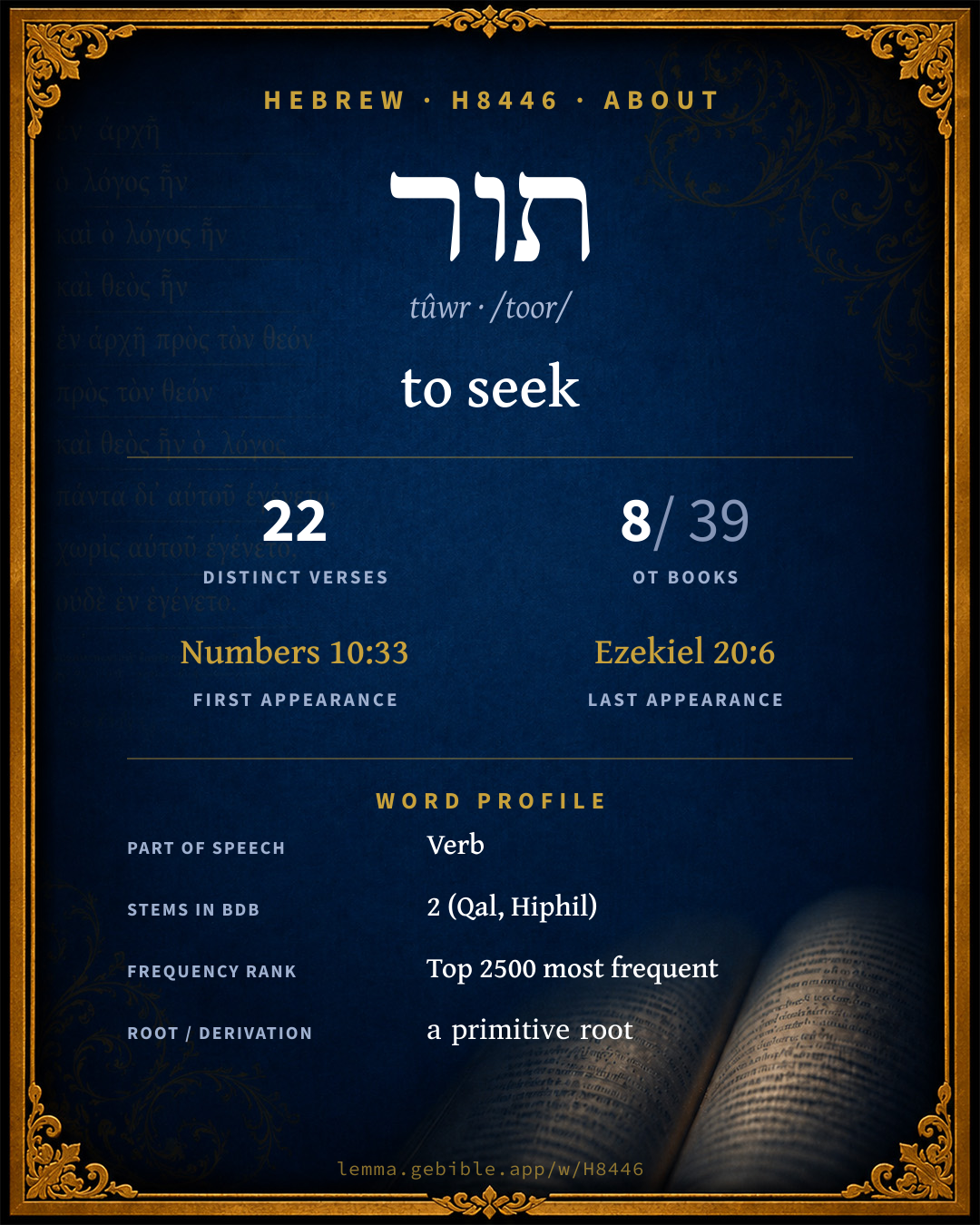
תּוּר
to seek
also: search out, spy out, explore fuller range ↓
Full lexicon entry — Brown-Driver-Briggs (BDB)
From Brown-Driver-Briggs (BDB)
Where this word appears
See every Qal verb in the Hebrew Bible →
Grammar key — what these labels mean
Part of speech
- Verb
- An action or state-of-being word.
Stem
- Qal
- The basic, simple active stem — the plain form of the verb (“he wrote”). Here: ‘seek out’
- Hiphil
- The causative active stem (“he caused / brought about”).
Form
- Infinitive Construct
- A bound verbal noun, frequently with prepositions (“to write / in writing”).
- Participle Active
- A verbal adjective expressing ongoing or characteristic action (“writing / one who writes”).
- Perfect
- A completed action or state — Hebrew marks aspect (completeness) more than strict tense (“he wrote”).
- Sequential Imperfect
- An imperfect with prefixed waw — the standard past-narrative form (waw-consecutive imperfect).
- Imperfect
- An incomplete, ongoing, or future action (“he will / would write”).
State
- Absolute
- The independent form of a noun, not bound to a following word.
Person
- 1st Person
- The speaker (“I / we”).
- 3rd Person
- The one spoken about (“he / she / it / they”).
- 2nd Person
- The one addressed (“you”).
Gender
- Masculine
- Grammatically masculine.
- Common
- Either gender — not distinguished for this form.
Number
- Plural
- More than one (in Hebrew, generally three or more).
- Singular
- One.
20 distinct verses where H8446 appears in the Qal stem, across 6 books. Filtered view — show all forms. Click any verse to open its interlinear word-by-word view. Verse text shown in the World English Bible for context — . Each verse’s Hebrew form is shown with its reference; the English is not keyword-highlighted, since the data carries no word-level English alignment. Use “Compare translations” on any verse to read it across multiple English versions. This concordance covers the Hebrew Bible; Septuagint (Greek Old Testament) occurrences are not indexed here.
Numbers 13 verses
- Numbers 10:33 לָ/ת֥וּר prep + Qal inf.cs They set forward from the Mount of Yahweh three days' journey; and the ark of the covenant of Yahweh went before them three days' journey, to seek out a resting-place for them.
- Numbers 13:2 וְ/יָתֻ֨רוּ֙ conj + Qal impf 3mp Send you men, that they may spy out the land of Canaan, which I give to the children of Israel: of every tribe of their fathers shall you send a man, everyone a prince among them.
- Numbers 13:16 לָ/ת֣וּר prep + Qal inf.cs These are the names of the men who Moses sent to spy out the land. Moses called Hoshea the son of Nun Joshua.
- Numbers 13:17 לָ/ת֖וּר prep + Qal inf.cs Moses sent them to spy out the land of Canaan, and said to them, Go up this way by the South, and go up into the hill-country:
- Numbers 13:21 וַ/יָּתֻ֣רוּ conj + Qal wimpf 3mp So they went up, and spied out the land from the wilderness of Zin to Rehob, to the entrance of Hamath.
- Numbers 13:25 מִ/תּ֣וּר prep + Qal inf.cs They returned from spying out the land at the end of forty days.
- Numbers 13:32 תָּר֣וּ לָ/ת֣וּר Qal pf 3cp prep + Qal inf.cs They brought up an evil report of the land which they had spied out to the children of Israel, saying, The land, through which we have gone to spy it out, is a land that eats up the inhabitants of it; and all the people who we saw in it are men of great stature.
- Numbers 14:6 הַ/תָּרִ֖ים ptcl def.art + Qal ptcp.act mp Joshua the son of Nun and Caleb the son of Jephunneh, who were of those who spied out the land, tore their clothes:
- Numbers 14:7 לָ/ת֣וּר prep + Qal inf.cs and they spoke to all the congregation of the children of Israel, saying, The land, which we passed through to spy it out, is an exceeding good land.
- Numbers 14:34 תַּרְתֶּ֣ם Qal pf 2mp After the number of the days in which you spied out the land, even forty days, for every day a year, shall you bear your iniquities, even forty years, and you shall know my alienation.
- Numbers 14:36 לָ/ת֣וּר prep + Qal inf.cs The men, whom Moses sent to spy out the land, who returned, and made all the congregation to murmur against him, by bringing up an evil report against the land,
- Numbers 14:38 לָ/ת֥וּר prep + Qal inf.cs But Joshua the son of Nun, and Caleb the son of Jephunneh, remained alive of those men who went to spy out the land.
- Numbers 15:39 תָתֻ֜רוּ Qal impf 2mp and it shall be to you for a fringe, that you may look on it, and remember all the commandments of Yahweh, and do them; and that you not follow after your own heart and your own eyes, after which you use to play the prostitute;
Deuteronomy 1 verse
1 Kings 1 verse
2 Chronicles 1 verse
Ecclesiastes 3 verses
- Ecclesiastes 1:13 וְ/לָ/תוּר֙ conj + prep + Qal inf.cs I applied my heart to seek and to search out by wisdom concerning all that is done under the sky. It is a heavy burden that God has given to the sons of men to be afflicted with.
- Ecclesiastes 2:3 תַּ֣רְתִּי Qal pf 1cs I searched in my heart how to cheer my flesh with wine, my heart yet guiding me with wisdom, and how to lay hold of folly, until I might see what it was good for the sons of men that they should do under heaven all the days of their lives.
- Ecclesiastes 7:25 וְ/לָ/ת֔וּר conj + prep + Qal inf.cs I turned around, and my heart sought to know and to search out, and to seek wisdom and the scheme of things, and to know that wickedness is stupidity, and that foolishness is madness.
Ezekiel 1 verse
About this entry
At a glance — auto-summarized from this page’s data, not written by a person. Every figure links to its source below. This summary describes the numbers; it doesn’t interpret them.
The Hebrew verb תור centers on the idea of “to seek.” The word gravitates to Numbers (59%), then Ecclesiastes and Deuteronomy. It turns up in 22 verses across 8 books, an uncommon footprint. Its earliest occurrence is Numbers 10:33. Different stems carry different senses — BDB groups them under 2 stems, among them Qal and Hiphil. For the data behind this summary, explore the sense tree and the renderings breakdown below.
Gloss history
Strong's 1890 vs modern scholarship
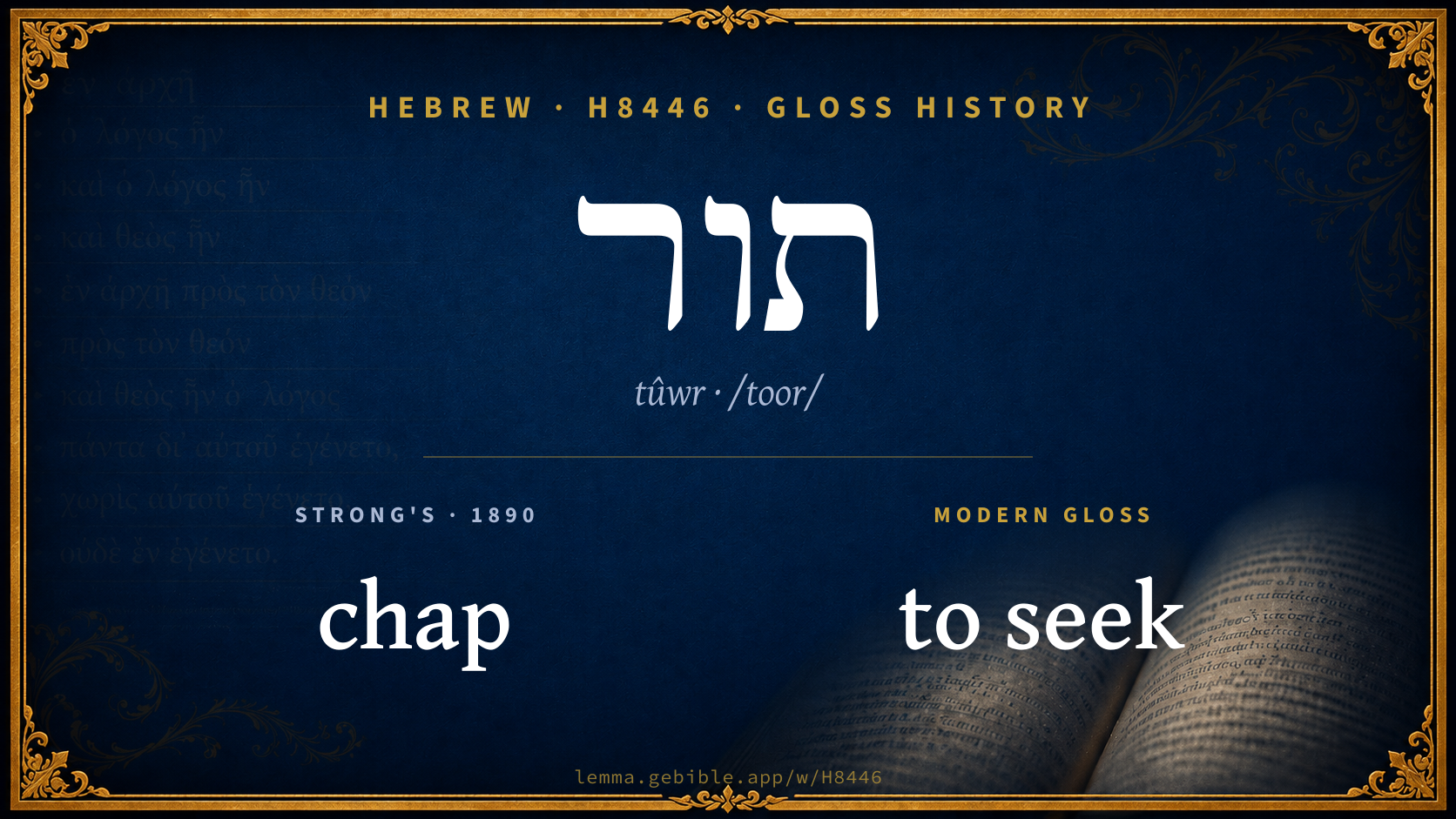
About this word
Strong's H8446 catalogs a Hebrew word from the Hebrew Old Testament.
These counts are not copied from any lexicon or concordance. They are computed here, from the morphology-tagged Hebrew Old Testament. What Lemma adds →
- 22
- distinct verses
- The word appears in 22 distinct verses.
- 8 / 39
- OT books
- The word appears in 8 of 39 Old Testament books.
- #1,368
- by frequency
- Top 2500 most frequent Hebrew words (rank 1,368 of 8,640 Hebrew words by occurrence).
View all 22 occurrences in the concordance →
Most concentrated in
- Numbers 13 verses 59%
- Ecclesiastes 3 verses 14%
- Deuteronomy 1 verse 5%
By section of the Old Testament
By traditional corpus
Conventional, traditional groupings — biblical authorship is debated, so this is a traditional corpus grouping, not an authorship claim. Each share is this word’s portion of its verses in that division of the Hebrew canon. Each figure is a share of the word’s 22 distinct verses.
- Torah (Pentateuch) 14 verses · 64%
- Writings (Ketuvim) 5 verses · 23%
- Prophets (Nevi'im) 3 verses · 14%
How translations render this word
Counts come from each version’s own published word-to-Strong’s tagging or interlinear alignment — an approximate guide to how each version renders this word, not a word-level alignment the data otherwise carries. Because each total is that version’s own tagged count, the per-version totals vary from one another and need not match the appearance or distinct-verse counts above. These counts may also differ from a printed concordance because Lemma counts each distinctly tagged rendering and does not collapse phrase taggings into a single head-word total. This is a fixed set of word-tagged versions (KJV, ASV, BSB, ULT) and does not change with the reading translation you choose elsewhere. Each version’s license is shown beside its name below (and on Sources).
- King James Version: Search 4×, Search out 2×, Spy out 2×
- American Standard Version: Spy 3×, Spy out 2×
- Berean Standard Bible: Spy out 5×, Explore 2×
- unfoldingWord Literal Text: Explore 9×, Seek out 2×, They explored 2×
King James Version Public Domain
Renders H8446 across 21 tagged occurrences — most commonly:
Plus 13 renderings that appear only once — usually multi-word phrases or single function words the recovered tagging swept in, not distinct renderings. Not rendered by a distinct English word in 2 further occurrences.
American Standard Version Public Domain
Renders H8446 across 21 tagged occurrences — most commonly:
Plus 16 renderings that appear only once — usually multi-word phrases or single function words the recovered tagging swept in, not distinct renderings.
Berean Standard Bible Public Domain
Renders H8446 across 21 tagged occurrences — most commonly:
Plus 14 renderings that appear only once — usually multi-word phrases or single function words the recovered tagging swept in, not distinct renderings. Not rendered by a distinct English word in 3 further occurrences.
unfoldingWord Literal Text CC BY-SA 4.0
Renders H8446 across 25 tagged occurrences — most commonly:
Plus 12 renderings that appear only once — usually multi-word phrases or single function words the recovered tagging swept in, not distinct renderings.
Senses in the full BDB
Hebrew verbs can shift meaning by stem (binyan): Qal is the basic action, Niphal is often passive or reflexive, Piel often intensifies or makes it factitive, and Hiphil is typically causative. The senses below are grouped under the stem BDB assigns to each.
What do BDB’s symbols mean?
BDB uses these scholarly abbreviations:
| Symbol | Meaning |
|---|---|
| 𝔊 | the Septuagint (the ancient Greek translation, LXX) |
| 𝔙 | the Vulgate (the Latin translation) |
| 𝔖 | the Syriac version (the Peshitta) |
| 𝔗 | the Targum (the Aramaic translation) |
| ψ | the Psalms |
| √ | root (the underlying root or stem) |
| ‖ | parallel passage (a synonymous or contrasted parallel) |
| † | the dagger: every passage where the word occurs is cited |
The 5 senses and sub-senses the full Brown-Driver-Briggs lexicon distinguishes for this word, in lexicon order (not ranked by frequency), with BDB’s own verbatim wording and sub-sense lettering. Shown in Hebrew script with BDB’s own scholarly abbreviations. The condensed entry is in the Lexicon Entry tab. See also the Forms in the corpus table below.
Qal
- Pf. 1 s. תַּרְתִּי Ez 20:6; Ec 2:3; 3 pl. תָּרוּ Nu 13:32; 2 mpl. תַּרְתֶּם 14:24; Impf. 3 mpl. יָתֻ֫רוּ 13:2, וַיָּתֻ֫רוּ v 21; read also 3 ms. יָתוּר Jb 39:8 𝔙 𝔗 Ew Di Bu Du and most (for יְתוּר); 2 mpl. תָּתוּ֫רוּ Nu 15:39; Inf. cstr. תּוּר 10:33 +; Pt. pl. תָּרִים 14:6, on 1 K 10:15; 2 Ch 9:14 v. infra;— e.g. Ezekiel 20:6
- 1. seek out, select: לָתוּר לָהֶם מְנוּחָה Nu 10:33 (J, subj. ark of י׳), cf. Dt 1:33 (subj. י׳), Ez 20:6 (id., acc. land); sq. inf. = find out how to do something, ת׳ בְּלִבִּי לְ Ec 2:3. e.g. Numbers 10:33
- 2. spy out, explore, acc. of land Nu 13:2, 16, 17, 21, 25, 32(×2); 14:7, 34, 36, 38, acc. of mts. Jb 39:8 (v. supr.), cf. Pt. as subj. explorers, spies Nu 14:6 (all P); explore mentally, לָדַעַת וְלָת׳ וּבַקֵּשׁ חָכְמָה Ec 7:25, cf. 9:1 Gr (ת׳ for בוּר q.v.), לָת׳ בְּחָכְמָה עָל־ 1:13 (KueOnd. 2, iii. 196). e.g. Numbers 13:2
- 3. go about, fig. אַחֲרֵי לְבַבְכֶם Nu 15:39 (P); Pt. אַנְשֵׁי הַתָּרִים 1 K 10:15; 2 Ch 9:14, usually merchants (‖ סֹחֲרִים רֹכְלִים); Kit, after 𝔖 2 Ch, proposes הֶעָרִים for הַתָּרִים. e.g. Numbers 15:39
Hiphil
- Impf. 3 mpl. וַיָּתִּ֫ירוּ בְּבֵית־אֵל Ju 1:23 they made a reconnaisance at Bethel (Vrss disagree, Gie וַיַּחֲנוּ, cf. GFM); 3 ms. יָתֵר מֵרֵעֵהוּ צַדִּיק Pr 12:26 the righteous searches out (RV is a guide to) his friend, 𝔗 AV is more excellent than (reading יָתָר), Hi Ew De al. spies out his pasture (מִרְעֵהוּ, in spiritual sense), all dubious; Toy conjectures יָסֻר מֵרָעָה. e.g. Judges 1:23
Senses from the full Brown-Driver-Briggs lexicon (Brown, Driver, Briggs; Oxford 1906 — public domain), digitized via Sefaria, supplemented by the OpenScriptures HebrewLexicon (CC BY 4.0). Full attribution on Sources.
Word origin
vb. seek out, spy out, explore (NH id. (rare); perhaps orig. turn (to or about), Assyrian târu, turn about, back, taiâru adj. turning back, also merciful, and subst. mercy; Arabic تَارَ (و) iv. go about (rare), تَوْرٌ a go-between);—
— Brown-Driver-Briggs (Oxford 1906, public domain), digitized via Sefaria, supplemented by the OpenScriptures HebrewLexicon (CC BY 4.0). See Sources.
Origin: a primitive root
Jastrow Dictionary
A second Hebrew/Aramaic lexicon for comparison, covering Aramaic and post-biblical (Talmudic, Targumic, Midrashic) usage that the biblical-Hebrew BDB does not. Matched by lemma rather than by Strong’s number, so a lemma may carry more than one Jastrow headword (shown separately below), and the entries cover usage well beyond the Bible.
תּוּר I
- v. טוּר) [to go around; cmp. אָלַל,) to espy. Shebu. 47ᵇ (play on ות̇ר̇ג̇נ̇ו, Deut. I, 27) תַּ֗רְֹתֶּם וג̇ינ̇יתם באהלו וכ׳ you have espied (the land) and found fault with God’s tent; Num. R. s. 1620 תרתם גנות א"י you have espied the faults of the land of Israel; Tanḥ. Sh’laḥ 11. Y. Yoma I, 38ᵇ (play on האתרים, Num. XXI, 1) מת התייר הגדול שהיה תָר להם וכ׳ the great spy (Aaron) is dead who espied for them the road (of life); Y. Sot. I, end, 17ᶜ; Num. R. s. 1920. Lev. R. s. 15; Yalk. ib. 554 את מבקש לצאת לָתוּר פרנסתך thou desirest to go out and espy the means of thy sustenance; a. e. e.g. Deuteronomy 1:27
תּוּר II
- (contr. of תער, v. עוּר) to be awake.—V. תִּיר.
- to awaken. B. Kam. 117ᵇ תַּיְּירֵיה אוקמיה he waked him up (from the dead) and made him to stand (live).—[Gitt. 69ᵇ וניתייריה, read: וניתריה, v. תְּרֵי II.]
תּוֹר I
- v. תּוּר I)
- 1. turn, order. — Pl. תּוֹרִים. Cant. R. to I, 10 (ref. to בתורים, ib.) בשעה שקורין … בתוֹרֵיהֶן וכ׳ when they read the words of the Law in their due turn: the Passover laws on Passover &c.
- 2. string, twist. —Pl. as ab. Tosef. Sabb. VIII (IX), 31; Y. ib. VIII, 11ᵇ top; Bab. ib. 90ᵇ תּוֹרֵי דקל strings made of the fibrous bast of the palm, contrad. to צורי דקל, v. צוּר III.
תּוֹר II
- onomatop.) turtle-dove. Kinn. II, 5 האשה … חטאתה ת׳ וכ׳ if a woman brought a turtle-dove for her sin-offering, and a young pigeon for her burnt-offering; a. e.—Pl. תּוֹרִים, תּוֹרִין. Ib. אין מביאין ת׳ כנגד וכ׳ you must not offer turtle-doves in connection with young pigeons, nor young pigeons in connection with turtle-doves (but either the ones or the others). Ḥull. I, 5 כשר בת׳, v. יוֹנָה II. Ib. 22ᵇ; a. fr.
תּוֹר
- = h. שׁוֹר, ox. Targ. Ex. XXI, 28, sq. Targ. Lev. IV, 3; a. fr.—ת׳ בר aurochs (v. תּוֹרְבָּלָא). Targ. Ps. L, 10.—Pirké d’R. El. ch. XXVIII (ref. to וְתר̇, Gen. XV, 9) לא נאמר ת׳ זה בלשון … ת׳ זה השור וכ׳ this tor is not meant in its Biblical (Hebrew) sense (dove), but in its Chaldaic meaning: tor means the ox &c. Y. R. Hash. II, 58ᵇ top; Y. Snh. I, 18ᶜ bot., v. עַדְרָא; Bab. Snh. 18ᵇ. Nidd. 33ᵇ, v. רְמֵי. Lam. R. to I, 7 (prov.) נפל ת׳ סגין וכ׳ when the ox is felled, its butchers are many (when one is in distress, his enemies increase); נפל ת׳ תחדדון סכינוי (not תחדדן) when the ox is down, sharpen the knives for him; Sabb. 32ᵃ, v. חֲדַד. Ab. Zar. 16ᵃ בר ת׳ a young ox; a. fr.—ראש תור, v. רֹאשׁ.—Pl. תֹּרִין, תּוֹרַיָּא, תּוֹרֵי. Targ. Gen. XXXII, 6. Targ. I Chr. XXI, 23. Targ. Num. XXIX, 13. Targ. Y. Deut. XIV, 5 תורי בר, v. supra; a. fr.—B. Mets. 30ᵃ top; 73ᵃ; Ḥull. 84ᵇ, v. תַּיָּרָא.—Fem. תּוֹרְתָּא cow. Targ. Num. XIX, 2 (O. ed. Vien. תּוֹרְתָא; Y. תּוֹרָתָא, corr. acc.); a. fr.—Pl. תּוֹרָתָא, תּוֹרָן. Targ. I Sam. VI, 7. Targ. Job I, 14 Ms. (ed. תורייא); a. e. e.g. Genesis 15:9
A Dictionary of the Targumim, the Talmud Babli and Yerushalmi, and the Midrashic Literature (Marcus Jastrow; London, Luzac, 1903) — Public Domain. Digitized via Sefaria. Digitized via Sefaria. Full attribution on Sources.
Forms in the corpus
The 17 distinct written forms H8446 takes in the Hebrew Bible, most frequent first — each parse links to that stem’s occurrences in the concordance. Hebrew forms include their vowel points and cantillation, so a single lemma takes many written forms.
Same root — word family
Other BDB entries built from the same root as H8446, grouped by Strong’s listed origin. These share a root / origin per the lexicon — not necessarily a shared meaning. Each links to that word’s own entry.
Derived from this word
Compare all same-root words → They share a root, not necessarily a meaning.
Septuagint verse parallels
This word appears in 22 verses that also exist in the Greek Old Testament (Septuagint), out of the 22 Hebrew verses it occurs in. You can read those verses in Greek by switching the Old Testament edition to the Septuagint.
Read these verses in the Septuagint
- Numbers 10:33
- Deuteronomy 1:33
- Judges 1:23
- 1 Kings 10:15
- 2 Chronicles 9:14
- Proverbs 12:26
- Ecclesiastes 1:13
- Ezekiel 20:6
This is a verse-level parallel only — the same verses exist in both the Hebrew and Greek Old Testaments. No word-level Hebrew↔Greek correspondence is claimed: the data carries no such alignment, so no Greek word is shown as this Hebrew word’s translation. Coverage is not total — the Septuagint omits the deuterocanon and renumbers the Psalms, so some Hebrew verses have no direct Greek parallel.