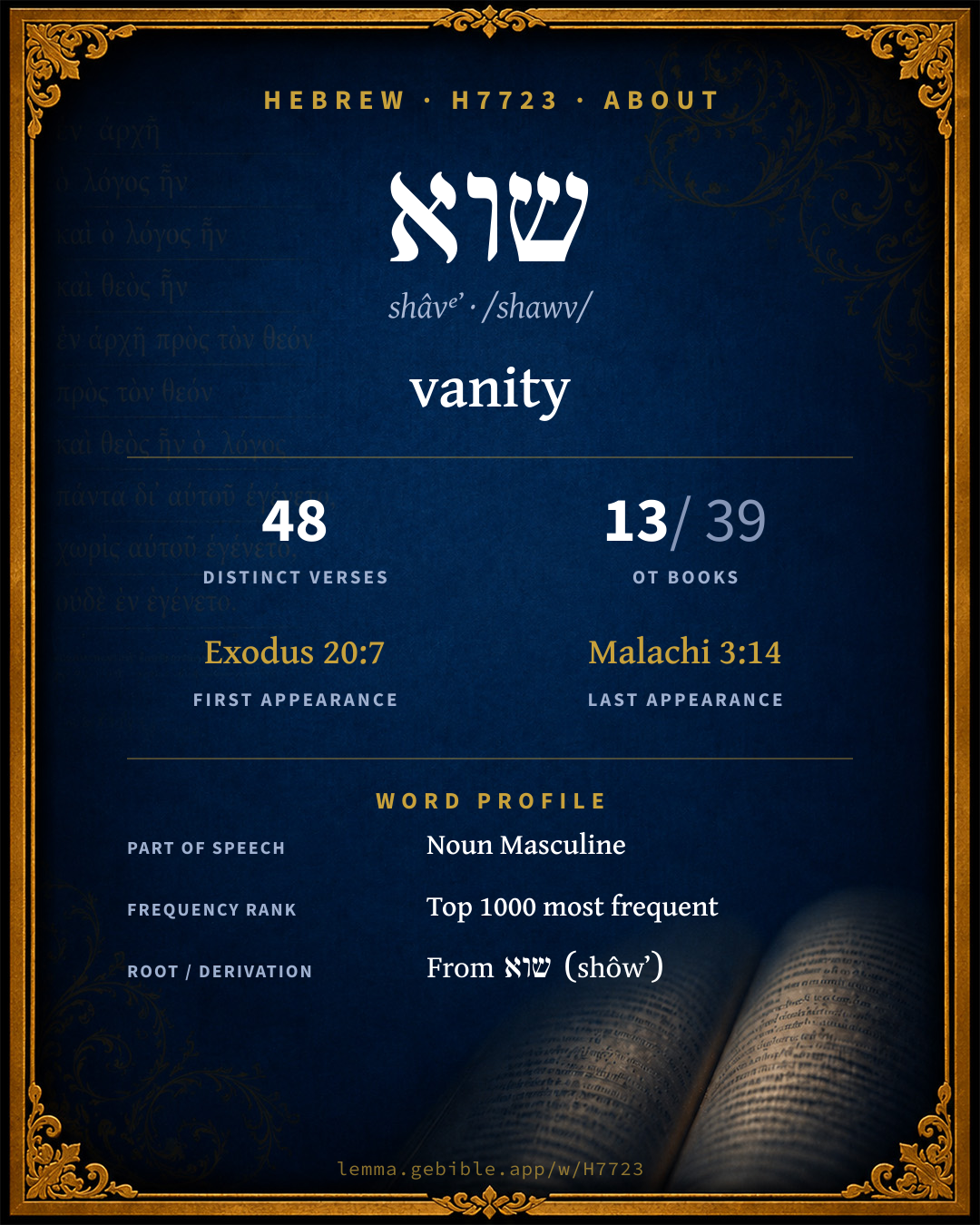
שָׁוְא
vanity
also: emptiness, falsehood fuller range ↓
Full lexicon entry — Brown-Driver-Briggs (BDB)
From Brown-Driver-Briggs (BDB)
Where this word appears
Grammar key — what these labels mean
Part of speech
- Noun
- A naming word — a person, place, thing, or idea.
Noun type
- Common
- A common noun — a general class of person, place, or thing (“king,” “city,” “water”), not a specific name.
State
- Absolute
- The independent form of a noun, not bound to a following word.
Gender
- Masculine
- Grammatically masculine.
Number
- Singular
- One.
Every verse where H7723 appears in the Book of Lamentations — 1 distinct verse. Click any verse to open its interlinear word-by-word view. Verse text shown in the World English Bible for context — . Each verse’s Hebrew form is shown with its reference; the English is not keyword-highlighted, since the data carries no word-level English alignment. Use “Compare translations” on any verse to read it across multiple English versions. This concordance covers the Hebrew Bible; Septuagint (Greek Old Testament) occurrences are not indexed here.
Lamentations
About this entry
At a glance — auto-summarized from this page’s data, not written by a person. Every figure links to its source below. This summary describes the numbers; it doesn’t interpret them.
שוא (shâvᵉʼ) is a Hebrew noun most often rendered “vanity.” The King James Version usually renders it “vanity,” while modern versions prefer “emptiness” (unfoldingWord Literal Text) — see the renderings breakdown. Spanning 48 verses in 13 books, it ranks among the moderately common words of the Hebrew Bible. Psalms dominates its distribution — 14 of 48 verses. Beyond its headline sense, its full sense range takes in “emptiness” and “falsehood”. Dig into 48-verse concordance and the renderings breakdown below.
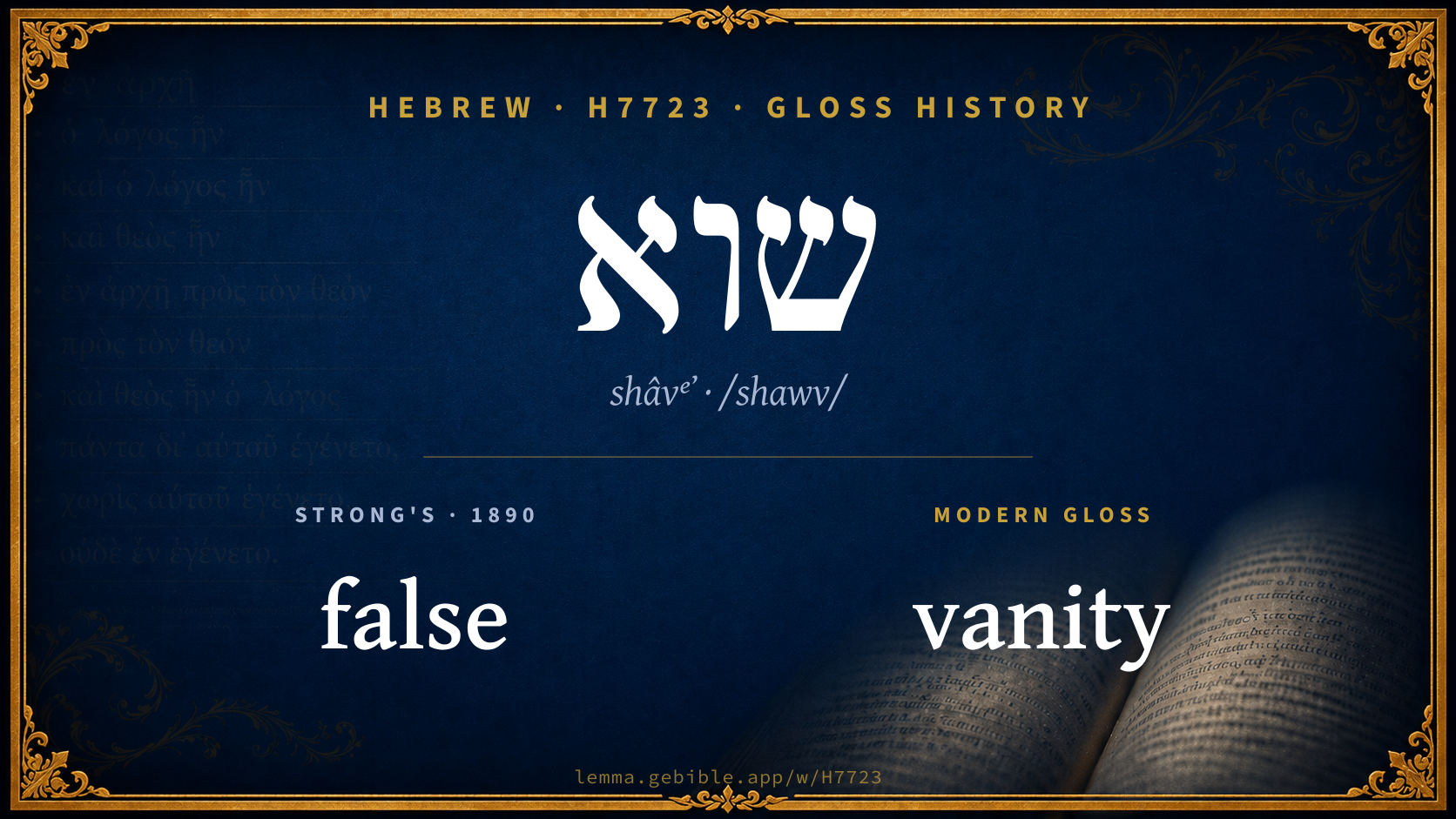
Gloss history
Strong's 1890 vs modern scholarship
About this word
Strong's H7723 catalogs a Hebrew word from the Hebrew Old Testament.
These counts are not copied from any lexicon or concordance. They are computed here, from the morphology-tagged Hebrew Old Testament. What Lemma adds →
- 48
- distinct verses
- The word appears in 48 distinct verses.
- 13 / 39
- OT books
- The word appears in 13 of 39 Old Testament books.
- #696
- by frequency
- Top 1000 most frequent Hebrew words (rank 696 of 8,640 Hebrew words by occurrence).
View all 48 occurrences in the concordance →
By section of the Old Testament
By traditional corpus
Conventional, traditional groupings — biblical authorship is debated, so this is a traditional corpus grouping, not an authorship claim. Each share is this word’s portion of its verses in that division of the Hebrew canon. Each figure is a share of the word’s 48 distinct verses.
- Prophets (Nevi'im) 23 verses · 48%
- Writings (Ketuvim) 21 verses · 44%
- Torah (Pentateuch) 4 verses · 8%
How translations render this word
Counts come from each version’s own published word-to-Strong’s tagging or interlinear alignment — an approximate guide to how each version renders this word, not a word-level alignment the data otherwise carries. Because each total is that version’s own tagged count, the per-version totals vary from one another and need not match the appearance or distinct-verse counts above. These counts may also differ from a printed concordance because Lemma counts each distinctly tagged rendering and does not collapse phrase taggings into a single head-word total. This is a fixed set of word-tagged versions (KJV, ASV, BSB, ULT) and does not change with the reading translation you choose elsewhere. Each version’s license is shown beside its name below (and on Sources).
- King James Version: Vanity 20×, Vain 18×, False 3×
- American Standard Version: Vain 13×, False 7×, Falsehood 7×
- Berean Standard Bible: Vain 12×, False 8×, Falsehood 4×
- unfoldingWord Literal Text: Emptiness 10×, Worthlessness 10×, Falsehood 7×
King James Version Public Domain
Renders H7723 across 53 tagged occurrences — most commonly:
Plus 8 renderings that appear only once — usually multi-word phrases or single function words the recovered tagging swept in, not distinct renderings.
American Standard Version Public Domain
Renders H7723 across 51 tagged occurrences — most commonly:
Plus 14 renderings that appear only once — usually multi-word phrases or single function words the recovered tagging swept in, not distinct renderings.
Berean Standard Bible Public Domain
Renders H7723 across 52 tagged occurrences — most commonly:
Plus 13 renderings that appear only once — usually multi-word phrases or single function words the recovered tagging swept in, not distinct renderings. Not rendered by a distinct English word in 1 further occurrence.
unfoldingWord Literal Text CC BY-SA 4.0
Renders H7723 across 54 tagged occurrences — most commonly:
Plus 18 renderings that appear only once — usually multi-word phrases or single function words the recovered tagging swept in, not distinct renderings.
Senses in the full BDB
What do BDB’s symbols mean?
BDB uses these scholarly abbreviations:
| Symbol | Meaning |
|---|---|
| 𝔊 | the Septuagint (the ancient Greek translation, LXX) |
| 𝔙 | the Vulgate (the Latin translation) |
| 𝔖 | the Syriac version (the Peshitta) |
| 𝔗 | the Targum (the Aramaic translation) |
| ψ | the Psalms |
| √ | root (the underlying root or stem) |
| ‖ | parallel passage (a synonymous or contrasted parallel) |
| † | the dagger: every passage where the word occurs is cited |
The 3 senses and sub-senses the full Brown-Driver-Briggs lexicon distinguishes for this word, in lexicon order (not ranked by frequency), with BDB’s own verbatim wording and sub-sense lettering. Shown in Hebrew script with BDB’s own scholarly abbreviations. The condensed entry is in the Lexicon Entry tab. See also the Forms in the corpus table below.
- 1. emptiness, nothingness, vanity: שׁ׳ תְּשׁוּעַת אָדָם ψ 60:13 vain (is) man’s deliverance, = 108:13; שׁ׳ לָכֶם 127:2 it is vain (useless) for you; 89:48 for (עַל) what nothingness hast thou created man? cf. שׁ׳ יַרְחֵי Jb 7:3; הַבְלֵי שׁ׳ ψ 31:7 (idols) = Jon 2:9, cf. Je 18:15; מִנְחַת שׁ׳ Is 1:13 of ineffective offering to י׳; נשׂא לַשּׁ׳ (לֹא) Ex 20:7(×2) take up name of God in vain (to no good purpose) = Dt 5:11(×2), cf. ψ 24:4; 139:20 [MT lifted up in vain are thy foes; היה שׁ׳ Ho 12:12 become nothing (We עשׂה שׁ׳, and so 3); ראה שׁ׳ ψ 119:37; adv. לַשּׁ׳ in vain Je 2:30; 4:30; 6:29; 46:11; שׁ׳ ψ 127:1(×2); Mal 3:14; Jb 35:13. e.g. Psalms 60:13
- 2. emptiness of speech, שׁ׳ וּדְבַר כָּזָב Pr 30:8; דבּר שׁ׳ ψ 12:3; 41:7; 144:8, 11; Is 59:4; Ez 13:8; אָלוֹת שׁ׳ Ho 10:4 + 12:2 𝔊 We al. (for שֹׁד); הָלַךְ עִם־שׁ׳ Jb 31:5 (‖ מִרְמָה); עֵד שׁ׳ Dt 5:17 = עֵד שָֽׁקֶר Ex 20:16); cf. שֵׁמַע שׁ׳ Ex 23:1 (E); of false (empty) prophecy חֲזוֹן שׁ׳ Ez 12:24, חָזוּ שׁ׳ La 2:14; v. also Ez 13:6, 7, 9, 23; 21:34; 22:28; Jb 35:13 (or empty complaint) La 2:14(×2); קסם שׁ׳ Ez 21:28; חֲלמוֹת הַשּׁ׳ Zc 10:2. e.g. Proverbs 30:8
- 3. of conduct, worthlessness (Buhl sub 1, 2); מְתֵי שׁ׳ worthless men ψ 26:4; Jb 11:11; worthless motives (in fig.) חֵבְלֵי הַשּׁ׳ Is 5:18; נָפַת שׁ׳ 30:28 (i.e. sifting out the worthless; al. sieve of (bringing) disappointment); play on meanings in Jb 15:31(×2), cf. DrJob, Psalt. 464. e.g. Psalms 26:4
Senses from the full Brown-Driver-Briggs lexicon (Brown, Driver, Briggs; Oxford 1906 — public domain), digitized via Sefaria, supplemented by the OpenScriptures HebrewLexicon (CC BY 4.0). Full attribution on Sources.
Word origin
n.[m.] emptiness, vanity;—שׁ׳ abs. Ex 23:1 + 51 times, שָׁו Jb 15:31 (Kt);—
— Brown-Driver-Briggs (Oxford 1906, public domain), digitized via Sefaria, supplemented by the OpenScriptures HebrewLexicon (CC BY 4.0). See Sources.
Derived from שוא (shôwʼ) (H7722) — devastation.
Jastrow Dictionary
A second Hebrew/Aramaic lexicon for comparison, covering Aramaic and post-biblical (Talmudic, Targumic, Midrashic) usage that the biblical-Hebrew BDB does not. Matched by lemma rather than by Strong’s number, so a lemma may carry more than one Jastrow headword (shown separately below), and the entries cover usage well beyond the Bible.
שָׁוְא
- v. שָׁהָה) [vacancy,] vanity, inanity, falsehood. שבועת ש׳ a false oath, vowing to do something impossible, opp. בִּיטּוּי. Shebu. III, 9 שבועה שאוכל … והשנייה שבועת ש׳ (if one says) ‘I swear that I will eat this loaf, (and) I swear that I will not eat it’, the former is a useless oath (or vow), the second a false oath; אכלה עבר על שבועת ש׳ וכ׳ if he eats it, he is guilty of a false oath (having sworn that he would not eat it); if he does not eat it, he is (also) guilty of a useless oath. Ib. 8 איזוהי שבועת ש׳ נשבע וכ׳ what is a vain oath of affirmation? If one swears to that which is known to be otherwise, saying of a stone column that it is gold &c.; נשבע … שאי אפשר וכ׳ if one affirms an impossibility, saying I swear that I have seen a camel fly in the air. Ib. נשבע לבטל … זו היא שבועת ש׳ וכ׳ if he swears that he will neglect a command, that he will not erect a Succah, …: that is a vain oath, on the wilful pronouncing of which he is punished with stripes &c. Ib. 21ᵃ איזוהי שבועת ש׳ … שקר נשבע וכ׳ what is a vain oath? If one swears to what is known to be otherwise; a false oath, if one swears to the opposite of the truth (e.g. ‘I have eaten’, when he has not, ‘I have not eaten’, when he has), v. שֶׁקֶר. Ib. 20ᵇ ש׳ ושקר אחד הן a vain oath (shav) and a false oath (sheḳer) are the same; a. fr.—תפלת ש׳ a vain prayer, a prayer concerning a thing which cannot be changed. Ber. IX, 3; a. fr.—Ex. R. s. 3 (ref. to מתי שוא, Job XI, 11) God knows העם המתים על הש׳ לעשותו the people that risk their lives for falsehood (idolatry) to commit it; העתידים לעשות ש׳ וכ׳ those that will commit falsehood and be put to death.—לַשָּׁ׳ in vain, to no purpose. Keth. 62ᵇ, v. שָׁמַר. Y. Meg. III, 74ᵃ bot., v. תַּמְרוּרִים. e.g. Job 11:11
A Dictionary of the Targumim, the Talmud Babli and Yerushalmi, and the Midrashic Literature (Marcus Jastrow; London, Luzac, 1903) — Public Domain. Digitized via Sefaria. Digitized via Sefaria. Full attribution on Sources.
Forms in the corpus
The 22 distinct written forms H7723 takes in the Hebrew Bible, most frequent first — each parse links to that state’s occurrences in the concordance. Hebrew forms include their vowel points and cantillation, so a single lemma takes many written forms.
| Form | Parsing | Example | Uses |
|---|---|---|---|
| שָׁ֑וְא | Noun, Common, Masculine, Singular, Absolute | Exodus 23:1 | 11 |
| שָׁ֤וְא | Noun, Common, Masculine, Singular, Absolute | Proverbs 30:8 | 6 |
| שָׁ֔וְא | Noun, Common, Masculine, Singular, Absolute | Ezekiel 13:8 | 5 |
| שָׁ֖וְא | Noun, Common, Masculine, Singular, Absolute | Ezekiel 12:24 | 4 |
| לַ/שָּׁ֣וְא | Noun, Common, Masculine, Singular, Absolute | Jeremiah 18:15 | 3 |
| לַ/שָּׁוְא֙ | Noun, Common, Masculine, Singular, Absolute | Jeremiah 2:30 | 3 |
| שָׁוְא֙ | Noun, Common, Masculine, Singular, Absolute | Ezekiel 13:6 | 3 |
| וְ֝/שָׁ֗וְא | Noun, Common, Masculine, Singular, Absolute | Psalms 60:11 | 2 |
| לַ/שָּׁ֑וְא | Noun, Common, Masculine, Singular, Absolute | Deuteronomy 5:11 | 2 |
| לַ/שָּֽׁוְא | Noun, Common, Masculine, Singular, Absolute | Deuteronomy 5:11 | 2 |
| שָׁ֣וְא | Noun, Common, Masculine, Singular, Absolute | Hosea 12:11 | 2 |
| ב/שו | Noun, Common, Masculine, Singular, Absolute | Job 15:31 | 1 |
| בַּ/שָּׁ֣יו | Noun, Common, Masculine, Singular, Absolute | Job 15:31 | 1 |
| הַ/שָּׁ֑וְא | Noun, Common, Masculine, Singular, Absolute | Isaiah 5:18 | 1 |
| הַ/שָּׁ֣וא | Noun, Common, Masculine, Singular, Absolute | Zechariah 10:2 | 1 |
| לַ/שָּׁ֖וְא | Noun, Common, Masculine, Singular, Absolute | Jeremiah 4:30 | 1 |
| שָׁ֚וְא | Noun, Common, Masculine, Singular, Absolute | Ezekiel 13:23 | 1 |
| שָׁ֝֗וְא | Noun, Common, Masculine, Singular, Absolute | Job 15:31 | 1 |
| שָׁ֭וְא | Noun, Common, Masculine, Singular, Absolute | Job 35:13 | 1 |
| שָֽׁוְא | Noun, Common, Masculine, Singular, Absolute | Deuteronomy 5:20 | 1 |
| שָׁוְא֮ | Noun, Common, Masculine, Singular, Absolute | Ezekiel 13:9 | 1 |
| שָּׁ֝֗וְא | Noun, Common, Masculine, Singular, Absolute | Psalms 89:47 | 1 |
Same root — word family
Other BDB entries built from the same root as H7723, grouped by Strong’s listed origin. These share a root / origin per the lexicon — not necessarily a shared meaning. Each links to that word’s own entry.
Derives from
Shares the same root
Proper names from this root
People and places named from this root — a name, not an additional meaning of the word.
Compare all same-root words → Showing 4 of 6 — not the complete family. 2 of the same-root words are proper names (people or places). They share a root, not necessarily a meaning.
Septuagint verse parallels
This word appears in 43 verses that also exist in the Greek Old Testament (Septuagint), out of the 48 Hebrew verses it occurs in. You can read those verses in Greek by switching the Old Testament edition to the Septuagint.
Read these verses in the Septuagint
- Exodus 20:7
- Deuteronomy 5:11
- Job 7:3
- Psalms 12:2
- Proverbs 30:8
- Isaiah 1:13
- Jeremiah 2:30
- Lamentations 2:14
- Ezekiel 12:24
- Hosea 10:4
- Jonah 2:8
- Zechariah 10:2
This is a verse-level parallel only — the same verses exist in both the Hebrew and Greek Old Testaments. No word-level Hebrew↔Greek correspondence is claimed: the data carries no such alignment, so no Greek word is shown as this Hebrew word’s translation. Coverage is not total — the Septuagint omits the deuterocanon and renumbers the Psalms, so some Hebrew verses have no direct Greek parallel.