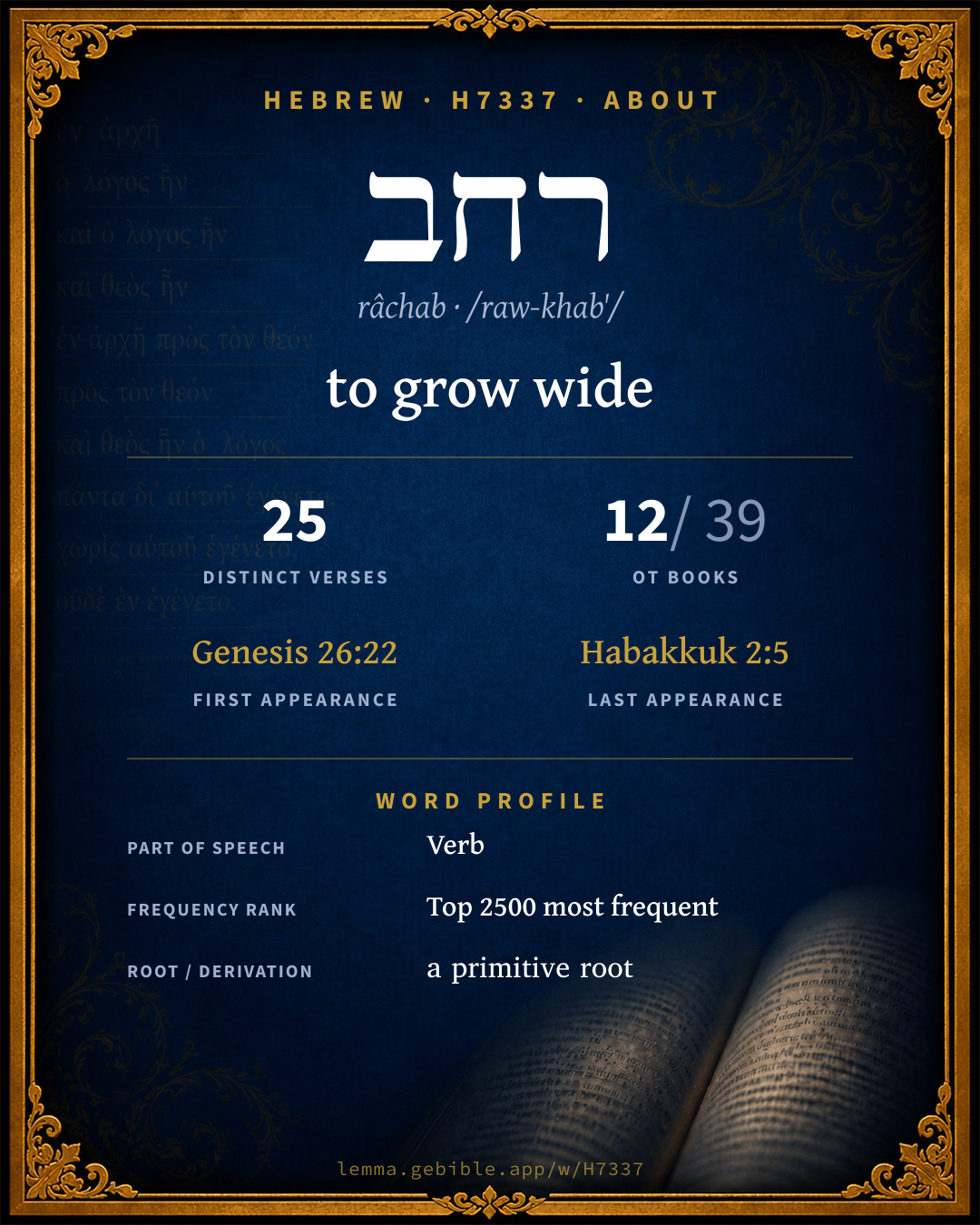
רָחַב
to grow wide
‘to grow wide’ is one of 3 main senses fuller range ↓
Full lexicon entry — Brown-Driver-Briggs (BDB)
From Brown-Driver-Briggs (BDB)
Where this word appears
See every Hiphil verb in the Hebrew Bible →
Grammar key — what these labels mean
Part of speech
- Verb
- An action or state-of-being word.
Stem
- Hiphil
- The causative active stem (“he caused / brought about”).
- Qal
- The basic, simple active stem — the plain form of the verb (“he wrote”).
- Niphal
- Usually the simple passive or reflexive of the Qal (“he was written”).
Form
- Imperfect
- An incomplete, ongoing, or future action (“he will / would write”).
- Perfect
- A completed action or state — Hebrew marks aspect (completeness) more than strict tense (“he wrote”).
- Imperative
- A direct command (“write!”).
- Sequential Perfect
- A perfect with prefixed waw continuing a preceding imperfect or command (waw-consecutive perfect).
- Sequential Imperfect
- An imperfect with prefixed waw — the standard past-narrative form (waw-consecutive imperfect).
- Participle Active
- A verbal adjective expressing ongoing or characteristic action (“writing / one who writes”).
- Infinitive Construct
- A bound verbal noun, frequently with prepositions (“to write / in writing”).
State
- Absolute
- The independent form of a noun, not bound to a following word.
- Construct
- A noun bound to a following noun in a possessive / “of” relationship (the construct chain).
Person
- 2nd Person
- The one addressed (“you”).
- 3rd Person
- The one spoken about (“he / she / it / they”).
- 1st Person
- The speaker (“I / we”).
Gender
- Masculine
- Grammatically masculine.
- Feminine
- Grammatically feminine.
- Common
- Either gender — not distinguished for this form.
Number
- Singular
- One.
- Plural
- More than one (in Hebrew, generally three or more).
Grammatical forms 18 distinct
- Verb, Hiphil, Imperfect, 2nd Person, Masculine, Singular 3 times (12%)
- Verb, Hiphil, Imperfect, 3rd Person, Masculine, Singular 3 times (12%)
- Verb, Hiphil, Perfect, 3rd Person, Masculine, Singular 3 times (12%)
- Verb, Hiphil, Imperative, 2nd Person, Feminine, Singular 2 times (8%)
- Verb, Hiphil, Sequential Perfect, 1st Person, Common, Singular 1 time (4%)
- Verb, Hiphil, Sequential Imperfect, 3rd Person, Masculine, Plural 1 time (4%)
- Verb, Qal, Perfect, 3rd Person, Feminine, Singular 1 time (4%)
- Verb, Qal, Sequential Perfect, 3rd Person, Masculine, Singular 1 time (4%)
+10 more forms (10 occurrences)
Parsed forms decoded from the imported morphology (morphhb / Westminster Leningrad Codex — WLC text public domain, morphhb tagging CC BY 4.0), counted across 25 parsed occurrences — not distinct verses.
Every verse where H7337 appears — 25 distinct verses across 12 books. Click any verse to open its interlinear word-by-word view. Verse text shown in the World English Bible for context — . Each verse’s Hebrew form is shown with its reference; the English is not keyword-highlighted, since the data carries no word-level English alignment. Use “Compare translations” on any verse to read it across multiple English versions. This concordance covers the Hebrew Bible; Septuagint (Greek Old Testament) occurrences are not indexed here.
Genesis 1 verse
Exodus 1 verse
Deuteronomy 3 verses
- Deuteronomy 12:20 יַרְחִיב֩ Hiphil impf 3ms When Yahweh your God shall enlarge your border, as he has promised you, and you shall say, I will eat flesh, because your soul desires to eat flesh; you may eat flesh, after all the desire of your soul.
- Deuteronomy 19:8 יַרְחִ֞יב Hiphil impf 3ms If Yahweh your God enlarge your border, as he has sworn to your fathers, and give you all the land which he promised to give to your fathers;
- Deuteronomy 33:20 מַרְחִ֣יב Hiphil ptcp.act ms cs Of Gad he said, Blessed be he who enlarges Gad: He dwells as a lioness, Tears the arm, yes, the crown of the head.
1 Samuel 1 verse
2 Samuel 1 verse
Psalms 6 verses
- Psalms 4:1 הִרְחַ֣בְתָּ Hiphil pf 2ms Answer me when I call, God of my righteousness. Give me relief from my distress. Have mercy on me, and hear my prayer.
- Psalms 18:36 תַּרְחִ֣יב Hiphil impf 2ms You have enlarged my steps under me, My feet have not slipped.
- Psalms 25:17 הִרְחִ֑יבוּ Hiphil pf 3cp The troubles of my heart are enlarged. Oh bring me out of my distresses.
- Psalms 35:21 וַ/יַּרְחִ֥יבוּ conj + Hiphil wimpf 3mp Yes, they opened their mouth wide against me. They said, "Aha! Aha! Our eye has seen it!"
- Psalms 81:10 הַרְחֶב Hiphil impv 2ms I am Yahweh, your God, Who brought you up out of the land of Egypt. Open your mouth wide, and I will fill it.
- Psalms 119:32 תַרְחִ֣יב Hiphil impf 2ms I run in the path of your commandments, For you have set my heart free.
Proverbs 1 verse
Isaiah 7 verses
- Isaiah 5:14 הִרְחִ֤יבָה Hiphil pf 3fs Therefore Sheol has enlarged its desire, And opened its mouth without measure; And their glory, their multitude, their pomp, and he who rejoices among them, descend into it.
- Isaiah 30:23 נִרְחָֽב Niphal ptcp.act ms He will give the rain for your seed, with which you shall sow the ground; and bread of the increase of the ground, and it shall be fat and plenteous. In that day shall your cattle feed in large pastures;
- Isaiah 30:33 הִרְחִ֑ב Hiphil pf 3ms For a Topheth is prepared of old; yes, for the king it is made ready; he has made it deep and large; the pile of it is fire and much wood; the breath of Yahweh, like a stream of sulfur, does kindle it.
- Isaiah 54:2 הַרְחִ֣יבִי Hiphil impv 2fs Enlarge the place of your tent, and let them stretch forth the curtains of your habitations; don't spare: lengthen your cords, and strengthen your stakes.
- Isaiah 57:4 תַּרְחִ֥יבוּ Hiphil impf 2mp Against whom do you sport yourselves? against whom make you a wide mouth, and put out the tongue? Aren't you children of disobedience, a seed of falsehood,
- Isaiah 57:8 הִרְחַ֤בְתְּ Hiphil pf 2fs Behind the doors and the posts have you set up your memorial: for you have uncovered [yourself] to another than me, and are gone up; you have enlarged your bed, and made you a covenant with them: you loved their bed where you saw it.
- Isaiah 60:5 וְ/רָחַ֖ב conj + Qal wpf 3ms Then you shall see and be radiant, and your heart shall thrill and be enlarged; because the abundance of the sea shall be turned to you, the wealth of the nations shall come to you.
Ezekiel 1 verse
Amos 1 verse
Micah 1 verse
Habakkuk 1 verse
About this entry
At a glance — auto-summarized from this page’s data, not written by a person. Every figure links to its source below. This summary describes the numbers; it doesn’t interpret them.
The Hebrew verb רחב centers on the idea of “to grow wide.” Its earliest occurrence is Genesis 26:22. The Hebrew Bible uses it across 25 verses — uncommon. Isaiah dominates its distribution — 7 of 25 verses. The lexicon spreads it across several senses; see its full sense range. For the data behind this summary, explore the sense tree and the renderings breakdown below.
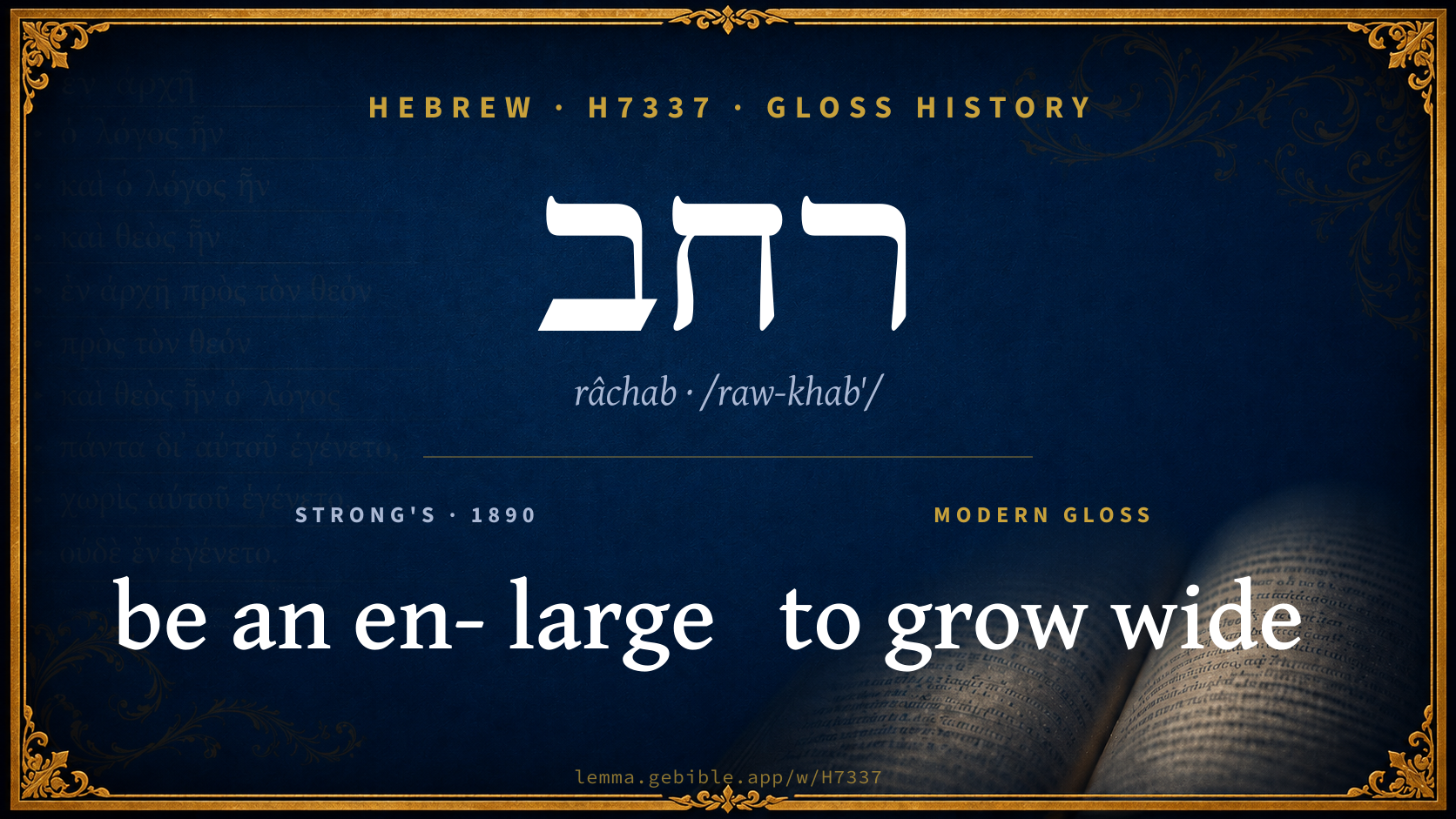
Gloss history
Strong's 1890 vs modern scholarship
About this word
Strong's H7337 catalogs a Hebrew word from the Hebrew Old Testament.
These counts are not copied from any lexicon or concordance. They are computed here, from the morphology-tagged Hebrew Old Testament. What Lemma adds →
- 25
- distinct verses
- The word appears in 25 distinct verses.
- 12 / 39
- OT books
- The word appears in 12 of 39 Old Testament books.
- #1,282
- by frequency
- Top 2500 most frequent Hebrew words (rank 1,282 of 8,640 Hebrew words by occurrence).
View all 25 occurrences in the concordance →
Most concentrated in
- Isaiah 7 verses 28%
- Psalms 6 verses 24%
- Deuteronomy 3 verses 12%
By section of the Old Testament
By traditional corpus
Conventional, traditional groupings — biblical authorship is debated, so this is a traditional corpus grouping, not an authorship claim. Each share is this word’s portion of its verses in that division of the Hebrew canon. Each figure is a share of the word’s 25 distinct verses.
- Prophets (Nevi'im) 13 verses · 52%
- Writings (Ketuvim) 7 verses · 28%
- Torah (Pentateuch) 5 verses · 20%
How translations render this word
Counts come from each version’s own published word-to-Strong’s tagging or interlinear alignment — an approximate guide to how each version renders this word, not a word-level alignment the data otherwise carries. Because each total is that version’s own tagged count, the per-version totals vary from one another and need not match the appearance or distinct-verse counts above. These counts may also differ from a printed concordance because Lemma counts each distinctly tagged rendering and does not collapse phrase taggings into a single head-word total. This is a fixed set of word-tagged versions (KJV, ASV, BSB, ULT) and does not change with the reading translation you choose elsewhere. Each version’s license is shown beside its name below (and on Sources).
- King James Version: Thou hast enlarged 4×, Enlarge 3×, Large 2×
- American Standard Version: Enlarge 3×, Large 2×, Thou hast enlarged 2×
- Berean Standard Bible: Enlarge 3×, Enlarges 3×, You broaden 2×
- unfoldingWord Literal Text: You enlarge 3×, Broaden 2×, Enlarges 2×
King James Version Public Domain
Renders H7337 across 25 tagged occurrences — most commonly:
Plus 14 renderings that appear only once — usually multi-word phrases or single function words the recovered tagging swept in, not distinct renderings.
American Standard Version Public Domain
Renders H7337 across 25 tagged occurrences — most commonly:
Plus 18 renderings that appear only once — usually multi-word phrases or single function words the recovered tagging swept in, not distinct renderings.
Berean Standard Bible Public Domain
Renders H7337 across 23 tagged occurrences — most commonly:
Plus 15 renderings that appear only once — usually multi-word phrases or single function words the recovered tagging swept in, not distinct renderings. Not rendered by a distinct English word in 2 further occurrences.
unfoldingWord Literal Text CC BY-SA 4.0
Renders H7337 across 26 tagged occurrences — most commonly:
Plus 19 renderings that appear only once — usually multi-word phrases or single function words the recovered tagging swept in, not distinct renderings.
Senses in the full BDB
What do BDB’s symbols mean?
BDB uses these scholarly abbreviations:
| Symbol | Meaning |
|---|---|
| 𝔊 | the Septuagint (the ancient Greek translation, LXX) |
| 𝔙 | the Vulgate (the Latin translation) |
| 𝔖 | the Syriac version (the Peshitta) |
| 𝔗 | the Targum (the Aramaic translation) |
| ψ | the Psalms |
| √ | root (the underlying root or stem) |
| ‖ | parallel passage (a synonymous or contrasted parallel) |
| † | the dagger: every passage where the word occurs is cited |
The 2 senses and sub-senses the full Brown-Driver-Briggs lexicon distinguishes for this word, in lexicon order (not ranked by frequency), with BDB’s own verbatim wording and sub-sense lettering. Shown in Hebrew script with BDB’s own scholarly abbreviations. The condensed entry is in the Lexicon Entry tab. See also the Forms in the corpus table below.
- 1. make large, c. acc. baldness Mi 1:16 (sign of mourning), fun. pile Is 30:33 (acc. om.; + הֶעְמִיק); make wide, acc. couch Is 57:8 (fig.). e.g. Micah 1:16
- 2. enlarge limit of territory (גְּבוּל) Am 1:13; Ex 34:24 (J), Dt 12:20; 19:8, so מַר׳ נָּ֑ד 33:20, cf. הַר׳ מְקוֹם אָהֳלֵךְ Is 54:2 (fig.); also abs. + ל pers., הִר׳ י׳ לָנוּ Gn 26:22 (J), and (fig. of deliverance), בַּצָּר הִר׳ לִי ψ 4:2; מַתַּן אָדָם יַר׳ לוֹ Pr 18:16 a man’s gift makes room for him, gives access to patron; of י׳’s enlarging the heart (לִבִּי) ψ 119:32 (cf. Qal); צָרוֹת לְבָבִי הִרְחִיבוּ מ׳ ψ 25:17 read prob. (with most) Imv. הַרְחֵ(י)ב ומ׳ (Bae הִרְהִיבוּ, alarm, cf. Ct 6:5); c. acc. צַעֲדִי my step, stride ψ 18:37 = 2 S 22:37 (i.e. givest me firm footing and vigorous step, cf. צַעַד 2); enlarge mouth, open it wide, c. עַל pers. against Is 57:4 ψ 35:21 (cf. Qal); without עַל, as a young bird to receive food, fig., ψ 81:11; הִר׳ שְׁאוֹל נַפְשָׁהּ Is 5:14 (‖ פָּֽעֲרָה פִיהָ; נֶפֶשׁ 5 c), cf. Hb 2:5. e.g. Amos 1:13
Senses from the full Brown-Driver-Briggs lexicon (Brown, Driver, Briggs; Oxford 1906 — public domain), digitized via Sefaria, supplemented by the OpenScriptures HebrewLexicon (CC BY 4.0). Full attribution on Sources.
Word origin
[? also רָחֹב, so LagBN 31; cf. also Id. ib. 52 f.] vb. be, or grow, wide, large (NH in der. spec. (rare) and deriv.; Arabic رَحُبَ / رَحِبَ, Ethiopic ርሕበ: Sab. in epith. dei FellZMG liv (1900), 249, and n.pr. CISiv. no. 1, 3 etc.; Assyrian in rêbitu, open place; Aramaic רְחַב in deriv.);—Qal Pf. 3 ms. ר׳ פִּי 1 S 2:1, + עַל against (i.e. to devour, in fig.; cf. Hiph.); consec. וּפָחַד וְר׳ לְבָבֵךְ Is 60:5 be widened, enlarged, relieved, and expanded with joy (cf. Hiph. 2); 3 fs. וְרָֽחֲבָה וְנָֽסְבָה Ez 41:7 prob. error, Co רָחְבָּהּ וְנוֹסָפָה, Toy וְהָרֹחַב נוֹסַף, Krae וְיָֽסְפוּ רָֽחֲבוּ [וְ?]. Niph. Pt. as adj. כַּר נִרְחָב Is 30:23 a broad, roomy, pasture. Hiph. Pf. 3 ms. הִרְחִיב Gn 26:22; Hb 2:5, הִרְחִ֑ב Is 30:33; 2 ms. הִרְחַבְתָּ ψ 4:2, etc.; Impf. 3 ms. יַרְחִיב Dt 12:20 +, etc.; Imv. ms. הַרְחֶב־ ψ 81:11 (cf. also 25:17 infr.); fs. הַרְחִיבִי Is 54:2, הַרְחִבִי Mi 1:16; Inf. cstr. הַרְחִיב Am 1:13; Pt. מַרְחִיב Dt 33:20;—
— Brown-Driver-Briggs (Oxford 1906, public domain), digitized via Sefaria, supplemented by the OpenScriptures HebrewLexicon (CC BY 4.0). See Sources.
Origin: a primitive root
Jastrow Dictionary
A second Hebrew/Aramaic lexicon for comparison, covering Aramaic and post-biblical (Talmudic, Targumic, Midrashic) usage that the biblical-Hebrew BDB does not. Matched by lemma rather than by Strong’s number, so a lemma may carry more than one Jastrow headword (shown separately below), and the entries cover usage well beyond the Bible.
רָחָב I
- (b. h.) pr. n. f. Rahab, a woman of Jericho who received the Israelitish spies. Zeb. 116ᵃ, sq. Sot. 34ᵃ. Meg. 15ᵃ; Taan. 5ᵇ; a. fr.
רָחַב
- (b. h.) to be wide.
- 1. (neut. verb) (neut. verb) to widen, be broader; to extend. Lev. R. s. 31 היו מקטינות … ומַרְחִיבוֹת וכ׳ (the windows of the Temple) became narrow towards the inside and wider towards the outside, in order to send light forth to the world; Pesik. Ḳumi, p. 145ᵃ, sq. Sifré Deut. s. 1; Yalk. Zech. 575 מַרְחֶבֶת, v. infra. Yalk. Is. 302, v. פָּתָה.
- 2. to broaden, widen; (with דעת) to comfort, gratify. Ber. 57ᵇ שלשה מַרְחִיבִין דעתו וכ׳ three things give a man comfort: a nice dwelling &c.
- 3. to amplify. B. Bath. 61ᵇ, v. מֵצַר.
- to be enlarged, extend. Cant. R. to VII, 5 עתידה … מִתְרַחֶבֶת וכ׳ Jerusalem will be enlarged on all sides; Sifré l. c.; Yalk. Zech. l. c. מרחבת.
רָחָב II
- preced.) wide, broad. Midd. IV, 7 מה ארי צר … ור׳ מלפניו וכ׳ (not ורוחב) as the lion’s body is narrow behind and wide in front, so was the Temple &c.; a. fr.—נפש ר׳ (wide desire,) ambition, greed, opp. שפלה. Ab. V, 19; a. e.—יד ר׳, v. יָד.—Pl. רְחָבִים, רְחָבִין; רְחָבוֹת. Tanḥ. B’haʿăl. 5 שהיו ר׳ מבחוץ וכ׳ they (the Temple windows) were wide without &c., v. preced.; Tanḥ. T’tsav. 6; Num. R. s. 15, beg. Y. Sot. IX, 24ᵃ bot., v. צַר; a. fr.
רְחַב
- , esp. (with or sub. נפשא) ambitious, greedy. Targ. Prov. XXVIII, 25 גברא ר׳ (Bxt. ר׳ נפשא; Ms. רעיינא, read: רחב עיינא or רחב רעיינא).
רֹחַב
- preced. wds.) width. Midd. II, 6 אורך … על ר׳ וכ׳ one hundred and twenty-five cubits in length by eleven in width. Ib. IV, 1 ורָחְבּוֹ וכ׳ and its width was ten cubits. Tam. 29ᵇ; Shek. VIII, 5 ורָחְבָּהּ; a. fr.—Sifré Deut. 120 בר׳ יד with liberality.
A Dictionary of the Targumim, the Talmud Babli and Yerushalmi, and the Midrashic Literature (Marcus Jastrow; London, Luzac, 1903) — Public Domain. Digitized via Sefaria. Digitized via Sefaria. Full attribution on Sources.
Forms in the corpus
The 25 distinct written forms H7337 takes in the Hebrew Bible, most frequent first — each parse links to that stem’s occurrences in the concordance. Hebrew forms include their vowel points and cantillation, so a single lemma takes many written forms.
Same root — word family
Other BDB entries built from the same root as H7337, grouped by Strong’s listed origin. These share a root / origin per the lexicon — not necessarily a shared meaning. Each links to that word’s own entry.
Derived from this word
- מרחב merchâb H4800 wide place
- רחב rachab H7338 breadth
- רחב rᵉchôb H7339 plaza
- רחב rôchab H7341 breadth
- רחב râchâb H7342 wide
Proper names from this root
People and places named from this root — a name, not an additional meaning of the word.
Compare all same-root words → Showing 4 of 8 — not the complete family. 2 of the same-root words are proper names (people or places). They share a root, not necessarily a meaning.
Septuagint verse parallels
This word appears in 20 verses that also exist in the Greek Old Testament (Septuagint), out of the 25 Hebrew verses it occurs in. You can read those verses in Greek by switching the Old Testament edition to the Septuagint.
Read these verses in the Septuagint
- Genesis 26:22
- Exodus 34:24
- Deuteronomy 12:20
- 1 Samuel 2:1
- 2 Samuel 22:37
- Psalms 4:1
- Proverbs 18:16
- Isaiah 5:14
- Ezekiel 41:7
- Amos 1:13
- Micah 1:16
- Habakkuk 2:5
This is a verse-level parallel only — the same verses exist in both the Hebrew and Greek Old Testaments. No word-level Hebrew↔Greek correspondence is claimed: the data carries no such alignment, so no Greek word is shown as this Hebrew word’s translation. Coverage is not total — the Septuagint omits the deuterocanon and renumbers the Psalms, so some Hebrew verses have no direct Greek parallel.