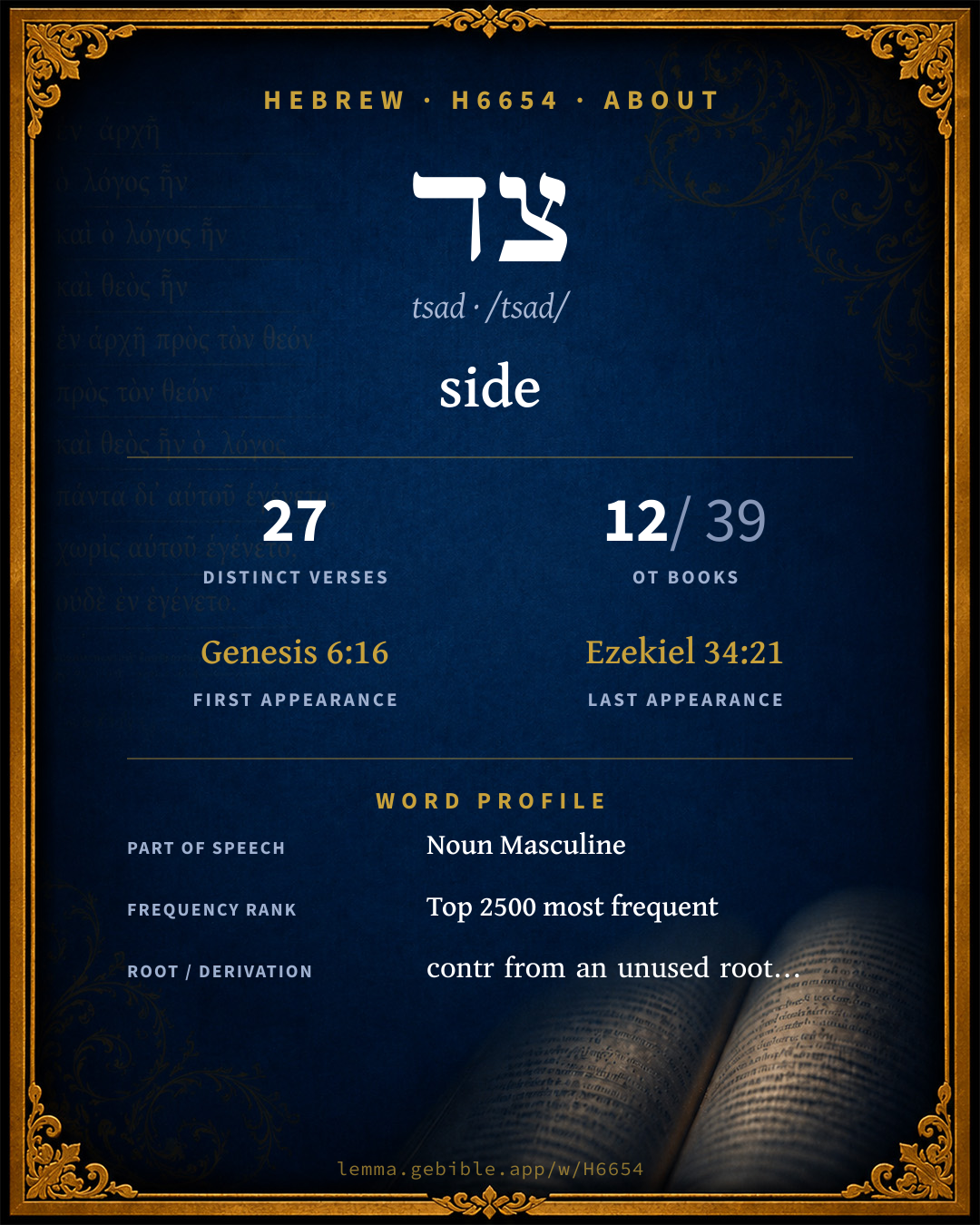
צַד
side
Full lexicon entry — Brown-Driver-Briggs (BDB)
From Brown-Driver-Briggs (BDB)
Where this word appears
See every Construct-state word in the Hebrew Bible →
Grammar key — what these labels mean
Part of speech
- Noun
- A naming word — a person, place, thing, or idea.
Noun type
- Common
- A common noun — a general class of person, place, or thing (“king,” “city,” “water”), not a specific name.
State
- Construct
- A noun bound to a following noun in a possessive / “of” relationship (the construct chain).
- Absolute
- The independent form of a noun, not bound to a following word.
Gender
- Masculine
- Grammatically masculine.
Number
- Singular
- One.
- Plural
- More than one (in Hebrew, generally three or more).
Every verse where H6654 appears in the Book of Ezekiel — 5 distinct verses. Click any verse to open its interlinear word-by-word view. Verse text shown in the World English Bible for context — . Each verse’s Hebrew form is shown with its reference; the English is not keyword-highlighted, since the data carries no word-level English alignment. Use “Compare translations” on any verse to read it across multiple English versions. This concordance covers the Hebrew Bible; Septuagint (Greek Old Testament) occurrences are not indexed here.
Ezekiel
- Ezekiel 4:4 צִדְּ/ךָ֣ n c ms cs + sfx pers 2ms Moreover lie you on your left side, and lay the iniquity of the house of Israel on it; [according to] the number of the days that you shall lie on it, you shall bear their iniquity.
- Ezekiel 4:6 צִדְּ/ךָ֤ n c ms cs + sfx pers 2ms Again, when you have accomplished these, you shall lie on your right side, and shall bear the iniquity of the house of Judah: forty days, each day for a year, have I appointed it to you.
- Ezekiel 4:8 מִֽ/צִּדְּ/ךָ֙ צִדֶּ֔/ךָ prep + n c ms cs + sfx pers 2ms n c ms cs + sfx pers 2ms Behold, I lay bands on you, and you shall not turn you from one side to the other, until you have accomplished the days of your siege.
- Ezekiel 4:9 צִדְּ/ךָ֗ n c ms cs + sfx pers 2ms Take for yourself also wheat, and barley, and beans, and lentils, and millet, and spelt, and put them in one vessel, and make you bread of it; [according to] the number of the days that you shall lie on your side, even three hundred ninety days, shall you eat of it.
- Ezekiel 34:21 בְּ/צַ֤ד prep + n c ms Because you thrust with side and with shoulder, and push all the diseased with your horns, until you have scattered them abroad;
About this entry
At a glance — auto-summarized from this page’s data, not written by a person. Every figure links to its source below. This summary describes the numbers; it doesn’t interpret them.
צד (tsad) is a Hebrew noun most often rendered “side.” It first appears in Genesis 6:16. Spanning 27 verses in 12 books, it ranks among the moderately common words of the Hebrew Bible. Related forms include צד, צדד and צדים. For the data behind this summary, explore the sense tree and the renderings breakdown below.
Gloss history
Strong's 1890 vs modern scholarship
About this word
Strong's H6654 catalogs a Hebrew word from the Hebrew Old Testament.
These counts are not copied from any lexicon or concordance. They are computed here, from the morphology-tagged Hebrew Old Testament. What Lemma adds →
- 27
- distinct verses
- The word appears in 27 distinct verses.
- 12 / 39
- OT books
- The word appears in 12 of 39 Old Testament books.
- #1,064
- by frequency
- Top 2500 most frequent Hebrew words (rank 1,064 of 8,640 Hebrew words by occurrence).
View all 27 occurrences in the concordance →
By section of the Old Testament
By traditional corpus
Conventional, traditional groupings — biblical authorship is debated, so this is a traditional corpus grouping, not an authorship claim. Each share is this word’s portion of its verses in that division of the Hebrew canon. Each figure is a share of the word’s 27 distinct verses.
- Prophets (Nevi'im) 17 verses · 63%
- Torah (Pentateuch) 8 verses · 30%
- Writings (Ketuvim) 2 verses · 7%
How translations render this word
Counts come from each version’s own published word-to-Strong’s tagging or interlinear alignment — an approximate guide to how each version renders this word, not a word-level alignment the data otherwise carries. Because each total is that version’s own tagged count, the per-version totals vary from one another and need not match the appearance or distinct-verse counts above. These counts may also differ from a printed concordance because Lemma counts each distinctly tagged rendering and does not collapse phrase taggings into a single head-word total. This is a fixed set of word-tagged versions (KJV, ASV, BSB, ULT) and does not change with the reading translation you choose elsewhere. Each version’s license is shown beside its name below (and on Sources).
- King James Version: Side 18×, Sides 7×, Is beside 2×
- American Standard Version: Side 11×, Side thereof 3×, Sides 3×
- Berean Standard Bible: Side 12×, Sides 6×, Beside 3×
- unfoldingWord Literal Text: Side 12×, Sides 8×, Side of 6×
King James Version Public Domain
Renders H6654 across 33 tagged occurrences — most commonly:
Plus 6 renderings that appear only once — usually multi-word phrases or single function words the recovered tagging swept in, not distinct renderings.
American Standard Version Public Domain
Renders H6654 across 31 tagged occurrences — most commonly:
Plus 8 renderings that appear only once — usually multi-word phrases or single function words the recovered tagging swept in, not distinct renderings.
Berean Standard Bible Public Domain
Renders H6654 across 31 tagged occurrences — most commonly:
Plus 6 renderings that appear only once — usually multi-word phrases or single function words the recovered tagging swept in, not distinct renderings. Not rendered by a distinct English word in 2 further occurrences.
unfoldingWord Literal Text CC BY-SA 4.0
Renders H6654 across 41 tagged occurrences — most commonly:
Plus 9 renderings that appear only once — usually multi-word phrases or single function words the recovered tagging swept in, not distinct renderings.
Senses in BDB
The 1 sense BDB distinguishes for this word, in lexicon order (not ranked by frequency or importance). The full entry — with sub-senses — is in the Lexicon Entry tab.
- side
Word origin
n.m. Ex 25:32 side;—צַד abs. Ez 34:21; Is 60:4, cstr. 2 S 2:16 +; sf. צִדָּהּ Gn 6:16 +, etc.; for צִדָּה 1 S 20:20 read צַ֫דָּה (or צִדֹּה; cf. Dr, > צִ֫דָּה); pl. צִדִּים Ju 2:3, read prob. צִדֵּיכֶם as Nu 33:55; Jos 23:13; cstr. צִדֵּי Ex 26:13, etc.;—side, of man 2 S 2:16; Nu 33:55; (H) Jos 23:13 (D), Ju 2:3 (prob. read context as Nu 33:55 GFM; DlPr 75 cp. Assyrian ṣaddu, snare, trap); of one lying Ez 4:4, 6, 9, מִצִּדְּךָ אֶל־צִדֶּ֑ךָ v 8 turn from side to side; children carried עַל־צ׳ (i.e. prob. on hip) Is 60:4; 66:12; of cattle Ez 34:21 (in fig.); of things 1 S 20:20 (cf. Dr), Gn 6:16; Ex 25:32(×3) = 37:18(×3), 26:13; 30:4 = 37:27 (all P); מִצַּד at the side of c. gen. th. Dt 31:26, pers. 1 S 20:25; Ru 2:14, מִצִּדְּךָ ψ 91:7; c. gen. loc. Jos 3:16; 12:9, מִצַּד הָהָר 2 S 13:34; מִצַּד הָהָר מִזֶּה 1 S 23:26 bis on this side of the hill and on that side; c. sf. rei מִצִּדּוֹ 1 S 6:8.
— Brown-Driver-Briggs (Oxford 1906, public domain), digitized via Sefaria, supplemented by the OpenScriptures HebrewLexicon (CC BY 4.0). See Sources.
Origin: contr from an unused root meaning to sidle off
Jastrow Dictionary
A second Hebrew/Aramaic lexicon for comparison, covering Aramaic and post-biblical (Talmudic, Targumic, Midrashic) usage that the biblical-Hebrew BDB does not. Matched by lemma rather than by Strong’s number, so a lemma may carry more than one Jastrow headword (shown separately below), and the entries cover usage well beyond the Bible.
צַד
- צדד to join; cmp. סַד) side, border. B. Mets. 11ᵃ עומד בצד שדהו he was standing at the border of his field. Snh. IV, 2 in capital cases מתחילין מן הצד they begin to take the votes from the side bench (the junior judges), opp. הגדול. Ib. 36ᵃ (in Chald. dict.) כולהו … מן הצד הוו מתחלי they began all their voting with the youngest; Gitt. 59ᵃ. Snh. 38ᵇ תשובתן בצִידָּן, v. פָּקַר. Gen. R. s. 8 בצִדָּהּ, v. פִּתְחוֹן. Nidd. 22ᵇ מצד אחד, v. פָּנָה. Kidd. 74ᵇ מצידה (Var. in Ar. s. v. צד: מצמדה), v. תַּבְרָא.—B. Mets. 63ᵃ, a. fr. צד אחד בריבית, v. רִבִּית. B. Kam. I, 1, a. fr. הצד השוה שבהן the points common to both, v. הֲרֵי I. Kidd. 78ᵃ, a. e. מה להצד השוה וכ׳ what is the common point? Ib. ומייתי לה במה הצד and proves it by analogy from the common point. Ber. 35ᵃ מה להצד … שכן יש בו צד מזבח what is the common point? that it may eventually be used for the altar?; ואתי נמי זית … צד מזבח and so is ‘olive’ included, which is eventually used on the altar (as oil). B. Mets. 115ᵃ לצד שני another interpretation.—מן הצד sideways, in an unusual manner, indirectly. Sabb. 43ᵇ, v. טִלְטוּל h. Ib. 47ᵇ בנין מן הצד an indirect way of building (putting up a folding bed); a. fr.—כאיזה צד, כאי זה צד, כיזה צד, v. כֵּיצַד.—Pl. v. צְדָד
צַד ²
- ch., v. צֵיד
A Dictionary of the Targumim, the Talmud Babli and Yerushalmi, and the Midrashic Literature (Marcus Jastrow; London, Luzac, 1903) — Public Domain. Digitized via Sefaria. Digitized via Sefaria. Full attribution on Sources.
Forms in the corpus
The 25 distinct written forms H6654 takes in the Hebrew Bible, most frequent first — each parse links to that state’s occurrences in the concordance. Hebrew forms include their vowel points and cantillation, so a single lemma takes many written forms.
Same root — word family
Other BDB entries built from the same root as H6654, grouped by Strong’s listed origin. These share a root / origin per the lexicon — not necessarily a shared meaning. Each links to that word’s own entry.
Derived from this word
Proper names from this root
People and places named from this root — a name, not an additional meaning of the word.
Compare all same-root words → 2 of the same-root words are proper names (people or places). They share a root, not necessarily a meaning.
Septuagint verse parallels
This word appears in 26 verses that also exist in the Greek Old Testament (Septuagint), out of the 27 Hebrew verses it occurs in. You can read those verses in Greek by switching the Old Testament edition to the Septuagint.
Read these verses in the Septuagint
- Genesis 6:16
- Exodus 25:32
- Numbers 33:55
- Deuteronomy 31:26
- Joshua 3:16
- Judges 2:3
- Ruth 2:14
- 1 Samuel 6:8
- 2 Samuel 2:16
- Psalms 91:7
- Isaiah 60:4
- Ezekiel 4:4
This is a verse-level parallel only — the same verses exist in both the Hebrew and Greek Old Testaments. No word-level Hebrew↔Greek correspondence is claimed: the data carries no such alignment, so no Greek word is shown as this Hebrew word’s translation. Coverage is not total — the Septuagint omits the deuterocanon and renumbers the Psalms, so some Hebrew verses have no direct Greek parallel.