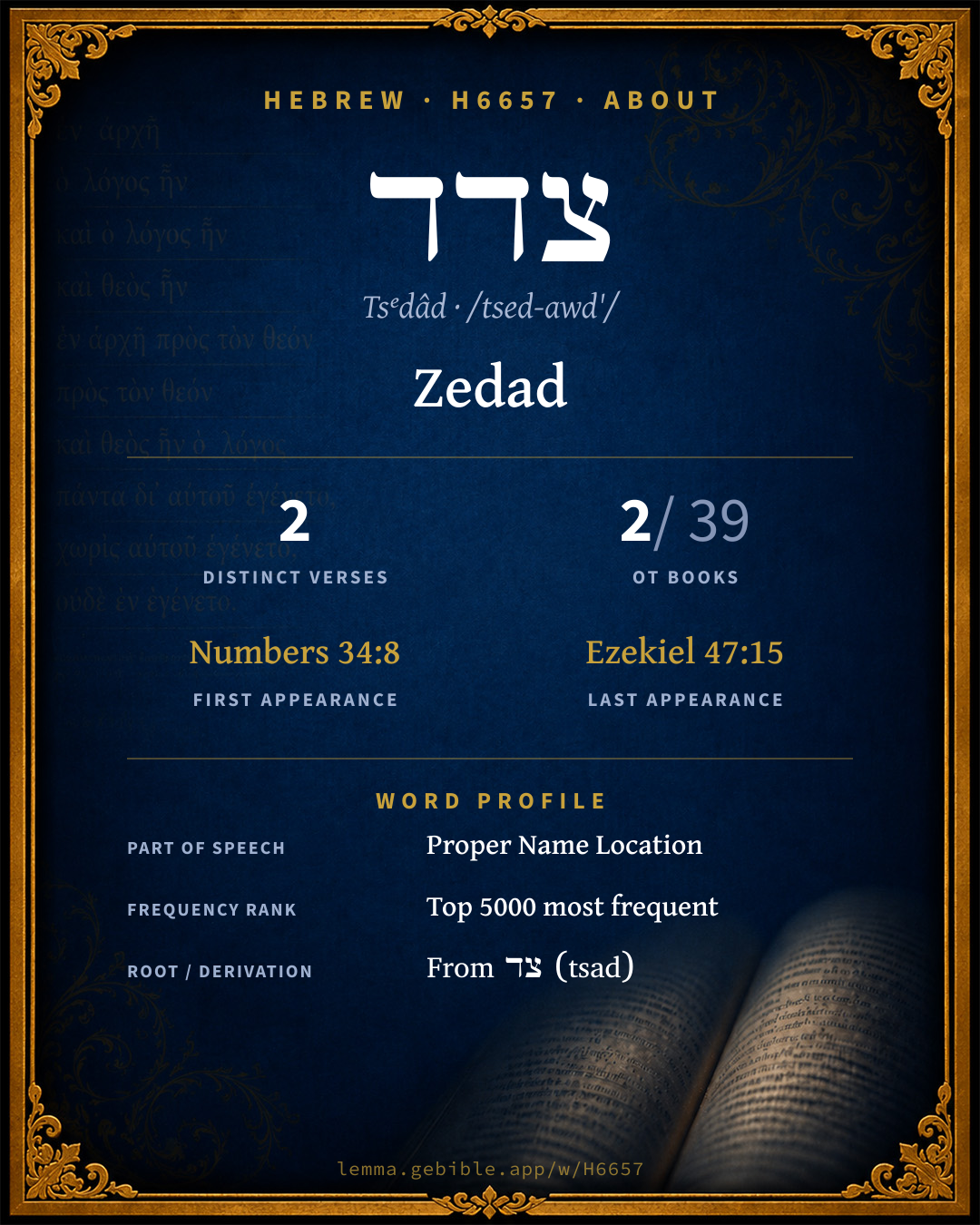
צְדָד
Zedad
BDB lists 2 entries for ‘Zedad’ fuller range ↓
Full lexicon entry — Brown-Driver-Briggs (BDB)
From Brown-Driver-Briggs (BDB)
Where this word appears
Grammar key — what these labels mean
Part of speech
- Noun
- A naming word — a person, place, thing, or idea.
Noun type
- Proper
- A name of a specific person, place, or people (e.g. Abraham, Zion, Israel).
Every verse where H6657 appears — 2 distinct verses across 2 books. Click any verse to open its interlinear word-by-word view. Verse text shown in the World English Bible for context — . Each verse’s Hebrew form is shown with its reference; the English is not keyword-highlighted, since the data carries no word-level English alignment. Use “Compare translations” on any verse to read it across multiple English versions. This concordance covers the Hebrew Bible; Septuagint (Greek Old Testament) occurrences are not indexed here.
Numbers 1 verse
Ezekiel 1 verse
About this entry
At a glance — auto-summarized from this page’s data, not written by a person. Every figure links to its source below. This summary describes the numbers; it doesn’t interpret them.
צדד (Tsᵉdâd) is a Hebrew name most often rendered “Zedad.” A scarce word — 2 verses in all of the Hebrew Bible. It clusters heavily in Numbers, which alone accounts for 50% of its uses. It first appears in Numbers 34:8. The sections below give every occurrence and version rendering.
Gloss history
Strong's 1890 vs modern scholarship
About this word
Strong's H6657 catalogs a Hebrew word from the Hebrew Old Testament.
These counts are not copied from any lexicon or concordance. They are computed here, from the morphology-tagged Hebrew Old Testament. What Lemma adds →
- 2
- distinct verses
- The word appears in 2 distinct verses.
- 2 / 39
- OT books
- The word appears in 2 of 39 Old Testament books.
- #4,807
- by frequency
- Top 5000 most frequent Hebrew words (rank 4,807 of 8,640 Hebrew words by occurrence).
View all 2 occurrences in the concordance →
By traditional corpus
Conventional, traditional groupings — biblical authorship is debated, so this is a traditional corpus grouping, not an authorship claim. Each share is this word’s portion of its verses in that division of the Hebrew canon. Each figure is a share of the word’s 2 distinct verses.
- Torah (Pentateuch) 1 verse · 50%
- Prophets (Nevi'im) 1 verse · 50%
How translations render this word
Counts come from each version’s own published word-to-Strong’s tagging or interlinear alignment — an approximate guide to how each version renders this word, not a word-level alignment the data otherwise carries. Because each total is that version’s own tagged count, the per-version totals vary from one another and need not match the appearance or distinct-verse counts above. These counts may also differ from a printed concordance because Lemma counts each distinctly tagged rendering and does not collapse phrase taggings into a single head-word total. This is a fixed set of word-tagged versions (KJV, ASV, BSB, ULT) and does not change with the reading translation you choose elsewhere. Each version’s license is shown beside its name below (and on Sources).
- King James Version: Shall be to zedad 1×, Zedad 1×
- American Standard Version: Shall be at zedad 1×, Zedad 1×
- Berean Standard Bible: Zedad 2×
- unfoldingWord Literal Text: Zedad 2×
King James Version Public Domain
Renders H6657 across 2 tagged occurrences — most commonly:
American Standard Version Public Domain
Renders H6657 across 2 tagged occurrences — most commonly:
Berean Standard Bible Public Domain
Renders H6657 across 2 tagged occurrences — most commonly:
unfoldingWord Literal Text CC BY-SA 4.0
Renders H6657 across 2 tagged occurrences — most commonly:
Senses in BDB
The 2 senses BDB distinguishes for this word, in lexicon order (not ranked by frequency or importance). The full entry — with sub-senses — is in the Lexicon Entry tab.
- Zedad = "mountain side"
- one of the landmarks on the northern border of Israel as promised by Moses and restated by Ezekiel
Word origin
[ צָדָד, צְדָד ] n.pr.loc. on N. border of Canaan
— Brown-Driver-Briggs (Oxford 1906, public domain), digitized via Sefaria, supplemented by the OpenScriptures HebrewLexicon (CC BY 4.0). See Sources.
Derived from צד (tsad) (H6654) — side.
Jastrow Dictionary
A second Hebrew/Aramaic lexicon for comparison, covering Aramaic and post-biblical (Talmudic, Targumic, Midrashic) usage that the biblical-Hebrew BDB does not. Matched by lemma rather than by Strong’s number, so a lemma may carry more than one Jastrow headword (shown separately below), and the entries cover usage well beyond the Bible.
צַד
- צדד to join; cmp. סַד) side, border. B. Mets. 11ᵃ עומד בצד שדהו he was standing at the border of his field. Snh. IV, 2 in capital cases מתחילין מן הצד they begin to take the votes from the side bench (the junior judges), opp. הגדול. Ib. 36ᵃ (in Chald. dict.) כולהו … מן הצד הוו מתחלי they began all their voting with the youngest; Gitt. 59ᵃ. Snh. 38ᵇ תשובתן בצִידָּן, v. פָּקַר. Gen. R. s. 8 בצִדָּהּ, v. פִּתְחוֹן. Nidd. 22ᵇ מצד אחד, v. פָּנָה. Kidd. 74ᵇ מצידה (Var. in Ar. s. v. צד: מצמדה), v. תַּבְרָא.—B. Mets. 63ᵃ, a. fr. צד אחד בריבית, v. רִבִּית. B. Kam. I, 1, a. fr. הצד השוה שבהן the points common to both, v. הֲרֵי I. Kidd. 78ᵃ, a. e. מה להצד השוה וכ׳ what is the common point? Ib. ומייתי לה במה הצד and proves it by analogy from the common point. Ber. 35ᵃ מה להצד … שכן יש בו צד מזבח what is the common point? that it may eventually be used for the altar?; ואתי נמי זית … צד מזבח and so is ‘olive’ included, which is eventually used on the altar (as oil). B. Mets. 115ᵃ לצד שני another interpretation.—מן הצד sideways, in an unusual manner, indirectly. Sabb. 43ᵇ, v. טִלְטוּל h. Ib. 47ᵇ בנין מן הצד an indirect way of building (putting up a folding bed); a. fr.—כאיזה צד, כאי זה צד, כיזה צד, v. כֵּיצַד.—Pl. v. צְדָד
צָדַד
- , Pi. צִידֵּד (denom. of צַד) to turn sideways, move aside; to arrange. Gen. R. s. 8 מְצַדֵּד man can look sideways (which other animals cannot); ib. s. 14. Yoma 55ᵃ כשהוא מזה למעלה מצדד ידו וכ׳ when he is to sprinkle upwards, he turns first his hand down &c. Sabb. 102ᵇ המצדד את האבן he who turns a building stone (makes room for it and sets it in its place). Bets. 32ᵇ מותר לצַדְּדָן you are permitted to arrange them for a seat; a. e.—Part. pass. מְצוּדָּד, pl. מְצוּדָּדִין. B. Bath. 99ᵃ ומצ׳ פניהם וכ׳ their faces were turned sideways, like a disciple taking leave of his teacher.
- (for נָצַד) to be removed (cmp. צָדָה II). Ruth R. to II, 14 (play on מִצּד ib.) שנוֹצַדָּה לו … לשעה his government was taken away from him for a time. Ib. שעתידה מלכותו לִיצַּד ממנו וכ׳ his government was destined to be taken away &c. Gen. R. s. 26 שיִּצּוֹד, v. צָדָה II.
צְדַד
- Pa. צַדֵּד same. Targ. Prov. XXIII, 5 אין תְּצַד וכ׳ ed. Lag. (oth. ed. תצר) if thou turnest thy eye (h. text התעיף, v. Pesh. a. l.).—Targ. Y. Lev. XVI, 24 (cmp. B. Bath. 99ᵃ, quot. in preced.).—Sabb. 102ᵇ תתאה בעי צַדּוּדֵי וכ׳ Ms. M. (ed. תתא) to place the lowest stone it is necessary to make room for it in the ground and surround it with earth (v. preced.). Yoma 37ᵃ דמְצַדֵּד אַצְדּוּדֵי (Rashi דמִיצֵּדּד, Ithpa.) he turns sideways. B. Bath. 99ᵃ דמְצַדְּדֵי אצדודי they (the Cherubim) were turned sideways (so as to face both the house and each other). Sabb. 141ᵃ לא לִיצַדֵּד וכ׳ (or לִיצַּדֵּד, Ithpa.), v. כּוּבָּא II.
- , inf. אצְדּוּדֵי, v. supra.
צְדָד
- = צַד; pl. צְדָדִים, צְדָדִין. Ḥull. 8ᵃ והאיכא צ׳ but are there not the sides (of the heated knife which burn instead of cutting)? Y. Sabb. XIII, end, 14ᵇ צִידְדֵי בהמה the sides of a beast. Bab. Sabb. 154ᵇ צ׳ הן וצ׳ לא וכ׳ this is making use of the sides of a beast, and this the Rabbis have not forbidden. Ib. צִדְדֵי צ׳ the sides of sides, indirect use of the sides of an object (v. צַד). Sifré Num. 126 בכל צְדָדָיו on any of its sides, opp. entrance of the tent. Nidd. 22ᵇ, v. פָּנָה. Sabb. 6ᵃ צִדֵּי רשות הרבים the sides (the walls &c.) along the public road. Ib. 99ᵃ צידי עגלה the sides of a wagon; עגלות תחתיהן וביניהן וצִידֵּיהֶן the spaces under wagons and between them, and their outsides. Y. Peah VI, 19ᶜ top דבר שהוא חומר משני צ׳ where a rule works as a restriction both ways; a. fr.—B. Kam. 16ᵇ, a. e. לצ׳ קתני it is meant in either way, i.e. disjunctively, the one or the other. Y. Yeb. IV, 5ᵈ לצ׳ … או וכ׳ the Mishnah means the Vav in a disjunctive sense, ‘or’ &c.
A Dictionary of the Targumim, the Talmud Babli and Yerushalmi, and the Midrashic Literature (Marcus Jastrow; London, Luzac, 1903) — Public Domain. Digitized via Sefaria. Digitized via Sefaria. Full attribution on Sources.
Same root — word family
Other BDB entries built from the same root as H6657, grouped by Strong’s listed origin. These share a root / origin per the lexicon — not necessarily a shared meaning. Each links to that word’s own entry.
Derives from
Shares the same root
Proper names from this root
People and places named from this root — a name, not an additional meaning of the word.
Compare all same-root words → 1 of the same-root words is a proper name (a person or place). They share a root, not necessarily a meaning.
Bible dictionary
Public-domain dictionary articles matched to this entry by name (Zedad). A biblical name can be shared by more than one person or place, so an article may treat several.
Easton's Bible Dictionary · M. G. Easton, 1897
Side; sloping place, a town in the north of Palestine, near Hamath (Num. 34:8; Ezek. 47:15). It has been identified with the ruins of Sudud, between Emesa (Hums) and Baalbec, but that is uncertain.
Smith's Bible Dictionary · William Smith, 1863
(mountain side), one of the landmarks on the north border of the land of Israel, as Promised by Moses, (Numbers 34:8) and as restored by Ezekiel. (Ezekiel 47:15) A place named Sudud exists to the east of the northern extremity of the chain of Anti-Libanus, about fifty miles east-northeast of Baalbec . This may be identical with Zedad.
Hitchcock's Bible Names Dictionary · Roswell D. Hitchcock, 1869
his side; his hunting
Classic public-domain reference works; full attribution on Sources.
Septuagint verse parallels
This word appears in 2 verses that also exist in the Greek Old Testament (Septuagint), out of the 2 Hebrew verses it occurs in. You can read those verses in Greek by switching the Old Testament edition to the Septuagint.
Read these verses in the Septuagint
This is a verse-level parallel only — the same verses exist in both the Hebrew and Greek Old Testaments. No word-level Hebrew↔Greek correspondence is claimed: the data carries no such alignment, so no Greek word is shown as this Hebrew word’s translation. Coverage is not total — the Septuagint omits the deuterocanon and renumbers the Psalms, so some Hebrew verses have no direct Greek parallel.