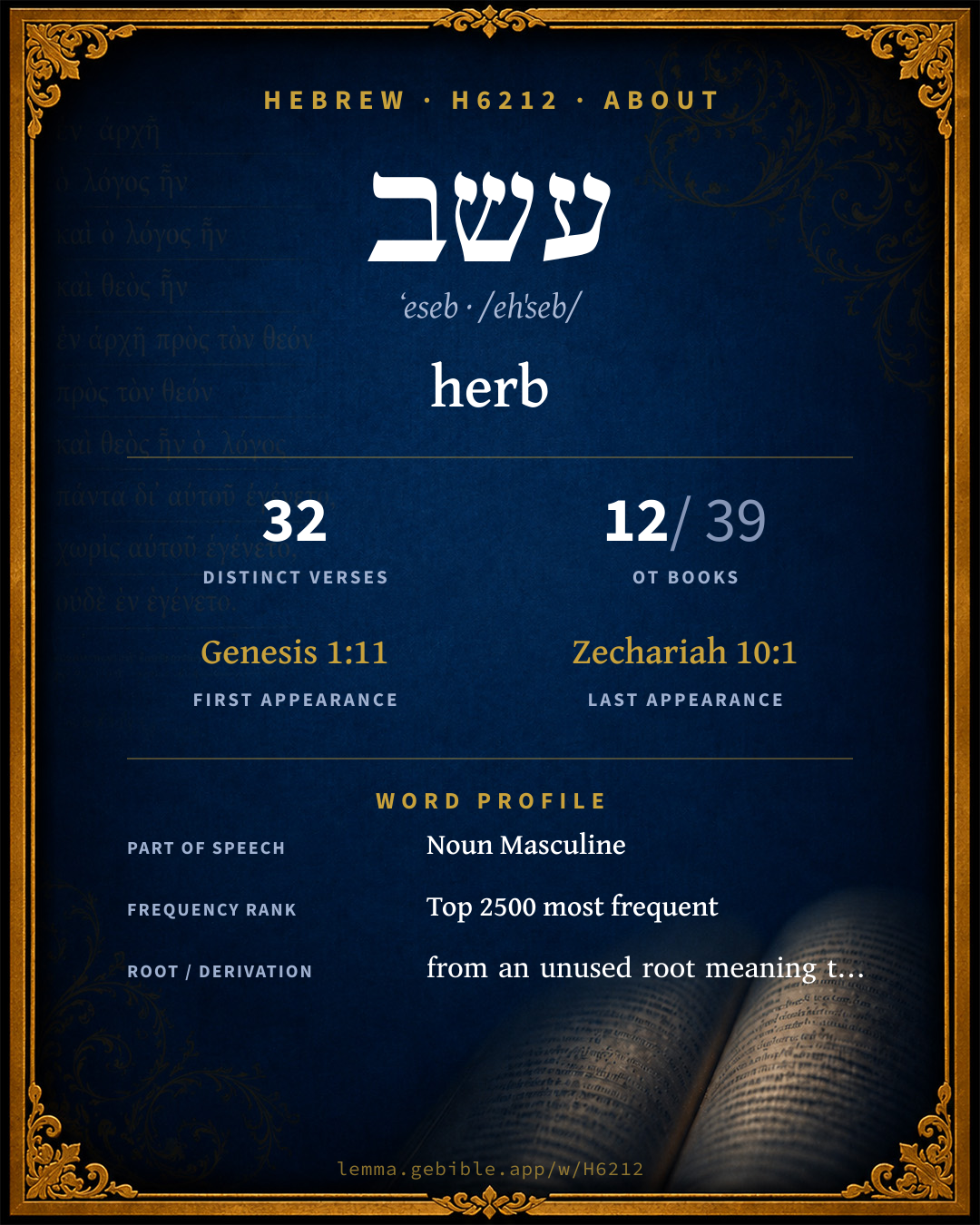
עֵ֫שֶׂב
herb
Full lexicon entry — Brown-Driver-Briggs (BDB)
From Brown-Driver-Briggs (BDB)
Where this word appears
Grammar key — what these labels mean
Part of speech
- Noun
- A naming word — a person, place, thing, or idea.
Noun type
- Common
- A common noun — a general class of person, place, or thing (“king,” “city,” “water”), not a specific name.
State
- Absolute
- The independent form of a noun, not bound to a following word.
- Construct
- A noun bound to a following noun in a possessive / “of” relationship (the construct chain).
Gender
- Masculine
- Grammatically masculine.
Number
- Singular
- One.
- Plural
- More than one (in Hebrew, generally three or more).
Every verse where H6212 appears in the Book of Exodus — 4 distinct verses. Click any verse to open its interlinear word-by-word view. Verse text shown in the World English Bible for context — . Each verse’s Hebrew form is shown with its reference; the English is not keyword-highlighted, since the data carries no word-level English alignment. Use “Compare translations” on any verse to read it across multiple English versions. This concordance covers the Hebrew Bible; Septuagint (Greek Old Testament) occurrences are not indexed here.
Exodus
- Exodus 9:22 עֵ֥שֶׂב n c ms cs Yahweh said to Moses, "Stretch forth your hand toward the sky, that there may be hail in all the land of Egypt, on man, and on animal, and on every herb of the field, throughout the land of Egypt."
- Exodus 9:25 עֵ֤שֶׂב n c ms cs The hail struck throughout all the land of Egypt all that was in the field, both man and animal; and the hail struck every herb of the field, and broke every tree of the field.
- Exodus 10:12 עֵ֣שֶׂב n c ms cs Yahweh said to Moses, "Stretch out your hand over the land of Egypt for the locusts, that they may come up on the land of Egypt, and eat every herb of the land, even all that the hail has left."
- Exodus 10:15 עֵ֣שֶׂב וּ/בְ/עֵ֥שֶׂב n c ms cs conj + prep + n c ms cs For they covered the surface of the whole earth, so that the land was darkened, and they ate every herb of the land, and all the fruit of the trees which the hail had left. There remained nothing green, either tree or herb of the field, through all the land of Egypt.
About this entry
At a glance — auto-summarized from this page’s data, not written by a person. Every figure links to its source below. This summary describes the numbers; it doesn’t interpret them.
At its core, עשב (ʻeseb) means “herb.” Where the King James Version says “grass,” newer translations reach for “plant” (Berean Standard Bible); the renderings breakdown has the detail. It appears 32 verses across 12 books of the Hebrew Bible, among its moderately common vocabulary. First canonically at Genesis 1:11, it enters the text early. Dig into 32-verse concordance and the renderings breakdown below.
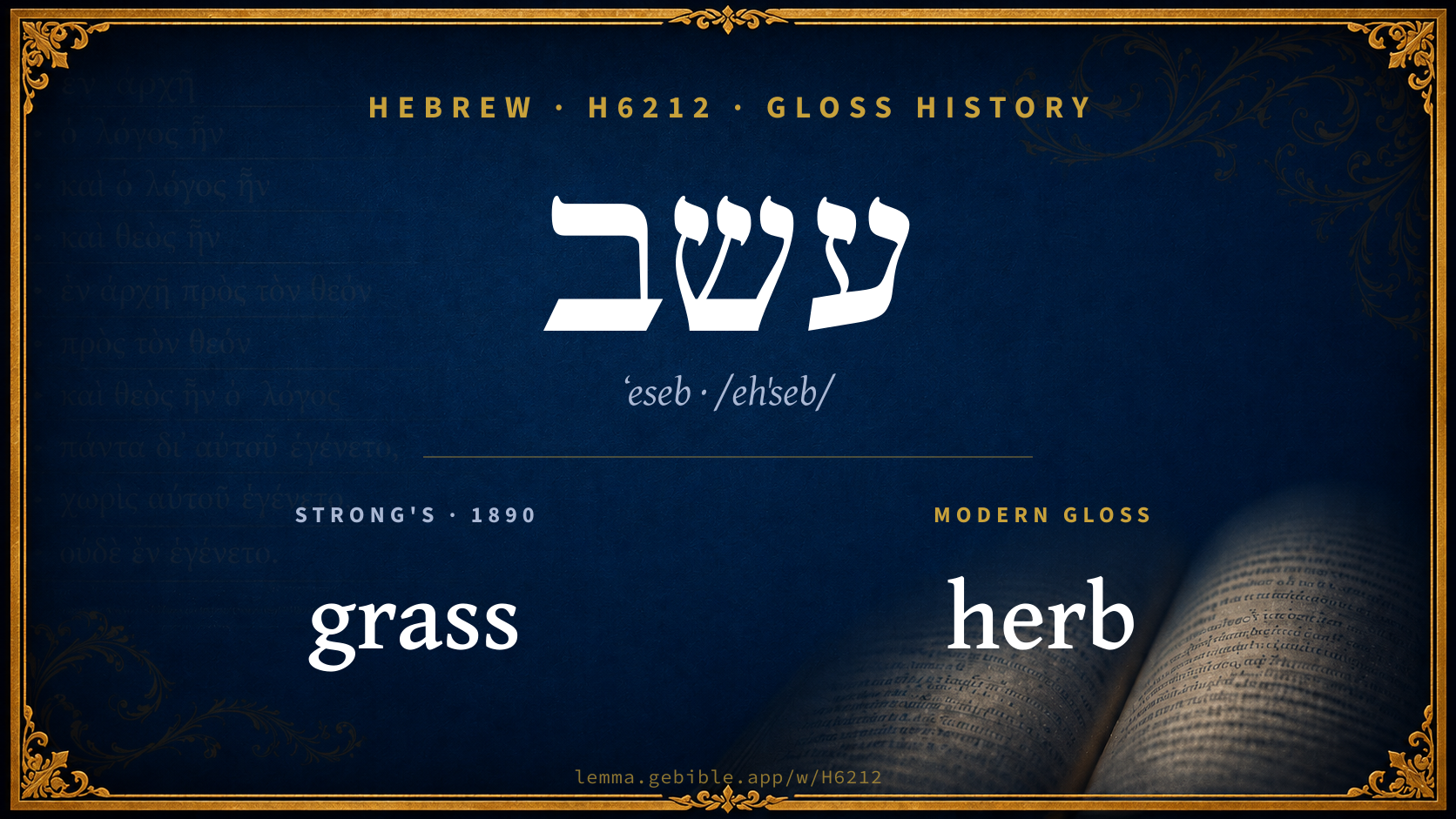
Gloss history
Strong's 1890 vs modern scholarship
About this word
Strong's H6212 catalogs a Hebrew word from the Hebrew Old Testament.
These counts are not copied from any lexicon or concordance. They are computed here, from the morphology-tagged Hebrew Old Testament. What Lemma adds →
- 32
- distinct verses
- The word appears in 32 distinct verses.
- 12 / 39
- OT books
- The word appears in 12 of 39 Old Testament books.
- #1,064
- by frequency
- Top 2500 most frequent Hebrew words (rank 1,064 of 8,640 Hebrew words by occurrence).
View all 32 occurrences in the concordance →
By section of the Old Testament
By traditional corpus
Conventional, traditional groupings — biblical authorship is debated, so this is a traditional corpus grouping, not an authorship claim. Each share is this word’s portion of its verses in that division of the Hebrew canon. Each figure is a share of the word’s 32 distinct verses.
- Torah (Pentateuch) 14 verses · 44%
- Writings (Ketuvim) 10 verses · 31%
- Prophets (Nevi'im) 8 verses · 25%
How translations render this word
Counts come from each version’s own published word-to-Strong’s tagging or interlinear alignment — an approximate guide to how each version renders this word, not a word-level alignment the data otherwise carries. Because each total is that version’s own tagged count, the per-version totals vary from one another and need not match the appearance or distinct-verse counts above. These counts may also differ from a printed concordance because Lemma counts each distinctly tagged rendering and does not collapse phrase taggings into a single head-word total. This is a fixed set of word-tagged versions (KJV, ASV, BSB, ULT) and does not change with the reading translation you choose elsewhere. Each version’s license is shown beside its name below (and on Sources).
- King James Version: Grass 9×, Herb 6×, Every herb 5×
- American Standard Version: Grass 8×, Every herb 5×, Herb 4×
- Berean Standard Bible: Plant 8×, Plants 7×, Grass 6×
- unfoldingWord Literal Text: Grass 6×, Vegetation 4×, Plant of 3×
King James Version Public Domain
Renders H6212 across 33 tagged occurrences — most commonly:
Plus 8 renderings that appear only once — usually multi-word phrases or single function words the recovered tagging swept in, not distinct renderings.
American Standard Version Public Domain
Renders H6212 across 33 tagged occurrences — most commonly:
Plus 8 renderings that appear only once — usually multi-word phrases or single function words the recovered tagging swept in, not distinct renderings.
Berean Standard Bible Public Domain
Renders H6212 across 32 tagged occurrences — most commonly:
Plus 7 renderings that appear only once — usually multi-word phrases or single function words the recovered tagging swept in, not distinct renderings. Not rendered by a distinct English word in 1 further occurrence.
unfoldingWord Literal Text CC BY-SA 4.0
Renders H6212 across 34 tagged occurrences — most commonly:
Plus 8 renderings that appear only once — usually multi-word phrases or single function words the recovered tagging swept in, not distinct renderings.
Senses in BDB
The 1 sense BDB distinguishes for this word, in lexicon order (not ranked by frequency or importance). The full entry — with sub-senses — is in the Lexicon Entry tab.
- herb, herbage, grass, green plants
Word origin
n.m. Gn 1:11 herb, herbage;—ע׳ abs. Dt 11:15 +; cstr. Gn 2:5 +; sf. עֶשְׂבָּם Is 42:15; pl. cstr. עִשְּׂבוֹת (d.f. dirim.) Pr 27:25;—herb, herbage, in oldest use often gen. (therefore incl. grass [דֶּשֶׁא]): ע׳ הַשָּׂדֶה Ex 9:22 (E), Gn 2:5 (+ שִׂיחַ) Ex 9:25 (+ עֵץ), 10:15 (+ id; all J) Am 7:2, so ע׳ הָאָרֶץ Ex 10:12 (E), + פְּרִי הָעֵץ v 15 (J), whence ψ 105:35; appar. gen. also in ע׳ הארץ Jb 5:25 ψ 72:16, ע׳ alone 92:8; ע׳ כָּל־הַשָּׂדֶה Je 12:14, ע׳ alone Dt 32:2 (‖ דֶּשֶׁא), Is 42:15 ψ 102:5, 12, and Dt 29:22 Mi 5:6 Pr 19:12; hence ע׳ as food for cattle Dt 11:15 ψ 106:20 cf. Je 14:6 Zc 10:1; עִשְּׂבוֹת הָרִים Pr 27:25 (‖ דֶּשֶׁא, חָצִיר); but as human food (hence excluding דֶּשֶׁא) ע׳ הַשָּׂדֶה Gn 3:18 (J); especially P Gn 1:29 (+ עֶץ), יֶרֶק ע׳ v 30; 9:3, hence ע׳ ψ 104:14 (‖ חָצִיר for cattle); ע׳ disting. from דֶּשֶׁא, עֵץ also Gn 1:11, 12, ע׳ שָׂדֶה + דֶּשֶׁא, חָצִיר 2 K 19:26 + Is 37:27.
— Brown-Driver-Briggs (Oxford 1906, public domain), digitized via Sefaria, supplemented by the OpenScriptures HebrewLexicon (CC BY 4.0). See Sources.
Origin: from an unused root meaning to glisten (or be green)
Jastrow Dictionary
A second Hebrew/Aramaic lexicon for comparison, covering Aramaic and post-biblical (Talmudic, Targumic, Midrashic) usage that the biblical-Hebrew BDB does not. Matched by lemma rather than by Strong’s number, so a lemma may carry more than one Jastrow headword (shown separately below), and the entries cover usage well beyond the Bible.
עֵשֶׂב
- (b. h.) herb, plant, grass. Gen. R. s. 10, v. מַזָּל. Cant. R. to IV, 11 ע׳ הבאר the plants surrounding the well, v. גִּעְגֵּעַ; a. fr.—Pl. עֲשַׂבִּים. Kil. V, 7 אם ע׳ יופך if the dropped seeds have not grown beyond the stage of herbage, he must turn the soil over (v. אָפַךְ). Lev. R. s. 27, beg. ההרים מעלין ע׳ וכ׳ the mountains produce herbs, and the righteous, good deeds. Erub. 54ᵃ בני האדם דומין לעִשְׂבֵּי השדה וכ׳ men are like the plants of the field, these blossom &c., v. הָלָה. Y. Taan. IV, 68ᵈ bot., a. e., v. לֶחִי; a. fr.
עֲשַׂב
- Targ. Gen. I, 29 some ed.; a. fr.; v. עִסְבָּא.—Lev. R. s. 22 חמא חד עשב וכ׳ saw a certain plant and picked it up, and made of it a wreath for his head. Ib. חמא ההוא ע׳ saw that same plant. B. Bath. 74ᵇ, v. סַמְתְּרֵי; a. fr.—Pl. עִשְׂבֵּי, עִי׳. Ib. ואנחנא אע׳ and we rested on the herbs. Sot. 48ᵇ ע׳ טוריא mountain herbs, v. שׁוּט I ch.; a. fr.
A Dictionary of the Targumim, the Talmud Babli and Yerushalmi, and the Midrashic Literature (Marcus Jastrow; London, Luzac, 1903) — Public Domain. Digitized via Sefaria. Digitized via Sefaria. Full attribution on Sources.
Forms in the corpus
The 17 distinct written forms H6212 takes in the Hebrew Bible, most frequent first — each parse links to that state’s occurrences in the concordance. Hebrew forms include their vowel points and cantillation, so a single lemma takes many written forms.
Septuagint verse parallels
This word appears in 31 verses that also exist in the Greek Old Testament (Septuagint), out of the 32 Hebrew verses it occurs in. You can read those verses in Greek by switching the Old Testament edition to the Septuagint.
Read these verses in the Septuagint
- Genesis 1:11
- Exodus 9:22
- Deuteronomy 11:15
- 2 Kings 19:26
- Job 5:25
- Psalms 72:16
- Proverbs 19:12
- Isaiah 37:27
- Jeremiah 12:4
- Amos 7:2
- Micah 5:7
- Zechariah 10:1
This is a verse-level parallel only — the same verses exist in both the Hebrew and Greek Old Testaments. No word-level Hebrew↔Greek correspondence is claimed: the data carries no such alignment, so no Greek word is shown as this Hebrew word’s translation. Coverage is not total — the Septuagint omits the deuterocanon and renumbers the Psalms, so some Hebrew verses have no direct Greek parallel.