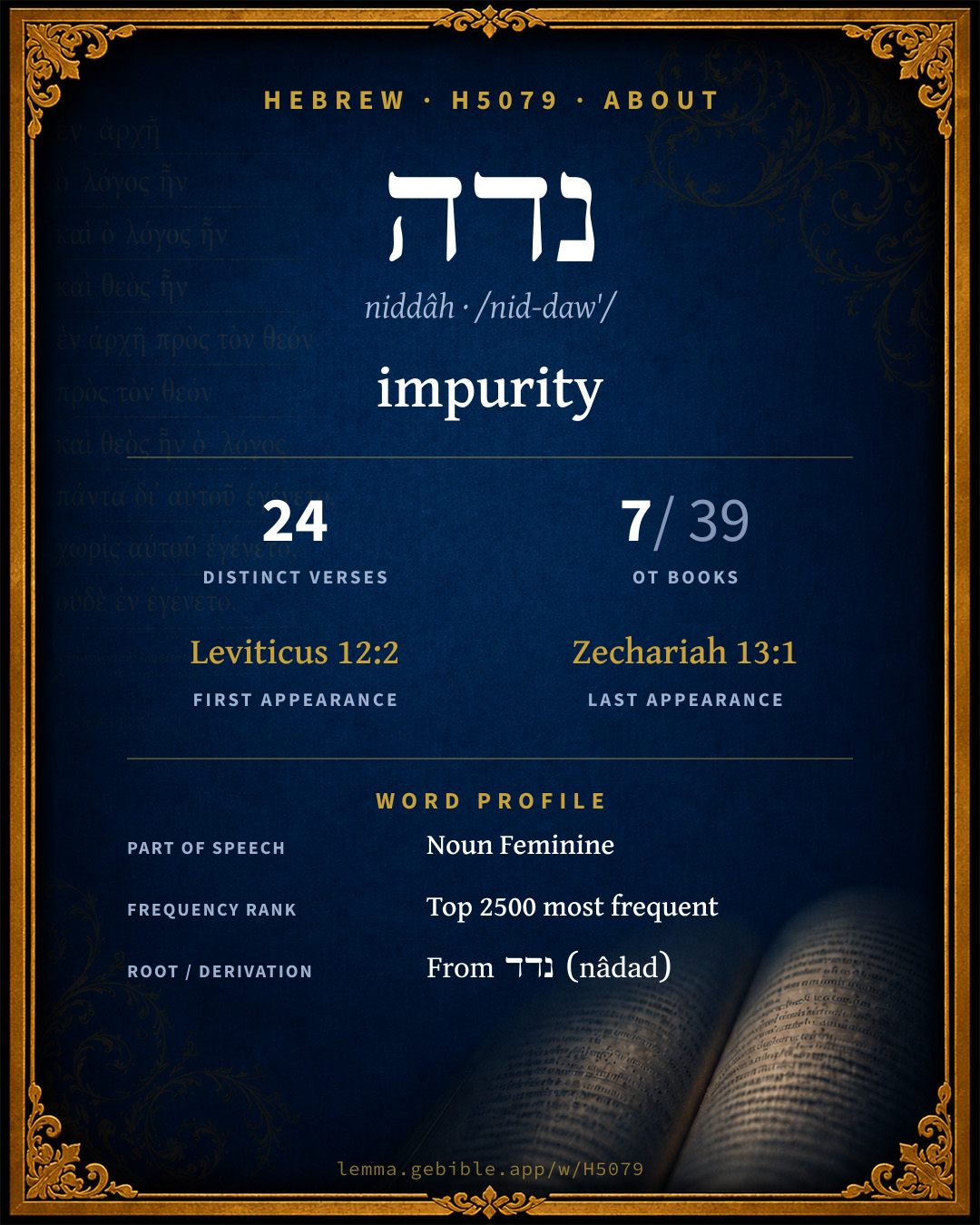
נִדָּה
impurity
also: filthiness, menstruous, set apart fuller range ↓
Full lexicon entry — Brown-Driver-Briggs (BDB)
From Brown-Driver-Briggs (BDB)
Where this word appears
See every Absolute-state word in the Hebrew Bible →
Grammar key — what these labels mean
Part of speech
- Noun
- A naming word — a person, place, thing, or idea.
Noun type
- Common
- A common noun — a general class of person, place, or thing (“king,” “city,” “water”), not a specific name.
State
- Absolute
- The independent form of a noun, not bound to a following word.
- Construct
- A noun bound to a following noun in a possessive / “of” relationship (the construct chain).
Gender
- Feminine
- Grammatically feminine.
Number
- Singular
- One.
10 distinct verses where H5079 appears in the Construct state, across 2 books. Filtered view — show all forms. Click any verse to open its interlinear word-by-word view. Verse text shown in the World English Bible for context — . Each verse’s Hebrew form is shown with its reference; the English is not keyword-highlighted, since the data carries no word-level English alignment. Use “Compare translations” on any verse to read it across multiple English versions. This concordance covers the Hebrew Bible; Septuagint (Greek Old Testament) occurrences are not indexed here.
Leviticus 9 verses
- Leviticus 12:2 נִדַּ֥ת n c fs cs "Speak to the children of Israel, saying, 'If a woman conceives, and bears a male child, then she shall be unclean seven days; as in the days of her monthly period she shall be unclean.
- Leviticus 12:5 כְּ/נִדָּתָ֑/הּ prep + n c fs cs + sfx pers 3fs But if she bears a female child, then she shall be unclean two weeks, as in her period; and she shall continue in the blood of purification sixty-six days.
- Leviticus 15:19 בְ/נִדָּתָ֔/הּ prep + n c fs cs + sfx pers 3fs "'If a woman has a discharge, and her discharge in her flesh is blood, she shall be in her impurity seven days: and whoever touches her shall be unclean until the evening.
- Leviticus 15:20 בְּ/נִדָּתָ֖/הּ prep + n c fs cs + sfx pers 3fs "'Everything that she lies on in her impurity shall be unclean. Everything also that she sits on shall be unclean.
- Leviticus 15:24 נִדָּתָ/הּ֙ n c fs cs + sfx pers 3fs "'If any man lies with her, and her monthly flow is on him, he shall be unclean seven days; and every bed whereon he lies shall be unclean.
- Leviticus 15:25 נִדָּתָ֔/הּ נִדָּתָ֑/הּ נִדָּתָ֛/הּ n c fs cs + sfx pers 3fs n c fs cs + sfx pers 3fs n c fs cs + sfx pers 3fs "'If a woman has a discharge of her blood many days not in the time of her period, or if she has a discharge beyond the time of her period; all the days of the discharge of her uncleanness shall be as in the days of her period: she is unclean.
- Leviticus 15:26 נִדָּתָ֖/הּ נִדָּתָֽ/הּ n c fs cs + sfx pers 3fs n c fs cs + sfx pers 3fs Every bed whereon she lies all the days of her discharge shall be to her as the bed of her period: and everything whereon she sits shall be unclean, as the uncleanness of her period.
- Leviticus 15:33 בְּ/נִדָּתָ֔/הּ prep + n c fs cs + sfx pers 3fs and of her who has her period, and of a man or woman who has a discharge, and of him who lies with her who is unclean.
- Leviticus 18:19 בְּ/נִדַּ֣ת prep + n c fs cs "'You shall not approach a woman to uncover her nakedness, as long as she is impure by her uncleanness.
Ezra 1 verse
About this entry
At a glance — auto-summarized from this page’s data, not written by a person. Every figure links to its source below. This summary describes the numbers; it doesn’t interpret them.
The Hebrew noun נדה centers on the idea of “impurity.” Where the King James Version says “separation,” newer translations reach for “menstruation” (unfoldingWord Literal Text); the renderings breakdown has the detail. It appears 24 verses across 7 books of the Hebrew Bible, among its uncommon vocabulary. The word gravitates to Leviticus (42%), then Numbers and Ezekiel. Alongside “impurity” the lexicon also lists “filthiness”, “menstruous”, and “set apart” — part of its full sense range. Dig into 24-verse concordance and the renderings breakdown below.
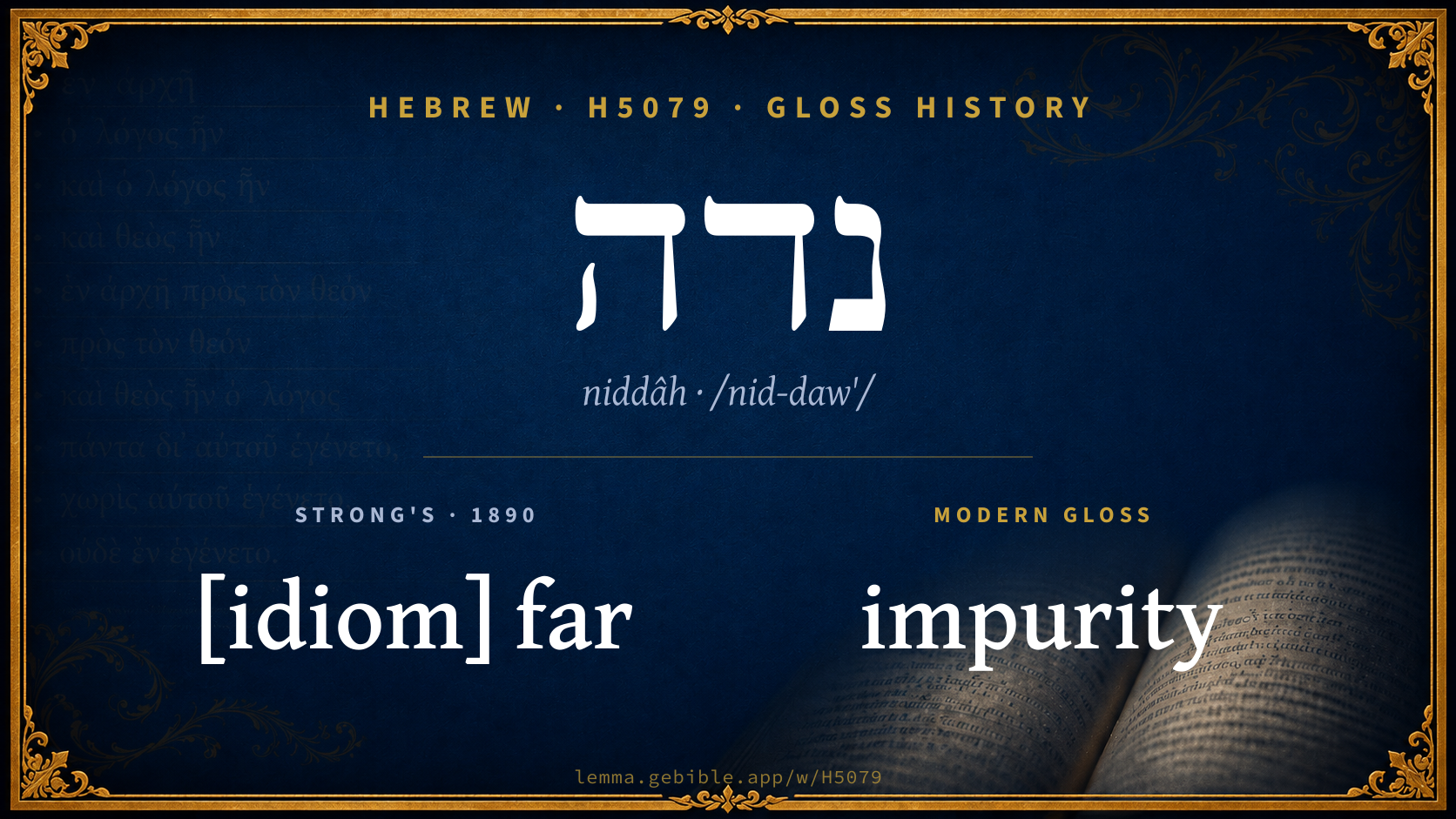
Gloss history
Strong's 1890 vs modern scholarship
About this word
Strong's H5079 catalogs a Hebrew word from the Hebrew Old Testament.
These counts are not copied from any lexicon or concordance. They are computed here, from the morphology-tagged Hebrew Old Testament. What Lemma adds →
- 24
- distinct verses
- The word appears in 24 distinct verses.
- 7 / 39
- OT books
- The word appears in 7 of 39 Old Testament books.
- #1,160
- by frequency
- Top 2500 most frequent Hebrew words (rank 1,160 of 8,640 Hebrew words by occurrence).
View all 24 occurrences in the concordance →
By section of the Old Testament
By traditional corpus
Conventional, traditional groupings — biblical authorship is debated, so this is a traditional corpus grouping, not an authorship claim. Each share is this word’s portion of its verses in that division of the Hebrew canon. Each figure is a share of the word’s 24 distinct verses.
- Torah (Pentateuch) 15 verses · 63%
- Prophets (Nevi'im) 6 verses · 25%
- Writings (Ketuvim) 3 verses · 13%
How translations render this word
Counts come from each version’s own published word-to-Strong’s tagging or interlinear alignment — an approximate guide to how each version renders this word, not a word-level alignment the data otherwise carries. Because each total is that version’s own tagged count, the per-version totals vary from one another and need not match the appearance or distinct-verse counts above. These counts may also differ from a printed concordance because Lemma counts each distinctly tagged rendering and does not collapse phrase taggings into a single head-word total. This is a fixed set of word-tagged versions (KJV, ASV, BSB, ULT) and does not change with the reading translation you choose elsewhere. Each version’s license is shown beside its name below (and on Sources).
- King James Version: Separation 14×, Filthiness 2×, Flowers 2×
- American Standard Version: Impurity 16×
- Berean Standard Bible: Impurity 3×, Of 3×, Purification 3×
- unfoldingWord Literal Text: Menstruation 10×, Impurity 8×
King James Version Public Domain
Renders H5079 across 29 tagged occurrences — most commonly:
Plus 11 renderings that appear only once — usually multi-word phrases or single function words the recovered tagging swept in, not distinct renderings.
American Standard Version Public Domain
Renders H5079 across 29 tagged occurrences — most commonly:
Plus 13 renderings that appear only once — usually multi-word phrases or single function words the recovered tagging swept in, not distinct renderings.
Berean Standard Bible Public Domain
Renders H5079 across 26 tagged occurrences — most commonly:
Plus 13 renderings that appear only once — usually multi-word phrases or single function words the recovered tagging swept in, not distinct renderings. Not rendered by a distinct English word in 3 further occurrences.
unfoldingWord Literal Text CC BY-SA 4.0
Renders H5079 across 30 tagged occurrences — most commonly:
Plus 12 renderings that appear only once — usually multi-word phrases or single function words the recovered tagging swept in, not distinct renderings.
Senses in the full BDB
What do BDB’s symbols mean?
BDB uses these scholarly abbreviations:
| Symbol | Meaning |
|---|---|
| 𝔊 | the Septuagint (the ancient Greek translation, LXX) |
| 𝔙 | the Vulgate (the Latin translation) |
| 𝔖 | the Syriac version (the Peshitta) |
| 𝔗 | the Targum (the Aramaic translation) |
| ψ | the Psalms |
| √ | root (the underlying root or stem) |
| ‖ | parallel passage (a synonymous or contrasted parallel) |
| † | the dagger: every passage where the word occurs is cited |
The 2 senses and sub-senses the full Brown-Driver-Briggs lexicon distinguishes for this word, in lexicon order (not ranked by frequency), with BDB’s own verbatim wording and sub-sense lettering. Shown in Hebrew script with BDB’s own scholarly abbreviations. The condensed entry is in the Lexicon Entry tab. See also the Forms in the corpus table below.
- 1. of ceremonial impurity, as union with brother’s wife, Lv 20:21; especially of menstruation Ez 18:6 (read אִשָּׁה בְּנִדָּתָהּ for MT א׳ נִדָּה 𝔖 Co), טְמֵאַת הַנּ׳ 22:10, cf. 36:17, נִדַּת דְּוֹתָהּ Lv 12:2, cf. v 5; 15:19, 20, 24, 25 (עֶת־נִדּ׳), v 25(×2), v 26 (מִשְׁכַּב נִדּ׳), v 26 (טֻמְאַת נִדּ׳), v 33; 18:19; of defilement contracted by contact with a corpse, מֵי (הַ)נִּדָּה water of impurity (i.e. to remove it, cf. Di) Nu 19:9, 13, 20, 21(×2); 31:23. e.g. Leviticus 20:21
- 2. fig. (with allusion to cerem. usage), impure thing, Ez 7:19, 20 (of gold), La 1:17 (of Jerus.); of idolatry, immorality, etc., 2 Ch 29:5 Ezr 9:11 (אֶרֶץ נִדָּה), v 11, Zc 13:1 (לְחַטַּאת וּלְנִדָּה). e.g. Ezekiel 7:19
Senses from the full Brown-Driver-Briggs lexicon (Brown, Driver, Briggs; Oxford 1906 — public domain), digitized via Sefaria, supplemented by the OpenScriptures HebrewLexicon (CC BY 4.0). Full attribution on Sources.
Word origin
n.f. impurity (as abhorrent, shunned);—abs. נ׳ Ez 18:6 +; cstr. נִדַּת Lv 12:2 +; sf. נִדָּתָהּ v 5 +;—impurity (especially P and Ezek.):
— Brown-Driver-Briggs (Oxford 1906, public domain), digitized via Sefaria, supplemented by the OpenScriptures HebrewLexicon (CC BY 4.0). See Sources.
Derived from נדד (nâdad) (H5074) — to flee.
Jastrow Dictionary
A second Hebrew/Aramaic lexicon for comparison, covering Aramaic and post-biblical (Talmudic, Targumic, Midrashic) usage that the biblical-Hebrew BDB does not. Matched by lemma rather than by Strong’s number, so a lemma may carry more than one Jastrow headword (shown separately below), and the entries cover usage well beyond the Bible.
נָדָה
- , v. נדי
נִדָּה
- 1. (v. נִידּוּי) isolation, condition of uncleanness, esp. period of menstruation. Sabb. 64ᵇ, a. e. (ref. to Lev. XV, 33) בנִדָּתָהּ ההא וכ׳ she shall remain in her isolation (from her husband) until &c. Ib. VI, 5 שהתקינה לנדתה which she has prepared for her menstruating time. Ib. II, 6 בנ׳ (= במצות נ׳) in the observance of the laws connected with menstruation; a. fr. e.g. Leviticus 15:33
- 2. (sub. בעלת) a woman during menstruation, menstruant. Nidd. I, 7 חוץ מן הנ׳, expl. ib. 11ᵃ בתוך ימי נדתה during the days of actual menstruation. Treat. Kallah beg. נ׳ שלא טבלה a woman after menstruation before she has taken the ritual bath; כנ׳ is to be treated like a woman during menstruation; a. fr.—Pl. נִדּוֹת. Nidd. IV, 1 נ׳ are to be treated like menstruants; a. fr.—Niddah, name of a treatise, of the Order of Tohăroth, of Mishnah, Tosefta and Talmud Babli and Y’rushalmi (fragmentary).—Ab. III, 18 פתחי נדה the laws treated in Arakh. II, 1 (8ᵃ), v. פֶּתַח.
נדי
- cmp. preced.) to be restless, flee.
- to banish, excommunicate. Ber. 19ᵃ את מי נִדּוּ whom did they (the scholars) excommunicate? Ib. ב"ד מְנַדִּין על כבוד הרב the court proclaims the ban to protect a teacher’s authority. Pes. 52ᵃ מנדין על שני וכ׳ we excommunicate for disregarding the second Holy Day observed in the diaspora; a. v. fr.—[Yalk. Is. 287 נדית עלי, v. נִדְּנֵד.]—Part. pass. מְנוּדֶּה; pl. מְנוּדִּין. M. Kat. 15ᵃ מנ׳ לשמים one excommunicated by the Lord, i.e. a mourner. Ib. מנ׳ מהו בד"ת dare an excommunicated person study the Law? Ib. מנ׳ מהו בקריעה must an excommunicated person rend his garments? Ned. I, 1 מנ׳ אני לך I vow to be excommunicated towards thee, i.e. I vow not to receive any favors at thy hands. M. Kat. 17ᵃ מנ׳ לרב מנ׳ לתלמיד one excommunicated by a teacher must be treated as such by his disciple (the latter cannot raise the ban). Ib. מנ׳ לעירו one excommunicated by the authorities of his own city. Ib. 15ᵇ כל אותן שנים … מנ׳ היו during all the years the Israelites were in the wilderness, they were excommunicated (by the Lord); a. v. fr.
- to be excommunicated. Eduy. V, 6 ח"ו שעקביא נ׳ God forbid (to say) that ‘A. was excommunicated. Ib. כל המִתְנַדֶּה ומת וכ׳ he who dies while under excommunication has a stone placed on his coffin; a. fr.
A Dictionary of the Targumim, the Talmud Babli and Yerushalmi, and the Midrashic Literature (Marcus Jastrow; London, Luzac, 1903) — Public Domain. Digitized via Sefaria. Digitized via Sefaria. Full attribution on Sources.
Forms in the corpus
The 25 distinct written forms H5079 takes in the Hebrew Bible, most frequent first — each parse links to that state’s occurrences in the concordance. Hebrew forms include their vowel points and cantillation, so a single lemma takes many written forms.
Same root — word family
Other BDB entries built from the same root as H5079, grouped by Strong’s listed origin. These share a root / origin per the lexicon — not necessarily a shared meaning. Each links to that word’s own entry.
Derives from
Shares the same root
Compare all same-root words → Showing 4 of 5 — not the complete family. They share a root, not necessarily a meaning.
Septuagint verse parallels
This word appears in 24 verses that also exist in the Greek Old Testament (Septuagint), out of the 24 Hebrew verses it occurs in. You can read those verses in Greek by switching the Old Testament edition to the Septuagint.
Read these verses in the Septuagint
- Leviticus 12:2
- Numbers 19:9
- 2 Chronicles 29:5
- Ezra 9:11
- Lamentations 1:17
- Ezekiel 7:19
- Zechariah 13:1
This is a verse-level parallel only — the same verses exist in both the Hebrew and Greek Old Testaments. No word-level Hebrew↔Greek correspondence is claimed: the data carries no such alignment, so no Greek word is shown as this Hebrew word’s translation. Coverage is not total — the Septuagint omits the deuterocanon and renumbers the Psalms, so some Hebrew verses have no direct Greek parallel.