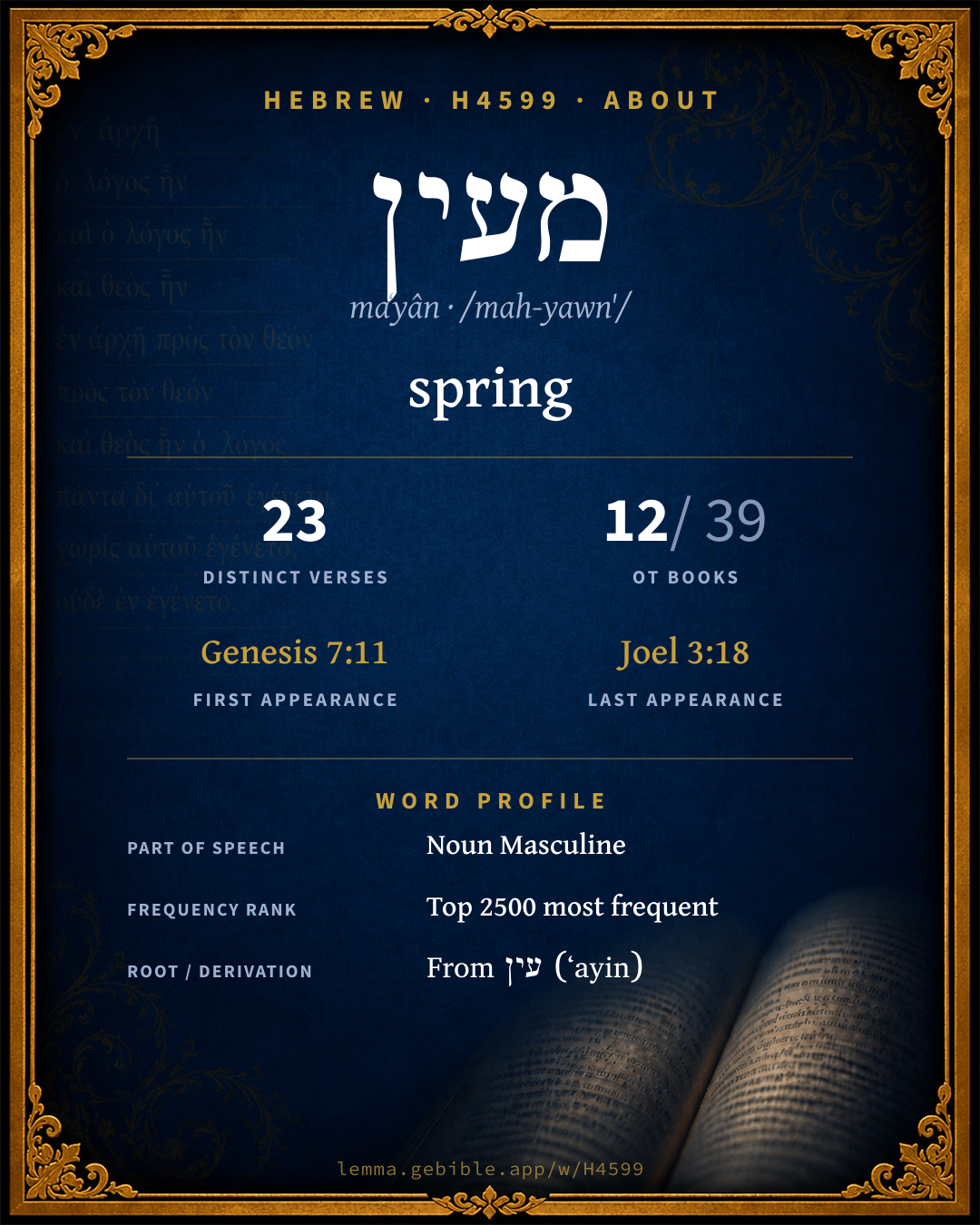
מַעְיָן
spring
Full lexicon entry — Brown-Driver-Briggs (BDB)
From Brown-Driver-Briggs (BDB)
Where this word appears
See every Construct-state word in the Hebrew Bible →
Grammar key — what these labels mean
Part of speech
- Noun
- A naming word — a person, place, thing, or idea.
Noun type
- Common
- A common noun — a general class of person, place, or thing (“king,” “city,” “water”), not a specific name.
State
- Absolute
- The independent form of a noun, not bound to a following word.
- Construct
- A noun bound to a following noun in a possessive / “of” relationship (the construct chain).
Gender
- Masculine
- Grammatically masculine.
Number
- Singular
- One.
- Plural
- More than one (in Hebrew, generally three or more).
13 distinct verses where H4599 appears in the Construct state, across 9 books. Filtered view — show all forms. Click any verse to open its interlinear word-by-word view. Verse text shown in the World English Bible for context — . Each verse’s Hebrew form is shown with its reference; the English is not keyword-highlighted, since the data carries no word-level English alignment. Use “Compare translations” on any verse to read it across multiple English versions. This concordance covers the Hebrew Bible; Septuagint (Greek Old Testament) occurrences are not indexed here.
Genesis 2 verses
- Genesis 7:11 מַעְיְנֹת֙ n c mp cs In the six hundredth year of Noah's life, in the second month, on the seventeenth day of the month, on the same day all the fountains of the great deep were burst open, and the sky's windows were opened.
- Genesis 8:2 מַעְיְנֹ֣ת n c mp cs The deep's fountains and the sky's windows were also stopped, and the rain from the sky was restrained.
Joshua 2 verses
- Joshua 15:9 מַעְיַן֙ n c ms cs and the border extended from the top of the mountain to the spring of the waters of Nephtoah, and went out to the cities of Mount Ephron; and the border extended to Baalah (the same is Kiriath Jearim);
- Joshua 18:15 מַעְיַ֖ן n c ms cs The south quarter was from the uttermost part of Kiriath Jearim; and the border went out westward, and went out to the spring of the waters of Nephtoah;
1 Kings 1 verse
2 Kings 2 verses
- 2 Kings 3:19 מַעְיְנֵי n c mp cs You shall strike every fortified city, and every choice city, and shall fell every good tree, and stop all springs of water, and mar every good piece of land with stones.
- 2 Kings 3:25 מַעְיַן n c ms cs They beat down the cities; and on every good piece of land they cast every man his stone, and filled it; and they stopped all the springs of water, and felled all the good trees, until in Kir Hareseth [only] they left the stones of it; however the men armed with slings went about it, and struck it.
Psalms 2 verses
Proverbs 1 verse
Song of Solomon 1 verse
Isaiah 1 verse
Hosea 1 verse
About this entry
At a glance — auto-summarized from this page’s data, not written by a person. Every figure links to its source below. This summary describes the numbers; it doesn’t interpret them.
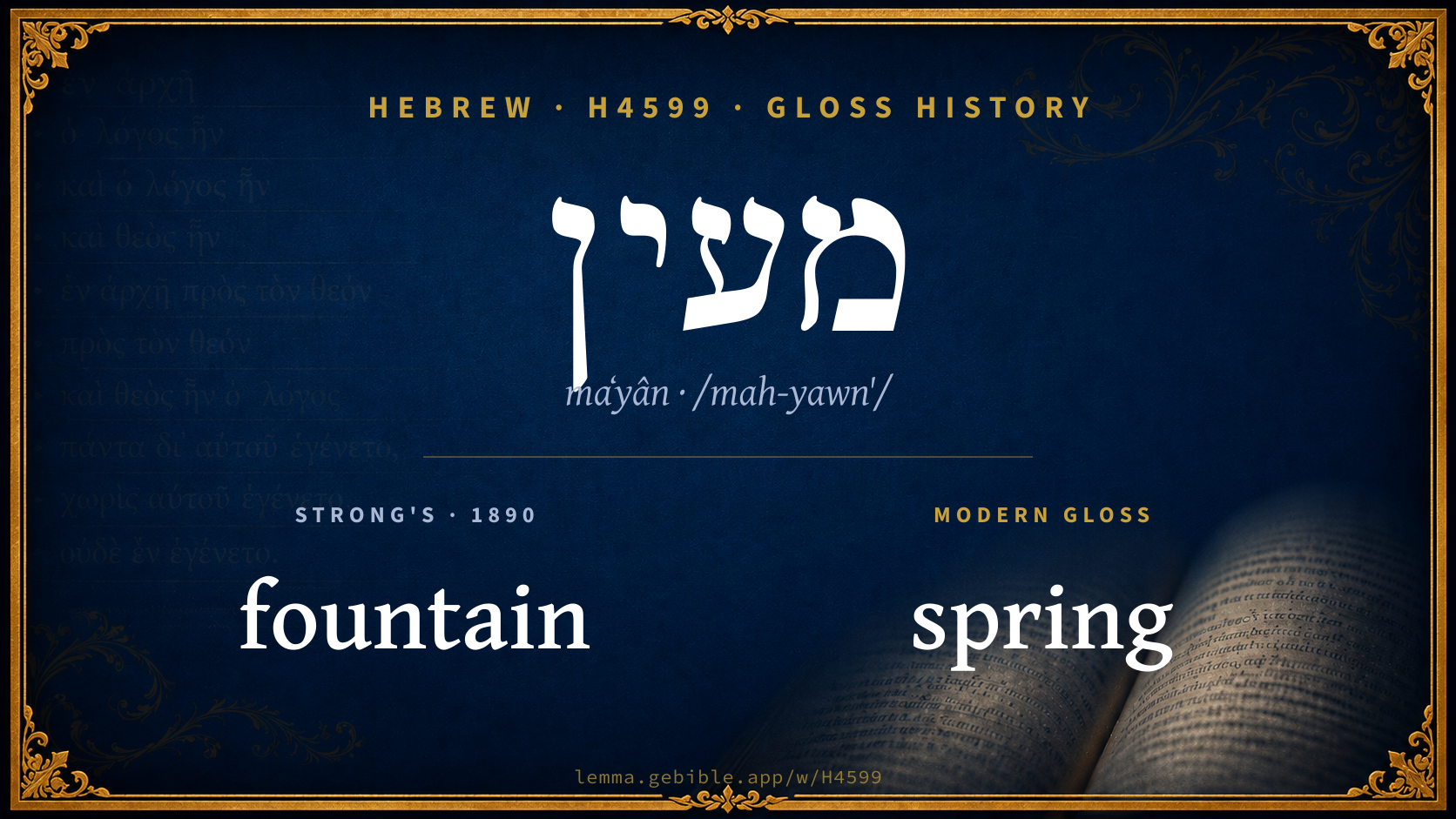
“spring” is the headline sense of the Hebrew noun מעין (maʻyân). Older and newer Bibles part ways — “fountain” in the King James Version, “spring” (Berean Standard Bible) in modern versions. See the renderings breakdown. It turns up in 23 verses across 12 books, an uncommon footprint. Its earliest occurrence is Genesis 7:11. It clusters with עין, עון and עין under a shared root. See the sense tree, 23-verse concordance, and the renderings breakdown below.
Gloss history
Strong's 1890 vs modern scholarship
About this word
Strong's H4599 catalogs a Hebrew word from the Hebrew Old Testament.
These counts are not copied from any lexicon or concordance. They are computed here, from the morphology-tagged Hebrew Old Testament. What Lemma adds →
- 23
- distinct verses
- The word appears in 23 distinct verses.
- 12 / 39
- OT books
- The word appears in 12 of 39 Old Testament books.
- #1,368
- by frequency
- Top 2500 most frequent Hebrew words (rank 1,368 of 8,640 Hebrew words by occurrence).
View all 23 occurrences in the concordance →
By section of the Old Testament
By traditional corpus
Conventional, traditional groupings — biblical authorship is debated, so this is a traditional corpus grouping, not an authorship claim. Each share is this word’s portion of its verses in that division of the Hebrew canon. Each figure is a share of the word’s 23 distinct verses.
- Writings (Ketuvim) 11 verses · 48%
- Prophets (Nevi'im) 9 verses · 39%
- Torah (Pentateuch) 3 verses · 13%
How translations render this word
Counts come from each version’s own published word-to-Strong’s tagging or interlinear alignment — an approximate guide to how each version renders this word, not a word-level alignment the data otherwise carries. Because each total is that version’s own tagged count, the per-version totals vary from one another and need not match the appearance or distinct-verse counts above. These counts may also differ from a printed concordance because Lemma counts each distinctly tagged rendering and does not collapse phrase taggings into a single head-word total. This is a fixed set of word-tagged versions (KJV, ASV, BSB, ULT) and does not change with the reading translation you choose elsewhere. Each version’s license is shown beside its name below (and on Sources).
BDB lists this Strong’s number as 2 distinct words (homographs). Each count above pools all of them and is not split by sense — see the Senses section below. A low-frequency rendering may belong to a different one of those words, not the primary meaning.
- King James Version†: Fountain 8×, Fountains 2×, Well 2×
- American Standard Version†: Fountain 8×, All the fountains 2×, Fountains 2×
- Berean Standard Bible†: Spring 10×, Springs 6×, Fountain 3×
- unfoldingWord Literal Text†: Spring 7×, Springs 5×, Spring of 3×
King James Version Public Domain
Renders H4599 across 23† tagged occurrences — most commonly:
Plus 11 renderings that appear only once — usually multi-word phrases or single function words the recovered tagging swept in, not distinct renderings.
American Standard Version Public Domain
Renders H4599 across 24† tagged occurrences — most commonly:
Plus 12 renderings that appear only once — usually multi-word phrases or single function words the recovered tagging swept in, not distinct renderings.
Berean Standard Bible Public Domain
Renders H4599 across 23† tagged occurrences — most commonly:
Plus 2 renderings that appear only once — usually multi-word phrases or single function words the recovered tagging swept in, not distinct renderings.
unfoldingWord Literal Text CC BY-SA 4.0
Renders H4599 across 24† tagged occurrences — most commonly:
Plus 5 renderings that appear only once — usually multi-word phrases or single function words the recovered tagging swept in, not distinct renderings.
Senses in BDB
The 1 sense BDB distinguishes for this word, in lexicon order (not ranked by frequency or importance). The full entry — with sub-senses — is in the Lexicon Entry tab.
- spring
Word origin
n.m. Pr 8:24 spring;—abs. מ׳ ψ 74:15 +; cstr. מַעְיַן 2 K 3:25 +, מַעְיְנוֹ ψ 114:8 (Ges§ 90 n); sf. מַעְיָנוֹ Ho 13:15; pl. מַעְיָנוֹת Is 41:18 +, מַעְיָנִים ψ 104:10; cstr. מַעְיְנוֹת Gn 7:11 +, מַעְיְנֵי 1 K 18:5; 2 K 3:19, מַעַיְנֵי Is 12:3; sf. מַעְיָנַי ψ 87:7 (but v. infr.), מַעְיְנֹתֶיךָ Pr 5:16;—spring, cstr. before מַיִם 1 K 18:5; 2 K 3:19, 25, Jos 15:9; 18:15 (both P), ψ 114:8, cf. Pr 8:24; מַע׳ alone Is 41:18; Lv 11:36 (P), ψ 74:15; 104:10; 2 Ch 32:4, cf. Jo 4:18 (in eschatol. picture); in sim. Pr 25:26; מ׳ תְּהוֹם Gn 7:11; 8:2 (cf. Pr 8:28); fig. of source of happiness, enjoyment Ho 13:15 (‖ מְקוֹרוֹ) ψ 84:7; Pr 5:16 (of wife, v. Toy), cf. מ׳ חָתוּם Ct 4:12, מ׳ גַּנִּים v 15; also ψ 87:7 (si vera l.; so De Che Du; Hup Bae We read form of מָעוֹן dwelling); מ׳ הַיִשׁוּעָה Is 12:3.
— Brown-Driver-Briggs (Oxford 1906, public domain), digitized via Sefaria, supplemented by the OpenScriptures HebrewLexicon (CC BY 4.0). See Sources.
Derived from עין (ʻayin) (H5869) — eye.
Jastrow Dictionary
A second Hebrew/Aramaic lexicon for comparison, covering Aramaic and post-biblical (Talmudic, Targumic, Midrashic) usage that the biblical-Hebrew BDB does not. Matched by lemma rather than by Strong’s number, so a lemma may carry more than one Jastrow headword (shown separately below), and the entries cover usage well beyond the Bible.
מְעָה
- Is. XLVIII, 19, v. Targ.; cmp. next w.) [grain of sand &c.) m’ah, (cmp. גֵּרָה) e.g. Isaiah 48:19
- 1. a weight. Y. Kil. I, 27ᵃ top מ׳ אחת וכ׳ one m’ah’s weight from the top of a melon, cucumber &c.; [R. S. to Kil. I, 2: one seed taken from the top &c., v. next w.].—Lev. R. s. 17 מ׳ אחת עבה ומ׳ וכ׳ one m’ah’s weight of coarse thread &c.; (Midr. Till. to Ps. LXXIII, 4 מַטְוֶה).
- 2. a coin, corresp. to the Tyrian Obolus (v. Zuckerm. Talm. Münz. p. 4). Tosef. B. Bath. V, 12 שש מ׳ כסף וכ׳ six m’ah silver make one denar; מ׳ כסף שני וכ׳ one m. silver is equal to two dupondia; Y. Kidd. I, 58ᵈ; Bab. Kidd. 12ᵃ; Bekh. 50ᵃ. Y. Shebu. VI, beg. 36ᵈ; a. fr.—Pl. מָעִין. Ib.; a. fr.—מָעוֹת in gen. small coins, money. B. Mets. IV, 1, v. קָנָה. Pes. 50ᵇ מ׳ הבאות ממדינת הים proceeds from trans-oceanic traffic. Ib. מְ׳ יתומים orphans’ money (invested at half-profits between executor and orphans). Ab. Zar. 17ᵇ מ׳ של פורים money laid aside for Purim enjoyments; מ׳ של צדקה charity fund. Ib. לא יתן אדם מְעוֹתָיו וכ׳ one must not give his contribution to the charity fund, unless its manager be &c.; a. fr.
מֵעַיִם
- , v. מֵעֶה
מָעִין
- , v. מְעָה, מְעָא.
מֵעֵין
- , v. עַיִן
מַעְיָן
- 1. spring, fountain; source, issue. Mikv. V, 1. Ib. 3, v. נָדָל. Ned. 41ᵇ מ׳ הנובע a bubbling well, v. בּוּרְדָּם. Tanḥ. Thazr. 6 כל שער … מ׳ בפני עצמו for each hair … a separate well (which feeds it). Ex. R. s. 24 ברא הקב"ה מ׳ וכ׳ (not מעון), v. גַּרְגֶּרֶת. Gen. R. s. 26; Midr. Till. to Ps. I, 2 כבש … מַעְיָינוֹ the Lord held back his germinating issue. Lev. R. s. 32; Cant. R. to IV, 12 מ׳ חתום אלו הזכרים ‘a sealed well’ (Cant. l. c.), that means the (pure) males. Yeb. 64ᵇ מ׳ גורם the well (in her womb) is the cause of the death of her successive husbands. Nidd. 11ᵇ; ib. 35ᵇ מ׳ אחד הוא it is one and the same source (from which the menses and the blood at parturition issue); a. fr.—Pl. מַעְיָנוֹת, מַעְיָי׳. Ib. B. Mets. 87ᵃ, a. e. כשני מ׳ like two springs. Pesik. R. s. 42 יבש כל המ׳ שלו וכ׳ he laid dry all the wells (secretory organs) both his own and those of his household &c. Tosef. Sot. XV, 3, a. e. מ׳ חכמה the well-springs of wisdom. Nidd. 28ᵇ מַעְיְנוֹתָיו, מַעְיְנוֹתֶיהָ his, her (the leper’s) discharges; a. fr.
- 2. (cmp. מֵעֶה) inside, digestive organs. Snh. 81ᵇ עד שיוקטן מעיינו until his bowels are shrunk.
עַיִן
- 1. eye, sight, look. Kidd. 24ᵃ בשן וע׳, v. יָצָא. Ib. 24ᵇ הכהו על עֵינוֹ וכ׳ if the master struck him on his eye and made it blind. B. Kam. 83ᵇ (ref. to Ex. XXI, 24) אימא ע׳ ממש may not the text mean that he who injures a person’s eye must really suffer the same injury? Sabb. 108ᵇ bot. יד לע׳ וכ׳ an unwashed hand (in the morning) touching the eye deserves to be cut off. Taan. 8ᵇ סמוי מן הע׳, v. סָמָא. Ib. דבר שאין הע׳ שולטת בו something which the eye cannot look at (being stored away), v. infra; a. v. fr.—[Y. Ned. IX, end, 41ᶜ עשה לה ע׳ של זהב, a corrupt dittography of עשה לה שן של זהב.]—ע׳ טובה (also יפה) a benevolent eye, good will, liberality, opp. ע׳ רעה or עֵין הרע (abbr. עה"ר), also ע׳ צרה ill-will, selfishness, envy. Ab. II, 9. Sabb. 74ᵃ משום ע׳ יפה וכ׳ he intended to show his good will. Tosef. Ḥall. I, 7 שעינו יפה בעיסתו he is liberal with his dough (is glad to give the priest’s portion), opp. עינו צרה. Esth. R. to I, 4 היתה עינו צרה בממונו he was jealous of his wealth (unwilling to leave it to his heirs to be enjoyed by them). Ab. V, 13 עינו רצה בשל אחרים he is illiberal with regard to other people’s money (begrudges them the privilege of giving charity), ע׳ רעה בשלו he is illiberal with his own money (is too greedy to afford himself the pleasure of giving charity). Ib. II, 11, v. יֵצֶר; a. fr.—צַר ע׳ (= רַע ע׳) selfish, opp. טוב ע׳ liberal, selfless. Sabb. 108ᵇ שדורי … צר ע׳ אנא I send you (the salve), lest you say that I am selfish. Sot. 38ᵇ אפי׳ העופות מכירין בצָרֵי ע׳ even birds recognize selfish men. Ib. כל הנהנה מצרי ע׳ וכ׳ he who accepts benefits from self-seeking men, transgresses a law (ref. to Prov. XXIII, 6). Ib. אין … לטוב ע׳ the cup of benediction must be handed to none but an unselfish person (with ref. to Prov. XXII, 9); a. e.—Esp. ע׳ רעה, עֵין הרע (abbrev. עה"ר), or only עַיִן, the evil eye, an envious glance that brings harm to the person looked at, bewitchment. B. Mets. 107ᵇ (ref. to Deut. VII, 15) זו ע׳ that means the effect of an evil eye. Ib. תשעים … בע׳ רעה וכ׳ ninety-nine persons die of an evil eye against one in the natural course. Gen. R. s. 91 שלא תשלוט בכם עה"ר that the evil eye may have no power over you. Ib. לא הייתם … מפני הע׳ were you not afraid of the evil eye? Ber. 20a ע׳ שלא … אין עה"ר שולטת בי no evil eye can affect him whose eye refused to feed on what was not his (to look at the charms of a married woman); a. fr.—שקל ע׳ בע׳ to balance the scales exactly, to allow no overweight (v. עוּן, a. כָּרַע). B. Bath. V, 11; a. fr.—בע׳ visible to the eye, discernible; in natural form. Y. Ber. VI, 10ᵃ אע"פ ששחוקין בעֵינָן הן although they are ground, they are still discernible. Ib. אם בעַיְינָן הן if they are in their natural form (not mashed); a. fr.—כְּעֵין like the appearance of, similar to, a sort of (cmp. גַּוָּון). Ib.ᵇ כל שהוא כע׳ סולת וכ׳ whatever resembles a pudding or dumpling. Ber. 58ᵃ (in Chald. dict.) מלכותא דארעא כע׳ וכ׳ the government on earth is like the government in heaven (inspires reverence); a. fr.—מֵעֵין a reflection of, of the nature of; an abstract of. Snh. 105ᵇ (ref. to the preposition מ in I Kings I, 47) מע׳ קאמר ליה he means, ‘as a reflection’ (of thy name, thy throne). Ib. (ref. to Jud. V, 24) מע׳ קאמר it means ‘similar to’ (the blessings of Sarah &c.). Ber. IV, 3 מע׳ י"ח an abstract of the eighteen benedictions. Y. ib. 8ᵃ bot. שבע מע׳ י"ח seven benedictions embodying the eighteen. Ib. VI, 10ᵇ ברכה אחת מע׳ שלש one benediction embodying the three. Gen. R. s. 11, a. e., v. דּוּגְמַטְרִין.—Du. עֵינַיִים, עֵינַיִם. Bekh. VII, 4 עֵינָיו גדולות וכ׳ if his (the priest’s) eyes are as large as those of a calf. Ib. 3. Ber. 58ᵃ, a. e. נתן עיניו בו וכ׳ he put his eyes on him, and he was turned into a heap of bones. Y. Hor. III, end, 48ᶜ נתנו עֵינֵיהֶן בשמואל וכ׳ they directed their attention to Samuel &c.; a. fr.—אחז את הע׳, v. אָחַז. e.g. Exodus 21:24
- 2. anything resembling the eye, hole, ring &c. Kel. VIII, 7 ע׳ של תנור the ‘eye’ of an oven (the fire-place under the oven, Maim.; the opening for the escape of the smoke, which may be closed to retain the heat, R. S.). Ib. IX, 8 תנור שניקב מעינו an oven in the eye of which is a defect. Ib. XXI, 2 ע׳ the ring-shaped pad around an animal’s neck (a halter of soft material). Ib. ע׳ של מתכת a metal hame (cmp. עוֹנָתָא). Tosef. Kel. B. Bath. I, 7 העיין שבמצעד the ring attached to an adze; a. fr.
- 3. spring, well. Keth. I, 10; a. fr.—[Frequ. עֵין in pr. n. pl., as ע׳ סוכר, ע׳ טב; v. respective determinants].
עַיִן ²
- 1. eye, sight &c. Targ. Lev. XXIV, 20. Targ. O. Ex. XXII, 2. Ib. X, 5; a. fr.—Ḥull. 96ᵃ, a. fr. טביעות ע׳, v. טְבִיעוּתָא.—בע׳ (v. preced.) discernible, in natural form. Pes. 75ᵃ top בְּעֵינֵיה, v. קִיּוּהָא.—כְּעֵין, מֵעֵין, v. preced. Targ. Deut. XXXIII, 28. Targ. Josh. XXIV, 27; a. e.—ע׳ בישא (or only ע׳) evil eye. Targ. Y. Gen. XLII, 5.—Ber. 20ᵃ. Pes. 50ᵇ שלטא בהו ע׳ the eye controls them (they cannot be hidden from sight; v. Taan. 8ᵇ, quot. in preced.). B. Mets. 30ᵃ משום ע׳ (Ms. M. ע׳ בישא) because it attracts the (evil) eye; a. v. fr.—Ned. 50ᵃ the ram (figure-head, v. אֵילָא) דכל ספינתא עבדין ליה מן ע׳ which all ships have attached (as a protection) from the evil eye (and which the losers paid a high price for redeeming; cmp. Sm. Ant. s. v. Insigne) [comment. explain differently].—Pl. עֵינִין, עַיְינִין. Targ. Gen. III, 6; a. fr.
- 2. ring, collar; hole. M. Kat. 10ᵃ בת עינא (he cuts out) the hole for the hopper, v. כָּבַשׁ.—Pl. as ab. Targ. Hos. X, 10, v. עוֹנָתָא
- 3. [guide,] guide-post on cross-roads (only in pl.). Targ. O. Gen. XXXVIII, 14 פרשות ע׳; ib. 21 ע׳ (ed. Berl. עֵינַיִם, as pr. n. pl.; Y. סכות ע׳).
- 4. spring, well. Targ. Gen. XVI, 7; a. fr.—Targ. Y. I Ex. XV, 27 ענווא (some ed. עניא, read: עֵינָא or עַיְינָא).—Pl. עַיְינִין, עֵינָוָון, עֵינָוָן, עֵינְוָתָא; עֵינָתָא. Targ. Y. I, II ib. Targ. II Chr. XXXII, 3. Ib. 4 עַיְינָוָתָא. Targ. Y. I Num. XXXIV, 9, sq. (טירת) עֵינְוָותָא pr. n. pl. Ṭirath ‘Envatha (h. text חצר עינן); Targ. Y. II ib. (דירת) עַיְינוּתָא, v. עַיְנוּתָא.—Bekh. 55ᵃ sq. והאיכא עינתא מידליין but are there not springs higher than the Euphrates?
A Dictionary of the Targumim, the Talmud Babli and Yerushalmi, and the Midrashic Literature (Marcus Jastrow; London, Luzac, 1903) — Public Domain. Digitized via Sefaria. Digitized via Sefaria. Full attribution on Sources.
Forms in the corpus
The 20 distinct written forms H4599 takes in the Hebrew Bible, most frequent first — each parse links to that state’s occurrences in the concordance. Hebrew forms include their vowel points and cantillation, so a single lemma takes many written forms.
Same root — word family
Other BDB entries built from the same root as H4599, grouped by Strong’s listed origin. These share a root / origin per the lexicon — not necessarily a shared meaning. Each links to that word’s own entry.
Derives from
Shares the same root
Proper names from this root
People and places named from this root — a name, not an additional meaning of the word.
- עין ʻAyin H5871 Ain
- עין גדי ʻÊyn Gedîy H5872 En-gedi
- עין גנים ʻÊyn Gannîym H5873 En-gannim
- עיןדאר ʻÊyn-Dôʼr H5874 En-dor
- עין הקורא ʻÊyn haq-Qôwrêʼ H5875 En-hakkore
- עין חדה ʻÊyn Chaddâh H5876 En-haddah
- עין חצור ʻÊyn Châtsôwr H5877 En-hazor
- עין חרד ʻÊyn Chărôd H5878 En-harod
- עינים ʻÊynayim H5879 Enam
- עין משפט ʻÊyn Mishpâṭ H5880 En-mishpat
- עינן ʻÊynân H5881 Enan
- עין עגלים ʻÊyn ʻEglayim H5882 En-eglaim
- עין רגל ʻÊyn Rôgêl H5883 En-rogel
- עין רמון ʻÊyn Rimmôwn H5884 En-rimmon
- עין שמש ʻÊyn Shemesh H5885 En-shemesh
- עין תנים ʻÊyn Tannîym H5886 dragon well
- עין תפוח ʻÊyn Tappûwach H5887 En-tappuah
- ענים ʻÂnîym H6044 Anim
- ענם ʻÂnêm H6046 Anem
Compare all same-root words → Showing 4 of 23 — not the complete family. 19 of the same-root words are proper names (people or places). They share a root, not necessarily a meaning.
Septuagint verse parallels
This word appears in 21 verses that also exist in the Greek Old Testament (Septuagint), out of the 23 Hebrew verses it occurs in. You can read those verses in Greek by switching the Old Testament edition to the Septuagint.
Read these verses in the Septuagint
- Genesis 7:11
- Leviticus 11:36
- Joshua 15:9
- 1 Kings 18:5
- 2 Kings 3:19
- 2 Chronicles 32:4
- Psalms 84:6
- Proverbs 5:16
- Song of Solomon 4:12
- Isaiah 12:3
- Hosea 13:15
This is a verse-level parallel only — the same verses exist in both the Hebrew and Greek Old Testaments. No word-level Hebrew↔Greek correspondence is claimed: the data carries no such alignment, so no Greek word is shown as this Hebrew word’s translation. Coverage is not total — the Septuagint omits the deuterocanon and renumbers the Psalms, so some Hebrew verses have no direct Greek parallel.