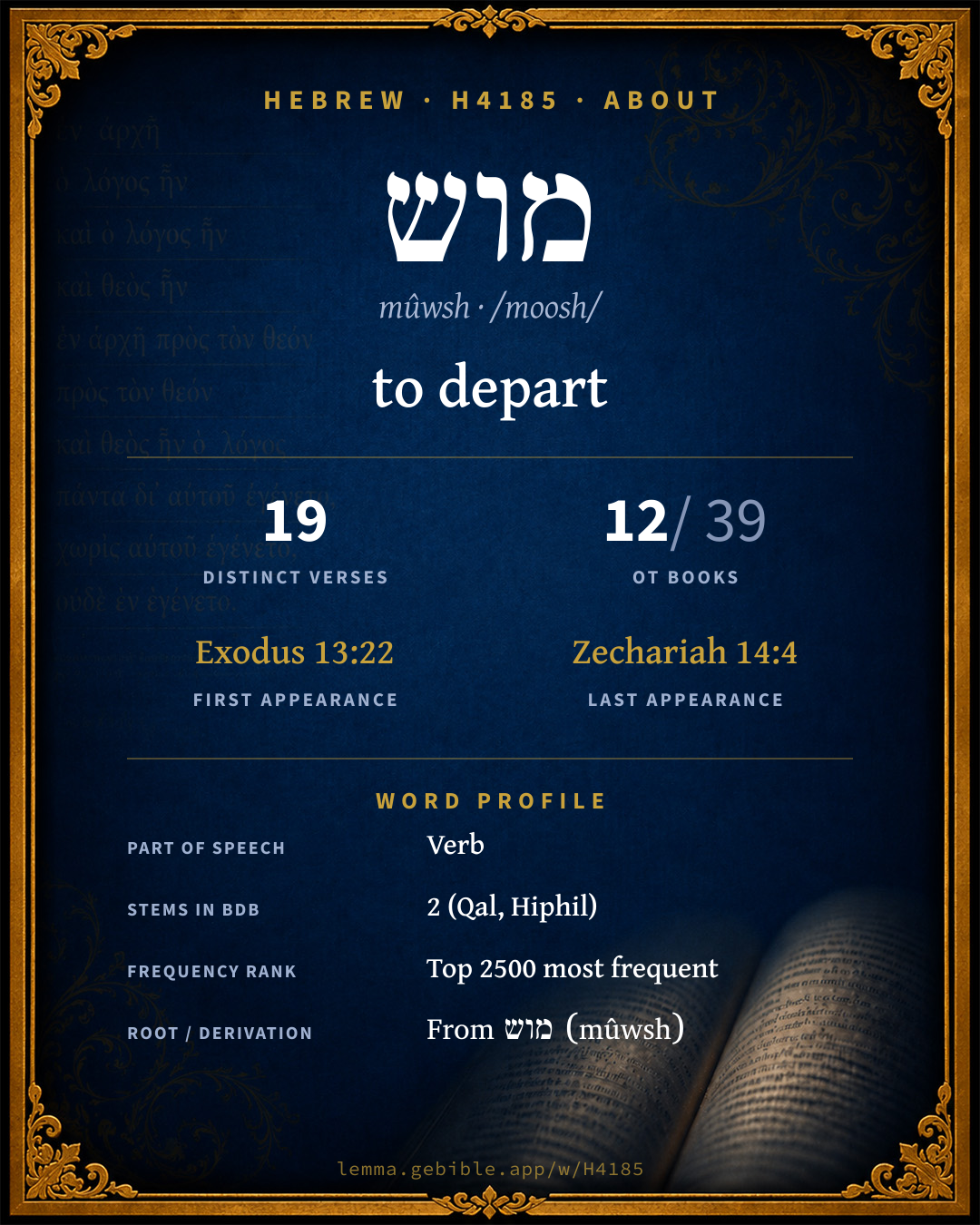
מוּשׁ
to depart
‘to depart’ is one of 2 main senses fuller range ↓
Full lexicon entry — Brown-Driver-Briggs (BDB)
From Brown-Driver-Briggs (BDB)
Where this word appears
See every Qal verb in the Hebrew Bible →
Grammar key — what these labels mean
Part of speech
- Verb
- An action or state-of-being word.
Stem
- Qal
- The basic, simple active stem — the plain form of the verb (“he wrote”).
- Hiphil
- The causative active stem (“he caused / brought about”).
Form
- Imperfect
- An incomplete, ongoing, or future action (“he will / would write”).
- Sequential Perfect
- A perfect with prefixed waw continuing a preceding imperfect or command (waw-consecutive perfect).
- Jussive
- A third- or second-person volitional form expressing wish or command (“let him write”).
- Perfect
- A completed action or state — Hebrew marks aspect (completeness) more than strict tense (“he wrote”).
Person
- 3rd Person
- The one spoken about (“he / she / it / they”).
- 1st Person
- The speaker (“I / we”).
- 2nd Person
- The one addressed (“you”).
Gender
- Masculine
- Grammatically masculine.
- Feminine
- Grammatically feminine.
- Common
- Either gender — not distinguished for this form.
Number
- Singular
- One.
- Plural
- More than one (in Hebrew, generally three or more).
16 distinct verses where H4185 appears in the Qal stem, across 10 books. Filtered view — show all forms. Click any verse to open its interlinear word-by-word view. Verse text shown in the World English Bible for context — . Each verse’s Hebrew form is shown with its reference; the English is not keyword-highlighted, since the data carries no word-level English alignment. Use “Compare translations” on any verse to read it across multiple English versions. This concordance covers the Hebrew Bible; Septuagint (Greek Old Testament) occurrences are not indexed here.
Exodus 2 verses
- Exodus 13:22 יָמִ֞ישׁ Qal impf 3ms the pillar of cloud by day, and the pillar of fire by night, didn't depart from before the people.
- Exodus 33:11 יָמִ֖ישׁ Qal impf 3ms Yahweh spoke to Moses face to face, as a man speaks to his friend. He turned again into the camp, but his servant Joshua, the son of Nun, a young man, didn't depart out of the Tent.
Numbers 1 verse
Joshua 1 verse
Judges 1 verse
Psalms 1 verse
Proverbs 1 verse
Isaiah 4 verses
- Isaiah 22:25 תָּמוּשׁ֙ Qal impf 3fs In that day, says Yahweh of hosts, shall the nail that was fastened in a sure place give way; and it shall be hewn down, and fall; and the burden that was on it shall be cut off; for Yahweh has spoken it.
- Isaiah 46:7 יָמִ֑ישׁ Qal impf 3ms They bear it on the shoulder, they carry it, and set it in its place, and it stands, from its place it shall not move: yes, one may cry to it, yet it can not answer, nor save him out of his trouble.
- Isaiah 54:10 יָמ֔וּשׁוּ יָמ֗וּשׁ Qal impf 3mp Qal impf 3ms For the mountains may depart, and the hills be removed; but my loving kindness shall not depart from you, neither shall my covenant of peace be removed, says Yahweh who has mercy on you.
- Isaiah 59:21 יָמ֡וּשׁוּ Qal impf 3mp As for me, this is my covenant with them, says Yahweh: my Spirit who is on you, and my words which I have put in your mouth, shall not depart out of your mouth, nor out of the mouth of your seed, nor out of the mouth of your seed's seed, says Yahweh, from henceforth and forever.
Jeremiah 2 verses
- Jeremiah 17:8 יָמִ֖ישׁ Qal impf 3ms For he shall be as a tree planted by the waters, who spreads out its roots by the river, and shall not fear when heat comes, but its leaf shall be green; and shall not be careful in the year of drought, neither shall cease from yielding fruit.
- Jeremiah 31:36 יָמֻ֜שׁוּ Qal impf 3mp If these ordinances depart from before me, says Yahweh, then the seed of Israel also shall cease from being a nation before me forever.
Nahum 1 verse
Zechariah 2 verses
- Zechariah 3:9 וּ/מַשְׁתִּ֛י conj + Qal wpf 1cs For, behold, the stone that I have set before Joshua; on one stone are seven eyes: behold, I will engrave the engraving of it,' says Yahweh of Hosts, 'and I will remove the iniquity of that land in one day.
- Zechariah 14:4 וּ/מָ֨שׁ conj + Qal wpf 3ms His feet will stand in that day on the Mount of Olives, which is before Jerusalem on the east; and the Mount of Olives will be split in two, from east to west, making a very great valley. Half of the mountain will move toward the north, and half of it toward the south.
About this entry
At a glance — auto-summarized from this page’s data, not written by a person. Every figure links to its source below. This summary describes the numbers; it doesn’t interpret them.
מוש (mûwsh) is a Hebrew verb most often rendered “to depart.” Debuting at Exodus 13:22, it then recurs through the corpus. With 19 verses in 12 books, it is an uncommon word in the Hebrew Bible. Across 2 stems, its meaning turns on the binyan (Qal, Hiphil). From the same root come מוש, מושי and מישא. For the data behind this summary, explore the sense tree and the renderings breakdown below.
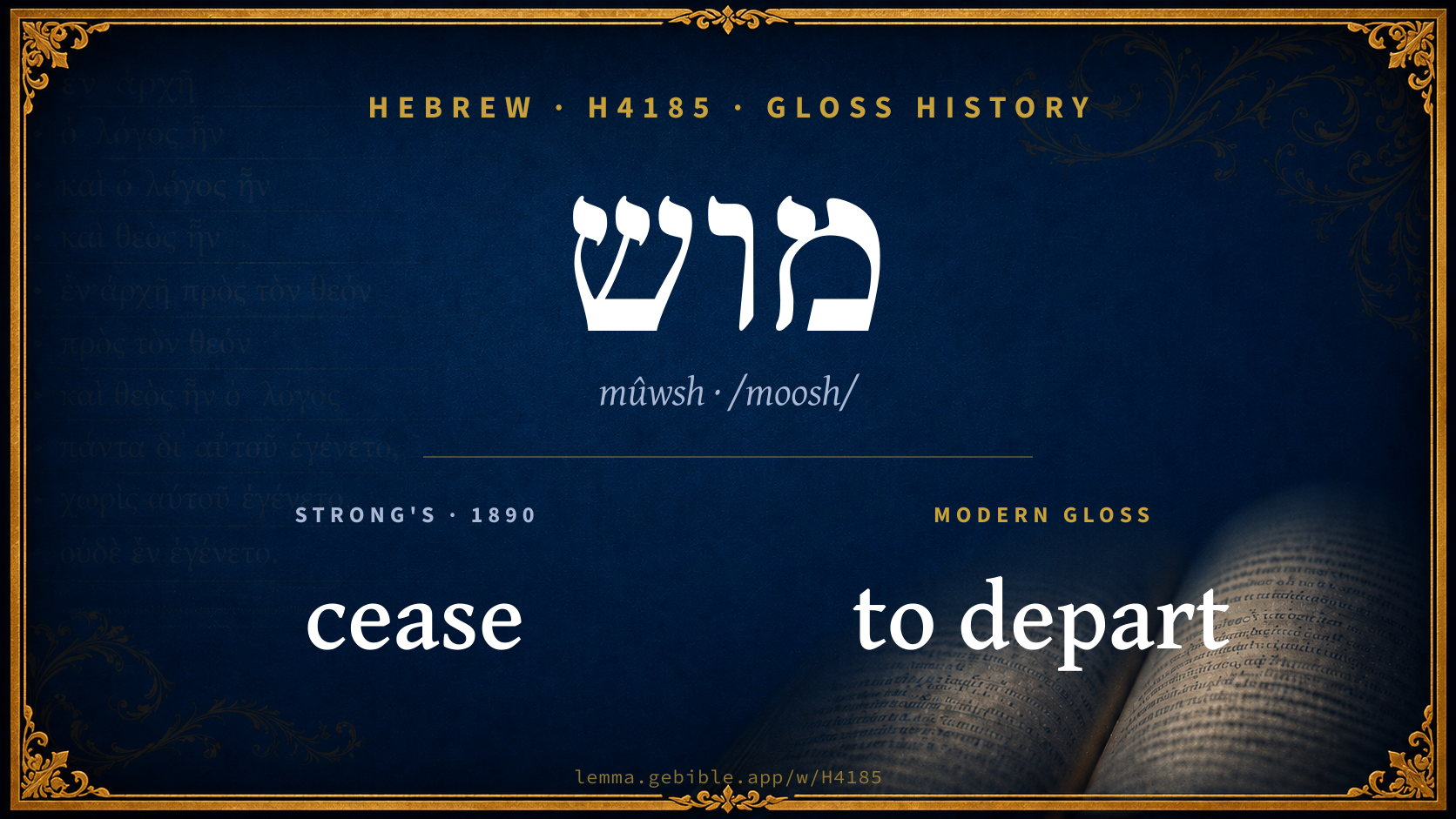
Gloss history
Strong's 1890 vs modern scholarship
About this word
Strong's H4185 catalogs a Hebrew word from the Hebrew Old Testament.
These counts are not copied from any lexicon or concordance. They are computed here, from the morphology-tagged Hebrew Old Testament. What Lemma adds →
- 19
- distinct verses
- The word appears in 19 distinct verses.
- 12 / 39
- OT books
- The word appears in 12 of 39 Old Testament books.
- #1,462
- by frequency
- Top 2500 most frequent Hebrew words (rank 1,462 of 8,640 Hebrew words by occurrence).
View all 19 occurrences in the concordance →
By section of the Old Testament
By traditional corpus
Conventional, traditional groupings — biblical authorship is debated, so this is a traditional corpus grouping, not an authorship claim. Each share is this word’s portion of its verses in that division of the Hebrew canon. Each figure is a share of the word’s 19 distinct verses.
- Prophets (Nevi'im) 13 verses · 68%
- Torah (Pentateuch) 3 verses · 16%
- Writings (Ketuvim) 3 verses · 16%
How translations render this word
Counts come from each version’s own published word-to-Strong’s tagging or interlinear alignment — an approximate guide to how each version renders this word, not a word-level alignment the data otherwise carries. Because each total is that version’s own tagged count, the per-version totals vary from one another and need not match the appearance or distinct-verse counts above. These counts may also differ from a printed concordance because Lemma counts each distinctly tagged rendering and does not collapse phrase taggings into a single head-word total. This is a fixed set of word-tagged versions (KJV, ASV, BSB, ULT) and does not change with the reading translation you choose elsewhere. Each version’s license is shown beside its name below (and on Sources).
- King James Version: Shall not depart 4×, Depart 3×, Departed 2×
- American Standard Version: Shall not depart 4×, Depart 3×, Departed 3×
- Berean Standard Bible: Depart 3×, Leave 3×, Departed 2×
- unfoldingWord Literal Text: Depart 7×, Will 3×, Do 2×
King James Version Public Domain
Renders H4185 across 20 tagged occurrences — most commonly:
Plus 11 renderings that appear only once — usually multi-word phrases or single function words the recovered tagging swept in, not distinct renderings. Not rendered by a distinct English word in 1 further occurrence.
American Standard Version Public Domain
Renders H4185 across 22 tagged occurrences — most commonly:
Plus 10 renderings that appear only once — usually multi-word phrases or single function words the recovered tagging swept in, not distinct renderings.
Berean Standard Bible Public Domain
Renders H4185 across 20 tagged occurrences — most commonly:
Plus 12 renderings that appear only once — usually multi-word phrases or single function words the recovered tagging swept in, not distinct renderings.
unfoldingWord Literal Text CC BY-SA 4.0
Renders H4185 across 31 tagged occurrences — most commonly:
Plus 17 renderings that appear only once — usually multi-word phrases or single function words the recovered tagging swept in, not distinct renderings.
Senses in the full BDB
Hebrew verbs can shift meaning by stem (binyan): Qal is the basic action, Niphal is often passive or reflexive, Piel often intensifies or makes it factitive, and Hiphil is typically causative. The senses below are grouped under the stem BDB assigns to each.
What do BDB’s symbols mean?
BDB uses these scholarly abbreviations:
| Symbol | Meaning |
|---|---|
| 𝔊 | the Septuagint (the ancient Greek translation, LXX) |
| 𝔙 | the Vulgate (the Latin translation) |
| 𝔖 | the Syriac version (the Peshitta) |
| 𝔗 | the Targum (the Aramaic translation) |
| ψ | the Psalms |
| √ | root (the underlying root or stem) |
| ‖ | parallel passage (a synonymous or contrasted parallel) |
| † | the dagger: every passage where the word occurs is cited |
The 2 senses and sub-senses the full Brown-Driver-Briggs lexicon distinguishes for this word, in lexicon order (not ranked by frequency), with BDB’s own verbatim wording and sub-sense lettering. Shown in Hebrew script with BDB’s own scholarly abbreviations. The condensed entry is in the Lexicon Entry tab. See also the Forms in the corpus table below.
Qal
- ;—depart, mostly of inanimate things (= be removed)
Hiphil
- .; remove, take away
Senses from the full Brown-Driver-Briggs lexicon (Brown, Driver, Briggs; Oxford 1906 — public domain), digitized via Sefaria, supplemented by the OpenScriptures HebrewLexicon (CC BY 4.0). Full attribution on Sources.
Word origin
[ מוּשׁ, מִישׁ ] vb. depart, remove
— Brown-Driver-Briggs (Oxford 1906, public domain), digitized via Sefaria, supplemented by the OpenScriptures HebrewLexicon (CC BY 4.0). See Sources.
Derived from מוש (mûwsh) (H4184) — to feel.
Jastrow Dictionary
A second Hebrew/Aramaic lexicon for comparison, covering Aramaic and post-biblical (Talmudic, Targumic, Midrashic) usage that the biblical-Hebrew BDB does not. Matched by lemma rather than by Strong’s number, so a lemma may carry more than one Jastrow headword (shown separately below), and the entries cover usage well beyond the Bible.
מוּשׁ
- v. מָשַׁשׁ) to feel, touch.
- , part. pl. נְמוֹשׁוֹת [gropers, searchers,] the last troop of gleaners. Peah VIII, 1 משילכו הנ׳ from the time the last gleaners go. Y. ib. 20ᵈ למה נקרא שמן נ׳ … בסוף וכ׳ why are they called n’moshoth (searchers)? Because they come out last. Ib. אית תני׳ נ׳ וכ׳ (not נמושית) some read n’moshoth, others mashoshoth &c.; he who reads mash. calls them so, because they feel their way in walking (old people); B. Mets. 21ᵇ; Taan. 6ᵇ מאי נ׳ סבי וכ׳ what is meant by n’moshoth? Old men walking on a staff; (oth. opin.) לקוטי וכ׳, v. לָקוֹטָא. Y. Peah l. c. היה יוצא בין הנ׳ (not מן) used to go out among the last gleaners.
מוּשׁ ²
- 1. same. Targ. O. Gen. XXVII, 12; a. e.—2) (perh. fr. מְשַׁשׁ; cmp. משמש) to handle, attend to, prepare. M. Kat. 27ᵇ תֵּימוּשׁ האי איתתא וכ׳ (v. Rabb. D. S. a. l. note; ed. incorr.) let that woman have her shroud in readiness. B. Kam. 92ᵇ אוכפא לגביך מוֹשׁ prepare a saddle for thy back, v. אוּכָּפָא.
- to allow to touch. Targ. Jud. XVI, 26 ואֲמִישֵׁנִי (ed. Lag. ואמשני, v. מְשָׁא).
A Dictionary of the Targumim, the Talmud Babli and Yerushalmi, and the Midrashic Literature (Marcus Jastrow; London, Luzac, 1903) — Public Domain. Digitized via Sefaria. Digitized via Sefaria. Full attribution on Sources.
Forms in the corpus
The 19 distinct written forms H4185 takes in the Hebrew Bible, most frequent first — each parse links to that stem’s occurrences in the concordance. Hebrew forms include their vowel points and cantillation, so a single lemma takes many written forms.
Same root — word family
Other BDB entries built from the same root as H4185, grouped by Strong’s listed origin. These share a root / origin per the lexicon — not necessarily a shared meaning. Each links to that word’s own entry.
Derives from
Proper names from this root
People and places named from this root — a name, not an additional meaning of the word.
Compare all same-root words → 2 of the same-root words are proper names (people or places). They share a root, not necessarily a meaning.
Septuagint verse parallels
This word appears in 19 verses that also exist in the Greek Old Testament (Septuagint), out of the 19 Hebrew verses it occurs in. You can read those verses in Greek by switching the Old Testament edition to the Septuagint.
Read these verses in the Septuagint
- Exodus 13:22
- Numbers 14:44
- Joshua 1:8
- Judges 6:18
- Job 23:12
- Psalms 55:11
- Proverbs 17:13
- Isaiah 22:25
- Jeremiah 17:8
- Micah 2:3
- Nahum 3:1
- Zechariah 3:9
This is a verse-level parallel only — the same verses exist in both the Hebrew and Greek Old Testaments. No word-level Hebrew↔Greek correspondence is claimed: the data carries no such alignment, so no Greek word is shown as this Hebrew word’s translation. Coverage is not total — the Septuagint omits the deuterocanon and renumbers the Psalms, so some Hebrew verses have no direct Greek parallel.