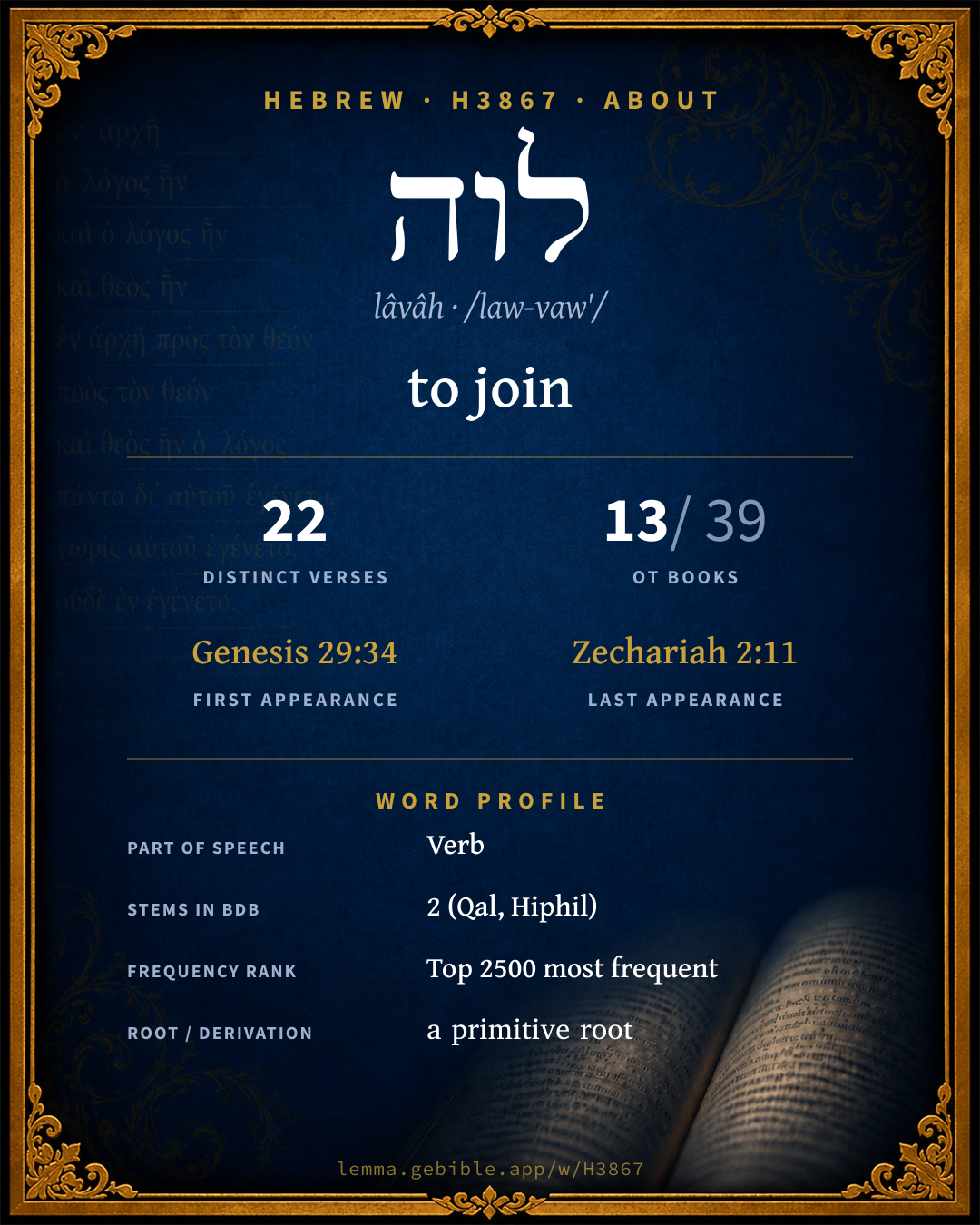
לָוָה
to join
‘to join’ is one of 3 main senses fuller range ↓
Full lexicon entry — Brown-Driver-Briggs (BDB)
From Brown-Driver-Briggs (BDB)
Where this word appears
See every Hiphil verb in the Hebrew Bible →
Grammar key — what these labels mean
Part of speech
- Verb
- An action or state-of-being word.
Stem
- Niphal
- Usually the simple passive or reflexive of the Qal (“he was written”).
- Hiphil
- The causative active stem (“he caused / brought about”).
- Qal
- The basic, simple active stem — the plain form of the verb (“he wrote”).
Form
- Sequential Perfect
- A perfect with prefixed waw continuing a preceding imperfect or command (waw-consecutive perfect).
- Participle Active
- A verbal adjective expressing ongoing or characteristic action (“writing / one who writes”).
- Imperfect
- An incomplete, ongoing, or future action (“he will / would write”).
- Perfect
- A completed action or state — Hebrew marks aspect (completeness) more than strict tense (“he wrote”).
State
- Absolute
- The independent form of a noun, not bound to a following word.
- Construct
- A noun bound to a following noun in a possessive / “of” relationship (the construct chain).
Person
- 3rd Person
- The one spoken about (“he / she / it / they”).
- 2nd Person
- The one addressed (“you”).
- 1st Person
- The speaker (“I / we”).
Gender
- Common
- Either gender — not distinguished for this form.
- Masculine
- Grammatically masculine.
Number
- Plural
- More than one (in Hebrew, generally three or more).
- Singular
- One.
2 verses where H3867 appears in the Hiphil stem in the Book of Deuteronomy. Filtered view — show all forms. Click any verse to open its interlinear word-by-word view. Verse text shown in the World English Bible for context — . Each verse’s Hebrew form is shown with its reference; the English is not keyword-highlighted, since the data carries no word-level English alignment. Use “Compare translations” on any verse to read it across multiple English versions. This concordance covers the Hebrew Bible; Septuagint (Greek Old Testament) occurrences are not indexed here.
Deuteronomy
- Deuteronomy 28:12 וְ/הִלְוִ֨יתָ֙ תִלְוֶֽה conj + Hiphil wpf 2ms Qal impf 2ms Yahweh will open to you his good treasure in the sky, to give the rain of your land in its season, and to bless all the work of your hand: and you shall lend to many nations, and you shall not borrow.
- Deuteronomy 28:44 יַלְוְ/ךָ֔ תַלְוֶ֑/נּוּ Hiphil impf 3ms + sfx pers 2ms Hiphil impf 2ms + sfx pers 3ms He shall lend to you, and you shall not lend to him: he shall be the head, and you shall be the tail.
About this entry
At a glance — auto-summarized from this page’s data, not written by a person. Every figure links to its source below. This summary describes the numbers; it doesn’t interpret them.
לוה — transliterated lâvâh — is a Hebrew verb carrying the sense “to join.” Debuting at Genesis 29:34, it then recurs through the corpus. Spanning 22 verses in 13 books, it ranks among the uncommon words of the Hebrew Bible. The verb spans 2 stems, from Qal to Hiphil. From the same root come לויה, לויתן and לות. Each statement above links to its evidence; the full detail follows below.
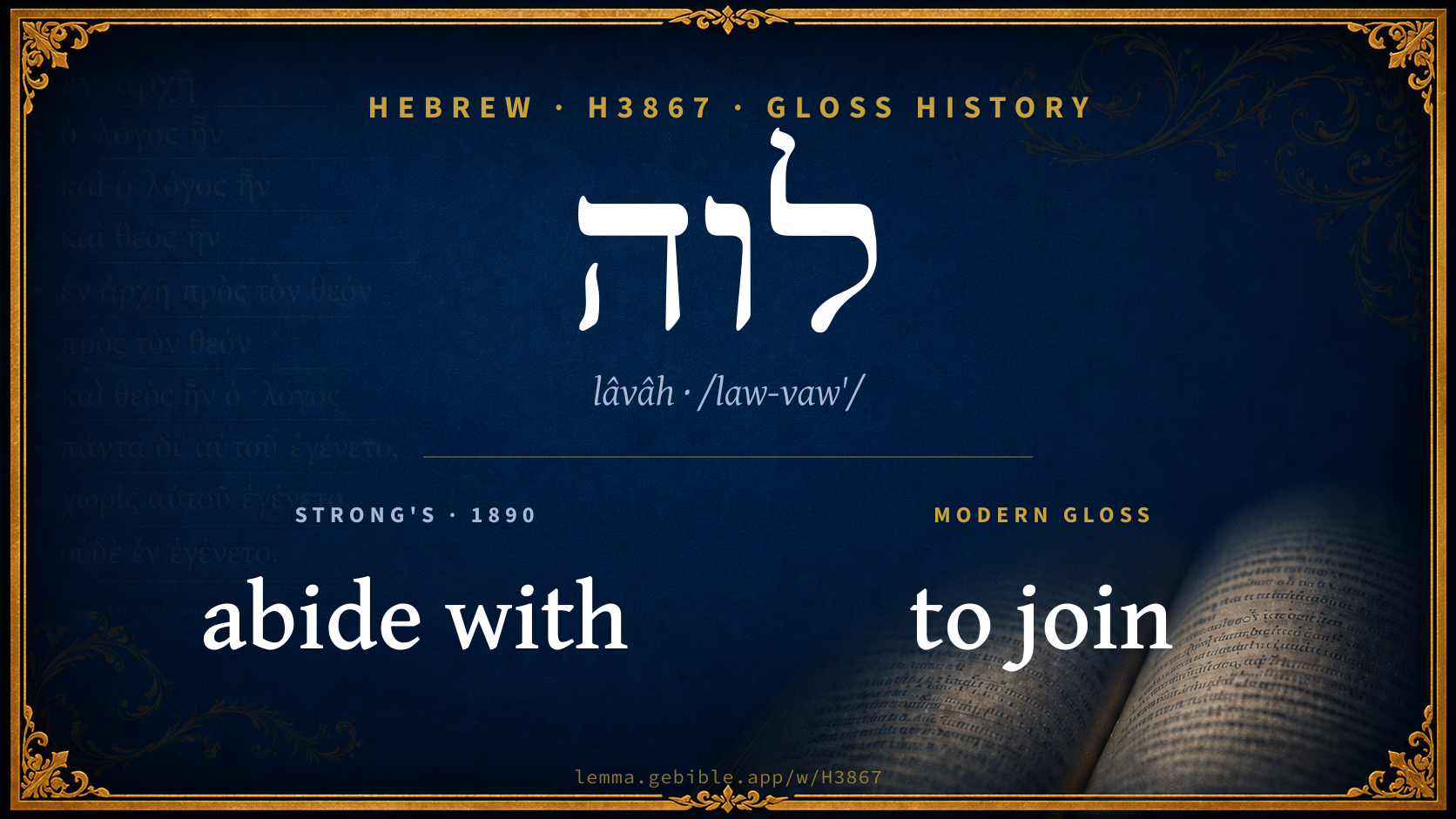
Gloss history
Strong's 1890 vs modern scholarship
About this word
Strong's H3867 catalogs a Hebrew word from the Hebrew Old Testament.
These counts are not copied from any lexicon or concordance. They are computed here, from the morphology-tagged Hebrew Old Testament. What Lemma adds →
- 22
- distinct verses
- The word appears in 22 distinct verses.
- 13 / 39
- OT books
- The word appears in 13 of 39 Old Testament books.
- #1,251
- by frequency
- Top 2500 most frequent Hebrew words (rank 1,251 of 8,640 Hebrew words by occurrence).
View all 22 occurrences in the concordance →
By section of the Old Testament
By traditional corpus
Conventional, traditional groupings — biblical authorship is debated, so this is a traditional corpus grouping, not an authorship claim. Each share is this word’s portion of its verses in that division of the Hebrew canon. Each figure is a share of the word’s 22 distinct verses.
- Writings (Ketuvim) 10 verses · 45%
- Torah (Pentateuch) 6 verses · 27%
- Prophets (Nevi'im) 6 verses · 27%
How translations render this word
Counts come from each version’s own published word-to-Strong’s tagging or interlinear alignment — an approximate guide to how each version renders this word, not a word-level alignment the data otherwise carries. Because each total is that version’s own tagged count, the per-version totals vary from one another and need not match the appearance or distinct-verse counts above. These counts may also differ from a printed concordance because Lemma counts each distinctly tagged rendering and does not collapse phrase taggings into a single head-word total. This is a fixed set of word-tagged versions (KJV, ASV, BSB, ULT) and does not change with the reading translation you choose elsewhere. Each version’s license is shown beside its name below (and on Sources).
BDB lists this Strong’s number as 2 distinct words (homographs). Each count above pools all of them and is not split by sense — see the Senses section below. A low-frequency rendering may belong to a different one of those words, not the primary meaning.
- King James Version†: Lendeth 3×, Borrower 2×, Shall be joined 2×
- American Standard Version†: Lendeth 3×, Shall join 3×
- Berean Standard Bible†: Join 3×, Borrow 2×, Borrower 2×
- unfoldingWord Literal Text†: And 2×, Lending 2×, Lends 2×
King James Version Public Domain
Renders H3867 across 25† tagged occurrences — most commonly:
Plus 18 renderings that appear only once — usually multi-word phrases or single function words the recovered tagging swept in, not distinct renderings. Not rendered by a distinct English word in 1 further occurrence.
American Standard Version Public Domain
Renders H3867 across 25† tagged occurrences — most commonly:
Plus 19 renderings that appear only once — usually multi-word phrases or single function words the recovered tagging swept in, not distinct renderings.
Berean Standard Bible Public Domain
Renders H3867 across 26† tagged occurrences — most commonly:
Plus 15 renderings that appear only once — usually multi-word phrases or single function words the recovered tagging swept in, not distinct renderings.
unfoldingWord Literal Text CC BY-SA 4.0
Renders H3867 across 30† tagged occurrences — most commonly:
Plus 18 renderings that appear only once — usually multi-word phrases or single function words the recovered tagging swept in, not distinct renderings.
Senses in the full BDB
Hebrew verbs can shift meaning by stem (binyan): Qal is the basic action, Niphal is often passive or reflexive, Piel often intensifies or makes it factitive, and Hiphil is typically causative. The senses below are grouped under the stem BDB assigns to each.
What do BDB’s symbols mean?
BDB uses these scholarly abbreviations:
| Symbol | Meaning |
|---|---|
| 𝔊 | the Septuagint (the ancient Greek translation, LXX) |
| 𝔙 | the Vulgate (the Latin translation) |
| 𝔖 | the Syriac version (the Peshitta) |
| 𝔗 | the Targum (the Aramaic translation) |
| ψ | the Psalms |
| √ | root (the underlying root or stem) |
| ‖ | parallel passage (a synonymous or contrasted parallel) |
| † | the dagger: every passage where the word occurs is cited |
The 2 senses and sub-senses the full Brown-Driver-Briggs lexicon distinguishes for this word, in lexicon order (not ranked by frequency), with BDB’s own verbatim wording and sub-sense lettering. Shown in Hebrew script with BDB’s own scholarly abbreviations. The condensed entry is in the Lexicon Entry tab. See also the Forms in the corpus table below.
לוה I join (intr.), be joined (NH Pi. לִוָּה (ליוה) trans., Hithp. intr.
לוה II borrow (NH id.
Qal
- Pf. 1 pl. לָוִי֫נוּ Ne 5:4; Impf. 2 ms. תִּלְוֶה Dt 28:12; Pt. לֹוֶה Pr 22:7 + 2 times;—borrow, עֶבֶד לֹוֶה לְאִישׁ מַלְוֶה Pr 22:7 a borrower is slave to a man who lends; abs. Dt 28:12 Is 24:2 ψ 37:21; sq. כֶּסֶף Ne 5:4. e.g. Nehemiah 5:4
Hiphil
- Pf. 2 ms. consec. וְהִלְוִיתָה Dt 28:12; Impf. 3 ms. sf. יַלְוְךָ Dt 28:44; 2 ms. תַּלְוֶה Ex 22:24; sf. תַּלְוֶנּוּ Dt 28:44; Pt. מַלְוֶה ψ 37:26 + 3 times, cstr. מַלְוֵה Pr 19:17;—cause to borrow, i.e. lend to, c. acc. pers. + כֶּסֶף Ex 22:24 (E); c. acc. pers. Dt 28:12, 44(×2); abs. ψ 37:26; 112:5; אִישׁ מַלְוֶה Pr 22:7 (v. Qal supr.); as subst. Is 24:2; מַלְוֵה י׳ Pr 19:17 a lender to י׳ is one shewing favour to the poor. e.g. Deuteronomy 28:12
Senses from the full Brown-Driver-Briggs lexicon (Brown, Driver, Briggs; Oxford 1906 — public domain), digitized via Sefaria, supplemented by the OpenScriptures HebrewLexicon (CC BY 4.0). Full attribution on Sources.
Word origin
I. join (intr.), be joined (NH Pi. לִוָּה (ליוה) trans., Hithp. intr.; Aramaic לַוֵּי accompany; so ܠܘܳܐ; BAES 12 comp. Arabic وَلِىَ be near);—Qal (late) Impf. 3 ms. sf. יִלְוֶנּוּ. Ec 8:15, be joined to, attend (of mirth). Niph. נִלְוָה ψ 83:9 Is 14:1; 3 mpl. consec. וְנִלְווּ Nu 18:4 + 2 times, + Je 50:5 (GesLbg Bö Köi. 588 Gf Gie; >Imv. Ki Ew§ 226 c Ol§ 264); Impf. יִלָּוֶה Gn 29:34; יִלָּווּ Nu 18:2; Pt. נִלְוָה Is 56:3 (pointed as Pf., read prob. נִלְוֶח); pl. נִלְוִים Est 9:27; Is 56:6;—join oneself or be joined unto, sq. עַל Nu 18:2, 4 (מַטֵה לֵנִי to Aaron, by word-play), Is 14:1 (strangers to Isr.), Dn 11:34 (flatterers to the people), cf. Est 9:27; Is 56:6 (to י׳); sq. אֶל־ Is 56:3 (to י׳), Zc 2:15 (to י׳), Je 50:5 (to י׳), Gn 29:34 (J; husband to wife); sq. עִם ψ 83:9 (Aasshur with enemies of Isr.)
II. vb. borrow (NH id.; cf. Arabic لَوَى delay payment of debt (cf. BAES 12));—
— Brown-Driver-Briggs (Oxford 1906, public domain), digitized via Sefaria, supplemented by the OpenScriptures HebrewLexicon (CC BY 4.0). See Sources.
Origin: a primitive root
Jastrow Dictionary
A second Hebrew/Aramaic lexicon for comparison, covering Aramaic and post-biblical (Talmudic, Targumic, Midrashic) usage that the biblical-Hebrew BDB does not. Matched by lemma rather than by Strong’s number, so a lemma may carry more than one Jastrow headword (shown separately below), and the entries cover usage well beyond the Bible.
לָוָה
- , v. לוי
לוי
- (b. h.)
- 1. to join, be connected, v. Piel, a. לְוָיָה.
- 2. (cmp. Sm. Ant. s. v. Nexum) to assume an obligation; to borrow. Shebu. 41ᵇ; Keth. 88ᵃ; B. Bath. 6ᵃ האומר לא לָוִיתִי וכ׳ he who (being sued for a loan duly testified by witnesses) says, ‘I have not contracted any loan’, is considered as admitting that he has not paid. Ḥull. 84ᵃ כגון אנו לווִֹין אוכלין (delicate persons) like ourselves may buy food on credit. B. Mets. 72ᵇ אין לווִֹין על שער וכ׳ (also לוִֹין) you must not borrow money with the choice of repaying in grain at the present price; (another defin., v. Rashi a. l.). Bets. 15ᵇ לְווּ עלי make a loan on my (the Lord’s) account; a. v. fr.—Esp. לווֶֹה, לוֶֹה debtor, opp. to מַלְוֶה creditor. Shebu. 47ᵃ מת ל׳ בחיי מ׳ if the debtor died before the creditor; a. fr.—Pl. לווִֹין. Ib.ᵇ שני מלווין ושני ל׳ two (different) creditors and two debtors.
- , לִי׳
- 1. to order an escort for protection, v. לְוָיָה. Tanḥ. Bal. 12; Num. R. s. 20 ל׳ להם ענני וכ׳ He appointed the clouds of glory to escort them. Sot. 46ᵇ בשביל … של׳ פרעה וכ׳ for the sake of the four steps which Pharaoh ordered his men to escort Abraham &c.
- 2. to escort, to walk a distance with a departing guest; to follow. Sabb. 119ᵇ שני מה"ש מְלַוִּין לו וכ׳ two ministering angels escort man to his house on the Sabbath eve. Sot. l. c. כל שאינו מְלַוֶּה ומִתְלַוֶּה וכ׳ whoever omits to escort a guest or (as a guest) declines an escort, is regarded as if he had shed blood; שאילמלא לִיוּוּהוּ וכ׳ for if the men of Jericho had escorted Elisha &c. Koh. R. to V, 17 ומה מְלַוֵּהוּ וכ׳ and what does escort him (to the grave)? Merits and good deeds; a. fr.
- 1. to join the company of, to associate. Midr. Till. to Ps. CIV, 26 (play on לויתן, ib.) כל מי שמִתְלַוֶּה עמהן עתיד להיעשות וכ׳ whosoever joins them (the Romans) will be made sport of with them in future days. Ib. כל מי שמתלוה עמהן עתיד הקב"ה וכ׳ him who joins them (the scholars), the Lord will cause to rejoice with them &c.; Yalk. ib. 862. Gen. R. s. 63, end; Yalk. ib. 111 שנתלוה עמו קלונו וכ׳ the disgrace of starvation was made his companion. Tanḥ. Vayishl. 3 להִתְלַוּוֹת לו to be his escort; a. fr.
- 2. to be escorted, to accept escort. Sot. l. c., v. supra.
- 1. to escort. Ber. 18ᵃ ואם הִלְוָהוּ if he does escort him (the dead).
- 2. to lend. EX. R. s. 31 מַלְוֶה ברבית lends on interest; מ׳ שלא ברבית without interest. Ib. שלא יַלְווּ וכ׳ that they must not lend &c. Ib. ראו כמה הִלְוֵיתִי ואיני … ומה הִלְוְותָה הארץ וכ׳ see how much I lend (to man,) without taking interest, and what the earth lends &c. B. Mets. V, 1 המלוה סלע בחמשה וכ׳ he who lends a Sela to get five Denars in return. Ib. 62ᵇ הַלְוֵינִי מנה lend me a Maneh.—B. Kam. 94ᵇ מַלְיֵי רבית (a. ברבית) those who lend on interest; B. Mets. 62ᵃ; a. fr.—מַלְוֶה creditor, v. supra.
A Dictionary of the Targumim, the Talmud Babli and Yerushalmi, and the Midrashic Literature (Marcus Jastrow; London, Luzac, 1903) — Public Domain. Digitized via Sefaria. Digitized via Sefaria. Full attribution on Sources.
Forms in the corpus
The 23 distinct written forms H3867 takes in the Hebrew Bible, most frequent first — each parse links to that stem’s occurrences in the concordance. Hebrew forms include their vowel points and cantillation, so a single lemma takes many written forms.
Same root — word family
Other BDB entries built from the same root as H3867, grouped by Strong’s listed origin. These share a root / origin per the lexicon — not necessarily a shared meaning. Each links to that word’s own entry.
Derived from this word
Proper names from this root
People and places named from this root — a name, not an additional meaning of the word.
Compare all same-root words → Showing 4 of 5 — not the complete family. 1 of the same-root words is a proper name (a person or place). They share a root, not necessarily a meaning.
Septuagint verse parallels
This word appears in 20 verses that also exist in the Greek Old Testament (Septuagint), out of the 22 Hebrew verses it occurs in. You can read those verses in Greek by switching the Old Testament edition to the Septuagint.
Read these verses in the Septuagint
- Genesis 29:34
- Exodus 22:25
- Numbers 18:2
- Deuteronomy 28:12
- Esther 9:27
- Psalms 37:21
- Proverbs 19:17
- Ecclesiastes 8:15
- Isaiah 14:1
- Jeremiah 50:5
- Daniel 11:34
- Zechariah 2:11
This is a verse-level parallel only — the same verses exist in both the Hebrew and Greek Old Testaments. No word-level Hebrew↔Greek correspondence is claimed: the data carries no such alignment, so no Greek word is shown as this Hebrew word’s translation. Coverage is not total — the Septuagint omits the deuterocanon and renumbers the Psalms, so some Hebrew verses have no direct Greek parallel.