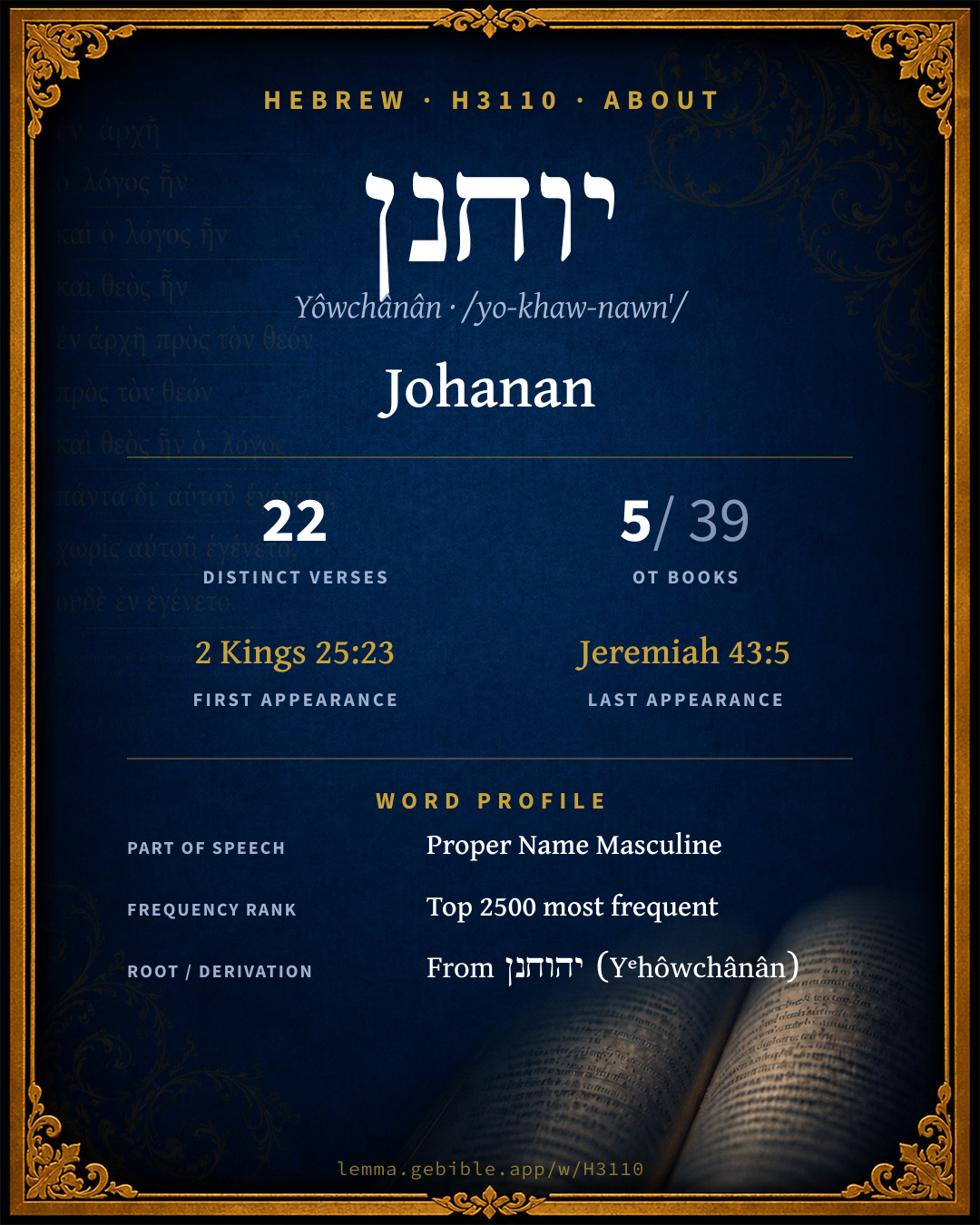
יוֹחָנָן
Johanan
BDB lists 9 entries for ‘Johanan’ fuller range ↓
Full lexicon entry — Brown-Driver-Briggs (BDB)
From Brown-Driver-Briggs (BDB)
Where this word appears
Grammar key — what these labels mean
Part of speech
- Noun
- A naming word — a person, place, thing, or idea.
Noun type
- Proper
- A name of a specific person, place, or people (e.g. Abraham, Zion, Israel).
Every verse where H3110 appears in the Book of Nehemiah — 2 distinct verses. Click any verse to open its interlinear word-by-word view. Verse text shown in the World English Bible for context — . Each verse’s Hebrew form is shown with its reference; the English is not keyword-highlighted, since the data carries no word-level English alignment. Use “Compare translations” on any verse to read it across multiple English versions. This concordance covers the Hebrew Bible; Septuagint (Greek Old Testament) occurrences are not indexed here.
Nehemiah
- Nehemiah 12:22 וְ/יוֹחָנָן֙ conj + n Proper As for the Levites, in the days of Eliashib, Joiada, and Johanan, and Jaddua, there were recorded the heads of fathers' [houses]; also the priests, in the reign of Darius the Persian.
- Nehemiah 12:23 יֽוֹחָנָ֥ן n Proper The sons of Levi, heads of fathers' [houses], were written in the book of the chronicles, even until the days of Johanan the son of Eliashib.
About this entry
At a glance — auto-summarized from this page’s data, not written by a person. Every figure links to its source below. This summary describes the numbers; it doesn’t interpret them.
At its core, יוחנן (Yôwchânân) means “Johanan.” Its uses cluster heavily in Jeremiah (64% of all occurrences). With 22 verses in 5 books, it is an uncommon word in the Hebrew Bible. Scripture first uses it in 2 Kings 25:23. Dig into 22-verse concordance and the renderings breakdown below.
Gloss history
Strong's 1890 vs modern scholarship
About this word
Strong's H3110 catalogs a Hebrew word from the Hebrew Old Testament.
These counts are not copied from any lexicon or concordance. They are computed here, from the morphology-tagged Hebrew Old Testament. What Lemma adds →
- 22
- distinct verses
- The word appears in 22 distinct verses.
- 5 / 39
- OT books
- The word appears in 5 of 39 Old Testament books.
- #1,412
- by frequency
- Top 2500 most frequent Hebrew words (rank 1,412 of 8,640 Hebrew words by occurrence).
View all 22 occurrences in the concordance →
Most concentrated in
- Jeremiah 14 verses 64%
- 1 Chronicles 4 verses 18%
- Nehemiah 2 verses 9%
By section of the Old Testament
By traditional corpus
Conventional, traditional groupings — biblical authorship is debated, so this is a traditional corpus grouping, not an authorship claim. Each share is this word’s portion of its verses in that division of the Hebrew canon. Each figure is a share of the word’s 22 distinct verses.
- Prophets (Nevi'im) 15 verses · 68%
- Writings (Ketuvim) 7 verses · 32%
How translations render this word
Counts come from each version’s own published word-to-Strong’s tagging or interlinear alignment — an approximate guide to how each version renders this word, not a word-level alignment the data otherwise carries. Because each total is that version’s own tagged count, the per-version totals vary from one another and need not match the appearance or distinct-verse counts above. These counts may also differ from a printed concordance because Lemma counts each distinctly tagged rendering and does not collapse phrase taggings into a single head-word total. This is a fixed set of word-tagged versions (KJV, ASV, BSB, ULT) and does not change with the reading translation you choose elsewhere. Each version’s license is shown beside its name below (and on Sources).
- King James Version: Johanan 22×
- American Standard Version: Johanan 21×
- Berean Standard Bible: Johanan 19×
- unfoldingWord Literal Text: Johanan 8×
King James Version Public Domain
Renders H3110 across 24 tagged occurrences — most commonly:
Plus 2 renderings that appear only once — usually multi-word phrases or single function words the recovered tagging swept in, not distinct renderings.
American Standard Version Public Domain
Renders H3110 across 24 tagged occurrences — most commonly:
Plus 3 renderings that appear only once — usually multi-word phrases or single function words the recovered tagging swept in, not distinct renderings.
Berean Standard Bible Public Domain
Renders H3110 across 22 tagged occurrences — most commonly:
Plus 3 renderings that appear only once — usually multi-word phrases or single function words the recovered tagging swept in, not distinct renderings.
unfoldingWord Literal Text CC BY-SA 4.0
Renders H3110 across 8 tagged occurrences — most commonly:
16 senses and sub-senses in the full BDB
What do BDB’s symbols mean?
BDB uses these scholarly abbreviations:
| Symbol | Meaning |
|---|---|
| 𝔊 | the Septuagint (the ancient Greek translation, LXX) |
| 𝔙 | the Vulgate (the Latin translation) |
| 𝔖 | the Syriac version (the Peshitta) |
| 𝔗 | the Targum (the Aramaic translation) |
| ψ | the Psalms |
| √ | root (the underlying root or stem) |
| ‖ | parallel passage (a synonymous or contrasted parallel) |
| † | the dagger: every passage where the word occurs is cited |
The 16 senses and sub-senses the full Brown-Driver-Briggs lexicon distinguishes for this word, in lexicon order (not ranked by frequency), with BDB’s own verbatim wording and sub-sense lettering. Shown in Hebrew script with BDB’s own scholarly abbreviations. The condensed entry is in the Lexicon Entry tab. See also the Forms in the corpus table below.
- 1.
- a. יְהוֹ׳ a priest Ne 12:13; e.g. Nehemiah 12:13
- b. high priest Ezr 10:6 = יוֹחָנָן Ne 12:22, 23 appar. = יוֹנָתָן Ne 12:11(×2) (𝔊 Ἰωναθαν). e.g. Ezra 10:6
- 2. יְהוֹ׳ Levite Ne 12:42. e.g. Nehemiah 12:42
- 3. יְהוֹ׳ son of Tobiah Ne 6:18 (𝔊 Codd. Ἰωναθαν). e.g. Nehemiah 6:18
- 4. יְהוֹ׳ porter in David’s time 1 Ch 26:3 (𝔊 Ἰωνας, 𝔊L Ἰωναθαν). e.g. 1 Chronicles 26:3
- 5. יְהוֹ׳ a Judaite captain 2 Ch 17:15 appar. also 23:1. e.g. 2 Chronicles 17:15
- 6. יְהוֹ׳ an Ephraimite 2 Ch 28:12. e.g. 2 Chronicles 28:12
- 7. יְהוֹ׳ an Israelite, Ezra’s time Ezr 10:28. e.g. Ezra 10:28
- 8. יוֹ׳ (& so all foll.) a Jewish captain, after fall of Jerus. 2 K 25:23; Je 40:8, 13, 15, 16; 41:11, 13, 14, 15, 16; 42:1, 8; 43:2, 4, 5 e.g. 2 Kings 25:23
- 9. eldest son of king Josiah 1 Ch 3:15 𝔊L ͂Ἰωαχας (appar. = יְהוֹאָחָז 2 K 23:30 +). e.g. 1 Chronicles 3:15
- 10. a post-exilic prince of the line of David 1 Ch 3:24. e.g. 1 Chronicles 3:24
- 11. father of Azariah, priest in Sol.’s time 1 Ch 5:35, 36. e.g. 1 Chronicles 5:35
- 12. two of David’s mighty men:
- a. a Benjamite 1 Ch 12:5; e.g. 1 Chronicles 12:5
- b. a Gadite 1 Ch 12:13. e.g. 1 Chronicles 12:13
- 13. a returning exile Ezr 8:12. e.g. Ezra 8:12
Senses from the full Brown-Driver-Briggs lexicon (Brown, Driver, Briggs; Oxford 1906 — public domain), digitized via Sefaria, supplemented by the OpenScriptures HebrewLexicon (CC BY 4.0). Full attribution on Sources.
Word origin
† יְהוֹחָנָן, יוֹחָנָן n.pr.m. 𝔊 mostly Ἰωαναν, Ἰωναν (י׳ hath been gracious, cf. אֶלְחָנָן, חֲנַנְאֵל & reff.; also Ph. יחנבעל בעליחן)—
— Brown-Driver-Briggs (Oxford 1906, public domain), digitized via Sefaria, supplemented by the OpenScriptures HebrewLexicon (CC BY 4.0). See Sources.
Derived from יהוחנן (Yᵉhôwchânân) (H3076) — Jehohanan.
Jastrow Dictionary
A second Hebrew/Aramaic lexicon for comparison, covering Aramaic and post-biblical (Talmudic, Targumic, Midrashic) usage that the biblical-Hebrew BDB does not. Matched by lemma rather than by Strong’s number, so a lemma may carry more than one Jastrow headword (shown separately below), and the entries cover usage well beyond the Bible.
יוֹחָנָן
- (b. h.) pr. n. m. Johanan, John;
- 1. J. ben Kareah, a follower of the Babylonian governor of Judaea (Jer. XL, 8 sq.). Esth. R. introd., beg.; Y. Succ. V, 55ᵇ top; Mekh. B’shall., Vayhi, s. 2. e.g. Jeremiah 40:8
- 2. John Hyrcan, the Asmonean highpriest and king (י׳ כהן גדול). Maash. Sh. V, 15; Sot. IX, 10; a. fr.
- 3. name of several Tannaim, esp. a) Rabban J. b. Zaccai. Ab. II, 8. R. Hash. IV, 3. Mekh. Yithro, Baḥod., s. 11. Sot. IX, 9; 15. Gitt. 56ᵃ, sq.; a. v. fr.—b) R. J. b. Bag-Bag (usu. only Ben-Bag-Bag). Y. Keth. V, 29ᵈ bot. B. Kam. 27ᵇ; a. fr.—c) R. J. b. B’roka. B. Kam. X, 2; a. fr.—d) R. J. b. Godgada. Eduy. VII, 9; a. e.—e) R. J. has-Sandlar. Ab. IV, 11; a. fr.—f) R. J. b. Nuri. Erub. IV, 5; Gitt. 67ᵃ; a. fr.;
- 4. name of several Amoraim, esp. R. J. han-Nappaḥ or Bar Nafḥa (the Smith). Y. R. Hash. II, 58ᵇ top. Ḥull. 137ᵇ; a. v. fr. (as R. J. only); v. Fr. M’bo p. 95ᵇ, sq.—V. חִיקוֹק.
A Dictionary of the Targumim, the Talmud Babli and Yerushalmi, and the Midrashic Literature (Marcus Jastrow; London, Luzac, 1903) — Public Domain. Digitized via Sefaria. Digitized via Sefaria. Full attribution on Sources.
Forms in the corpus
The 15 distinct written forms H3110 takes in the Hebrew Bible, most frequent first — each parse links to that state’s occurrences in the concordance. Hebrew forms include their vowel points and cantillation, so a single lemma takes many written forms.
| Form | Parsing | Example | Uses |
|---|---|---|---|
| וְ/יוֹחָנָ֣ן | Noun, Proper | 2 Kings 25:23 | 4 |
| וְ/יֽוֹחָנָן֙ | Noun, Proper | Jeremiah 40:13 | 2 |
| יֽוֹחָנָן֙ | Noun, Proper | Jeremiah 41:13 | 2 |
| יוֹחָנָ֣ן | Noun, Proper | Jeremiah 40:16 | 2 |
| יוֹחָנָ֨ן | Noun, Proper | Jeremiah 41:16 | 2 |
| וְ/יוֹחָנָ֖ן | Noun, Proper | 1 Chronicles 6:10 | 1 |
| וְ/יוֹחָנָ֧ן | Noun, Proper | 1 Chronicles 3:24 | 1 |
| וְ/יוֹחָנָן֙ | Noun, Proper | Nehemiah 12:22 | 1 |
| יֽוֹחָנָ֑ן | Noun, Proper | Jeremiah 41:15 | 1 |
| יֽוֹחָנָ֖ן | Noun, Proper | Jeremiah 41:14 | 1 |
| יֽוֹחָנָ֥ן | Noun, Proper | Nehemiah 12:23 | 1 |
| יוֹחָנָ֔ן | Noun, Proper | 1 Chronicles 3:15 | 1 |
| יוֹחָנָ֖ן | Noun, Proper | Ezra 8:12 | 1 |
| יוֹחָנָ֤ן | Noun, Proper | Jeremiah 43:5 | 1 |
| יוֹחָנָֽן | Noun, Proper | 1 Chronicles 6:9 | 1 |
Same root — word family
Other BDB entries built from the same root as H3110, grouped by Strong’s listed origin. These share a root / origin per the lexicon — not necessarily a shared meaning. Each links to that word’s own entry.
Derives from
Proper names from this root
People and places named from this root — a name, not an additional meaning of the word.
Compare all same-root words → 2 of the same-root words are proper names (people or places). They share a root, not necessarily a meaning.
Bible dictionary
Public-domain dictionary articles matched to this entry by name (Johanan). A biblical name can be shared by more than one person or place, so an article may treat several.
Easton's Bible Dictionary · M. G. Easton, 1897
Whom Jehovah graciously bestows. (1.) One of the Gadite heroes who joined David in the desert of Judah (1 Chr. 12:12).
(2.) The oldest of King Josiah's sons (1 Chr. 3:15).
(3.) Son of Careah, one of the Jewish chiefs who rallied round Gedaliah, whom Nebuchadnezzar had made governor in Jerusalem (2 Kings 25:23; Jer. 40:8). He warned Gedaliah of the plans of Ishmael against him, a warning which was unheeded (Jer. 40:13, 16). He afterwards pursued the murderer of the governor, and rescued the captives (41:8, 13, 15, 16). He and his associates subsequently fled to Tahpanhes in Egypt (43:2, 4, 5), taking Jeremiah with them. "The flight of Gedaliah's community to Egypt extinguished the last remaining spark of life in the Jewish state. The work of the ten centuries since Joshua crossed the Jordan had been undone."
Smith's Bible Dictionary · William Smith, 1863
(gift or grace of God).
+ Son of Azariah and grandson of Ahimaaz the son of Zadok, and father of Azariah, 3. (1 Chronicles 6:9,10) Authorized Version. + Son of Elioenai, the son of Neariah, the son of Shemaiah, in the line of Zerubbabel's heirs. (1 Chronicles 3:24) (B.C. after 406.) + The son of Kaereah, and one of the captains of the scattered remnants of the army of Judah, who escaped in the final attack upon Jerusalem by the Chaldeans. (B.C. 588.) After the murder of Gedaliah, Johanan was one of the foremost in the pursuit of his assassin, and rescued the captives he had carried off from Mizpah. (Jeremiah 41:11-16) Fearing the vengeance of the Chaldeans, the captains, with Johanan at their head, notwithstanding the warnings of Jeremiah, retired into Egypt. + The first-born son of Josiah king of Judah. (1 Chronicles 3:15) (B.C. 638-610.) + A valiant Benjamite who joined David at Ziklag. (1 Chronicles 12:4) (B.C. 1055.) + A Gadite warrior who followed David. (1 Chronicles 12:12) + The father of Azariah, an Ephraimite in the time of Ahaz. (2 Chronicles 28:12) + The son of Hakkatan, and chief of the Bene-Azgad who returned with Ezra. (Ezra 8:12) + The son of Eliashib, one of the chief Levites. (Ezra 10:6; Nehemiah 12:23) + The son of Tobiah the Ammonite. (Nehemiah 6:18)
Hitchcock's Bible Names Dictionary · Roswell D. Hitchcock, 1869
who is liberal or merciful
Classic public-domain reference works; full attribution on Sources.
Septuagint verse parallels
This word appears in 18 verses that also exist in the Greek Old Testament (Septuagint), out of the 22 Hebrew verses it occurs in. You can read those verses in Greek by switching the Old Testament edition to the Septuagint.
Read these verses in the Septuagint
This is a verse-level parallel only — the same verses exist in both the Hebrew and Greek Old Testaments. No word-level Hebrew↔Greek correspondence is claimed: the data carries no such alignment, so no Greek word is shown as this Hebrew word’s translation. Coverage is not total — the Septuagint omits the deuterocanon and renumbers the Psalms, so some Hebrew verses have no direct Greek parallel.