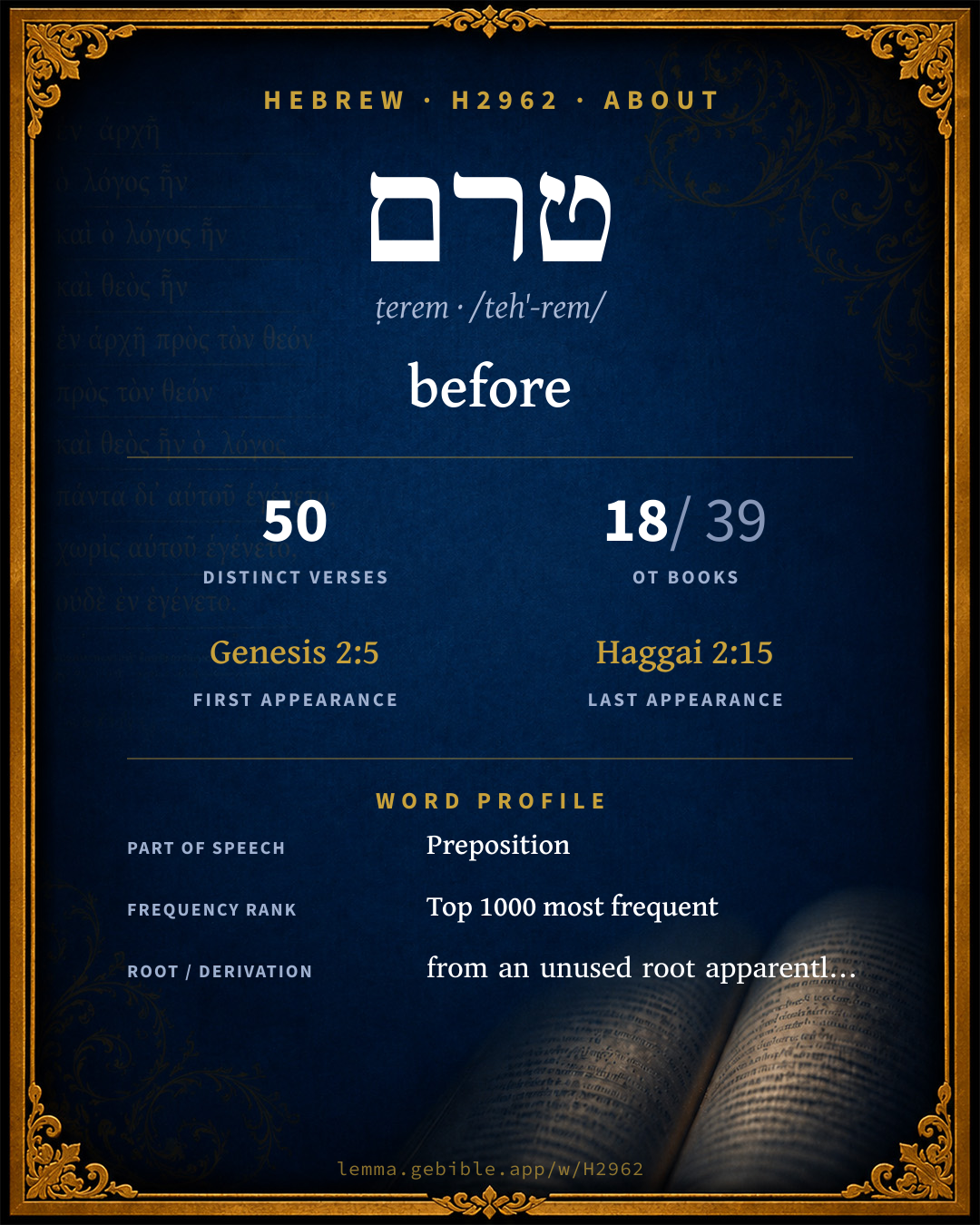
טֶ֫רֶם
before
Full lexicon entry — Brown-Driver-Briggs (BDB)
From Brown-Driver-Briggs (BDB)
Where this word appears
Grammar key — what these labels mean
Part of speech
- Adverb
- A word that modifies a verb, adjective, or other adverb.
Every verse where H2962 appears in the Book of Jeremiah — 4 distinct verses. Click any verse to open its interlinear word-by-word view. Verse text shown in the World English Bible for context — . Each verse’s Hebrew form is shown with its reference; the English is not keyword-highlighted, since the data carries no word-level English alignment. Use “Compare translations” on any verse to read it across multiple English versions. This concordance covers the Hebrew Bible; Septuagint (Greek Old Testament) occurrences are not indexed here.
Jeremiah
- Jeremiah 1:5 בְּ/טֶ֨רֶם וּ/בְ/טֶ֛רֶם prep + adv conj + prep + adv Before I formed you in the belly I knew you, and before you came forth out of the womb I sanctified you; I have appointed you a prophet to the nations.
- Jeremiah 13:16 בְּ/טֶ֣רֶם וּ/בְ/טֶ֛רֶם prep + adv conj + prep + adv Give glory to Yahweh your God, before he cause darkness, and before your feet stumble on the dark mountains, and, while you look for light, he turn it into the shadow of death, and make it gross darkness.
- Jeremiah 38:10 בְּ/טֶ֥רֶם prep + adv Then the king commanded Ebedmelech the Ethiopian, saying, Take from hence thirty men with you, and take up Jeremiah the prophet out of the dungeon, before he die.
- Jeremiah 47:1 בְּ/טֶ֛רֶם prep + adv The word of Yahweh that came to Jeremiah the prophet concerning the Philistines, before that Pharaoh struck Gaza.
About this entry
At a glance — auto-summarized from this page’s data, not written by a person. Every figure links to its source below. This summary describes the numbers; it doesn’t interpret them.
At its core, טרם (ṭerem) means “before.” First canonically at Genesis 2:5, it enters the text early. With 50 verses in 18 books, it is a moderately common word in the Hebrew Bible. From the same root come טרום. Dig into 50-verse concordance and the renderings breakdown below.
Gloss history
Strong's 1890 vs modern scholarship
About this word
Strong's H2962 catalogs a Hebrew word from the Hebrew Old Testament.
These counts are not copied from any lexicon or concordance. They are computed here, from the morphology-tagged Hebrew Old Testament. What Lemma adds →
- 50
- distinct verses
- The word appears in 50 distinct verses.
- 18 / 39
- OT books
- The word appears in 18 of 39 Old Testament books.
- #671
- by frequency
- Top 1000 most frequent Hebrew words (rank 671 of 8,640 Hebrew words by occurrence).
View all 50 occurrences in the concordance →
By section of the Old Testament
By traditional corpus
Conventional, traditional groupings — biblical authorship is debated, so this is a traditional corpus grouping, not an authorship claim. Each share is this word’s portion of its verses in that division of the Hebrew canon. Each figure is a share of the word’s 50 distinct verses.
- Prophets (Nevi'im) 24 verses · 48%
- Torah (Pentateuch) 16 verses · 32%
- Writings (Ketuvim) 10 verses · 20%
How translations render this word
Counts come from each version’s own published word-to-Strong’s tagging or interlinear alignment — an approximate guide to how each version renders this word, not a word-level alignment the data otherwise carries. Because each total is that version’s own tagged count, the per-version totals vary from one another and need not match the appearance or distinct-verse counts above. These counts may also differ from a printed concordance because Lemma counts each distinctly tagged rendering and does not collapse phrase taggings into a single head-word total. This is a fixed set of word-tagged versions (KJV, ASV, BSB, ULT) and does not change with the reading translation you choose elsewhere. Each version’s license is shown beside its name below (and on Sources).
- King James Version: Before 4×
- American Standard Version: Before 2×, Was yet 2×
- Berean Standard Bible: Before 48×
- unfoldingWord Literal Text: Before 46×, Yet 7×
King James Version Public Domain
Renders H2962 across 9 tagged occurrences — most commonly:
Plus 5 renderings that appear only once — usually multi-word phrases or single function words the recovered tagging swept in, not distinct renderings.
American Standard Version Public Domain
Renders H2962 across 9 tagged occurrences — most commonly:
Plus 5 renderings that appear only once — usually multi-word phrases or single function words the recovered tagging swept in, not distinct renderings.
Berean Standard Bible Public Domain
Renders H2962 across 53 tagged occurrences — most commonly:
Plus 5 renderings that appear only once — usually multi-word phrases or single function words the recovered tagging swept in, not distinct renderings. Not rendered by a distinct English word in 2 further occurrences.
unfoldingWord Literal Text CC BY-SA 4.0
Renders H2962 across 57 tagged occurrences — most commonly:
Plus 4 renderings that appear only once — usually multi-word phrases or single function words the recovered tagging swept in, not distinct renderings.
Senses in the full BDB
What do BDB’s symbols mean?
BDB uses these scholarly abbreviations:
| Symbol | Meaning |
|---|---|
| 𝔊 | the Septuagint (the ancient Greek translation, LXX) |
| 𝔙 | the Vulgate (the Latin translation) |
| 𝔖 | the Syriac version (the Peshitta) |
| 𝔗 | the Targum (the Aramaic translation) |
| ψ | the Psalms |
| √ | root (the underlying root or stem) |
| ‖ | parallel passage (a synonymous or contrasted parallel) |
| † | the dagger: every passage where the word occurs is cited |
The 3 senses and sub-senses the full Brown-Driver-Briggs lexicon distinguishes for this word, in lexicon order (not ranked by frequency), with BDB’s own verbatim wording and sub-sense lettering. Shown in Hebrew script with BDB’s own scholarly abbreviations. The condensed entry is in the Lexicon Entry tab. See also the Forms in the corpus table below.
- 1. †טֶרֶם in an independent sentence, not yet, Gn 2:5 and all the plants of the field טרם יהיה בארץ were not yet in the earth, etc., 19:4 טרם ישׁכבו not yet had they lain down, when etc., 24:15, 45 Nu 11:33 Jos 2:8 1 S 3:3, 7(×2); of present time, Ex 9:30; 10:7 הֲטֶרֶם תֵּדַע dost thou not yet know, etc.?; in a subord. clause, ere, before that, Ex 12:34 they took their dough טרם יחמץ before it was leavened, Jos 3:1 ψ 119:67; of future time Is 65:24. More frequently e.g. Genesis 2:5
- 2. בְּטֶרֶם39, with the same force: of past time, Gn 27:33 I ate of all בטרם תבא before thou camest, 37:18; 41:50 Ju 14:18 1 S 2:15 Je 1:5; 47:1 Ez 16:57; ψ 90:2 Pr 8:25 (both with pf.); more often of pres. or fut., as Gn 27:4 בטרם אמות before I die (so 45:28, cf. ψ 39:14 Jb 10:21), Lv 14:36 Dt 31:21 1 S 9:13 2 K 2:9 Is 7:16; 42:9; 48:5 Je 13:16; the impf. with a freq. force, Ex 1:19 before the midwife cometh, they are wont to bear, Ru 3:14 Pr 18:13. Pleon. בְּטֶרֶם לֹא Zp 2:2(×2). Construed with a subst. in the gen., †Is 17:14 בְּטֶרֶם בֹּקֶר = ere morning, 28:4 בְּטֶרֶם קַיִץ; with an inf. †Zp 2:2a (but read here with 𝔊 We בְּטֶרֶם לֹא תִהְיוּן כְּמוֹץ עֹבֵר, without יוֹם, ‘before ye become as chaff passing away’). e.g. Genesis 27:33
- 3. †מִטֶּרֶם Hg 2:15 (sq. inf.) מִטֶּרֶם שׂוּם אֶבֶן from before the laying of one stone upon another, etc. e.g. Haggai 2:15
Senses from the full Brown-Driver-Briggs lexicon (Brown, Driver, Briggs; Oxford 1906 — public domain), digitized via Sefaria, supplemented by the OpenScriptures HebrewLexicon (CC BY 4.0). Full attribution on Sources.
Word origin
once (Ru 3:14 Kt) טְרוֹם, adv. of time, not yet, ere, before that (deriv. unknown: not found in cogn. languages)—construed mostly with the impf. (with the pf. only Gn 24:15 (v 45 impf.), 1 S 3:7a (v b impf.), and בְּטֶרֶם ψ 90:2 Pr 8:25):—
— Brown-Driver-Briggs (Oxford 1906, public domain), digitized via Sefaria, supplemented by the OpenScriptures HebrewLexicon (CC BY 4.0). See Sources.
Origin: from an unused root apparently meaning to interrupt or suspend
Forms in the corpus
The 22 distinct written forms H2962 takes in the Hebrew Bible, most frequent first — each parse links to that state’s occurrences in the concordance. Hebrew forms include their vowel points and cantillation, so a single lemma takes many written forms.
| Form | Parsing | Example | Uses |
|---|---|---|---|
| בְּ/טֶ֣רֶם | Adverb | Deuteronomy 31:21 | 9 |
| בְּ/טֶ֥רֶם | Adverb | Genesis 27:4 | 9 |
| טֶ֣רֶם | Adverb | Exodus 9:30 | 6 |
| בְּ/טֶ֨רֶם | Adverb | Exodus 1:19 | 5 |
| בְּ/טֶ֨רֶם֙ | Adverb | Isaiah 8:4 | 4 |
| בְּ/טֶ֖רֶם | Adverb | 2 Kings 2:9 | 2 |
| בְּ/טֶ֛רֶם | Adverb | Jeremiah 47:1 | 2 |
| בְּ/טֶ֤רֶם | Adverb | Psalms 58:9 | 2 |
| בְּ/טֶרֶם֮ | Adverb | Ezekiel 16:57 | 2 |
| וּ/בְ/טֶ֛רֶם | Adverb | Jeremiah 1:5 | 2 |
| טֶ֖רֶם | Adverb | 1 Samuel 3:7 | 2 |
| טֶרֶם֮ | Adverb | Genesis 19:4 | 2 |
| בְּ/טֶרֶם֩ | Adverb | 1 Samuel 9:13 | 1 |
| הֲ/טֶ֣רֶם | Adverb | Exodus 10:7 | 1 |
| וְ/טֶ֛רֶם | Adverb | 1 Samuel 3:7 | 1 |
| וּ/בְ/טֶ֨רֶם֙ | Adverb | Genesis 37:18 | 1 |
| טֶ֚רֶם | Adverb | Genesis 2:5 | 1 |
| טֶ֥רֶם | Adverb | Joshua 3:1 | 1 |
| טֶ֨רֶם | Adverb | Genesis 24:45 | 1 |
| טֶֽרֶם | Adverb | Isaiah 65:24 | 1 |
| לְ/נֶ֣גֶד | Preposition | Psalms 5:5 | 1 |
| מִ/טֶּ֧רֶם | Adverb | Haggai 2:15 | 1 |
Same root — word family
Other BDB entries built from the same root as H2962, grouped by Strong’s listed origin. These share a root / origin per the lexicon — not necessarily a shared meaning. Each links to that word’s own entry.
Derived from this word
Compare all same-root words → They share a root, not necessarily a meaning.
Septuagint verse parallels
This word appears in 49 verses that also exist in the Greek Old Testament (Septuagint), out of the 50 Hebrew verses it occurs in. You can read those verses in Greek by switching the Old Testament edition to the Septuagint.
Read these verses in the Septuagint
- Genesis 2:5
- Exodus 1:19
- Leviticus 14:36
- Numbers 11:33
- Deuteronomy 31:21
- Joshua 2:8
- Judges 14:18
- Ruth 3:14
- 1 Samuel 2:15
- 2 Kings 2:9
- Job 10:21
- Psalms 5:5
This is a verse-level parallel only — the same verses exist in both the Hebrew and Greek Old Testaments. No word-level Hebrew↔Greek correspondence is claimed: the data carries no such alignment, so no Greek word is shown as this Hebrew word’s translation. Coverage is not total — the Septuagint omits the deuterocanon and renumbers the Psalms, so some Hebrew verses have no direct Greek parallel.