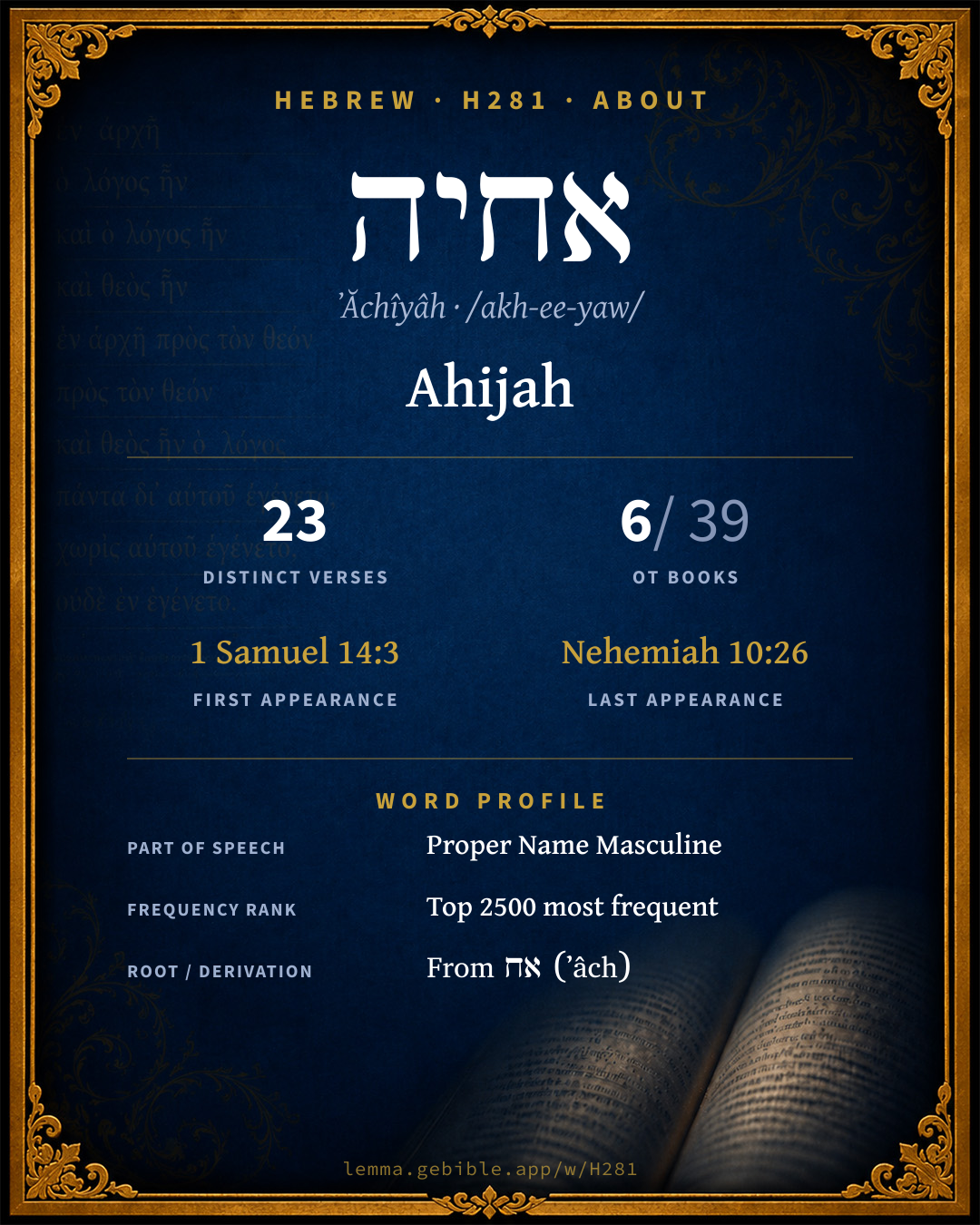
אֲחִיָּ֫הוּ
Ahijah
BDB lists 10 entries for ‘Ahijah’ fuller range ↓
Full lexicon entry — Brown-Driver-Briggs (BDB)
From Brown-Driver-Briggs (BDB)
Where this word appears
Grammar key — what these labels mean
Part of speech
- Noun
- A naming word — a person, place, thing, or idea.
Noun type
- Proper
- A name of a specific person, place, or people (e.g. Abraham, Zion, Israel).
Every verse where H281 appears in the Book of 1 Kings — 13 distinct verses. Click any verse to open its interlinear word-by-word view. Verse text shown in the World English Bible for context — . Each verse’s Hebrew form is shown with its reference; the English is not keyword-highlighted, since the data carries no word-level English alignment. Use “Compare translations” on any verse to read it across multiple English versions. This concordance covers the Hebrew Bible; Septuagint (Greek Old Testament) occurrences are not indexed here.
1 Kings
- 1 Kings 4:3 וַ/אֲחִיָּ֛ה conj + n Proper Elihoreph and Ahijah, the sons of Shisha, scribes; Jehoshaphat the son of Ahilud, the recorder;
- 1 Kings 11:29 אֲחִיָּה֩ n Proper It happened at that time, when Jeroboam went out of Jerusalem, that the prophet Ahijah the Shilonite found him in the way; now [Ahijah] had clad himself with a new garment; and they two were alone in the field.
- 1 Kings 11:30 אֲחִיָּ֔ה n Proper Ahijah laid hold of the new garment that was on him, and tore it in twelve pieces.
- 1 Kings 12:15 אֲחִיָּ֣ה n Proper So the king didn't listen to the people; for it was a thing brought about of Yahweh, that he might establish his word, which Yahweh spoke by Ahijah the Shilonite to Jeroboam the son of Nebat.
- 1 Kings 14:2 אֲחִיָּ֣ה n Proper Jeroboam said to his wife, Please get up and disguise yourself, that you not be known to be the wife of Jeroboam; and get you to Shiloh: behold, there is Ahijah the prophet, who spoke concerning me that I should be king over this people.
- 1 Kings 14:4 אֲחִיָּ֑ה וַ/אֲחִיָּ֨הוּ֙ n Proper conj + n Proper Jeroboam's wife did so, and arose, and went to Shiloh, and came to the house of Ahijah. Now Ahijah could not see; for his eyes were set by reason of his age.
- 1 Kings 14:5 אֲחִיָּ֗הוּ n Proper Yahweh said to Ahijah, Behold, the wife of Jeroboam comes to inquire of you concerning her son; for he is sick: thus and thus shall you tell her; for it will be, when she comes in, that she will feign herself to be another woman.
- 1 Kings 14:6 אֲחִיָּ֜הוּ n Proper It was so, when Ahijah heard the sound of her feet, as she came in at the door, that he said, Come in, you wife of Jeroboam; why feign you yourself to be another? for I am sent to you with heavy news.
- 1 Kings 14:18 אֲחִיָּ֥הוּ n Proper All Israel buried him, and mourned for him, according to the word of Yahweh, which he spoke by his servant Ahijah the prophet.
- 1 Kings 15:27 אֲחִיָּה֙ n Proper Baasha the son of Ahijah, of the house of Issachar, conspired against him; and Baasha struck him at Gibbethon, which belonged to the Philistines; for Nadab and all Israel were laying siege to Gibbethon.
- 1 Kings 15:29 אֲחִיָּ֥ה n Proper It happened that, as soon as he was king, he struck all the house of Jeroboam: he didn't leave to Jeroboam any who breathed, until he had destroyed him; according to the saying of Yahweh, which he spoke by his servant Ahijah the Shilonite;
- 1 Kings 15:33 אֲחִיָּ֤ה n Proper In the third year of Asa king of Judah began Baasha the son of Ahijah to reign over all Israel in Tirzah, [and reigned] twenty-four years.
- 1 Kings 21:22 אֲחִיָּ֑ה n Proper and I will make your house like the house of Jeroboam the son of Nebat, and like the house of Baasha the son of Ahijah for the provocation with which you have provoked me to anger, and have made Israel to sin.
About this entry
At a glance — auto-summarized from this page’s data, not written by a person. Every figure links to its source below. This summary describes the numbers; it doesn’t interpret them.
“Ahijah” is the headline sense of the Hebrew name אחיה (ʼĂchîyâh). More than half of its appearances fall in 1 Kings. The Hebrew Bible uses it across 23 verses — uncommon. Its earliest occurrence is 1 Samuel 14:3. See 23-verse concordance and the renderings breakdown below.
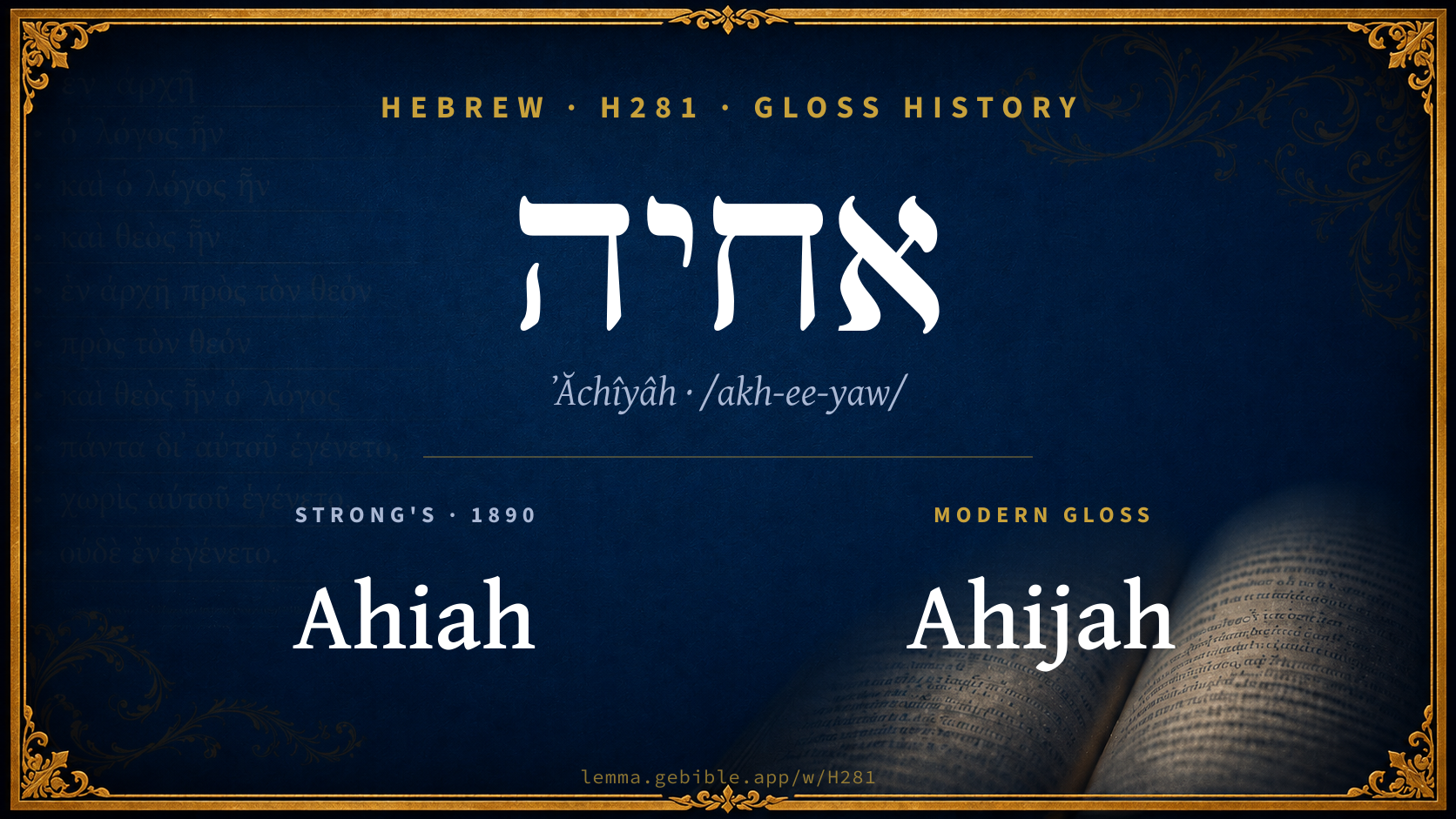
Gloss history
Strong's 1890 vs modern scholarship
About this word
Strong's H281 catalogs a Hebrew word from the Hebrew Old Testament.
These counts are not copied from any lexicon or concordance. They are computed here, from the morphology-tagged Hebrew Old Testament. What Lemma adds →
- 23
- distinct verses
- The word appears in 23 distinct verses.
- 6 / 39
- OT books
- The word appears in 6 of 39 Old Testament books.
- #1,327
- by frequency
- Top 2500 most frequent Hebrew words (rank 1,327 of 8,640 Hebrew words by occurrence).
View all 23 occurrences in the concordance →
Most concentrated in
- 1 Kings 13 verses 57%
- 1 Chronicles 4 verses 17%
- 1 Samuel 2 verses 9%
By section of the Old Testament
By traditional corpus
Conventional, traditional groupings — biblical authorship is debated, so this is a traditional corpus grouping, not an authorship claim. Each share is this word’s portion of its verses in that division of the Hebrew canon. Each figure is a share of the word’s 23 distinct verses.
- Prophets (Nevi'im) 16 verses · 70%
- Writings (Ketuvim) 7 verses · 30%
How translations render this word
Counts come from each version’s own published word-to-Strong’s tagging or interlinear alignment — an approximate guide to how each version renders this word, not a word-level alignment the data otherwise carries. Because each total is that version’s own tagged count, the per-version totals vary from one another and need not match the appearance or distinct-verse counts above. These counts may also differ from a printed concordance because Lemma counts each distinctly tagged rendering and does not collapse phrase taggings into a single head-word total. This is a fixed set of word-tagged versions (KJV, ASV, BSB, ULT) and does not change with the reading translation you choose elsewhere. Each version’s license is shown beside its name below (and on Sources).
- King James Version: Ahijah 18×, Ahiah 4×
- American Standard Version: Ahijah 20×
- Berean Standard Bible: Ahijah 20×
- unfoldingWord Literal Text: Ahijah 22×
King James Version Public Domain
Renders H281 across 24 tagged occurrences — most commonly:
Plus 2 renderings that appear only once — usually multi-word phrases or single function words the recovered tagging swept in, not distinct renderings.
American Standard Version Public Domain
Renders H281 across 24 tagged occurrences — most commonly:
Plus 4 renderings that appear only once — usually multi-word phrases or single function words the recovered tagging swept in, not distinct renderings.
Berean Standard Bible Public Domain
Renders H281 across 23 tagged occurrences — most commonly:
Plus 3 renderings that appear only once — usually multi-word phrases or single function words the recovered tagging swept in, not distinct renderings. Not rendered by a distinct English word in 1 further occurrence.
unfoldingWord Literal Text CC BY-SA 4.0
Renders H281 across 24 tagged occurrences — most commonly:
Plus 2 renderings that appear only once — usually multi-word phrases or single function words the recovered tagging swept in, not distinct renderings.
11 senses and sub-senses in the full BDB
What do BDB’s symbols mean?
BDB uses these scholarly abbreviations:
| Symbol | Meaning |
|---|---|
| 𝔊 | the Septuagint (the ancient Greek translation, LXX) |
| 𝔙 | the Vulgate (the Latin translation) |
| 𝔖 | the Syriac version (the Peshitta) |
| 𝔗 | the Targum (the Aramaic translation) |
| ψ | the Psalms |
| √ | root (the underlying root or stem) |
| ‖ | parallel passage (a synonymous or contrasted parallel) |
| † | the dagger: every passage where the word occurs is cited |
The 11 senses and sub-senses the full Brown-Driver-Briggs lexicon distinguishes for this word, in lexicon order (not ranked by frequency), with BDB’s own verbatim wording and sub-sense lettering. Shown in Hebrew script with BDB’s own scholarly abbreviations. The condensed entry is in the Lexicon Entry tab. See also the Forms in the corpus table below.
- 1. a priest 1 S 14:3, 18. e.g. 1 Samuel 14:3
- 2. a scribe 1 K 4:3. e.g. 1 Kings 4:3
- 3. a prophet 1 K 11:29, 30; 12:15; 14:2, 4; 15:29 2 Ch 9:29; 1 K 14:4, 5, 6, 18 2 Ch 10:15 (last five אֲחִיָּהוּ). e.g. 1 Kings 11:29
- 4. father of king Baasha 1 K 15:27, 33; 21:22 2 K 9:9. e.g. 1 Kings 15:27
- 5. grandson of Hezron 1 Ch 2:25, or perhaps n.pr.f., mother of preceding four, cf. Be. e.g. 1 Chronicles 2:25
- 6. son of Ehud, of Benj. 1 Ch 8:7 = אֲחוֹחַ v 4. e.g. 1 Chronicles 8:7
- 7. one of Dvd’s heroes 1 Ch 11:36. e.g. 1 Chronicles 11:36
- 8. a Levite, Dvd’s time 1 Ch 26:20. e.g. 1 Chronicles 26:20
- 9. a chief man under Nehem. Ne 10:27. e.g. Nehemiah 10:27
- 10. a Gadite 1 Ch 5:15 (אֲחִי). e.g. 1 Chronicles 5:15
- 11. a man of Asher 1 Ch 7:34 (id.) e.g. 1 Chronicles 7:34
Senses from the full Brown-Driver-Briggs lexicon (Brown, Driver, Briggs; Oxford 1906 — public domain), digitized via Sefaria, supplemented by the OpenScriptures HebrewLexicon (CC BY 4.0). Full attribution on Sources.
Word origin
† אֲחִיָּ֫הוּ, אֲחִיָּה (always, except where other form noted), אֲחִי n.pr.m. (brother of Yah(u), cf. Ph. חמלך brother of Milk, & especially אחתמלך sister of Milk, where אחת must be cstr. since מלך is a male deity; cf. Carth. חתמלקרת Euting 213).
— Brown-Driver-Briggs (Oxford 1906, public domain), digitized via Sefaria, supplemented by the OpenScriptures HebrewLexicon (CC BY 4.0). See Sources.
Derived from אח (ʼâch) (H251) — brother.
Jastrow Dictionary
A second Hebrew/Aramaic lexicon for comparison, covering Aramaic and post-biblical (Talmudic, Targumic, Midrashic) usage that the biblical-Hebrew BDB does not. Matched by lemma rather than by Strong’s number, so a lemma may carry more than one Jastrow headword (shown separately below), and the entries cover usage well beyond the Bible.
אֲחִיָּה
- (b. h.) pr. n. m. Aḥiyah, several men of various periods., several men of various periods.
- 1. Shek. V, 1 א׳ על הנסכים A. superintendent of the Temple libations (wines, oils).
- 2. Ber. 63ᵇ A., a Babylonian scholar opposing Palestine authorities.
- 3. רבי אחייה R. A., a Tannai. M. Kat. 20ᵃ; a. e. Ibid. 20ᵇ ר׳ חייא לחוד וכ׳ R. Ḥiya (although a Chald. abbreviation of Aḥiyah) and R. A. are two different persons.
A Dictionary of the Targumim, the Talmud Babli and Yerushalmi, and the Midrashic Literature (Marcus Jastrow; London, Luzac, 1903) — Public Domain. Digitized via Sefaria. Digitized via Sefaria. Full attribution on Sources.
Forms in the corpus
The 19 distinct written forms H281 takes in the Hebrew Bible, most frequent first — each parse links to that state’s occurrences in the concordance. Hebrew forms include their vowel points and cantillation, so a single lemma takes many written forms.
| Form | Parsing | Example | Uses |
|---|---|---|---|
| אֲחִיָּ֣ה | Noun, Proper | 1 Kings 12:15 | 3 |
| אֲחִיָּ֑ה | Noun, Proper | 1 Kings 14:4 | 2 |
| אֲחִיָּֽה | Noun, Proper | 1 Chronicles 2:25 | 2 |
| וַ/אֲחִיָּ֛ה | Noun, Proper | 1 Chronicles 8:7 | 2 |
| אֲחִיָּ֔ה | Noun, Proper | 1 Kings 11:30 | 1 |
| אֲחִיָּ֖ה | Noun, Proper | 1 Chronicles 11:36 | 1 |
| אֲחִיָּ֗ה | Noun, Proper | 1 Chronicles 26:20 | 1 |
| אֲחִיָּ֗הוּ | Noun, Proper | 1 Kings 14:5 | 1 |
| אֲחִיָּ֜הוּ | Noun, Proper | 1 Kings 14:6 | 1 |
| אֲחִיָּ֣הוּ | Noun, Proper | 2 Chronicles 10:15 | 1 |
| אֲחִיָּ֤ה | Noun, Proper | 1 Kings 15:33 | 1 |
| אֲחִיָּ֥ה | Noun, Proper | 1 Kings 15:29 | 1 |
| אֲחִיָּ֥הוּ | Noun, Proper | 1 Kings 14:18 | 1 |
| אֲחִיָּה֙ | Noun, Proper | 1 Kings 15:27 | 1 |
| אֲחִיָּה֩ | Noun, Proper | 1 Kings 11:29 | 1 |
| וַ/אֲחִיָּ֣ה | Noun, Proper | 1 Samuel 14:3 | 1 |
| וַ/אֲחִיָּ֥ה | Noun, Proper | Nehemiah 10:26 | 1 |
| וַ/אֲחִיָּ֨הוּ֙ | Noun, Proper | 1 Kings 14:4 | 1 |
| לַֽ/אֲחִיָּ֔ה | Noun, Proper | 1 Samuel 14:18 | 1 |
Same root — word family
Other BDB entries built from the same root as H281, grouped by Strong’s listed origin. These share a root / origin per the lexicon — not necessarily a shared meaning. Each links to that word’s own entry.
Derives from
Shares the same root
Proper names from this root
People and places named from this root — a name, not an additional meaning of the word.
- אחאב ʼAchʼâb H256 Ahab
- אחבן ʼAchbân H257 Ahban
- אחוח ʼĂchôwach H265 Ahoah
- אחומי ʼĂchûwmay H267 Ahumai
- אחי ʼĂchîy H277 Ahi
- אחיאם ʼĂchîyʼâm H279 Ahiam
- אחיהוד ʼĂchîyhûwd H282 Ahihud
- אחיו ʼAchyôw H283 Ahio
- אחיחד ʼĂchîychud H284 Ahihud
- אחיטוב ʼĂchîyṭûwb H285 Ahitub
- אחילוד ʼĂchîylûwd H286 Ahilud
- אחימות ʼĂchîymôwth H287 Ahimoth
- אחימלך ʼĂchîymelek H288 Ahimelech
- אחימן ʼĂchîyman H289 Ahiman
- אחימעץ ʼĂchîymaʻats H290 Ahimaaz
- אחין ʼAchyân H291 Ahian
- אחינדב ʼĂchîynâdâb H292 Ahinadab
- אחינעם ʼĂchîynôʻam H293 Ahinoam
- אחיסמך ʼĂchîyçâmâk H294 Ahisamach
- אחיעזר ʼĂchîyʻezer H295 Ahiezer
- אחיקם ʼĂchîyqâm H296 Ahikam
- אחירם ʼĂchîyrâm H297 Ahiram
- אחירע ʼĂchîyraʻ H299 Ahira
- אחישחר ʼĂchîyshachar H300 Ahishahar
+2 more proper names from this root (not shown).
Compare all same-root words → Showing 4 of 31 — not the complete family. 26 of the same-root words are proper names (people or places). They share a root, not necessarily a meaning.
Bible dictionary
Public-domain dictionary articles matched to this entry by name (Ahijah). A biblical name can be shared by more than one person or place, so an article may treat several.
Easton's Bible Dictionary · M. G. Easton, 1897
Brother (i.e., "friend") of Jehovah. (1.) One of the sons of Bela (1 Chr. 8:7, R.V.). In A.V. called "Ahiah."
(2.) One of the five sons of Jerahmeel, who was great-grandson of Judah (1 Chr. 2:25).
(3.) Son of Ahitub (1 Sam. 14:3, 18), Ichabod's brother; the same probably as Ahimelech, who was high priest at Nob in the reign of Saul (1 Sam. 22:11). Some, however, suppose that Ahimelech was the brother of Ahijah, and that they both officiated as high priests, Ahijah at Gibeah or Kirjath-jearim, and Ahimelech at Nob.
(4.) A Pelonite, one of David's heroes (1 Chr. 11:36); called also Eliam (2 Sam. 23:34).
(5.) A Levite having charge of the sacred treasury in the temple (1 Chr. 26:20).
(6.) One of Solomon's secretaries (1 Kings 4:3).
(7.) A prophet of Shiloh (1 Kings 11:29; 14:2), called the "Shilonite," in the days of Rehoboam. We have on record two of his remarkable prophecies, 1 Kings 11:31-39, announcing the rending of the ten tribes from Solomon; and 1 Kings 14:6-16, delivered to Jeroboam's wife, foretelling the death of Abijah the king's son, the destruction of Jeroboam's house, and the captivity of Israel "beyond the river." Jeroboam bears testimony to the high esteem in which he was held as a prophet of God (1 Kings 14:2, 3).
Smith's Bible Dictionary · William Smith, 1863
[Ahiah, Or Ahijah]
Hitchcock's Bible Names Dictionary · Roswell D. Hitchcock, 1869
same with Ahiah
Classic public-domain reference works; full attribution on Sources.
Septuagint verse parallels
This word appears in 21 verses that also exist in the Greek Old Testament (Septuagint), out of the 23 Hebrew verses it occurs in. You can read those verses in Greek by switching the Old Testament edition to the Septuagint.
Read these verses in the Septuagint
This is a verse-level parallel only — the same verses exist in both the Hebrew and Greek Old Testaments. No word-level Hebrew↔Greek correspondence is claimed: the data carries no such alignment, so no Greek word is shown as this Hebrew word’s translation. Coverage is not total — the Septuagint omits the deuterocanon and renumbers the Psalms, so some Hebrew verses have no direct Greek parallel.