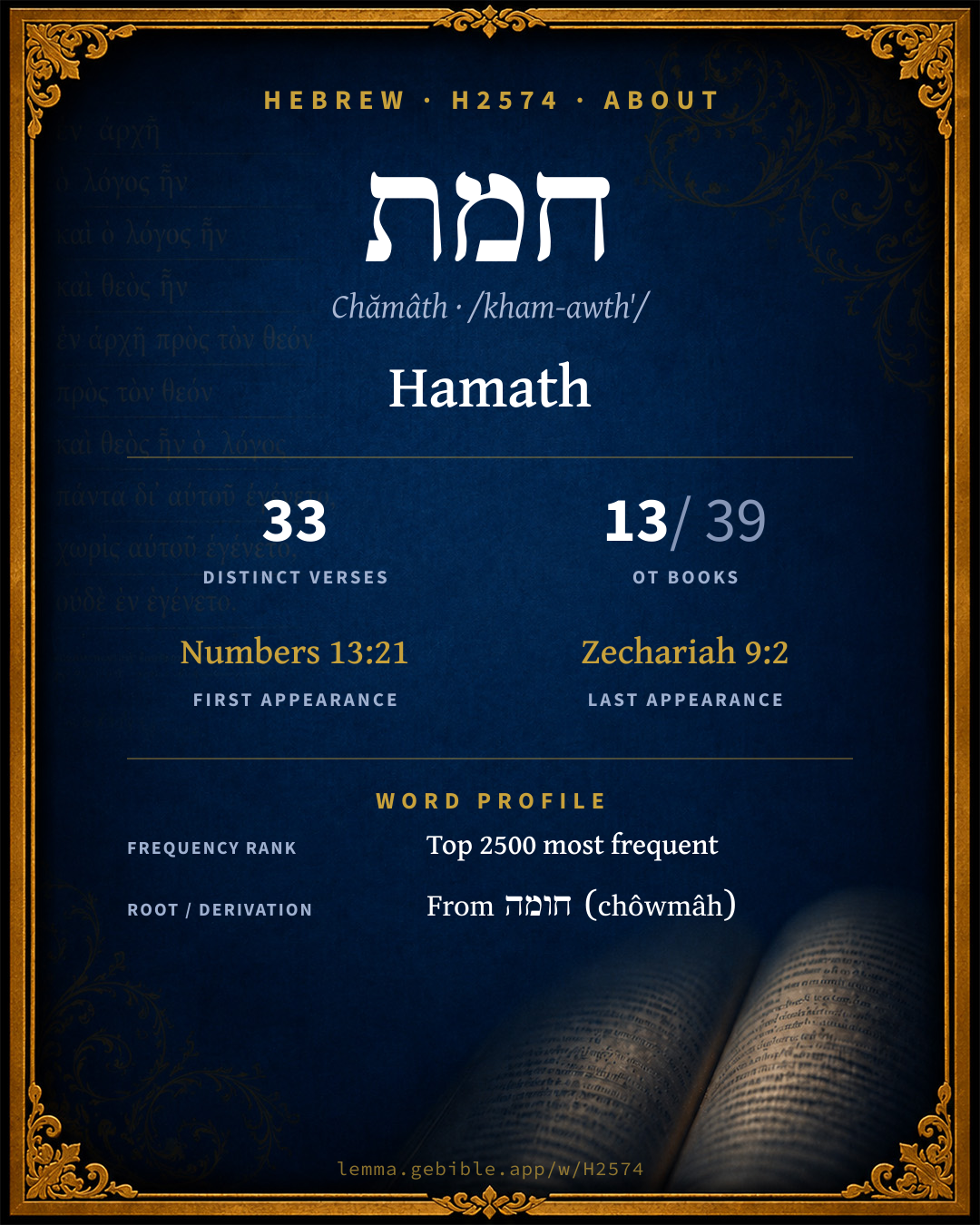
חֲמָת
Hamath
BDB lists 3 entries for ‘Hamath’ fuller range ↓
Full lexicon entry — Brown-Driver-Briggs (BDB)
From Brown-Driver-Briggs (BDB)
Where this word appears
Grammar key — what these labels mean
Part of speech
- Noun
- A naming word — a person, place, thing, or idea.
Noun type
- Proper
- A name of a specific person, place, or people (e.g. Abraham, Zion, Israel).
Every verse where H2574 appears in the Book of 1 Chronicles — 3 distinct verses. Click any verse to open its interlinear word-by-word view. Verse text shown in the World English Bible for context — . Each verse’s Hebrew form is shown with its reference; the English is not keyword-highlighted, since the data carries no word-level English alignment. Use “Compare translations” on any verse to read it across multiple English versions. This concordance covers the Hebrew Bible; Septuagint (Greek Old Testament) occurrences are not indexed here.
1 Chronicles
- 1 Chronicles 13:5 חֲמָ֑ת n Proper So David assembled all Israel together, from the Shihor [the brook] of Egypt even to the entrance of Hamath, to bring the ark of God from Kiriath Jearim.
- 1 Chronicles 18:3 חֲמָ֑תָ/ה n Proper + sfx dem David struck Hadarezer king of Zobah to Hamath, as he went to establish his dominion by the river Euphrates.
- 1 Chronicles 18:9 חֲמָ֑ת n Proper When Tou king of Hamath heard that David had struck all the host of Hadarezer king of Zobah,
About this entry
At a glance — auto-summarized from this page’s data, not written by a person. Every figure links to its source below. This summary describes the numbers; it doesn’t interpret them.
At its core, חמת (Chămâth) means “Hamath.” It first appears in Numbers 13:21. Spanning 33 verses in 13 books, it ranks among the moderately common words of the Hebrew Bible. Dig into 33-verse concordance and the renderings breakdown below.
Gloss history
Strong's 1890 vs modern scholarship
About this word
Strong's H2574 catalogs a Hebrew word from the Hebrew Old Testament.
These counts are not copied from any lexicon or concordance. They are computed here, from the morphology-tagged Hebrew Old Testament. What Lemma adds →
- 33
- distinct verses
- The word appears in 33 distinct verses.
- 13 / 39
- OT books
- The word appears in 13 of 39 Old Testament books.
- #1,023
- by frequency
- Top 2500 most frequent Hebrew words (rank 1,023 of 8,640 Hebrew words by occurrence).
View all 33 occurrences in the concordance →
By section of the Old Testament
By traditional corpus
Conventional, traditional groupings — biblical authorship is debated, so this is a traditional corpus grouping, not an authorship claim. Each share is this word’s portion of its verses in that division of the Hebrew canon. Each figure is a share of the word’s 33 distinct verses.
- Prophets (Nevi'im) 26 verses · 79%
- Writings (Ketuvim) 5 verses · 15%
- Torah (Pentateuch) 2 verses · 6%
How translations render this word
Counts come from each version’s own published word-to-Strong’s tagging or interlinear alignment — an approximate guide to how each version renders this word, not a word-level alignment the data otherwise carries. Because each total is that version’s own tagged count, the per-version totals vary from one another and need not match the appearance or distinct-verse counts above. These counts may also differ from a printed concordance because Lemma counts each distinctly tagged rendering and does not collapse phrase taggings into a single head-word total. This is a fixed set of word-tagged versions (KJV, ASV, BSB, ULT) and does not change with the reading translation you choose elsewhere. Each version’s license is shown beside its name below (and on Sources).
- King James Version: Hamath 32×, Hemath 3×
- American Standard Version: Hamath 33×
- Berean Standard Bible: Hamath 23×, Lebo-hamath 7×
- unfoldingWord Literal Text: Hamath 28×, Lebo hamath 3×
King James Version Public Domain
Renders H2574 across 37 tagged occurrences — most commonly:
Plus 2 renderings that appear only once — usually multi-word phrases or single function words the recovered tagging swept in, not distinct renderings.
American Standard Version Public Domain
Renders H2574 across 37 tagged occurrences — most commonly:
Plus 4 renderings that appear only once — usually multi-word phrases or single function words the recovered tagging swept in, not distinct renderings.
Berean Standard Bible Public Domain
Renders H2574 across 31 tagged occurrences — most commonly:
Plus 1 rendering that appears only once — usually multi-word phrases or single function words the recovered tagging swept in, not distinct renderings. Not rendered by a distinct English word in 4 further occurrences.
unfoldingWord Literal Text CC BY-SA 4.0
Renders H2574 across 31 tagged occurrences — most commonly:
Senses in BDB
The 3 senses BDB distinguishes for this word, in lexicon order (not ranked by frequency or importance). The full entry — with sub-senses — is in the Lexicon Entry tab.
- Hamath = "fortress"
- the principle city of upper Syria in the valley of the Orontes (noun proper locative)
- father of the house of Rechab (noun proper masculine)
Word origin
n.pr.loc. (√ dub.; Thes MV al. der. from חָמָה, חֲמָת = fortress, or (v. RSSem i, 140), sacred enclosure, temenos, ḥimā, cf. HalJAS 7 ème Sér. x, 392 LagBN 82, 156; but no certainty that name is Shemitic; Arabic حَمَاة, Assyrian Amattu, DlPA 275 ff. Pr 174);—mod. Ḥamâ, on el-ʿÂṣi (Orontes), 38 h. (c. 115 m.) N. of Damascus, v. BdPal. 398 f. It had a king, תֹּעִי, in David’s time 2 S 8:9 = 1 Ch 18:9, and in 8th cent. b.c. 2 K 19:13 = Is 37:13; gods of its own 2 K 17:30; 18:34 = Is 36:19; gave its name to land (limits unknown) רִבְלָה בְּאֶרֶץ ח׳ 2 K 23:33; 25:21 Je 39:5; 52:9, 27, cf. 2 Ch 8:4; contained Isr. exiles Is 11:11; furnished colonists for Samaria 2 K 17:24 (cf. v 30 supr.) after being conquered by Sargon, (COT 2 K 17:24; 18:34 cf. Is 10:9). It is called great Hamath by Am 6:2 (חֲמַת רַבָּה,—חֲמַת only here). ח׳ is mentioned with דַּמֶּשֶׂק, צֹר, צִידוֹן in prophecy against land Hadrach (חַדְרָךְ) Zc 9:2, cf. Je 49:23. Often in phr. לְבֹא ח׳ (עַד־) = the entrance to H., i.e. the approach to H., as territorial limit Ju 3:3; usually as denoting (ideal) northern limit of Isr. territory Jos 13:5; Nu 13:21; 24:8; Am 6:14; 1 K 8:65 = 2 Ch 7:8, 2 K 14:25 1 Ch 13:5; חֲמָ֑תָה 1 Ch 18:3; ח׳ צובָה 2 Ch 8:3, and הֵשִׁיב אֶת־דַּמֶּשֶׂק וְאֶת־ח׳ לִיחוּדָה 2 K 14:28; so also Ez 47, 48: גְּבוּל ח׳ Ez 47:17, cf. v 16b + v 16a (del. Co); לְבוֹא ח׳ 48:1, cf. 47:20; אֶל־יַד ח׳ 48:1.
— Brown-Driver-Briggs (Oxford 1906, public domain), digitized via Sefaria, supplemented by the OpenScriptures HebrewLexicon (CC BY 4.0). See Sources.
Derived from חומה (chôwmâh) (H2346) — wall.
Jastrow Dictionary
A second Hebrew/Aramaic lexicon for comparison, covering Aramaic and post-biblical (Talmudic, Targumic, Midrashic) usage that the biblical-Hebrew BDB does not. Matched by lemma rather than by Strong’s number, so a lemma may carry more than one Jastrow headword (shown separately below), and the entries cover usage well beyond the Bible.
חֵמֶת
- (b. h.) the skin of a goat drawn off the body without opening the belly and sewed up and pitched at the ends where the legs and the tail were cut off (v. Sm. Bible Dict. s. v. Bottle), bottle, bag. Kel. XIX, 8 הח׳ שבצים וכ׳ a bottle (of a skin of a he-goat) whose scrotum (originally made to receive liquids in connection with the bottle) became defective. Ib. XX, 2 חֵמַת חלילין bag of the bagpipe (ascaula). Ib. XXVIII, 5 ח׳ שעשאה שטיח a closed up pouched skin which (by cutting open) was made a spread skin. Sabb. 152ᵃ a woman is ח׳ מלא דם(!) a bag full of blood (v. vers. Ms. O. in Rabb. D. S. a. l. note 7). Tosef. Kel. B. Kam. VI, 13. Ib. VII, 11 הח׳ מעור הדג a bag made of the skin of a fish. Y. Ab. Zar. IV, end, 44ᵇ bot. בחֶמְתּוֹ (not מח׳) in his wine bottle; a. fr.—Pl. חֲמָתוֹת. Kel. XXVI, 4 (5) כל ח׳ Mish. ed. (Talm. ed. כלי, corr. acc.); Men. 37ᵇ. Ḥull. 107ᵇ בבלאי ח׳ with pieces of goat skins wrapt around their hands (like gloves).—Midr. Till. to Ps. CXXXVII חֵמוֹת.
חַמָּת
- Ḥammath, name of a demon (fever, cmp. חֵימְתָא). Snh. 101ᵃ זיקא דח׳ וכ׳ the blast (breath; Ms. M. ריקא the spittle) of Ḥ. do I see in thy face (an eruption).
חַמַּת
- , constr. of חַמָּה heat of; מֵחַ׳ through the heat of, from the effect of, in consequence of. B. Mets. VI, 3 מח׳ המעלה overcome by heat through the exertion of climbing up the ascent. Ḥull. 4ᵇ מתו אחיו מח׳ מילה his brothers had died in consequence of the circumcision. Nidd. 36ᵇ מח׳ עצמה spontaneously; מח׳ ולד in consequence of travailing; מח׳ אונס from an accidental cause; a. fr.—(Also in Chald. phraseology) Targ. II, Esth. VII, 9 מחמת ד־ (ed. Lag. מהֵימַת) because they take &c.—B. Kam. 114ᵃ כל אונסא דאתי מֵחַמְתֵיה any injury that may arise from his action (of selling). Ab. Zar. 15ᵃ אזל מחמתיה (the animal) moves at his instance; a. fr. e.g. Esther 7:9
חֲמֵת
- (v. חֵמְתָא) to get hot, angry. [חמת־, to see, v. חֲמִי.]
- to make angry. Targ. Prov. XX, 2 מְחַמֵּית (Var. מַחְמֵית).
חֲמָת
- (b. h.) Hamath, a Syrian city, near the later Antiochia. Targ. O. Num. XIII, 21 (Y. אנטוכיא); ib. XXXIV, 8 (Y. טיבריא, v. חַמְּתָא); a. fr.—Num. R. s. 10 (ref. to Am. VI, 2) זו חֲמת אנטוכיא that is H. near Antiochia (Yalk. Am. 545 זה אנט׳). e.g. Amos 6:2
חַמַּת ²
- (b. h.) Hammath, v. חַמְּתָא.
A Dictionary of the Targumim, the Talmud Babli and Yerushalmi, and the Midrashic Literature (Marcus Jastrow; London, Luzac, 1903) — Public Domain. Digitized via Sefaria. Digitized via Sefaria. Full attribution on Sources.
Forms in the corpus
The 14 distinct written forms H2574 takes in the Hebrew Bible, most frequent first — each parse links to that state’s occurrences in the concordance. Hebrew forms include their vowel points and cantillation, so a single lemma takes many written forms.
| Form | Parsing | Example | Uses |
|---|---|---|---|
| חֲמָ֑ת | Noun, Proper | Ezekiel 47:16 | 11 |
| חֲמָ֖ת | Noun, Proper | Amos 6:14 | 5 |
| חֲמָת֙ | Noun, Proper | 2 Kings 19:13 | 4 |
| חֲמָ֔ת | Noun, Proper | Ezekiel 48:1 | 3 |
| חֲמָֽת | Noun, Proper | Joshua 13:5 | 3 |
| בַּ/חֲמָֽת | Noun, Proper | 2 Chronicles 8:4 | 1 |
| וּ/מֵ֣/חֲמָ֔ת | Noun, Proper | Isaiah 11:11 | 1 |
| וּ/מֵֽ/חֲמָת֙ | Noun, Proper | 2 Kings 17:24 | 1 |
| חֲמָ֑תָ/ה | Noun, Proper | 1 Chronicles 18:3 | 1 |
| חֲמָ֛ת | Noun, Proper | 2 Kings 14:28 | 1 |
| חֲמָ֜ת | Noun, Proper | 2 Kings 18:34 | 1 |
| חֲמָ֡ת | Noun, Proper | Ezekiel 48:1 | 1 |
| חֲמָ֣ת | Noun, Proper | 1 Kings 8:65 | 1 |
| חֲמָ֤ת | Noun, Proper | Ezekiel 47:16 | 1 |
Same root — word family
Other BDB entries built from the same root as H2574, grouped by Strong’s listed origin. These share a root / origin per the lexicon — not necessarily a shared meaning. Each links to that word’s own entry.
Derives from
Shares the same root
Proper names from this root
People and places named from this root — a name, not an additional meaning of the word.
- חמתי Chămâthîy H2577 Hamathite
- חמת צובה Chămath Tsôwbâh H2578 Hamath-zobah
- חמת רבה Chămath Rabbâh H2579 Hamath-rabbah
Compare all same-root words → Showing 4 of 8 — not the complete family. 3 of the same-root words are proper names (people or places). They share a root, not necessarily a meaning.
Bible dictionary
Public-domain dictionary articles matched to this entry by name (Hamath). A biblical name can be shared by more than one person or place, so an article may treat several.
Easton's Bible Dictionary · M. G. Easton, 1897
Fortress, the capital of one of the kingdoms of Upper Syria of the same name, on the Orontes, in the valley of Lebanon, at the northern boundary of Palestine (Num. 13:21; 34:8), at the foot of Hermon (Josh. 13:5) towards Damascus (Zech. 9:2; Jer. 49:23). It is called "Hamath the great" in Amos 6:2, and "Hamath-zobah" in 2 Chr. 8:3.
Hamath, now Hamah, had an Aramaean population, but Hittite monuments discovered there show that it must have been at one time occupied by the Hittites. It was among the conquests of the Pharaoh Thothmes III. Its king, Tou or Toi, made alliance with David (2 Sam. 8:10), and in B.C. 740 Azariah formed a league with it against Assyria. It was, however, conquered by the Assyrians, and its nineteen districts placed under Assyrian governors. In B.C. 720 it revolted under a certain Yahu-bihdi, whose name, compounded with that of the God of Israel (Yahu), perhaps shows that he was of Jewish origin. But the revolt was suppressed, and the people of Hamath were transported to Samaria (2 Kings 17:24, 30), where they continued to worship their god Ashima. Hamah is beautifully situated on the Orontes, 32 miles north of Emesa, and 36 south of the ruins of Assamea.
The kingdom of Hamath comprehended the great plain lying on both banks of the Orontes from the fountain near Riblah to Assamea on the north, and from Lebanon on the west to the desert on the east. The "entrance of Hamath" (Num. 34:8), which was the north boundary of Palestine, led from the west between the north end of Lebanon and the Nusairiyeh mountains.
Smith's Bible Dictionary · William Smith, 1863
(fortress), the principal city of upper Syria, was situated in the valley of the Orontes, which it commanded from the low screen of hills which forms the water-shed between the source of the Orontes and Antioch. The Hamathites were a Hamitic race, and are included among the descendants of Canaan. (Genesis 10:18) Nothing appears of the power of Hamath until the time of David. (2 Samuel 8:9) Hamath seems clearly to have been included in the dominions of Solomon. (1 Kings 4:21-24) The "store-cities" which Solomon "built in Hamath," (2 Chronicles 8:4) were perhaps staples for trade. In the Assyrian inscriptions of the time of Ahab (B.C. 900) Hamath appears as a separate power, in alliance with the Syrians of Damascus, the Hittites and the Phoenicians. About three-quarters of a century later Jeroboam the Second "recovered Hamath." (2 Kings 14:28) Soon afterwards the Assyrians took it, (2 Kings 18:34; 19:13) etc., and from this time it ceased to be a place of much importance. Antiochus Epiphanes changed its name to Epiphaneia. The natives, however, called it Hamath even in St. Jerome's time, and its present name, Hamah, is but slightly altered from the ancient form.
Hitchcock's Bible Names Dictionary · Roswell D. Hitchcock, 1869
anger; heat; a wall
Classic public-domain reference works; full attribution on Sources.
Septuagint verse parallels
This word appears in 32 verses that also exist in the Greek Old Testament (Septuagint), out of the 33 Hebrew verses it occurs in. You can read those verses in Greek by switching the Old Testament edition to the Septuagint.
Read these verses in the Septuagint
- Numbers 13:21
- Joshua 13:5
- Judges 3:3
- 2 Samuel 8:9
- 1 Kings 8:65
- 2 Kings 14:25
- 1 Chronicles 13:5
- 2 Chronicles 7:8
- Isaiah 10:9
- Jeremiah 39:5
- Ezekiel 47:16
- Amos 6:14
This is a verse-level parallel only — the same verses exist in both the Hebrew and Greek Old Testaments. No word-level Hebrew↔Greek correspondence is claimed: the data carries no such alignment, so no Greek word is shown as this Hebrew word’s translation. Coverage is not total — the Septuagint omits the deuterocanon and renumbers the Psalms, so some Hebrew verses have no direct Greek parallel.