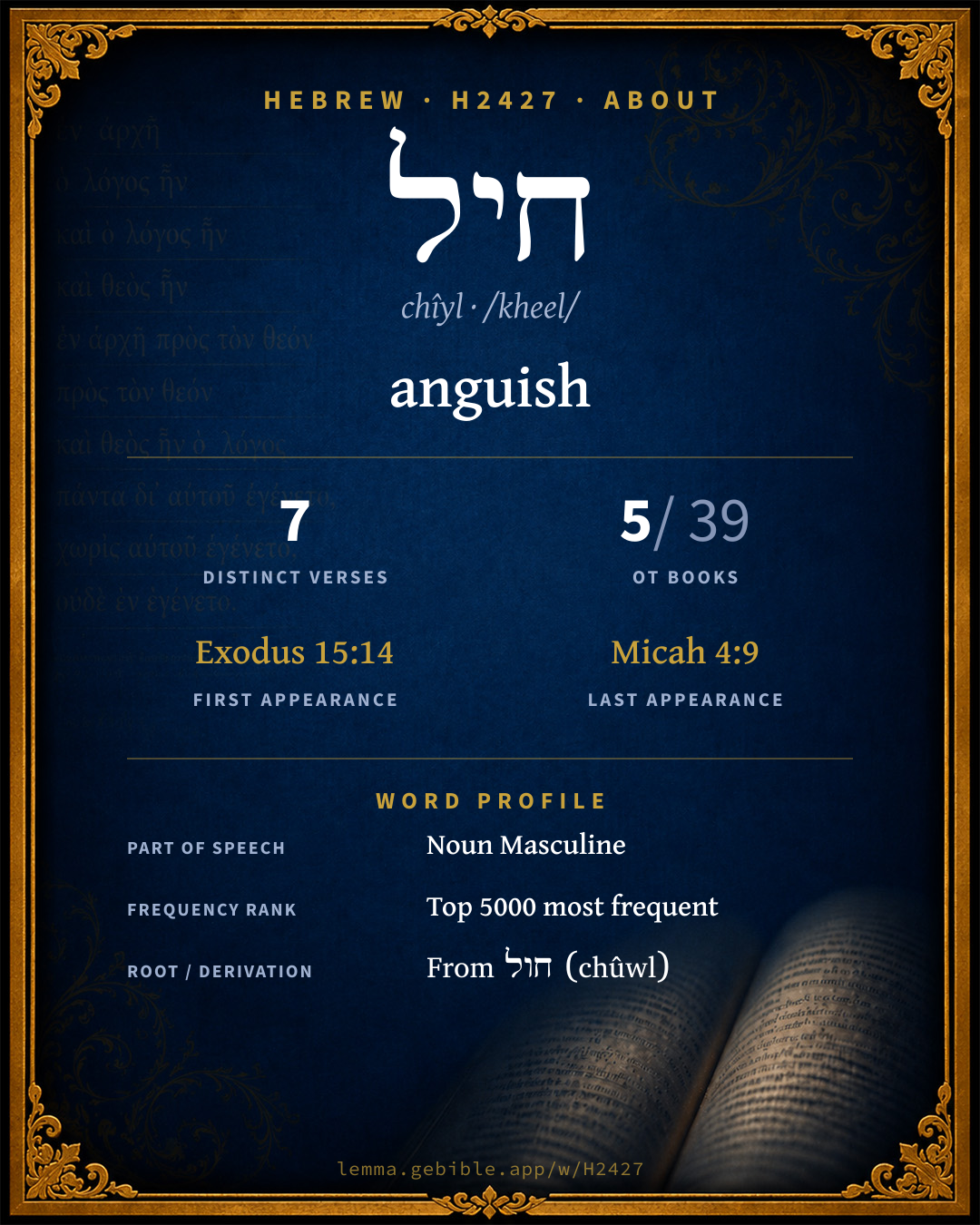
חִיל
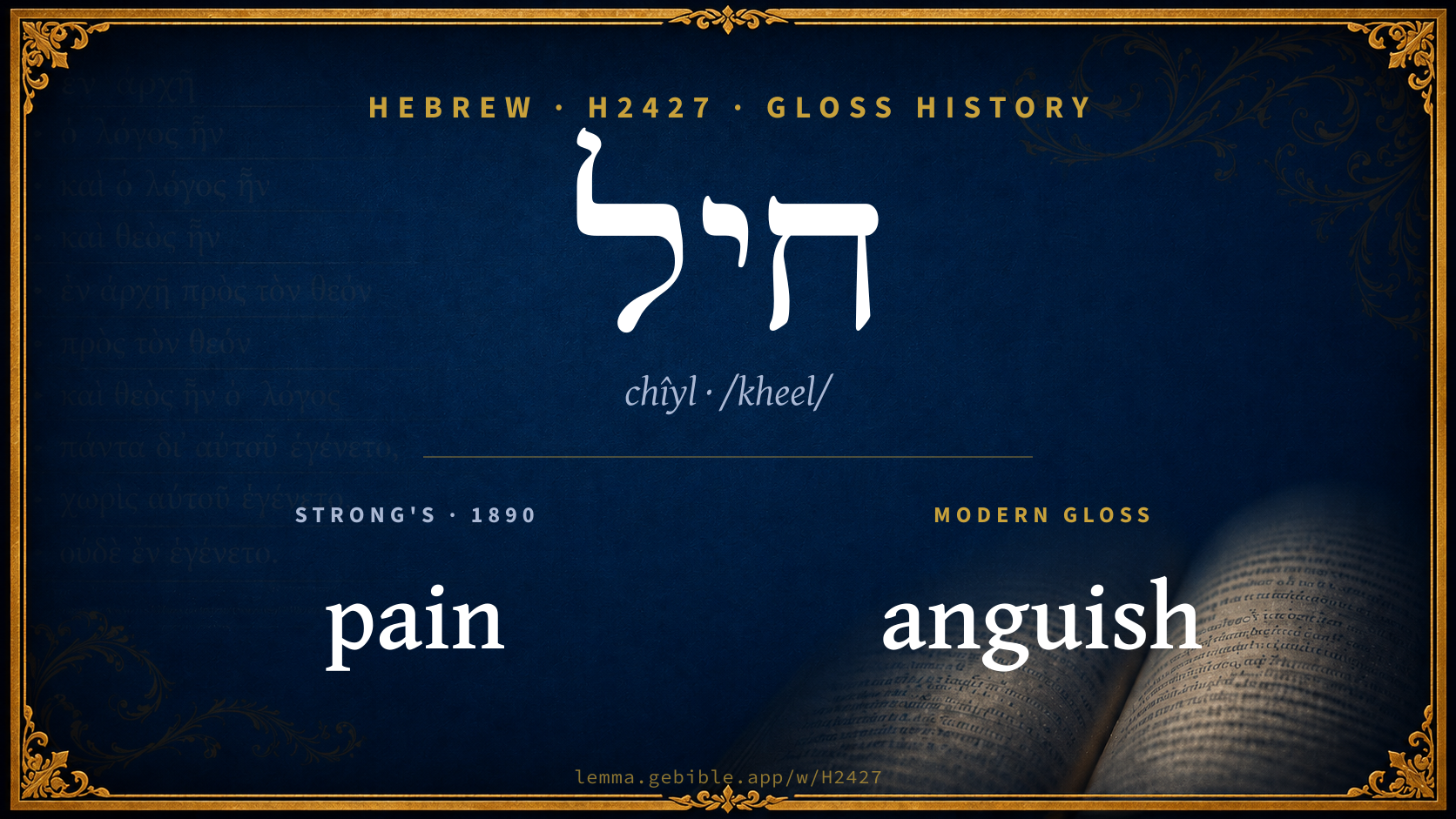
anguish
also: pain, agony, sorrow, a writhing fuller range ↓
Full lexicon entry — Brown-Driver-Briggs (BDB)
From Brown-Driver-Briggs (BDB)
Where this word appears
Grammar key — what these labels mean
Part of speech
- Noun
- A naming word — a person, place, thing, or idea.
Noun type
- Common
- A common noun — a general class of person, place, or thing (“king,” “city,” “water”), not a specific name.
State
- Absolute
- The independent form of a noun, not bound to a following word.
Gender
- Masculine
- Grammatically masculine.
- Feminine
- Grammatically feminine.
Number
- Singular
- One.
Every verse where H2427 appears in the Book of Job — 1 distinct verse. Click any verse to open its interlinear word-by-word view. Verse text shown in the World English Bible for context — . Each verse’s Hebrew form is shown with its reference; the English is not keyword-highlighted, since the data carries no word-level English alignment. Use “Compare translations” on any verse to read it across multiple English versions. This concordance covers the Hebrew Bible; Septuagint (Greek Old Testament) occurrences are not indexed here.
Job
About this entry
At a glance — auto-summarized from this page’s data, not written by a person. Every figure links to its source below. This summary describes the numbers; it doesn’t interpret them.
At its core, חיל (chîyl) means “anguish.” First canonically at Exodus 15:14, it enters the text early. With 7 verses in 5 books, it is an uncommon word in the Hebrew Bible. Its uses concentrate in Jeremiah (43% of all occurrences). Not a single-sense word: its full sense range also takes in “pain”, “agony”, and “sorrow”. Dig into 7-verse concordance and the renderings breakdown below.
Gloss history
Strong's 1890 vs modern scholarship
About this word
Strong's H2427 catalogs a Hebrew word from the Hebrew Old Testament.
These counts are not copied from any lexicon or concordance. They are computed here, from the morphology-tagged Hebrew Old Testament. What Lemma adds →
- 7
- distinct verses
- The word appears in 7 distinct verses.
- 5 / 39
- OT books
- The word appears in 5 of 39 Old Testament books.
- #2,835
- by frequency
- Top 5000 most frequent Hebrew words (rank 2,835 of 8,640 Hebrew words by occurrence).
View all 7 occurrences in the concordance →
By section of the Old Testament
By traditional corpus
Conventional, traditional groupings — biblical authorship is debated, so this is a traditional corpus grouping, not an authorship claim. Each share is this word’s portion of its verses in that division of the Hebrew canon. Each figure is a share of the word’s 7 distinct verses.
- Prophets (Nevi'im) 4 verses · 57%
- Writings (Ketuvim) 2 verses · 29%
- Torah (Pentateuch) 1 verse · 14%
How translations render this word
Counts come from each version’s own published word-to-Strong’s tagging or interlinear alignment — an approximate guide to how each version renders this word, not a word-level alignment the data otherwise carries. Because each total is that version’s own tagged count, the per-version totals vary from one another and need not match the appearance or distinct-verse counts above. These counts may also differ from a printed concordance because Lemma counts each distinctly tagged rendering and does not collapse phrase taggings into a single head-word total. This is a fixed set of word-tagged versions (KJV, ASV, BSB, ULT) and does not change with the reading translation you choose elsewhere. Each version’s license is shown beside its name below (and on Sources).
BDB lists this Strong’s number as 5 distinct words (homographs). Each count above pools all of them and is not split by sense — see the Senses section below. A low-frequency rendering may belong to a different one of those words, not the primary meaning.
- King James Version†: Pain 2×, Pangs 2×
- American Standard Version†: Pangs 2×
- Berean Standard Bible†: Anguish 3×, Pain 3×
- unfoldingWord Literal Text†: Pain 4×, Anguish 2×
King James Version Public Domain
Renders H2427 across 7† tagged occurrences — most commonly:
Plus 3 renderings that appear only once — usually multi-word phrases or single function words the recovered tagging swept in, not distinct renderings.
American Standard Version Public Domain
Renders H2427 across 8† tagged occurrences — most commonly:
Plus 6 renderings that appear only once — usually multi-word phrases or single function words the recovered tagging swept in, not distinct renderings.
Berean Standard Bible Public Domain
Renders H2427 across 7† tagged occurrences — most commonly:
Plus 1 rendering that appears only once — usually multi-word phrases or single function words the recovered tagging swept in, not distinct renderings.
unfoldingWord Literal Text CC BY-SA 4.0
Renders H2427 across 6† tagged occurrences — most commonly:
23 senses and sub-senses in the full BDB
Hebrew verbs can shift meaning by stem (binyan): Qal is the basic action, Niphal is often passive or reflexive, Piel often intensifies or makes it factitive, and Hiphil is typically causative. The senses below are grouped under the stem BDB assigns to each. This entry also uses one or more reduplicated stems (the Pōlēl/Pilpēl type), which for hollow or geminate roots behave much like Piel — often intensive or iterative.
What do BDB’s symbols mean?
BDB uses these scholarly abbreviations:
| Symbol | Meaning |
|---|---|
| 𝔊 | the Septuagint (the ancient Greek translation, LXX) |
| 𝔙 | the Vulgate (the Latin translation) |
| 𝔖 | the Syriac version (the Peshitta) |
| 𝔗 | the Targum (the Aramaic translation) |
| ψ | the Psalms |
| √ | root (the underlying root or stem) |
| ‖ | parallel passage (a synonymous or contrasted parallel) |
| † | the dagger: every passage where the word occurs is cited |
The 23 senses and sub-senses the full Brown-Driver-Briggs lexicon distinguishes for this word, in lexicon order (not ranked by frequency), with BDB’s own verbatim wording and sub-sense lettering. Shown in Hebrew script with BDB’s own scholarly abbreviations. The condensed entry is in the Lexicon Entry tab. See also the Forms in the corpus table below.
חיל I [חִיל] vb. whirl, dance, writhe (NH, Aramaic id., dance
Qal
- Pf. 3 fs. חָ֫לָה Mi 1:12 + 2 times; וְחָלָה֫ consec. Ho 11:6; חַלְתִּי Is 23:4; חָ֫לוּ Je 5:3 (but v. infr.), La 4:6; וְחָלוּ֫ Dt 2:25; חַ֫לְנוּ Is 26:18; Impf. יָחוּל Je 23:19; 30:23; 3 fs. תָּחוּל Ez 30:16 Qr (Kt Co תחיל); וַתָּחֹ֑ל Je 51:29; אחולה Je 4:19 Kt (Qr אוֹחִילָה, Hiph. יחל); יָחֻ֫לוּ 2 S 3:29; but also יָחִיל ψ 55:5 (Jb 20:21 v. ii. חול); וַיָּ֫חֶל 1 S 31:3 = 1 Ch 10:3 + Gn 8:10 (where read prob. וַיִּיָּ֫חֶל as v 12; = וַיְיַחֵל Ol Di); 3 fs. תָּחִיל Is 26:17 + 2 times + Ez 30:16 Kt (cf. supr.); וַתָּ֑חֶל ψ 97:4; 2 fs. תְּחִלִין Is 45:10; יָחִילוּ ψ 77:17 = 3 times (ψ 10:5 v. ii. חול); וַיָּחִ֫ילוּ Ju 3:25; וַחִילוּן Is 13:8; תָּחִ֫ילוּ Je 5:22; Imv. fs. חוּ֫לִי Mi 4:10 ψ 114:7; mpl. חִילוּ ψ 96:9 1 Ch 16:30; Inf. cstr. (לָ)חוּל Ju 21:21 Ez 30:16 (= Inf. abs.); Pt. fs. חוֹלָה Je 4:31 vid. Gf Gie and Ges§ 72 R.1.;— e.g. Micah 1:12
- 1. dance Ju 21:21 (לָחוּל בַּמְּחֹלוֹת ψ 96:9). e.g. Judges 21:21
- 2. twist, writhe:
- a. in pain, especially childbirth Is 26:17; 45:10 מַה־תח׳ (‖ מה־תוליד); metaph., of sea Is 23:4 (‖ ילד); Israel 26:18 (‖ הרה), 54:1 (‖ ילד); Zion 66:7, 8 (‖ id.), Mi 4:10 (‖ גֹּ֫חִי, sim. כיולדה; cf. v. 9), Je 4:31. e.g. Isaiah 26:17
- b. fig., be in severe pain, or anguish (mostly poet. and elevated prose), sq. מפני Dt 2:25 (‖ רגז, cf. also פַּחַד and יִרְאָה v a); Ez 30:16 Je 5:22 (‖ ירא); sq. מִלִּפְנֵי 1 Ch 16:30 ψ 114:7; abs. ψ 55:5 (‖ אימות מָוֶת נפלו עלי), Je 4:19 Kt, ψ 77:17 (‖ רגז) 97:4 Is 13:8; 23:5 Je 51:29 (‖ רָעַשׁ), Jo 2:6 Zc 9:5 (‖ ירֵא), prob. also 1 S 31:3 (cf. 28:5) = 1 Ch 10:3, cf. Öt; fig. of mts. Hb 3:10. e.g. Deuteronomy 2:25
- c. in contrition Je 5:3, חָ֫לוּ der. from חול Ew Gf Gie; חלה (wrongly accented; vid. חלה Qal 2). e.g. Jeremiah 5:3
- d. in anxious longing עַד בּוֹשׁ Ju 3:25, sq. לְ Mi 1:12 (on Gn 8:10, cf. supr.) e.g. Judges 3:25
- 3. whirl, whirl about עַל־רֹאשׁ יוֹאָב (i.e. blood—דמים—of Abner, from sword) 2 S 3:29; of attach of sword itself Ho 11:6 (‖ כִּלָּה, אכל), cf. La 4:6 לא חָ֫לוּ בה ידים; of tempest על ראשׁ רשׁעים יחול Je 23:19 (v a סער מִתְחוֹלֵל) = 30:23 (v a סַעַר מִתְגּוֹרֵר). e.g. 2 Samuel 3:29
Poʿlel
- Impf. יְחוֹלֵל ψ 29:9; 3 fs. תְּחוֹלֵל Pr 25:23; sf. תְּחוֹלֶלְכֶם Is 51:2; 2 ms. תְּחוֹלֵל Jb 35:14; וַתְּחוֹלֵל ψ 90:2; Inf. cstr. חֹלֵל Jb 39:1; Pt. מְחוֹלֵל Pr 26:10; מְחֹלֶלְךָ Dt 32:18; מְחֹלְלוֹת Ju 21:23;—1 S 18:6 ψ 87:7 v infr.; on Is 51:9 and Jb 26:13 v. I. חלל;— e.g. Psalms 29:9
- 1. dance Ju 21:23, so perhaps also 1 S 18:6 (read חַמְּחֹלְלוֹת 𝔊 We Dr; and חֹלֲלִים pt. (מ om.) ψ 87:7 RV Pe De Che Bae; cf. Qal 1). e.g. Judges 21:23
- 2. writhe in travail with, bear, bring forth (poet.), of Sarah, mother of Isr., Is 51:2 (‖ אַבְרָהָם אֲבִיכֶם); of hinds Jb 39:1 ψ 29:9 (caus.); fig. of י׳’s producing earth ψ 90:2 (‖ יֻלָּד֑וּ); of his bringing forth Isr. (with difficulty, v. Di) Dt 32:18; of north wind bringing forth rain Pr 25:23; רַב מְחוֹלֵל כֹּ֑ל 26:10 a master produceth everything (on trans. see VB; Ew. al. derive from חלל wound). e.g. Isaiah 51:2
- 3. wait anxiously (cf. Qal 2 d), sq. לְ Jb 35:14 (Elihu). e.g. Job 35:14
Poʿlal
- Pf. חוֹלָ֑לתִּי ψ 51:7 + 2 times; חוֹלָ֑לְתָּ Jb 15:7; Impf. יְחוֹלָ֑לוּ Jb 26:5;— e.g. Psalms 51:7
- 1. be made to writhe Jb 26:5 (הָֽרְפָאִים). e.g. Job 26:5
- 2. be brought forth Jb 15:7 (‖ תִּוָּלֵד), ψ 51:7 (‖ יחם), metaph. of wisdom Pr 8:24, 25. e.g. Job 15:7
Hiphil
- Impf. יָחִיל ψ 29:8(×2) cause to be in anguish, c. acc. מִדְבָּר, subj. י׳. Hoph. Impf. יוּחַל Is 66:8 be born (= travailed with, Che), subj. אֶרֶץ (‖ יִוָּלֵד גוי). e.g. Psalms 29:8
Hithpol
- 1. Pt. מִתְחוֹלֵל whirling סַעַר מתח׳ Je 23:19 (= סער מִתְגּוֹרֵר 30:23). e.g. Jeremiah 23:19
- 2. writhing, suffering torture Jb 15:20 (of life of wicked). e.g. Job 15:20
- 3. Imv. הִתְחוֹלֵל ψ 37:7 wait longingly sq. לְ for, ‖ דּוֹם. e.g. Psalms 37:7
Hithpalp
- Impf. 3 fs. וַתִּתְחַלְחַל Est 4:4 and she writhed in anxiety. e.g. Esther 4:4
חיל II
- 1. writhing (contortions of fear) Ex 15:14 (‖ vb. רָגַז). e.g. Exodus 15:14
- 2. anguish, always in sim. כַּיּוֹלֵדָה ψ 48:7 (allied kings against Jerus.); Zion, before Assyrians Mi 4:9; before Scythians or Chaldeans Je 6:24 (‖ צָרָה), = 50:43 (of king of Babylon; ‖ צָרָה); 22:23 (‖ חבלים q.v.) e.g. Psalms 48:7
חיל III be firm, strong (Aramaic Pa. Strengthen, חֵילָא, ܚܰܝܠܴܐ strength
Qal
- Impf. in לֹא יָחִיל טוּבוֹ Jb 20:21 his prosperity is not firm (does not endure); יָחִילוּ דְרָכָו֯ בְּכָל־עֵת ψ 10:5 his ways are always firm (stable, prosperous), so Ol De Pe Che al. e.g. Job 20:21
חיל IV anguish, Jb 6
Senses from the full Brown-Driver-Briggs lexicon (Brown, Driver, Briggs; Oxford 1906 — public domain), digitized via Sefaria, supplemented by the OpenScriptures HebrewLexicon (CC BY 4.0). Full attribution on Sources.
Word origin
I. v. sub I. II. חול supr.
I. [חִיל] vb. whirl, dance, writhe (NH, Aramaic id., dance; Arabic حَاَل change, turn; Assyrian ḫîlu, writhe in fear DlPr 191 (on ḫ = ح v. DHMZK i. 357); on form of Heb. vb. v. NöZMG, 1883, 536)—
I. n.m. Ex 15:14 a writhing, anguish;—ח׳ abs. Ex 15:14 + 5 times—
I. vb. be firm, strong (Aramaic Pa. Strengthen, חֵילָא, ܚܰܝܠܴܐ strength; Palm. רב חילא רבא general-in-chief VogNo. 28 al.; Sab. חֿיל Sab. Denkm.91 (on חֿל in Sab. n.pr.v HalJAS Juin, 1872, 533); Ethiopic ኄለ, ኀyየለ be strong, ኀይል strength, army, ኀyያl strong; Assyrian ḫâ(i)ltu, army Flood Tabl. iii.22 horses (as strong ones? cf. ψ 33:17))—only
I. n.f. anguish, Jb 6:10.
— Brown-Driver-Briggs (Oxford 1906, public domain), digitized via Sefaria, supplemented by the OpenScriptures HebrewLexicon (CC BY 4.0). See Sources.
Derived from חול (chûwl) (H2342) — to writhe.
Jastrow Dictionary
A second Hebrew/Aramaic lexicon for comparison, covering Aramaic and post-biblical (Talmudic, Targumic, Midrashic) usage that the biblical-Hebrew BDB does not. Matched by lemma rather than by Strong’s number, so a lemma may carry more than one Jastrow headword (shown separately below), and the entries cover usage well beyond the Bible.
חַיִל
- , v. חַיִיל.—בְּרוֹר חַ׳, v. בְּרוֹר.
חֵיל I
- (חוּל, v. חַיִיל) surrounding, esp. Ḥel, a place within the fortification of the Temple. Midd. I, 5. Snh. 88ᵇ. Par. III, 11; Targ. Y. Num. XIX, 9; a. fr.
חִיל
- , Pa. חַיֵּיל, חַיֵּל (denom. of חֵילָא)
- 1. to strengthen. Targ. Job IV, 4. Ib. XVI, 5 (incorr. ed. אאח׳); a. e.
- 2. to serve. Targ. Num. IV, 23; a. e.
- 1. to be strengthened. Targ. Job VI, 16; a. fr.
- 2. to move into war, to gather together. Targ. Num. XXXI, 7. Targ. Job X, 17 (some ed. מתייחל׳, corr. acc.).
חֵיל II
- (v. חַיִל)
- 1. (adj.) strong. Targ. Job VIII, 2 Ms. (ed. רַבָּא). Keth. 62ᵃ דחיל מר כולי האי Ar. ed. Koh. (Var. דחֵילָא דמר; ed. דהכי) that you are so strong (that such is your strength).
- 2. (noun) strength. Targ. Job XX, 11 (ed. Lag. חִיּוּל׳; some ed. חֲיָיל׳). Targ. Prov. V, 10; a. fr.—Keth. 62ᵃ, v. supra. Y. B. Mets. IV, beg. 9ᶜ עד דהוה חֵילָךְ עלך while thou wast yet in thy strength (of manhood). Y. Yeb. IV, 6ᵇ לית בחֲיָילִי I cannot do it. B. Mets. 84ᵃ חילך לאורייתא give thy physical strength to the study of the Law; a. fr.—Trnsf. logical support, evidence, argument. Y. Pes. V, 32ᵃ top נסיב חֲיָילֵיה מן וכ׳ borrowed his argument from &c. Y. Maasr. I, 49ᵇ top; a. e.
- 3. army, host; service. Targ. Num. I, 3; a. fr.—Targ. Ps. LXVIII, 12 Ms. (ed. חֵילְוַת).—Pl. חֵילַיָּא, constr. חֵילֵי; חֵילְוָתָא, constr. חֵילְוַת. Targ. Ex. XII, 41. Targ. I Kings XXII, 19; a. fr.—Targ. Ps. XXXIII, 16; a. fr. Targ. II Esth. I, 4 ed. Amst. חֶלְוָתָא. Targ. Ps. XLIV, 10 ed. Lag. חֵילְוָתָנָא (oth. ed. חֵילְוָנָא, חַלְוָנָא).—Ḥull. 60ᵃ נפישן חֵילְוָותֵיה (not נפישי) his troops are too numerous.
A Dictionary of the Targumim, the Talmud Babli and Yerushalmi, and the Midrashic Literature (Marcus Jastrow; London, Luzac, 1903) — Public Domain. Digitized via Sefaria. Digitized via Sefaria. Full attribution on Sources.
Forms in the corpus
The 4 distinct written forms H2427 takes in the Hebrew Bible, most frequent first — each parse links to that state’s occurrences in the concordance. Hebrew forms include their vowel points and cantillation, so a single lemma takes many written forms.
| Form | Parsing | Example | Uses |
|---|---|---|---|
| חִ֖יל | Noun, Common, Masculine, Singular, Absolute | Jeremiah 6:24 | 4 |
| בְ֭/חִילָה | Noun, Common, Feminine, Singular, Absolute | Job 6:10 | 1 |
| חִ֝֗יל | Noun, Common, Masculine, Singular, Absolute | Psalms 48:6 | 1 |
| חִ֣יל | Noun, Common, Masculine, Singular, Absolute | Exodus 15:14 | 1 |
Same root — word family
Other BDB entries built from the same root as H2427, grouped by Strong’s listed origin. These share a root / origin per the lexicon — not necessarily a shared meaning. Each links to that word’s own entry.
Derives from
Shares the same root
Proper names from this root
People and places named from this root — a name, not an additional meaning of the word.
Compare all same-root words → Showing 4 of 9 — not the complete family. 3 of the same-root words are proper names (people or places). They share a root, not necessarily a meaning.
Septuagint verse parallels
This word appears in 6 verses that also exist in the Greek Old Testament (Septuagint), out of the 7 Hebrew verses it occurs in. You can read those verses in Greek by switching the Old Testament edition to the Septuagint.
Read these verses in the Septuagint
This is a verse-level parallel only — the same verses exist in both the Hebrew and Greek Old Testaments. No word-level Hebrew↔Greek correspondence is claimed: the data carries no such alignment, so no Greek word is shown as this Hebrew word’s translation. Coverage is not total — the Septuagint omits the deuterocanon and renumbers the Psalms, so some Hebrew verses have no direct Greek parallel.