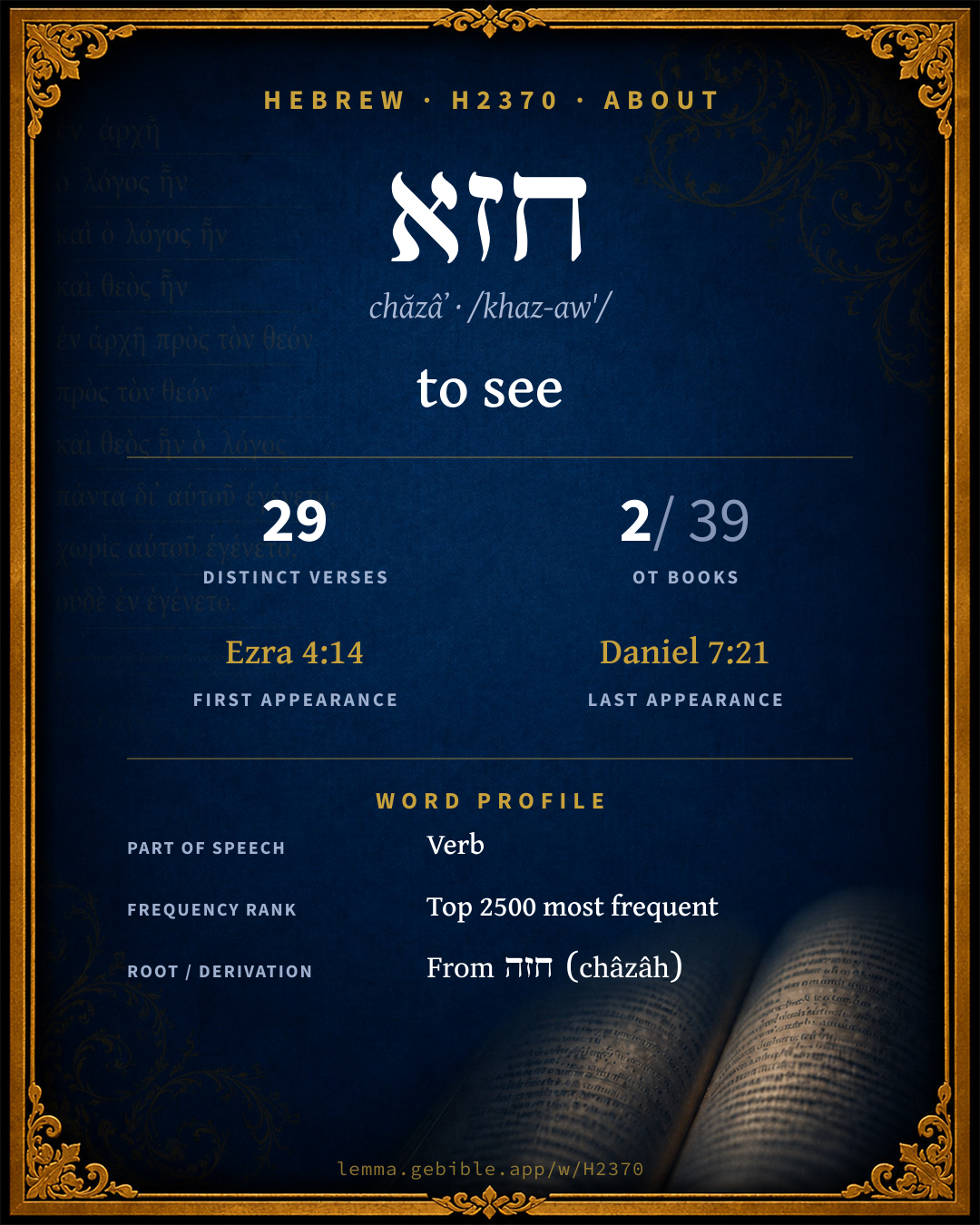
חֲזָה
to see
‘to see’ is one of 5 main senses fuller range ↓
Full lexicon entry — Brown-Driver-Briggs (BDB)
From Brown-Driver-Briggs (BDB)
Where this word appears
See every Qal verb in the Hebrew Bible →
Grammar key — what these labels mean
Part of speech
- Verb
- An action or state-of-being word.
- Particle
- A short function word — article, negation, interrogative, the sign of the direct object, and the like.
Stem
- Qal
- The basic, simple active stem — the plain form of the verb (“he wrote”).
- Hiphil
- The causative active stem (“he caused / brought about”).
Form
- Participle Active
- A verbal adjective expressing ongoing or characteristic action (“writing / one who writes”).
- Perfect
- A completed action or state — Hebrew marks aspect (completeness) more than strict tense (“he wrote”).
- Infinitive Construct
- A bound verbal noun, frequently with prepositions (“to write / in writing”).
- Participle Passive
- A verbal adjective expressing action received (“written”).
State
- Absolute
- The independent form of a noun, not bound to a following word.
Person
- 2nd Person
- The one addressed (“you”).
- 1st Person
- The speaker (“I / we”).
- 3rd Person
- The one spoken about (“he / she / it / they”).
Gender
- Masculine
- Grammatically masculine.
- Common
- Either gender — not distinguished for this form.
Number
- Singular
- One.
- Plural
- More than one (in Hebrew, generally three or more).
26 verses where H2370 appears in the Qal stem in the Book of Daniel. Filtered view — show all forms. Click any verse to open its interlinear word-by-word view. Verse text shown in the World English Bible for context — . Each verse’s Hebrew form is shown with its reference; the English is not keyword-highlighted, since the data carries no word-level English alignment. Use “Compare translations” on any verse to read it across multiple English versions. This concordance covers the Hebrew Bible; Septuagint (Greek Old Testament) occurrences are not indexed here.
Daniel
- Daniel 2:8 חֲזֵית֔וֹן Qal pf 2mp The king answered, I know of a certainty that you would gain time, because you see the thing is gone from me.
- Daniel 2:34 חָזֵ֣ה Qal ptcp.act ms You saw until a stone was cut out without hands, which struck the image on its feet that were of iron and clay, and broke them in pieces.
- Daniel 2:41 חֲזַ֜יְתָה חֲזַ֔יְתָה Qal pf 2ms Qal pf 2ms Whereas you saw the feet and toes, part of potters' clay, and part of iron, it shall be a divided kingdom; but there shall be in it of the strength of the iron, because you saw the iron mixed with miry clay.
- Daniel 2:43 חֲזַ֗יְתָ Qal pf 2ms Whereas you saw the iron mixed with miry clay, they shall mingle themselves with the seed of men; but they shall not cling to one another, even as iron does not mingle with clay.
- Daniel 2:45 חֲזַ֡יְתָ Qal pf 2ms Because you saw that a stone was cut out of the mountain without hands, and that it broke in pieces the iron, the brass, the clay, the silver, and the gold; the great God has made known to the king what shall happen hereafter: and the dream is certain, and the interpretation of it sure.
- Daniel 3:19 חֲזֵ֖ה Qal ptcp.pass ms Then was Nebuchadnezzar full of fury, and the form of his visage was changed against Shadrach, Meshach, and Abednego: [therefore] he spoke, and commanded that they should heat the furnace seven times more than it was wont to be heated.
- Daniel 3:25 חָזֵ֜ה Qal ptcp.act ms He answered, Look, I see four men loose, walking in the midst of the fire, and they have no hurt; and the aspect of the fourth is like a son of the gods.
- Daniel 3:27 חָזַ֣יִן Qal ptcp.act mp The satraps, the deputies, and the governors, and the king's counselors, being gathered together, saw these men, that the fire had no power on their bodies, nor was the hair of their head singed, neither were their pants changed, nor had the smell of fire passed on them.
- Daniel 4:5 חֲזֵ֖ית Qal pf 1cs I saw a dream which made me afraid; and the thoughts on my bed and the visions of my head troubled me.
- Daniel 4:9 חֲזֵ֛ית Qal pf 1cs Belteshazzar, master of the magicians, because I know that the spirit of the holy gods is in you, and no secret troubles you, tell me the visions of my dream that I have seen, and the interpretation of it.
- Daniel 4:10 חָזֵ֣ה Qal ptcp.act ms Thus were the visions of my head on my bed: I saw, and, behold, a tree in the midst of the earth; and the height of it was great.
- Daniel 4:13 חָזֵ֥ה Qal ptcp.act ms I saw in the visions of my head on my bed, and, behold, a watcher and a holy one came down from the sky.
- Daniel 4:18 חֲזֵ֔ית Qal pf 1cs This dream I, king Nebuchadnezzar, have seen; and you, Belteshazzar, declare the interpretation, because all the wise men of my kingdom are not able to make known to me the interpretation; but you are able; for the spirit of the holy gods is in you.
- Daniel 4:20 חֲזַ֔יְתָ Qal pf 2ms The tree that you saw, which grew, and was strong, whose height reached to the sky, and the sight of it to all the earth;
- Daniel 4:23 חֲזָ֣ה Qal pf 3ms Whereas the king saw a watcher and a holy one coming down from the sky, and saying, Hew down the tree, and destroy it; nevertheless leave the stump of the roots of it in the earth, even with a band of iron and brass, in the tender grass of the field, and let it be wet with the dew of the sky: and let his portion be with the animals of the field, until seven times pass over him;
- Daniel 5:5 חָזֵ֔ה Qal ptcp.act ms In the same hour came forth the fingers of a man's hand, and wrote over against the lampstand on the plaster of the wall of the king's palace: and the king saw the part of the hand that wrote.
- Daniel 5:23 חָזַ֧יִן Qal ptcp.act mp but have lifted up yourself against the Lord of heaven; and they have brought the vessels of his house before you, and you and your lords, your wives and your concubines, have drunk wine from them; and you have praised the gods of silver and gold, of brass, iron, wood, and stone, which don't see, nor hear, nor know; and the God in whose hand your breath is, and whose are all your ways, you have not glorified.
- Daniel 7:1 חֲזָ֔ה Qal pf 3ms In the first year of Belshazzar king of Babylon Daniel had a dream and visions of his head on his bed: then he wrote the dream and told the sum of the matters.
- Daniel 7:2 חָזֵ֥ה Qal ptcp.act ms Daniel spoke and said, I saw in my vision by night, and, behold, the four winds of the sky broke forth on the great sea.
- Daniel 7:4 חָזֵ֣ה Qal ptcp.act ms The first was like a lion, and had eagle's wings: I saw until the wings of it were plucked, and it was lifted up from the earth, and made to stand on two feet as a man; and a man's heart was given to it.
- Daniel 7:6 חָזֵ֣ה Qal ptcp.act ms After this I saw, and, behold, another, like a leopard, which had on its back four wings of a bird; the animal had also four heads; and dominion was given to it.
- Daniel 7:7 חָזֵ֨ה Qal ptcp.act ms After this I saw in the night-visions, and, behold, a fourth animal, awesome and powerful, and strong exceedingly; and it had great iron teeth; it devoured and broke in pieces, and stamped the residue with its feet: and it was diverse from all the animals that were before it; and it had ten horns.
- Daniel 7:9 חָזֵ֣ה Qal ptcp.act ms I saw until thrones were placed, and one who was ancient of days sat: his clothing was white as snow, and the hair of his head like pure wool; his throne was fiery flames, [and] the wheels of it burning fire.
- Daniel 7:11 חָזֵ֣ה חָזֵ֣ה Qal ptcp.act ms Qal ptcp.act ms I saw at that time because of the voice of the great words which the horn spoke; I saw even until the animal was slain, and its body destroyed, and it was given to be burned with fire.
- Daniel 7:13 חָזֵ֤ה Qal ptcp.act ms I saw in the night-visions, and, behold, there came with the clouds of the sky one like a son of man, and he came even to the ancient of days, and they brought him near before him.
- Daniel 7:21 חָזֵ֣ה Qal ptcp.act ms I saw, and the same horn made war with the saints, and prevailed against them;
About this entry
At a glance — auto-summarized from this page’s data, not written by a person. Every figure links to its source below. This summary describes the numbers; it doesn’t interpret them.
חזא (chăzâʼ) is a Hebrew verb most often rendered “to see.” It clusters heavily in Daniel, which alone accounts for 97% of its uses. With 29 verses in 2 books, it is a moderately common word in the Hebrew Bible. Ranging over 5 senses, it is not a single-sense word. Translators differ — “thou sawest” in the King James Version, then “watched” (Berean Standard Bible) and “looking” (unfoldingWord Literal Text), as the renderings breakdown shows. The sections below give every sense, occurrence, and version rendering.
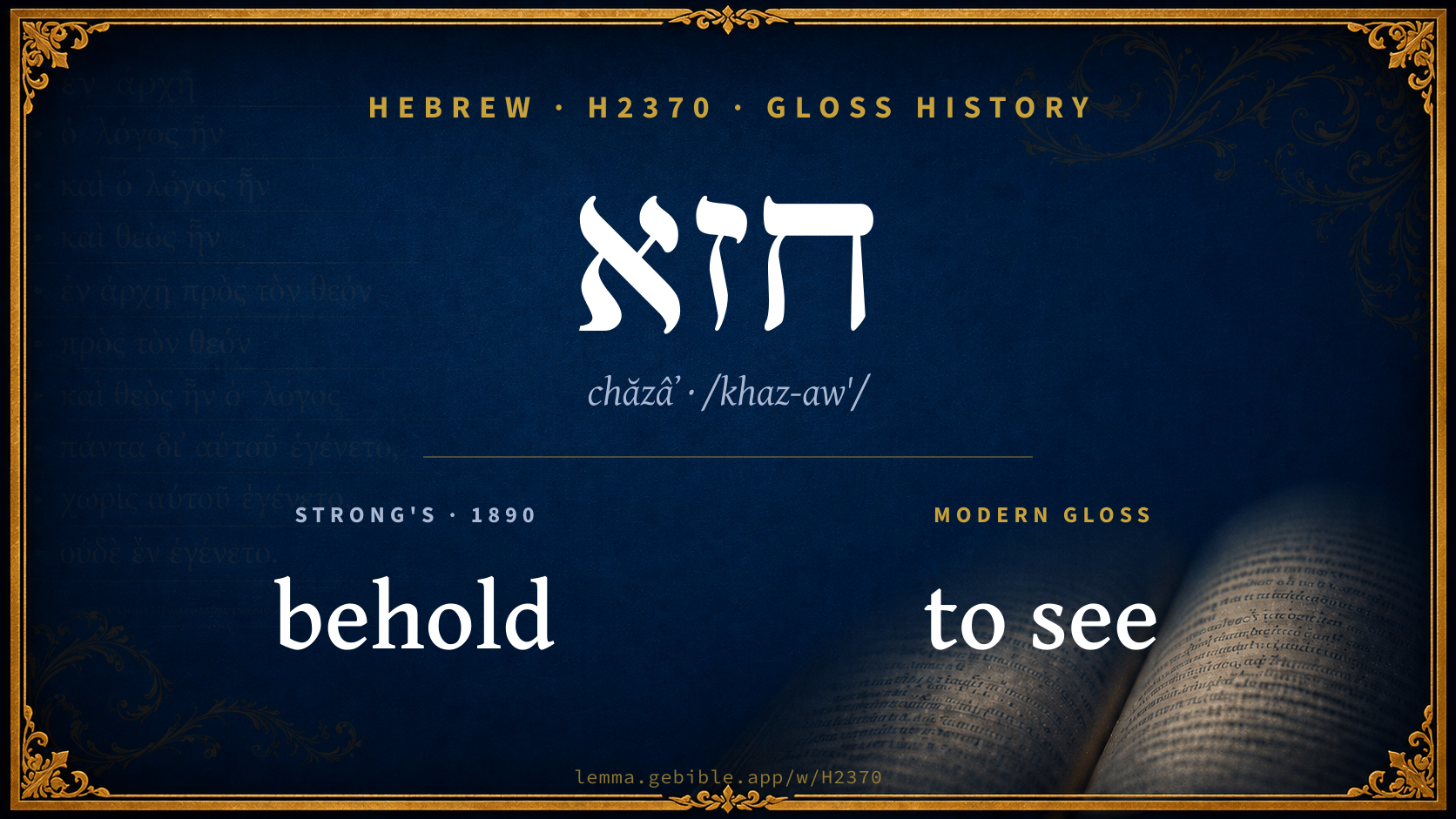
Gloss history
Strong's 1890 vs modern scholarship
About this word
Strong's H2370 catalogs a Hebrew word from the Hebrew Old Testament.
These counts are not copied from any lexicon or concordance. They are computed here, from the morphology-tagged Hebrew Old Testament. What Lemma adds →
- 29
- distinct verses
- The word appears in 29 distinct verses.
- 2 / 39
- OT books
- The word appears in 2 of 39 Old Testament books.
- #1,120
- by frequency
- Top 2500 most frequent Hebrew words (rank 1,120 of 8,640 Hebrew words by occurrence).
View all 29 occurrences in the concordance →
By traditional corpus
Conventional, traditional groupings — biblical authorship is debated, so this is a traditional corpus grouping, not an authorship claim. Each share is this word’s portion of its verses in that division of the Hebrew canon. Each figure is a share of the word’s 29 distinct verses.
- Writings (Ketuvim) 29 verses · 100%
How translations render this word
Counts come from each version’s own published word-to-Strong’s tagging or interlinear alignment — an approximate guide to how each version renders this word, not a word-level alignment the data otherwise carries. Because each total is that version’s own tagged count, the per-version totals vary from one another and need not match the appearance or distinct-verse counts above. These counts may also differ from a printed concordance because Lemma counts each distinctly tagged rendering and does not collapse phrase taggings into a single head-word total. This is a fixed set of word-tagged versions (KJV, ASV, BSB, ULT) and does not change with the reading translation you choose elsewhere. Each version’s license is shown beside its name below (and on Sources).
- King James Version: Thou sawest 5×, Saw 3×, See 3×
- American Standard Version: Thou sawest 5×, Saw 3×, See 3×
- Berean Standard Bible: Watched 6×, You saw 4×, I saw 2×
- unfoldingWord Literal Text: Looking 13×, You saw 5×, Saw 4×
King James Version Public Domain
Renders H2370 across 20 tagged occurrences — most commonly:
Plus 5 renderings that appear only once — usually multi-word phrases or single function words the recovered tagging swept in, not distinct renderings. Not rendered by a distinct English word in 11 further occurrences.
American Standard Version Public Domain
Renders H2370 across 20 tagged occurrences — most commonly:
Plus 5 renderings that appear only once — usually multi-word phrases or single function words the recovered tagging swept in, not distinct renderings.
Berean Standard Bible Public Domain
Renders H2370 across 31 tagged occurrences — most commonly:
Plus 13 renderings that appear only once — usually multi-word phrases or single function words the recovered tagging swept in, not distinct renderings.
unfoldingWord Literal Text CC BY-SA 4.0
Renders H2370 across 32 tagged occurrences — most commonly:
Plus 4 renderings that appear only once — usually multi-word phrases or single function words the recovered tagging swept in, not distinct renderings.
Senses in BDB
The 5 senses BDB distinguishes for this word, in lexicon order (not ranked by frequency or importance). The full entry — with sub-senses — is in the Lexicon Entry tab.
- to see, behold
(Peal)
- to see
- to see, behold, witness
- to behold (in a dream or vision)
- customary, seemly (passive)
Word origin
חֲזָה vb. see, behold
— Brown-Driver-Briggs (Oxford 1906, public domain), digitized via Sefaria, supplemented by the OpenScriptures HebrewLexicon (CC BY 4.0). See Sources.
Derived from חזה (châzâh) (H2372) — to see.
Jastrow Dictionary
A second Hebrew/Aramaic lexicon for comparison, covering Aramaic and post-biblical (Talmudic, Targumic, Midrashic) usage that the biblical-Hebrew BDB does not. Matched by lemma rather than by Strong’s number, so a lemma may carry more than one Jastrow headword (shown separately below), and the entries cover usage well beyond the Bible.
חֲזָא
- , v. חֲזֵי
A Dictionary of the Targumim, the Talmud Babli and Yerushalmi, and the Midrashic Literature (Marcus Jastrow; London, Luzac, 1903) — Public Domain. Digitized via Sefaria. Digitized via Sefaria. Full attribution on Sources.
Forms in the corpus
The 21 distinct written forms H2370 takes in the Hebrew Bible, most frequent first — each parse links to that stem’s occurrences in the concordance. Hebrew forms include their vowel points and cantillation, so a single lemma takes many written forms.
Same root — word family
Other BDB entries built from the same root as H2370, grouped by Strong’s listed origin. These share a root / origin per the lexicon — not necessarily a shared meaning. Each links to that word’s own entry.
Derives from
Shares the same root
- הזה hâzâh H1957 to dream
- חזה châzeh H2373 breast
- חזה chôzeh H2374 seer
- חזון châzôwn H2377 vision
- חזות châzôwth H2378 visions
- חזות châzûwth H2380 vision
- חזיון chizzâyôwn H2384 vision
- מחזה machăzeh H4236 vision
- מחזה mechĕzâh H4237 window
Derived from this word
Proper names from this root
People and places named from this root — a name, not an additional meaning of the word.
- חזאל Chăzâʼêl H2371 Hazael
- חזו Chăzôw H2375 Hazo
- חזיאל Chăzîyʼêl H2381 Haziel
- חזיה Chăzâyâh H2382 Hazaiah
- חזיון Chezyôwn H2383 Hezion
- יחזיאל Yachăzîyʼêl H3166 Jahaziel
- יחזיה Yachzᵉyâh H3167 Jahaziah
- מחזיאות Machăzîyʼôwth H4238 Mahazioth
Compare all same-root words → Showing 4 of 21 — not the complete family. 8 of the same-root words are proper names (people or places). They share a root, not necessarily a meaning.
Septuagint verse parallels
This word appears in 28 verses that also exist in the Greek Old Testament (Septuagint), out of the 29 Hebrew verses it occurs in. You can read those verses in Greek by switching the Old Testament edition to the Septuagint.
Read these verses in the Septuagint
This is a verse-level parallel only — the same verses exist in both the Hebrew and Greek Old Testaments. No word-level Hebrew↔Greek correspondence is claimed: the data carries no such alignment, so no Greek word is shown as this Hebrew word’s translation. Coverage is not total — the Septuagint omits the deuterocanon and renumbers the Psalms, so some Hebrew verses have no direct Greek parallel.