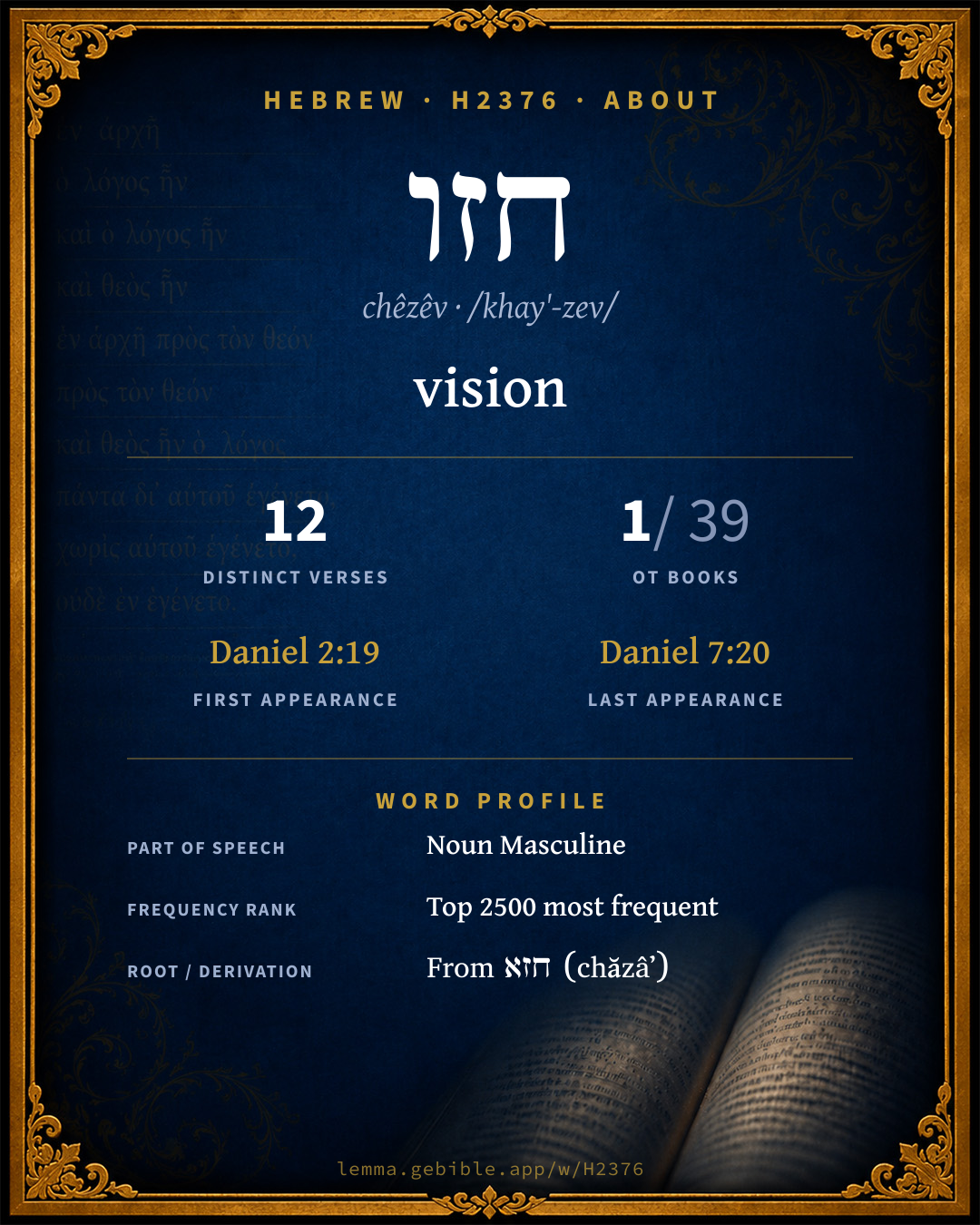
חֱזוּ
vision
‘vision’ is one of 3 main senses fuller range ↓
Full lexicon entry — Brown-Driver-Briggs (BDB)
From Brown-Driver-Briggs (BDB)
Where this word appears
Grammar key — what these labels mean
Part of speech
- Noun
- A naming word — a person, place, thing, or idea.
Noun type
- Common
- A common noun — a general class of person, place, or thing (“king,” “city,” “water”), not a specific name.
State
- Construct
- A noun bound to a following noun in a possessive / “of” relationship (the construct chain).
Gender
- Masculine
- Grammatically masculine.
Number
- Plural
- More than one (in Hebrew, generally three or more).
- Singular
- One.
Grammatical forms
- Noun, Common, Masculine, Plural, Construct 9 times (75%)
- Noun, Common, Masculine, Singular, Construct 2 times (17%)
- Particle, Definite Article 1 time (8%)
Parsed forms decoded from the imported morphology (morphhb / Westminster Leningrad Codex — WLC text public domain, morphhb tagging CC BY 4.0), counted across 12 parsed occurrences — not distinct verses.
Every verse where H2376 appears — 12 distinct verses across 1 book. Click any verse to open its interlinear word-by-word view. Verse text shown in the World English Bible for context — . Each verse’s Hebrew form is shown with its reference; the English is not keyword-highlighted, since the data carries no word-level English alignment. Use “Compare translations” on any verse to read it across multiple English versions. This concordance covers the Hebrew Bible; Septuagint (Greek Old Testament) occurrences are not indexed here.
Daniel 12 verses
- Daniel 2:19 בְּ/חֶזְוָ֥/א prep + n c ms det + ptcl def.art Then was the secret revealed to Daniel in a vision of the night. Then Daniel blessed the God of heaven.
- Daniel 2:28 וְ/חֶזְוֵ֥י conj + n c mp cs but there is a God in heaven who reveals secrets, and he has made known to the king Nebuchadnezzar what shall be in the latter days. Your dream, and the visions of your head on your bed, are these:
- Daniel 4:5 וְ/חֶזְוֵ֥י conj + n c mp cs I saw a dream which made me afraid; and the thoughts on my bed and the visions of my head troubled me.
- Daniel 4:9 חֶזְוֵ֨י n c mp cs Belteshazzar, master of the magicians, because I know that the spirit of the holy gods is in you, and no secret troubles you, tell me the visions of my dream that I have seen, and the interpretation of it.
- Daniel 4:10 וְ/חֶזְוֵ֥י conj + n c mp cs Thus were the visions of my head on my bed: I saw, and, behold, a tree in the midst of the earth; and the height of it was great.
- Daniel 4:13 בְּ/חֶזְוֵ֥י prep + n c mp cs I saw in the visions of my head on my bed, and, behold, a watcher and a holy one came down from the sky.
- Daniel 7:1 וְ/חֶזְוֵ֥י conj + n c mp cs In the first year of Belshazzar king of Babylon Daniel had a dream and visions of his head on his bed: then he wrote the dream and told the sum of the matters.
- Daniel 7:2 בְּ/חֶזְוִ֖/י prep + n c ms cs + sfx pers 1cs Daniel spoke and said, I saw in my vision by night, and, behold, the four winds of the sky broke forth on the great sea.
- Daniel 7:7 בְּ/חֶזְוֵ֣י prep + n c mp cs After this I saw in the night-visions, and, behold, a fourth animal, awesome and powerful, and strong exceedingly; and it had great iron teeth; it devoured and broke in pieces, and stamped the residue with its feet: and it was diverse from all the animals that were before it; and it had ten horns.
- Daniel 7:13 בְּ/חֶזְוֵ֣י prep + n c mp cs I saw in the night-visions, and, behold, there came with the clouds of the sky one like a son of man, and he came even to the ancient of days, and they brought him near before him.
- Daniel 7:15 וְ/חֶזְוֵ֥י conj + n c mp cs As for me, Daniel, my spirit was grieved in the midst of my body, and the visions of my head troubled me.
- Daniel 7:20 וְ/חֶזְוַ֖/הּ conj + n c ms cs + sfx pers 3fs and concerning the ten horns that were on its head, and the other [horn] which came up, and before which three fell, even that horn that had eyes, and a mouth that spoke great things, whose look was more stout than its fellows.
About this entry
At a glance — auto-summarized from this page’s data, not written by a person. Every figure links to its source below. This summary describes the numbers; it doesn’t interpret them.
The Hebrew noun חזו centers on the idea of “vision.” The word gravitates to Daniel (100%). It turns up in 12 verses across 1 book, an uncommon footprint. Lexicons map it across 3 senses. Translators differ — “visions” in the King James Version, then “visions of” (unfoldingWord Literal Text), as the renderings breakdown shows. For the data behind this summary, explore the sense tree and the renderings breakdown below.
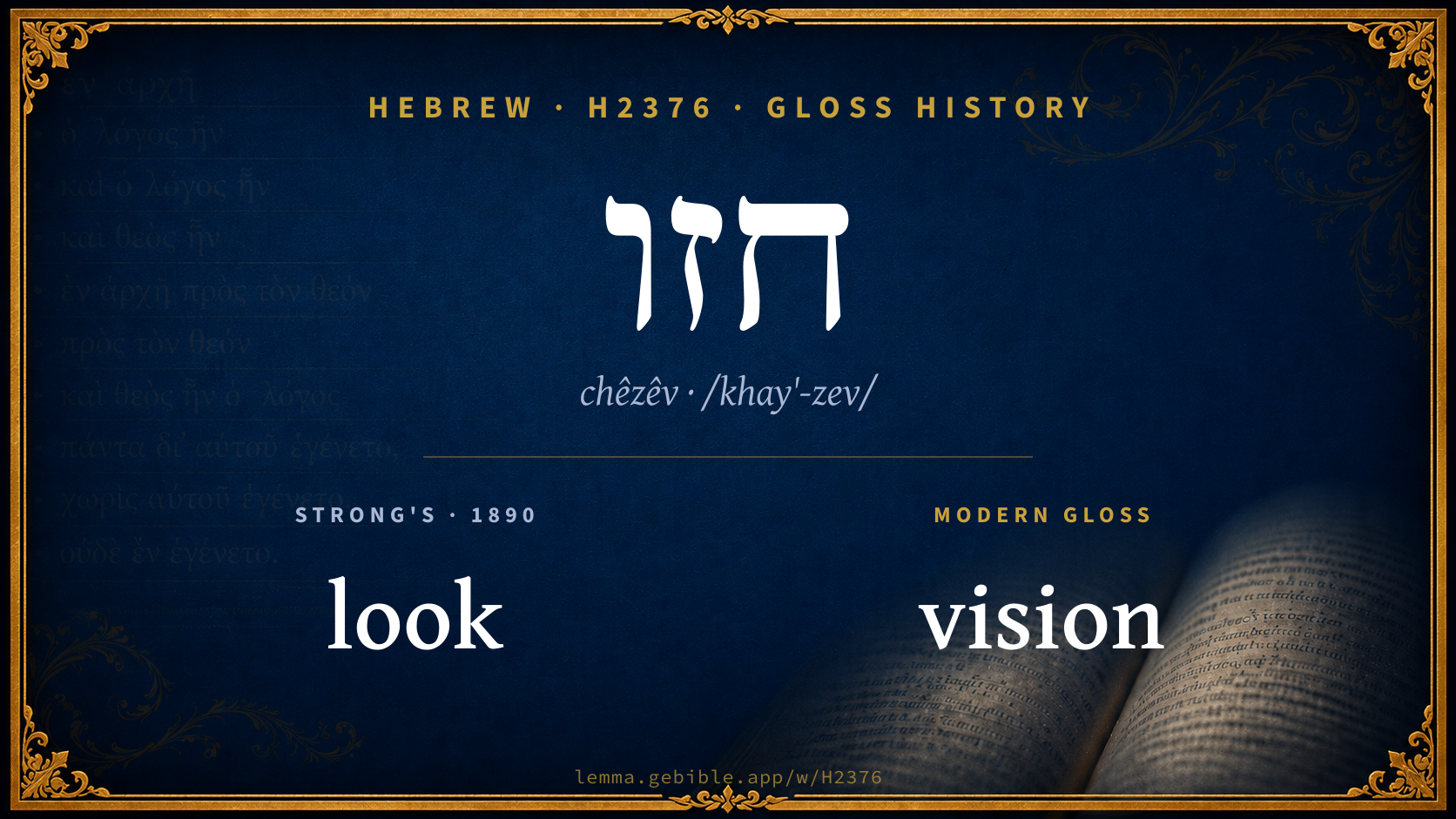
Gloss history
Strong's 1890 vs modern scholarship
About this word
Strong's H2376 catalogs a Hebrew word from the Hebrew Old Testament.
These counts are not copied from any lexicon or concordance. They are computed here, from the morphology-tagged Hebrew Old Testament. What Lemma adds →
- 12
- distinct verses
- The word appears in 12 distinct verses.
- 1 / 39
- OT books
- The word appears in 1 of 39 Old Testament books.
- #2,101
- by frequency
- Top 2500 most frequent Hebrew words (rank 2,101 of 8,640 Hebrew words by occurrence).
View all 12 occurrences in the concordance →
Most concentrated in
- Daniel 12 verses 100%
By section of the Old Testament
By traditional corpus
Conventional, traditional groupings — biblical authorship is debated, so this is a traditional corpus grouping, not an authorship claim. Each share is this word’s portion of its verses in that division of the Hebrew canon. Each figure is a share of the word’s 12 distinct verses.
- Writings (Ketuvim) 12 verses · 100%
How translations render this word
Counts come from each version’s own published word-to-Strong’s tagging or interlinear alignment — an approximate guide to how each version renders this word, not a word-level alignment the data otherwise carries. Because each total is that version’s own tagged count, the per-version totals vary from one another and need not match the appearance or distinct-verse counts above. These counts may also differ from a printed concordance because Lemma counts each distinctly tagged rendering and does not collapse phrase taggings into a single head-word total. This is a fixed set of word-tagged versions (KJV, ASV, BSB, ULT) and does not change with the reading translation you choose elsewhere. Each version’s license is shown beside its name below (and on Sources).
- King James Version: Visions 8×, Vision 2×
- American Standard Version: Visions 5×, - visions 2×, Vision 2×
- Berean Standard Bible: Visions 7×, Vision 4×
- unfoldingWord Literal Text: Visions of 7×, Vision 2×
King James Version Public Domain
Renders H2376 across 12 tagged occurrences — most commonly:
Plus 2 renderings that appear only once — usually multi-word phrases or single function words the recovered tagging swept in, not distinct renderings.
American Standard Version Public Domain
Renders H2376 across 12 tagged occurrences — most commonly:
Plus 3 renderings that appear only once — usually multi-word phrases or single function words the recovered tagging swept in, not distinct renderings.
Berean Standard Bible Public Domain
Renders H2376 across 12 tagged occurrences — most commonly:
Plus 1 rendering that appears only once — usually multi-word phrases or single function words the recovered tagging swept in, not distinct renderings.
unfoldingWord Literal Text CC BY-SA 4.0
Renders H2376 across 13 tagged occurrences — most commonly:
Plus 4 renderings that appear only once — usually multi-word phrases or single function words the recovered tagging swept in, not distinct renderings.
Senses in BDB
The 3 senses BDB distinguishes for this word, in lexicon order (not ranked by frequency or importance). The full entry — with sub-senses — is in the Lexicon Entry tab.
- vision, appearance
- vision
- appearance
Word origin
[ חֱזוּ ] n.m. vision, appearance
— Brown-Driver-Briggs (Oxford 1906, public domain), digitized via Sefaria, supplemented by the OpenScriptures HebrewLexicon (CC BY 4.0). See Sources.
Derived from חזא (chăzâʼ) (H2370) — to see.
Jastrow Dictionary
A second Hebrew/Aramaic lexicon for comparison, covering Aramaic and post-biblical (Talmudic, Targumic, Midrashic) usage that the biblical-Hebrew BDB does not. Matched by lemma rather than by Strong’s number, so a lemma may carry more than one Jastrow headword (shown separately below), and the entries cover usage well beyond the Bible.
חֲזוּ
- , constr. of חֶזְוָא.
חֵזוּ
- = next w. Targ. O. Gen. XXIV, 16 (ed. Berl. למיחזי).—Ib. Num. XII, 8; a. e.—Pl., v. חָזוּתָא e.g. Numbers 12:8
חֲזִי
- , to see, recognize, to decide. Targ. O. Gen. XXIX, 10; a. fr.—Ber. 45ᵃ; Erub. 14ᵇ, a. e. פוק חֲזִי וכ׳, v. דְּבַר. Ib. 13ᵇ דחֲזִיתֵיה לר"מ וכ׳ (not דחזיתא) because I have seen R. M. &c. Ḥull. 59ᵇ בעינא דאֶיחְזֵי וכ׳ I want to see your God Erub. 63ᵃ ח׳ לנפשיה may examine the knife for his own use; a. fr.—Part. pass. חָזֵי, חֲזֵי, f. חַזְיָא (cmp. רָאוּי) pointed out, fit for, prepared; (it is) proper. Targ. Job XV, 11. Targ. O. Lev. V, 10; a. e.—Keth. 21ᵃ כְּדַחֲ׳, כִּדְחָ׳ as it is proper. B. Bath. 19ᵇ ח׳ לבהמתו fit for his cattle as feed; a. fr.—Sabb. 90ᵃ, a. fr. למאי חזיא what is it good for (what use can be made of it)?—Pl. חָזוּ, חֲזוּ. Ib. top ח׳ למתק וכ׳ they may be used for seasoning &c. Bets. 26ᵇ; a. fr.—חזי לי it was pointed out to me, I saw. Gitt. 57ᵃ. Taan. 25ᵇ; a. fr.
- to show, let see, reveal; to lay before a teacher for examination or decision. Targ. O. Gen. XLI, 28; a. fr.—Ḥull. 59ᵇ בעינא דמַחֲזִית וכ׳ I want thee to show it to me. Bets. l. c. אַחֲזַיֵיה לחכם וכ׳ as soon as he showed it to an expert (and the latter decided favorably) &c.; a. fr.
- same. Targ. II Esth. II, 8.—B. Mets. 67ᵃ ואודיק חַזִּיתָן איילונית and when he looked at me (and noticed that I was going to object by referring to אוֹנָאָה), he pointed out to us the case of אַיְילוֹנִית (v. Rabb. D. S. a. l. note 50; Ms. R. חַזְּתָן).
- , אִחְזֵי
- 1. to be seen, to appear. Targ. Jud. XIII, 10; a. fr.—Ber. 17ᵇ מִיחֲזֵי כיוהרא it looks like assumption; a. fr.
- 2. to look at each other. Targ. O. Gen. XLII, 1.
- 3. to become fit, adapted for use. Bets. 26ᵇ אי דאִחֲזוּ בה"ש א׳ if on the entrance of the Sabbath they became fit for use, they have become so (for the entire Sabbath). Ib. אחזו והדר … אחזו they had been fit (on the entrance of the Sabbath), and were unfitted (through rain), and became fit again; a. fr.
- 4. to be shown, to be laid before the scholar for decision. Ib. אתח׳ לחכם וכ׳ it had been shown to (and decided upon by) the expert on the eve &c.; a. fr.
A Dictionary of the Targumim, the Talmud Babli and Yerushalmi, and the Midrashic Literature (Marcus Jastrow; London, Luzac, 1903) — Public Domain. Digitized via Sefaria. Digitized via Sefaria. Full attribution on Sources.
Forms in the corpus
The 7 distinct written forms H2376 takes in the Hebrew Bible, most frequent first — each parse links to that state’s occurrences in the concordance. Hebrew forms include their vowel points and cantillation, so a single lemma takes many written forms.
| Form | Parsing | Example | Uses |
|---|---|---|---|
| וְ/חֶזְוֵ֥י | Noun, Common, Masculine, Plural, Construct | Daniel 2:28 | 5 |
| בְּ/חֶזְוֵ֣י | Noun, Common, Masculine, Plural, Construct | Daniel 7:7 | 2 |
| בְּ/חֶזְוִ֖/י | Noun, Common, Masculine, Singular, Construct | Daniel 7:2 | 1 |
| בְּ/חֶזְוֵ֥י | Noun, Common, Masculine, Plural, Construct | Daniel 4:13 | 1 |
| בְּ/חֶזְוָ֥/א | Particle, Definite Article | Daniel 2:19 | 1 |
| וְ/חֶזְוַ֖/הּ | Noun, Common, Masculine, Singular, Construct | Daniel 7:20 | 1 |
| חֶזְוֵ֨י | Noun, Common, Masculine, Plural, Construct | Daniel 4:9 | 1 |
Same root — word family
Other BDB entries built from the same root as H2376, grouped by Strong’s listed origin. These share a root / origin per the lexicon — not necessarily a shared meaning. Each links to that word’s own entry.
Derives from
Shares the same root
Compare all same-root words → They share a root, not necessarily a meaning.
Septuagint verse parallels
This word appears in 12 verses that also exist in the Greek Old Testament (Septuagint), out of the 12 Hebrew verses it occurs in. You can read those verses in Greek by switching the Old Testament edition to the Septuagint.
Read these verses in the Septuagint
This is a verse-level parallel only — the same verses exist in both the Hebrew and Greek Old Testaments. No word-level Hebrew↔Greek correspondence is claimed: the data carries no such alignment, so no Greek word is shown as this Hebrew word’s translation. Coverage is not total — the Septuagint omits the deuterocanon and renumbers the Psalms, so some Hebrew verses have no direct Greek parallel.