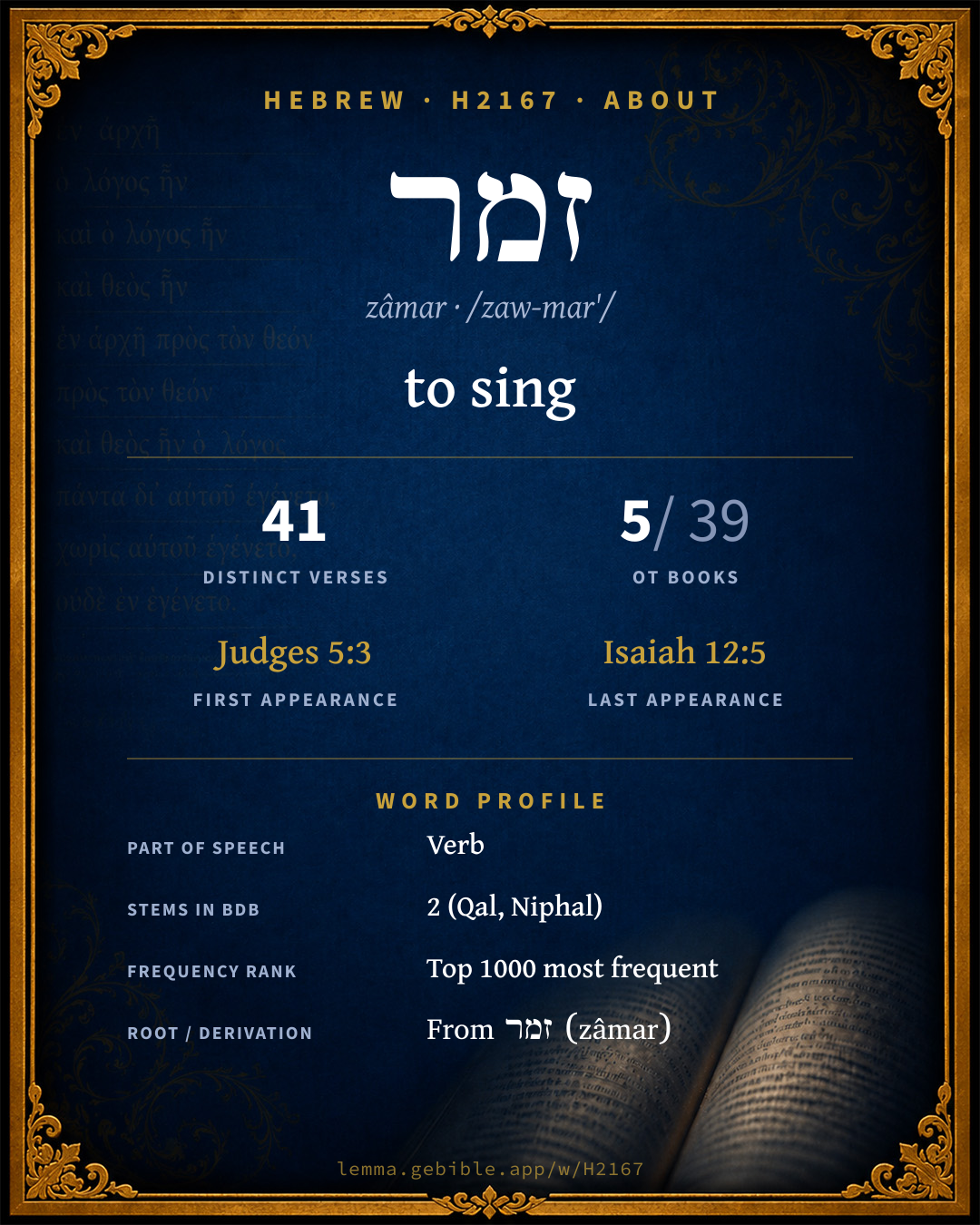
זָמַר
to sing
also: sing praise, make music fuller range ↓
Full lexicon entry — Brown-Driver-Briggs (BDB)
From Brown-Driver-Briggs (BDB)
Where this word appears
Grammar key — what these labels mean
Part of speech
- Verb
- An action or state-of-being word.
Stem
- Piel
- An intensive or resultative active stem.
Form
- Imperative
- A direct command (“write!”).
- Cohortative
- A first-person volitional form expressing wish or resolve (“let me / let us write”).
- Imperfect
- An incomplete, ongoing, or future action (“he will / would write”).
- Infinitive Construct
- A bound verbal noun, frequently with prepositions (“to write / in writing”).
Person
- 2nd Person
- The one addressed (“you”).
- 1st Person
- The speaker (“I / we”).
- 3rd Person
- The one spoken about (“he / she / it / they”).
Gender
- Masculine
- Grammatically masculine.
- Common
- Either gender — not distinguished for this form.
Number
- Plural
- More than one (in Hebrew, generally three or more).
- Singular
- One.
Every verse where H2167 appears in the Book of Judges — 1 distinct verse. Click any verse to open its interlinear word-by-word view. Verse text shown in the World English Bible for context — . Each verse’s Hebrew form is shown with its reference; the English is not keyword-highlighted, since the data carries no word-level English alignment. Use “Compare translations” on any verse to read it across multiple English versions. This concordance covers the Hebrew Bible; Septuagint (Greek Old Testament) occurrences are not indexed here.
Judges
About this entry
At a glance — auto-summarized from this page’s data, not written by a person. Every figure links to its source below. This summary describes the numbers; it doesn’t interpret them.
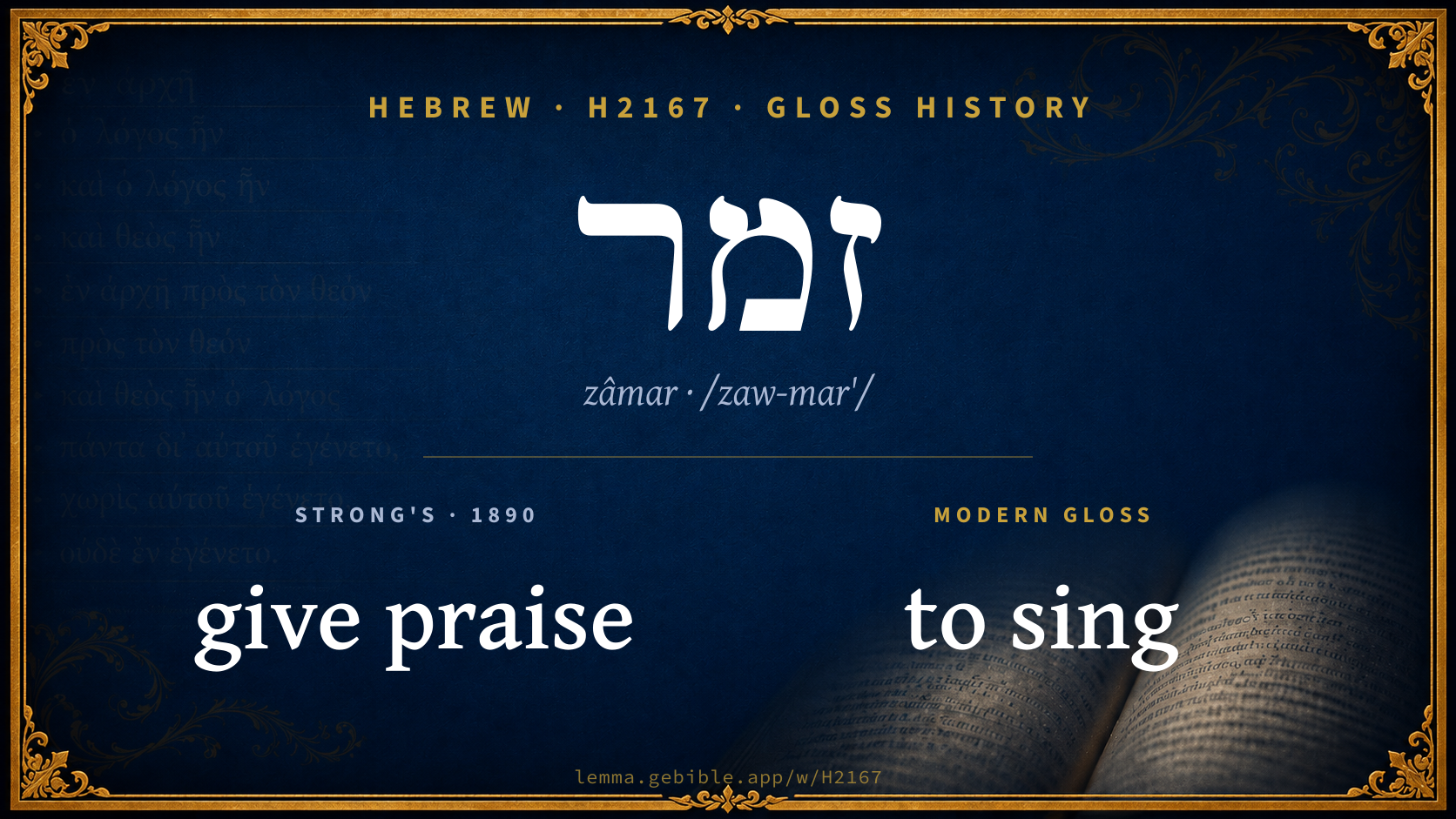
זמר (zâmar) is a Hebrew verb most often rendered “to sing.” Psalms dominates its distribution — 37 of 41 verses. The Hebrew Bible uses it across 41 verses — moderately common. Different stems carry different senses — BDB groups them under 2 stems, among them Qal and Niphal. Its English rendering has broadened — “sing praises” classically, “make music” (unfoldingWord Literal Text) in modern versions; see the renderings breakdown. For the data behind this summary, explore the sense tree and the renderings breakdown below.
Gloss history
Strong's 1890 vs modern scholarship
About this word
Strong's H2167 catalogs a Hebrew word from the Hebrew Old Testament.
These counts are not copied from any lexicon or concordance. They are computed here, from the morphology-tagged Hebrew Old Testament. What Lemma adds →
- 41
- distinct verses
- The word appears in 41 distinct verses.
- 5 / 39
- OT books
- The word appears in 5 of 39 Old Testament books.
- #810
- by frequency
- Top 1000 most frequent Hebrew words (rank 810 of 8,640 Hebrew words by occurrence).
View all 41 occurrences in the concordance →
By section of the Old Testament
By traditional corpus
Conventional, traditional groupings — biblical authorship is debated, so this is a traditional corpus grouping, not an authorship claim. Each share is this word’s portion of its verses in that division of the Hebrew canon. Each figure is a share of the word’s 41 distinct verses.
- Writings (Ketuvim) 38 verses · 93%
- Prophets (Nevi'im) 3 verses · 7%
How translations render this word
Counts come from each version’s own published word-to-Strong’s tagging or interlinear alignment — an approximate guide to how each version renders this word, not a word-level alignment the data otherwise carries. Because each total is that version’s own tagged count, the per-version totals vary from one another and need not match the appearance or distinct-verse counts above. These counts may also differ from a printed concordance because Lemma counts each distinctly tagged rendering and does not collapse phrase taggings into a single head-word total. This is a fixed set of word-tagged versions (KJV, ASV, BSB, ULT) and does not change with the reading translation you choose elsewhere. Each version’s license is shown beside its name below (and on Sources).
- King James Version: Sing praises 11×, Sing 5×, I will sing praises 4×
- American Standard Version: Sing praises 9×, Sing 4×, Yea 4×
- Berean Standard Bible: Sing praises 14×, Make music 6×, I will sing praise 5×
- unfoldingWord Literal Text: Make music 14×, Sing praise 6×, Let me make music 4×
King James Version Public Domain
Renders H2167 across 45 tagged occurrences — most commonly:
Plus 15 renderings that appear only once — usually multi-word phrases or single function words the recovered tagging swept in, not distinct renderings.
American Standard Version Public Domain
Renders H2167 across 47 tagged occurrences — most commonly:
Plus 16 renderings that appear only once — usually multi-word phrases or single function words the recovered tagging swept in, not distinct renderings.
Berean Standard Bible Public Domain
Renders H2167 across 45 tagged occurrences — most commonly:
Plus 7 renderings that appear only once — usually multi-word phrases or single function words the recovered tagging swept in, not distinct renderings.
unfoldingWord Literal Text CC BY-SA 4.0
Renders H2167 across 45 tagged occurrences — most commonly:
Plus 10 renderings that appear only once — usually multi-word phrases or single function words the recovered tagging swept in, not distinct renderings.
Senses in the full BDB
Hebrew verbs can shift meaning by stem (binyan): Qal is the basic action, Niphal is often passive or reflexive, Piel often intensifies or makes it factitive, and Hiphil is typically causative. The senses below are grouped under the stem BDB assigns to each.
What do BDB’s symbols mean?
BDB uses these scholarly abbreviations:
| Symbol | Meaning |
|---|---|
| 𝔊 | the Septuagint (the ancient Greek translation, LXX) |
| 𝔙 | the Vulgate (the Latin translation) |
| 𝔖 | the Syriac version (the Peshitta) |
| 𝔗 | the Targum (the Aramaic translation) |
| ψ | the Psalms |
| √ | root (the underlying root or stem) |
| ‖ | parallel passage (a synonymous or contrasted parallel) |
| † | the dagger: every passage where the word occurs is cited |
The 2 senses and sub-senses the full Brown-Driver-Briggs lexicon distinguishes for this word, in lexicon order (not ranked by frequency), with BDB’s own verbatim wording and sub-sense lettering. Shown in Hebrew script with BDB’s own scholarly abbreviations. The condensed entry is in the Lexicon Entry tab. See also the Forms in the corpus table below.
Qal
- Impf. 2 ms. תִּזְמֹר Lv 25:3, 4 of pruning a vineyard (כֶּרֶם; H). e.g. Leviticus 25:3
Niphal
- Impf. יִזָּמֵר Is 5:6 be pruned, subj. כֶּרֶם (‖ יֵעָדֵר). e.g. Isaiah 5:6
Senses from the full Brown-Driver-Briggs lexicon (Brown, Driver, Briggs; Oxford 1906 — public domain), digitized via Sefaria, supplemented by the OpenScriptures HebrewLexicon (CC BY 4.0). Full attribution on Sources.
Word origin
vb. trim, prune (NH id.; relation to √ I. obscure)—
— Brown-Driver-Briggs (Oxford 1906, public domain), digitized via Sefaria, supplemented by the OpenScriptures HebrewLexicon (CC BY 4.0). See Sources.
Derived from זמר (zâmar) (H2168) — to prune.
Jastrow Dictionary
A second Hebrew/Aramaic lexicon for comparison, covering Aramaic and post-biblical (Talmudic, Targumic, Midrashic) usage that the biblical-Hebrew BDB does not. Matched by lemma rather than by Strong’s number, so a lemma may carry more than one Jastrow headword (shown separately below), and the entries cover usage well beyond the Bible.
זָמַר I
- (b. h.) to nip; to prune; to cut. Sabb. 73ᵇ זוֹמֵר וצריך וכ׳ if one trims a tree (on the Sabbath) for making use of the wood. Snh. 26ᵃ כהן וזומר (not וזמר) a priest is he, and he prunes the vine (in the sabbatical year)!; a. fr.
- to be pruned, trnsf. to be checked, unnerved, defeated. Cant. R. to II, 12 (ref. to זמיר ib.) הגיע זמנה של ערלה שתִּזָּמֵר the time for pruning the preputium (circumcision) has come (v. Ex. R. s. 19); הגיע … שיִזָּמֵרוּ the time has come for the Egyptians to be checked; Pesik. Haḥod., p. 50ᵃ; Pesik. R. s. 15.—Lev. R. s. 9, beg. Akhan is named Zimri (I Chr. II, 6, cmp. with Josh. VII, 24) שנִזְמְרוּ … על ידו because through him the Israelites were unnerved (Josh. VII, 5); a. e. e.g. 1 Chronicles 2:6
זְמַר
- Af. אַזְמֵיר same. Y. Shebi. IV, 35ᵃ חמא חד אַ׳ וכ׳ (not איז׳) saw one prune &c. (in the Sabbatical year).
זָמַר II
- to tingle, make music, sing. V. זֶמֶר.
- 1. to sing one’s praise. Cant. R. to II, 16 הוא זִמְּרַנִי … זִמַּרְתִּיו (or זְמָרַנִי, זְמַרְתִּיו) He praised me, and I &c.—Gen. R. s. 91, end (expl. מזמרת, Gen. XLIII, 11) דברים שהן מְזַמְּרִין וכ׳ things which men praise all over the world. e.g. Genesis 43:11
- 2. to review a lesson in recitative chant (v. זִמְרָה). Snh. 99ᵇ top זַמֵּר בכל יום chant every day; Tosef. Ohol. XVI, 8 זַ׳ בי תדירה זַ׳ (the Law says) review me steadily &c.; ib. Par. IV (III), 7; cmp. גְּמָרָא.
זְמַר ²
- Pa. זַמֵּיר same,
- 1. to sing. Targ. Ps. XVIII, 50; a. e.—Sot. 48ᵃ זַמְּרי גברי וכ׳ when men sing and women respond.
- 2. to sing a satire, deride. Targ. Lam. III, 14.
*זָמַר III
- , Hif. הִזְמִיר (cmp. זְמוֹרָא) to look bluish. Y’lamd. to Num. XXV, 14, quot. in Ar. (play on זִמְרִי) עד שה׳ בשרו כביצה מוזרת until his flesh (through his lewdness) had the color of a smashed (rotten) egg; (cmp. Tanḥ. Pinḥ. 2, Num. R. s. 21, beg., Snh. 82ᵇ—where our w. is omitted).
זֶמֶר I
- (זָמַר II) music, song; כלי ז׳ (or sub. כלי) musical instrument. Sot. 48ᵃ בארבעה מיני ז׳ to the music of four instruments. Y. ib. VII, 21ᶜ top לעז לז׳ Greek is adapted for song; Y. Meg. I, 71ᵇ bot.—Snh. 101ᵃ ועושה אותו כמין ז׳ and treats it (a verse of Song of Songs) like a (secular) song; Yalk. Prov. 953; a. fr.
זֶמֶר II
- (זָמַר I; cmp. זמרה, Gen. XLIII, 11) fruits, (grapes &c.), dessert. Y. Pes. X, 37ᵈ bot. (expl. אפיקומין) מיני ז׳ various dessert fruits (Bab. ib. 119ᵇ תמרים וכ׳; Tosef. ib. X, 11 אגוזים וכ׳). e.g. Genesis 43:11
זַמָּר
- (זָמַר I) musician, singer. Kel. XVI, 7 מרכוף של ז׳, v. מַרְכּוֹף. Yalk. Lam. 1001.
A Dictionary of the Targumim, the Talmud Babli and Yerushalmi, and the Midrashic Literature (Marcus Jastrow; London, Luzac, 1903) — Public Domain. Digitized via Sefaria. Digitized via Sefaria. Full attribution on Sources.
Forms in the corpus
The 29 distinct written forms H2167 takes in the Hebrew Bible, most frequent first — each parse links to that stem’s occurrences in the concordance. Hebrew forms include their vowel points and cantillation, so a single lemma takes many written forms.
| Form | Parsing | Example | Uses |
|---|---|---|---|
| זַמְּר֣וּ | Verb, Piel, Imperative, 2nd Person, Masculine, Plural | Isaiah 12:5 | 4 |
| אֲזַמְּרָ֖ה | Verb, Piel, Cohortative, 1st Person, Common, Singular | Psalms 9:2 | 3 |
| וַ֝/אֲזַמְּרָ֗ה | Verb, Piel, Cohortative, 1st Person, Common, Singular | Psalms 7:17 | 3 |
| זַמְּר֖וּ | Verb, Piel, Imperative, 2nd Person, Masculine, Plural | Psalms 47:6 | 3 |
| זַמְּר֥וּ | Verb, Piel, Imperative, 2nd Person, Masculine, Plural | Psalms 47:7 | 3 |
| זַמְּרוּ | Verb, Piel, Imperative, 2nd Person, Masculine, Plural | 1 Chronicles 16:9 | 3 |
| אֲזַמְּרָ֣ה | Verb, Piel, Cohortative, 1st Person, Common, Singular | Psalms 61:8 | 2 |
| אֲזַמְּרָה | Verb, Piel, Cohortative, 1st Person, Common, Singular | Psalms 144:9 | 2 |
| אֲזַמֵּֽרָה | Verb, Piel, Cohortative, 1st Person, Common, Singular | Psalms 18:49 | 2 |
| אֲ֝זַמְּרָ֗ה | Verb, Piel, Cohortative, 1st Person, Common, Singular | Psalms 75:9 | 1 |
| אֲ֝זַמֶּרְ/ךָ֗ | Verb, Piel, Imperfect, 1st Person, Common, Singular | Psalms 57:9 | 1 |
| אֲזַמְּרֶֽ/ךָּ | Verb, Piel, Imperfect, 1st Person, Common, Singular | Psalms 138:1 | 1 |
| אֲזַמֵּ֑רָה | Verb, Piel, Imperfect, 1st Person, Common, Singular | Psalms 59:17 | 1 |
| אֲזַמֵּ֕ר | Verb, Piel, Imperfect, 1st Person, Common, Singular | Judges 5:3 | 1 |
| אֲזַמֵּֽר | Verb, Piel, Imperfect, 1st Person, Common, Singular | 2 Samuel 22:50 | 1 |
| וְ/זַמֵּֽרוּ | Verb, Piel, Imperative, 2nd Person, Masculine, Plural | Psalms 98:4 | 1 |
| וִֽ/יזַמְּרוּ | Verb, Piel, Imperfect, 3rd Person, Masculine, Plural | Psalms 66:4 | 1 |
| וַ/אֲזַמֵּֽרָה | Verb, Piel, Cohortative, 1st Person, Common, Singular | Psalms 57:7 | 1 |
| וַ֝/אֲזַמֶּרְ/ךָ֗ | Verb, Piel, Imperfect, 1st Person, Common, Singular | Psalms 108:3 | 1 |
| וּ/לְ/זַמֵּ֖ר | Verb, Piel, Infinitive Construct | Psalms 92:1 | 1 |
| וּֽ֝/נְזַמְּרָה | Verb, Piel, Cohortative, 1st Person, Common, Plural | Psalms 21:13 | 1 |
| זַמְּר֗וּ | Verb, Piel, Imperative, 2nd Person, Masculine, Plural | Psalms 9:11 | 1 |
| זַמְּר֪וּ | Verb, Piel, Imperative, 2nd Person, Masculine, Plural | Psalms 68:4 | 1 |
| זַמְּרָ֣ה | Verb, Piel, Infinitive Construct | Psalms 147:1 | 1 |
| זַמֵּ֑רוּ | Verb, Piel, Imperative, 2nd Person, Masculine, Plural | Psalms 47:6 | 1 |
| זַמֵּֽרוּ | Verb, Piel, Imperative, 2nd Person, Masculine, Plural | Psalms 47:6 | 1 |
| יְזַמְּר֖וּ | Verb, Piel, Imperfect, 3rd Person, Masculine, Plural | Psalms 66:4 | 1 |
| יְזַמְּרוּ | Verb, Piel, Imperfect, 3rd Person, Masculine, Plural | Psalms 149:3 | 1 |
| יְזַמֶּרְ/ךָ֣ | Verb, Piel, Imperfect, 3rd Person, Masculine, Singular | Psalms 30:12 | 1 |
Same root — word family
Other BDB entries built from the same root as H2167, grouped by Strong’s listed origin. These share a root / origin per the lexicon — not necessarily a shared meaning. Each links to that word’s own entry.
Derives from
Shares the same root
- זמורה zᵉmôwrâh H2156 branch
- זמיר zâmîyr H2159 pruning
- זמרה zimrâh H2173 choice fruits
- מזמרה mazmêrâh H4211 pruning knife
- מזמרה mᵉzammᵉrâh H4212 snuffers
Derived from this word
- זמיר zâmîyr H2158 song
- זמר zâmar H2168 to prune
- זמר zemer H2169 wild goat
- זמר zᵉmâr H2170 music
- זמרה zimrâh H2172 song
- זמרת zimrâth H2176 song of praise
- מזמור mizmôwr H4210 psalm
Proper names from this root
People and places named from this root — a name, not an additional meaning of the word.
Compare all same-root words → Showing 4 of 15 — not the complete family. 2 of the same-root words are proper names (people or places). They share a root, not necessarily a meaning.
Septuagint verse parallels
This word appears in 37 verses that also exist in the Greek Old Testament (Septuagint), out of the 41 Hebrew verses it occurs in. You can read those verses in Greek by switching the Old Testament edition to the Septuagint.
Read these verses in the Septuagint
This is a verse-level parallel only — the same verses exist in both the Hebrew and Greek Old Testaments. No word-level Hebrew↔Greek correspondence is claimed: the data carries no such alignment, so no Greek word is shown as this Hebrew word’s translation. Coverage is not total — the Septuagint omits the deuterocanon and renumbers the Psalms, so some Hebrew verses have no direct Greek parallel.