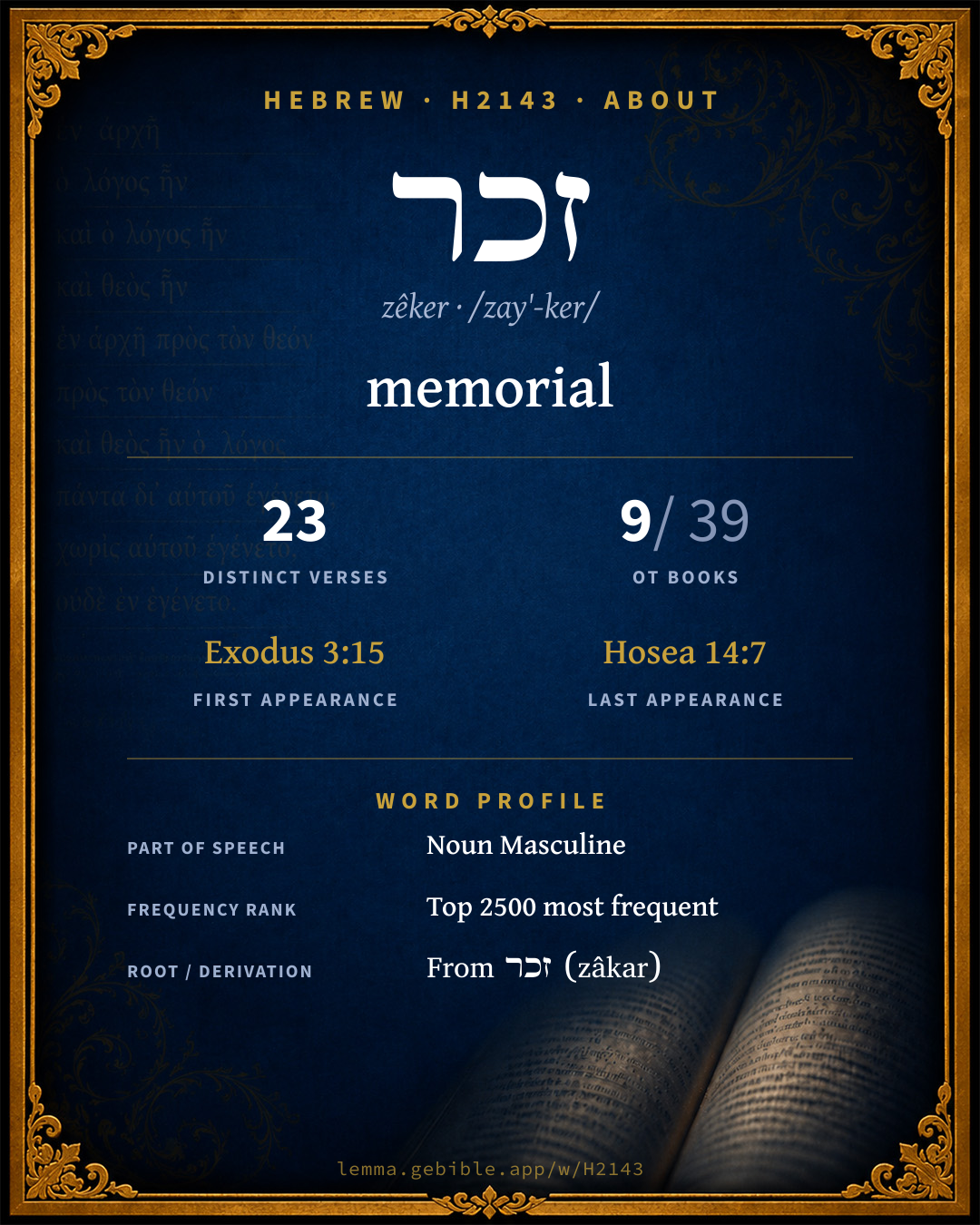
זֵ֫כֶר
memorial
‘memorial’ is one of 3 main senses fuller range ↓
Full lexicon entry — Brown-Driver-Briggs (BDB)
From Brown-Driver-Briggs (BDB)
Where this word appears
See every Absolute-state word in the Hebrew Bible →
Grammar key — what these labels mean
Part of speech
- Noun
- A naming word — a person, place, thing, or idea.
Noun type
- Common
- A common noun — a general class of person, place, or thing (“king,” “city,” “water”), not a specific name.
State
- Construct
- A noun bound to a following noun in a possessive / “of” relationship (the construct chain).
- Absolute
- The independent form of a noun, not bound to a following word.
Gender
- Masculine
- Grammatically masculine.
Number
- Singular
- One.
1 verse where H2143 appears in the Absolute state in the Book of Isaiah. Filtered view — show all forms. Click any verse to open its interlinear word-by-word view. Verse text shown in the World English Bible for context — . Each verse’s Hebrew form is shown with its reference; the English is not keyword-highlighted, since the data carries no word-level English alignment. Use “Compare translations” on any verse to read it across multiple English versions. This concordance covers the Hebrew Bible; Septuagint (Greek Old Testament) occurrences are not indexed here.
Isaiah
About this entry
At a glance — auto-summarized from this page’s data, not written by a person. Every figure links to its source below. This summary describes the numbers; it doesn’t interpret them.
“memorial” is the headline sense of the Hebrew noun זכר (zêker). First canonically at Exodus 3:15, it enters the text early. It appears 23 verses across 9 books of the Hebrew Bible, among its uncommon vocabulary. More than a third of its appearances fall in Psalms. Its meaning spans more than one sense — see its full sense range. See the sense tree, 23-verse concordance, and the renderings breakdown below.
Gloss history
Strong's 1890 vs modern scholarship
About this word
Strong's H2143 catalogs a Hebrew word from the Hebrew Old Testament.
These counts are not copied from any lexicon or concordance. They are computed here, from the morphology-tagged Hebrew Old Testament. What Lemma adds →
- 23
- distinct verses
- The word appears in 23 distinct verses.
- 9 / 39
- OT books
- The word appears in 9 of 39 Old Testament books.
- #1,368
- by frequency
- Top 2500 most frequent Hebrew words (rank 1,368 of 8,640 Hebrew words by occurrence).
View all 23 occurrences in the concordance →
Most concentrated in
- Psalms 11 verses 48%
- Exodus 2 verses 9%
- Deuteronomy 2 verses 9%
By section of the Old Testament
By traditional corpus
Conventional, traditional groupings — biblical authorship is debated, so this is a traditional corpus grouping, not an authorship claim. Each share is this word’s portion of its verses in that division of the Hebrew canon. Each figure is a share of the word’s 23 distinct verses.
- Writings (Ketuvim) 15 verses · 65%
- Torah (Pentateuch) 4 verses · 17%
- Prophets (Nevi'im) 4 verses · 17%
How translations render this word
Counts come from each version’s own published word-to-Strong’s tagging or interlinear alignment — an approximate guide to how each version renders this word, not a word-level alignment the data otherwise carries. Because each total is that version’s own tagged count, the per-version totals vary from one another and need not match the appearance or distinct-verse counts above. These counts may also differ from a printed concordance because Lemma counts each distinctly tagged rendering and does not collapse phrase taggings into a single head-word total. This is a fixed set of word-tagged versions (KJV, ASV, BSB, ULT) and does not change with the reading translation you choose elsewhere. Each version’s license is shown beside its name below (and on Sources).
- King James Version: Remembrance 9×, Memory 4×, Memorial 3×
- American Standard Version: Remembrance 5×, Memory 4×, Memorial 2×
- Berean Standard Bible: Memory 7×, Name 2×, Renown 2×
- unfoldingWord Literal Text: Remembrance 10×, Memory 4×, Memory of 3×
King James Version Public Domain
Renders H2143 across 23 tagged occurrences — most commonly:
Plus 7 renderings that appear only once — usually multi-word phrases or single function words the recovered tagging swept in, not distinct renderings.
American Standard Version Public Domain
Renders H2143 across 23 tagged occurrences — most commonly:
Plus 10 renderings that appear only once — usually multi-word phrases or single function words the recovered tagging swept in, not distinct renderings.
Berean Standard Bible Public Domain
Renders H2143 across 23 tagged occurrences — most commonly:
Plus 12 renderings that appear only once — usually multi-word phrases or single function words the recovered tagging swept in, not distinct renderings.
unfoldingWord Literal Text CC BY-SA 4.0
Renders H2143 across 25 tagged occurrences — most commonly:
Plus 5 renderings that appear only once — usually multi-word phrases or single function words the recovered tagging swept in, not distinct renderings.
8 senses and sub-senses in the full BDB
What do BDB’s symbols mean?
BDB uses these scholarly abbreviations:
| Symbol | Meaning |
|---|---|
| 𝔊 | the Septuagint (the ancient Greek translation, LXX) |
| 𝔙 | the Vulgate (the Latin translation) |
| 𝔖 | the Syriac version (the Peshitta) |
| 𝔗 | the Targum (the Aramaic translation) |
| ψ | the Psalms |
| √ | root (the underlying root or stem) |
| ‖ | parallel passage (a synonymous or contrasted parallel) |
| † | the dagger: every passage where the word occurs is cited |
The 8 senses and sub-senses the full Brown-Driver-Briggs lexicon distinguishes for this word, in lexicon order (not ranked by frequency), with BDB’s own verbatim wording and sub-sense lettering. Shown in Hebrew script with BDB’s own scholarly abbreviations. The condensed entry is in the Lexicon Entry tab. See also the Forms in the corpus table below.
- 1. remembrance, memory:
- a. of persons or people, blotted out by their destruction, Ex 17:14 (E; c. מחה) = Dt 25:19, Dt 32:26 (השׁבית) ψ 34:17; 109:15 (both הכרית), ψ 9:7 (אבד), Jb 18:17 (אבד; ‖ שֵׁם), Is 26:14 (אבּד); cf. on other hand ז׳ עוֹלָם as portion of righteous ψ 112:6. e.g. Exodus 17:14
- b. of י׳ ψ 6:6; 102:13 (‖ אַתָּה = יהוה). e.g. Psalms 6:6
- c. of י׳’s character and works ψ 30:5; 97:12; 111:4; 145:7. e.g. Psalms 30:5
- d. remembrance of certain days, i.e. their observance Est 9:28 (יִמֵי הַפּוּרִים). e.g. Esther 9:28
- 2. memorial, by which one is remembered:
- a. nearly = שֵׁם, ז׳ צַדִּיק לִבְרָכָה Pr 10:7 (‖ שֵׁם), cf. also Ec 9:5 (c. נשׁכח); especially of י׳ Ex 3:15 (E), Ho 12:6 Is 26:8 ψ 135:13 (all ‖ שֵׁם). e.g. Proverbs 10:7
- b. = renown (of Israel) Ho 14:8 (cf. VB). e.g. Hosea 14:8
Senses from the full Brown-Driver-Briggs lexicon (Brown, Driver, Briggs; Oxford 1906 — public domain), digitized via Sefaria, supplemented by the OpenScriptures HebrewLexicon (CC BY 4.0). Full attribution on Sources.
Word origin
n.m. ψ 9:7 remembrance, memorial (cf. HptHbr. 1885, 230)—ז׳ abs. ψ 111:4, cstr. Dt 25:19 +; זֶכֶר cstr. Ex 17:14 van d. H; sf. זִכְרִי Ex 3:15, זִכְרְךָ Is 26:8 +, זִכְרֶ֑ךָ ψ 6:6, זִכְרוֹ Ho 12:6 +, זִכְרָם Dt 32:26 +:—
— Brown-Driver-Briggs (Oxford 1906, public domain), digitized via Sefaria, supplemented by the OpenScriptures HebrewLexicon (CC BY 4.0). See Sources.
Derived from זכר (zâkar) (H2142) — to remember.
Jastrow Dictionary
A second Hebrew/Aramaic lexicon for comparison, covering Aramaic and post-biblical (Talmudic, Targumic, Midrashic) usage that the biblical-Hebrew BDB does not. Matched by lemma rather than by Strong’s number, so a lemma may carry more than one Jastrow headword (shown separately below), and the entries cover usage well beyond the Bible.
זָכַר
- [to mark,] to remember, mention; to celebrate (by a ceremony &c.). Pes. 106ᵃ (ref. to Ex. XX, 8 זכור) זָכְרֵהוּ על היין Ms. M. (ed. זוֹכְרֵהוּ) remember the Sabbath (distinguish it) by a benediction over wine; Bets. 15ᵇ זכרהו מֵאַחֵר שבא וכ׳ mark the Sabbath (by a ceremony) from another (Holy Day) which (preceding the Sabbath) may cause the neglect of it (Ms. M. לאחר, Rashi מֵאַחַר, v. אַחַר; v. R. Nissim a. l.). Men. 43ᵇ ראה … וזְכוֹר וכ׳ see this ceremony and be reminded of another &c.; a. fr.—Part. pass. זָכוּר, f. זְכוּרָה a) reminded, remembering, mindful.—ז׳ אני, contr. זְכוּרַנִי I recollect. Sabb. 115ᵃ ז׳ אני ב־ I recollect about &c.—Bets. 18ᵃ ז׳ היא she will remember. Snh. 52ᵇ; a. fr.—b) thought of, remembered. B. Mets. 11ᵃ ז׳ ולבסוף שכוח if the sheaf had been thought of and was afterwards forgotten.—ז׳ לטוב (abbr. ז"ל) remembered for blessing. Gen. R. s. 16 end אליהו ז"ל El. of blessed memory, v. זִכָּרוֹן.—Sabb. 13ᵇ, a. e., v. בְּרַם; a. fr.—Pl. זְכוּרִים. Pesik. R. s. 13, end; a. e. e.g. Exodus 20:8
- to be reminded, to remember (with accus.). Pes. 66ᵃ; Snh. 82ᵃ ראה מעשה ונ׳ הלכה he saw the practice and recalled the tradition. Yoma 38ᵃ כביד אבותי נִזְכַּרְתִּי I was thinking of the vanished glory of my ancestors. Ex. R. s. 45 הִזָּכֵר remember; a. fr.
- 1. to cause to be remembered, to recall. Ber. 55ᵃ, a. e. ג׳ דברים מַזְכִּירִים וכ׳ three occasions cause the sins of man to be remembered; a. fr.
- 2. to cite (as an argument), to take into account. Ib. 60ᵃ; a. e. אין מזכירין מ"נ miracles must not be cited as evidence. Kidd. 40ᵇ אין מזכירין לו שוב רשעו his wickedness is not counted; a. fr.
- 3. to recite (in prayer), quote. Hor. 14ᵃ ושמותם אין אנו מז׳ whose names we do not quote (as authorities). Ber. I, 5 מזכירין י"מ וכ׳ we must recite the going out from Egypt (Num. XV, 37 to 41) in night prayers; a. fr. e.g. Numbers 15:37
- to be mentioned. Kel. XVII, 5. Toh. VI, 6; a. e.—Part. מוּזְכָּר, f. מוּזְכֶּרֶת clearly defined. Kidd. 77ᵃ
זָכָר
- preced.) [v. זָכוּר,]
- 1. male (of man and animals), male child; opp. נקבה. Nidd. III, 7 תשב לז׳ וכ׳ she shall observe the laws as after the birth of a male child &c. (Lev. XII, 4). Ib. בריית הז׳ the formation of the male embryo. Y. B. Bath. IX, 16ᵈ bot. שמחת ז׳ the rejoicing over the birth of a boy; a. v. fr.—Pl. זְכָרִים. Nidd. 31ᵇ. Zeb. V, 3, a. fr. זִכְרֵי כהונה the male members of the priestly tribe.—Gen. R. s. 13, a. e. המים העליונים ז׳ וכ׳ the waters from above are the males (fructifiers), &c. e.g. Leviticus 12:4
- 2. (v. דְּכַר II) (של רחלים) ז׳ the male of the flock, ram. Bekh. V, 3; Yeb. 121ᵇ.—Shek. V, 3 ז׳ משמש עם וכ׳ that with the inscription ‘male’ was used only for libations connected with rams.—Pl. as above. R. Hash. III, 4, sq. בשל ז׳ with horns of rams; a. fr.
- 3. membrum (of animals). Tosef. Bekh. IV, 6, v. זוּבָּן.
- 4. (of inanimate objects) the thinner, pointed side of a double tool, v. זַכְרוּת. Kel. XIII, 2 הז׳ the pointed side of the cosmetic tube, contrad. to כף the broad part.
- 5. the marrow of horns, reeds &c. Tosef. Kel. B. Mets. VII, 12. [Ib. Par. II (I), 2, v. זַכְרוּת.]
- 6. (gramm.) לשון ז׳ masculine gender. Kidd. 2ᵇ אשכחן דרך דאיקרי ל׳ ז׳ we find (in the Bible) derekh in the masculine gender. Mekh. B’shall., Shirah 1 בל׳ ז׳ in the masculine form (שִׁיר); Cant. R. to I, 5; a. e.
זֵכֶר
- memorial, remembrance, symbol, mnemonical allusion. Succ. III, 12 ז׳ למקדש as a reminiscence of the Temple usages; Pes. 115ᵃ. Ib. 116ᵃ ז׳ לתפוח typical of the apple tree (Cant. VIII, 5; v. Sot. 11ᵇ); ז׳ לטיט typical of the clay (which the Israelites had to tread). Ber. 2ᵇ; Tosef. Sabb. VII (VIII), 4, a. e. אע"פ שאין … ז׳ לדבר although there is no proof for it (in the Bible), there is a mnemonical allusion to it; a. fr. e.g. Song of Solomon 8:5
A Dictionary of the Targumim, the Talmud Babli and Yerushalmi, and the Midrashic Literature (Marcus Jastrow; London, Luzac, 1903) — Public Domain. Digitized via Sefaria. Digitized via Sefaria. Full attribution on Sources.
Forms in the corpus
The 15 distinct written forms H2143 takes in the Hebrew Bible, most frequent first — each parse links to that state’s occurrences in the concordance. Hebrew forms include their vowel points and cantillation, so a single lemma takes many written forms.
Same root — word family
Other BDB entries built from the same root as H2143, grouped by Strong’s listed origin. These share a root / origin per the lexicon — not necessarily a shared meaning. Each links to that word’s own entry.
Derives from
Shares the same root
- אזכרה ʼazkârâh H234 memorial offering
- זכור zâkûwr H2138 male
- זכר zâkâr H2145 male
- זכרון zikrôwn H2146 memorial
Proper names from this root
People and places named from this root — a name, not an additional meaning of the word.
- זכור Zakkûwr H2139 Zaccur
- זכרי Zikrîy H2147 Zichri
- זכריה Zᵉkaryâh H2148 Zechariah
- זכר Zeker H2144 Zacher
Compare all same-root words → Showing 4 of 10 — not the complete family. 4 of the same-root words are proper names (people or places). They share a root, not necessarily a meaning.
Septuagint verse parallels
This word appears in 21 verses that also exist in the Greek Old Testament (Septuagint), out of the 23 Hebrew verses it occurs in. You can read those verses in Greek by switching the Old Testament edition to the Septuagint.
Read these verses in the Septuagint
- Exodus 3:15
- Deuteronomy 25:19
- Esther 9:28
- Job 18:17
- Psalms 6:5
- Proverbs 10:7
- Ecclesiastes 9:5
- Isaiah 26:8
- Hosea 12:5
This is a verse-level parallel only — the same verses exist in both the Hebrew and Greek Old Testaments. No word-level Hebrew↔Greek correspondence is claimed: the data carries no such alignment, so no Greek word is shown as this Hebrew word’s translation. Coverage is not total — the Septuagint omits the deuterocanon and renumbers the Psalms, so some Hebrew verses have no direct Greek parallel.