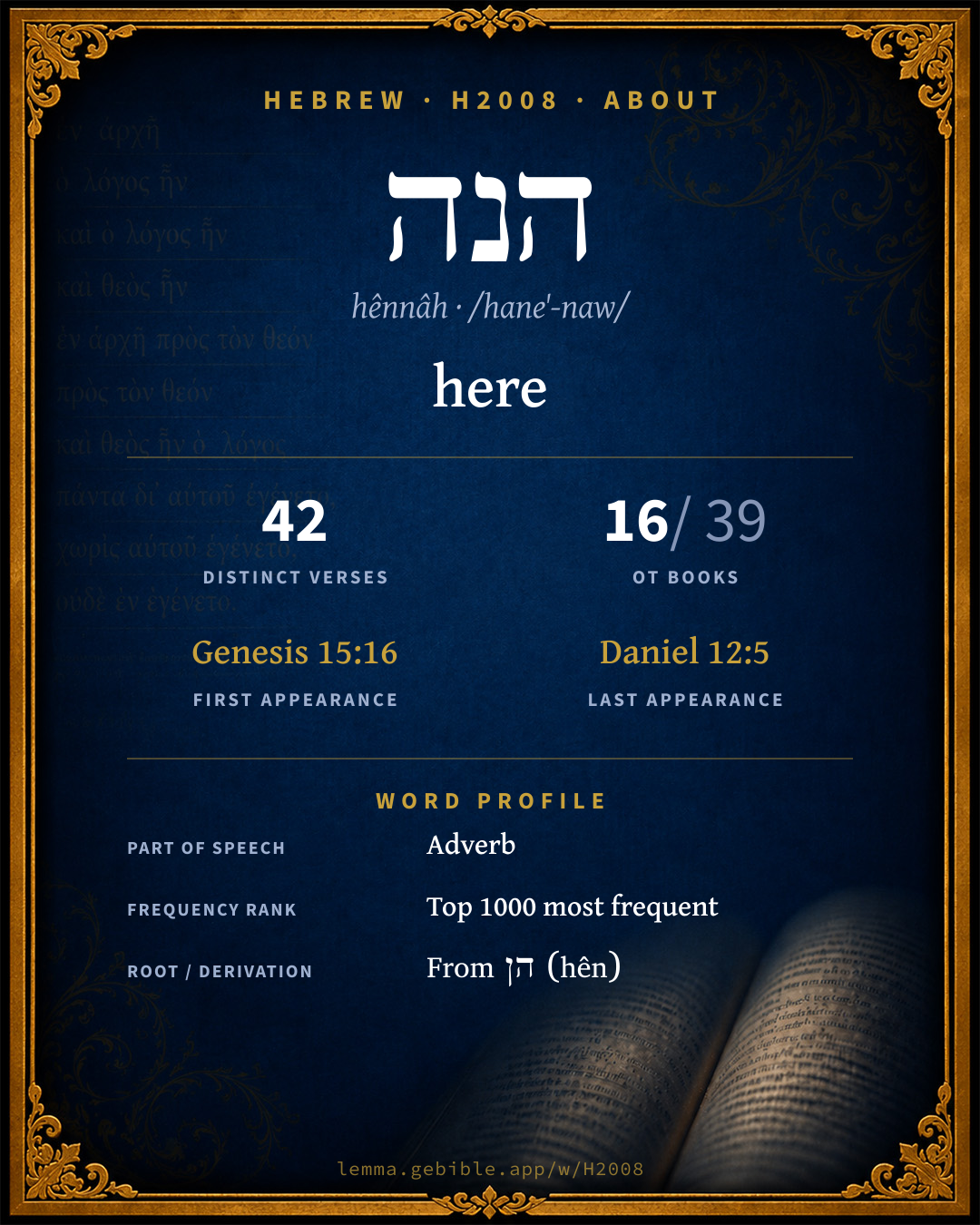
הֵ֫נָּה
here
Full lexicon entry — Brown-Driver-Briggs (BDB)
From Brown-Driver-Briggs (BDB)
Where this word appears
Grammar key — what these labels mean
Part of speech
- Adverb
- A word that modifies a verb, adjective, or other adverb.
- Pronoun
- A word standing in for a noun (“he,” “this,” “who”).
Person
- 3rd Person
- The one spoken about (“he / she / it / they”).
Gender
- Feminine
- Grammatically feminine.
Number
- Plural
- More than one (in Hebrew, generally three or more).
Every verse where H2008 appears in the Book of Proverbs — 3 distinct verses. Click any verse to open its interlinear word-by-word view. Verse text shown in the World English Bible for context — . Each verse’s Hebrew form is shown with its reference; the English is not keyword-highlighted, since the data carries no word-level English alignment. Use “Compare translations” on any verse to read it across multiple English versions. This concordance covers the Hebrew Bible; Septuagint (Greek Old Testament) occurrences are not indexed here.
Proverbs
- Proverbs 9:4 הֵ֑נָּה adv "Whoever is simple, let him turn in here!" As for him who is void of understanding, she says to him,
- Proverbs 9:16 הֵ֑נָּה adv "Whoever is simple, let him turn in here." As for him who is void of understanding, she says to him,
- Proverbs 25:7 הֵ֥נָּה adv For it is better that it be said to you, "Come up here," Than that you should be put lower in the presence of the prince, Whom your eyes have seen.
About this entry
At a glance — auto-summarized from this page’s data, not written by a person. Every figure links to its source below. This summary describes the numbers; it doesn’t interpret them.
The Hebrew verb הנה centers on the idea of “here.” First canonically at Genesis 15:16, it enters the text early. It turns up in 42 verses across 16 books, a moderately common footprint. It clusters with הן and הנה under a shared root. For the data behind this summary, explore the sense tree and the renderings breakdown below.
Gloss history
Strong's 1890 vs modern scholarship
About this word
Strong's H2008 catalogs a Hebrew word from the Hebrew Old Testament.
These counts are not copied from any lexicon or concordance. They are computed here, from the morphology-tagged Hebrew Old Testament. What Lemma adds →
- 42
- distinct verses
- The word appears in 42 distinct verses.
- 16 / 39
- OT books
- The word appears in 16 of 39 Old Testament books.
- #739
- by frequency
- Top 1000 most frequent Hebrew words (rank 739 of 8,640 Hebrew words by occurrence).
View all 42 occurrences in the concordance →
By section of the Old Testament
By traditional corpus
Conventional, traditional groupings — biblical authorship is debated, so this is a traditional corpus grouping, not an authorship claim. Each share is this word’s portion of its verses in that division of the Hebrew canon. Each figure is a share of the word’s 42 distinct verses.
- Prophets (Nevi'im) 25 verses · 60%
- Writings (Ketuvim) 9 verses · 21%
- Torah (Pentateuch) 8 verses · 19%
How translations render this word
Counts come from each version’s own published word-to-Strong’s tagging or interlinear alignment — an approximate guide to how each version renders this word, not a word-level alignment the data otherwise carries. Because each total is that version’s own tagged count, the per-version totals vary from one another and need not match the appearance or distinct-verse counts above. These counts may also differ from a printed concordance because Lemma counts each distinctly tagged rendering and does not collapse phrase taggings into a single head-word total. This is a fixed set of word-tagged versions (KJV, ASV, BSB, ULT) and does not change with the reading translation you choose elsewhere. Each version’s license is shown beside its name below (and on Sources).
BDB lists this Strong’s number as 3 distinct words (homographs). Each count above pools all of them and is not split by sense — see the Senses section below. A low-frequency rendering may belong to a different one of those words, not the primary meaning.
- King James Version†: Far 1×, Here 1×, Hither 1×
- American Standard Version†: Far 1×, Here 1×, Hither 1×
- Berean Standard Bible†: Here 21×, Left 2×, Right 2×
- unfoldingWord Literal Text†: Here 33×, Now 4×, Then 2×
King James Version Public Domain
Renders H2008 across 12† tagged occurrences — most commonly:
Not rendered by a distinct English word in 2 further occurrences.
American Standard Version Public Domain
Renders H2008 across 12† tagged occurrences — most commonly:
Berean Standard Bible Public Domain
Renders H2008 across 38† tagged occurrences — most commonly:
Plus 9 renderings that appear only once — usually multi-word phrases or single function words the recovered tagging swept in, not distinct renderings. Not rendered by a distinct English word in 9 further occurrences.
unfoldingWord Literal Text CC BY-SA 4.0
Renders H2008 across 47† tagged occurrences — most commonly:
Plus 6 renderings that appear only once — usually multi-word phrases or single function words the recovered tagging swept in, not distinct renderings.
Senses in the full BDB
What do BDB’s symbols mean?
BDB uses these scholarly abbreviations:
| Symbol | Meaning |
|---|---|
| 𝔊 | the Septuagint (the ancient Greek translation, LXX) |
| 𝔙 | the Vulgate (the Latin translation) |
| 𝔖 | the Syriac version (the Peshitta) |
| 𝔗 | the Targum (the Aramaic translation) |
| ψ | the Psalms |
| √ | root (the underlying root or stem) |
| ‖ | parallel passage (a synonymous or contrasted parallel) |
| † | the dagger: every passage where the word occurs is cited |
The 6 senses and sub-senses the full Brown-Driver-Briggs lexicon distinguishes for this word, in lexicon order (not ranked by frequency), with BDB’s own verbatim wording and sub-sense lettering. Shown in Hebrew script with BDB’s own scholarly abbreviations. The condensed entry is in the Lexicon Entry tab. See also the Forms in the corpus table below.
הנה I Once הִנֶּה־ Gn 19
- a. pointing to persons or things, Gn 12:19 and now הִנֵּה אִשְׁתְּךָ behold thy wife! 18:9 הִנֵּה בָאֹהֶל behold (she is) in the tent (the suffix, when the noun to which הנה refers has immediately preceded, being not unfrequently omitted, 16:14: cf. Dr§ 135. 6, 2), 30:3; 31:51(×2) Ex 24:8 1 K 2:29. With sf. of 1 ps., especially in response to a call, indicating the readiness of the person addressed to listen or obey, Here I am! (lit. Behold me!) Gn 22:1, 7, 11; 27:1, 18; 31:11; 37:13; 46:2 Ex 3:4 1 S 3:4, 5, 6, 8, 16; 22:12 2 S 1:7 Is, 6:8, cf. 1 S 12:3 הִנְנִי עֲנוּ בִי here I am, answer against me, 14:43 (cf. Drp. 292), 2 S 15:26 (in resignation: cf. Gn 44:16; 50:18 Jos 9:25 Ezr 9:15): of God Is 52:6; 58:9; 65:1(×2) (repeated for emphasis). In the pl. הננו Nu 14:40 Je 3:22 Jb 38:35.—Emph. הִנְנִי אָ֕נִי Ez 34:11, 20, cf. 6:3. On הִנְנִי אֶל …, v. אל 4, p. 40. e.g. Genesis 12:19
- b. introducing clauses involving predication: (a) with ref. to the past or present, it points generally to some truth either newly asserted, or newly recognised, Gn 1:29 behold! I have given to you all herbs etc. 17:20; 27:6 1 S 14:33 etc.; often one upon which some proposal or suggestion is to be founded, Ex 1:9 (cf. הן Gn 11:6) 1 S 20:2, 5; 2 K 5:20. When the proposal is to be of the nature of an entreaty or request, הִנֵּה־נָא is often used, instead of the simple הִנֵּה Gn 12:11; 16:2; 18:27 1 K 20:31; 22:13 al. (v. נָא). (b) with ref. to the future. Here it serves to introduce a solemn or important declaration Ex 32:34; 34:10 Is 7:14; and is used especially with the ptcp. (the fut. instans, Dr§ 135, 3) in predictions or threats, Gn 20:3 הִנְּךָ מֵת (lit.) behold thee (accus.) about to die, thou art about to die, Ex 4:23; 7:17; 9:3 Dt 31:16 1 S 3:11 1 K 20:35; 22:25 Is 3:1; 10:33; 17:1; 19:1; 22:17; 24:1 + often; in the phrase הנה ימים באים †1 S 2:31 2 K 20:17 = Is 39:6 Am 4:2; 8:11; 9:13 + Je 15 times; very often with the suffix of 1 ps. sg., as הִנְנִי מֵבִיא Behold, I bring (lit. behold me bringing, or about to bring) … Gn 6:17 Ex 10:4 & often, especially in Je; Gn 9:9 Ex 8:17; 9:18; 34:11 2 K 22:20 Is 13:17; 29:14; 43:19 Je 8:17; 11:22 (הִנְנִי פֹקֵד; so 23:2 +) 16:16; 20:4, etc.; anomalously, with change of person, Is 28:16 הִנְנִי יִסַּד (according to points) behold me, one who has founded, 29:14 הִנְנִי יוֹסִף behold me, one who will add (so 38:5); but it is dub. whether the ptcp. יֹסֵד, יוֹסֵף should not be read. e.g. Genesis 1:29
- c. וְהִנֵּה … very freq. in historical style, especially (but not exclusively) after verbs of seeing or discovering, making the narrative graphic and vivid, and enabling the reader to enter into the surprise or satisfaction of the speaker or actor concerned: Gn 1:31 and behold, it was very good, 6:12; 8:13; 15:12; 18:2; 37:29 Ex 2:6 Dt 9:13 etc.: in the description of a dream Gn 37:7, 9; 40:9, 16; 41:1, 2, 3 Is 29:8, or of a vision Am 7:1, 4; 8:1 etc. With a ptcp. (the context fixing the sense to the past), Gn 24:30; 37:15 (both without suffix); Ju 9:43; 11:34 1 K 19:5, 11 +. e.g. Genesis 1:31
- d. like II. הֵן (b), nearly = if (rare): Lv 13:5, 6, 8, 10 (& elsewhere in this and the next ch.) וְהִנֵּה and behold = and if, Dt 13:15 and 17:4 וְהִנֵּה אֱמֶת and behold it is true = and if it be true, 19:18 1 S 20:12; cf. 1 S 9:7 2 S 18:11 Ho 9:6; with ו׳ in apod. 2 K 10:9. e.g. Leviticus 13:5
הנה II hither (perhaps from II. הֵן, used δεικτικῶς, with ה-loc., proposes lo hitherwards! or perhaps akin to هُنَا, هَنَّا, هِنَّا here)
- a. of place: (α) hither Gn 15:16 יָשׁוּבוּ הֵנָּה, 42:15; 45:5 that you have sold me הֵנָּה hither, v 8, 13 Jos 2:2; 3:9; 18:6 2 S 1:10 Is 57:3 וְאַתֶּם קִרְבוּ הֵנָּה, Je 31:8; 50:5 +; 1 S 20:21 מִמְּךָ וָהֵנָּה from thee and hitherwards, i.e. on this side of thee (opp. מִמְּךָ וָהָֽלְאָה): repeated 2 K 4:35 אַחַת הֵנָּה וְאַחַת הֵנָּה once hither and once thither = once to and fro; הֵנָּה וָהֵנָּה hither and thither i.e. in different (or opposite) directions, †Jos 8:20 2 K 2:8, 14 1 K 20:40 strangely וַיְהִי עַבְדְּךָ עֹשֵׂה הֵנָּה וָהֵנָּה lit. and thy servant was a doer of hitherwards and thitherwards, i.e. was engaged in different directions (Ew§ 360, c treats ה׳ here as the pron. 3 pl. fem. construed irregularly, cf. עֹשֵׂה אֵלֶּה: but read prob. with 𝔊 𝔗 𝔖 𝔙 Th Klo פֹּנֶה was turning or looking (Ex 2:12) for עֹשֵׂה); עַד־הֵנָּה even hither, Nu 14:19 1 S 7:12 2 S 20:16 קְרַב עַד־הֵנָּה, 2 K 8:7, to this point (in a book) Je 48:47; 51:64 (note of compiler or scribe). (β) here (cf. שָׁמָּה = there) Gn 21:23 swear to me הֵנָּה here, Dn 12:5 הֵנָּה לְ׳ … הֵנָּה לְ׳ on this side of … on that side of … e.g. Genesis 15:16
- b. of time, in עַד הֵנָּה hitherto Gn 15:16 (with a neg., = not yet) 44:28 Ju 16:13 ψ 71:17 & until now do I keep declaring thy wonders, 1 Ch 9:18; 12:30 until now (the point reached in the narrative). In late Heb., contracted to עֲדֶ֫נָה hitherto, still †Ec 4:2, עֲדֶן †Ec 4:3 אֲשֶׁר עֲדֶן לֹא הָיָה = who has not yet been (cf. Mish. עֲדַיִן hitherto, still, עֲדַיִן לֹא = not yet). e.g. Genesis 15:16
הנה III on. 3 pl.fem. they
Senses from the full Brown-Driver-Briggs lexicon (Brown, Driver, Briggs; Oxford 1906 — public domain), digitized via Sefaria, supplemented by the OpenScriptures HebrewLexicon (CC BY 4.0). Full attribution on Sources.
Word origin
I. Once הִנֶּה־ Gn 19:2, demonstr. part. lo! behold! (Arabic إِنَّ certainly, surely, lit. lo!), with sf. (the pron. being conceived as accus., Ew§ 262 c; cf. إِنَّ, which takes an accus., whether of a noun or pron. sf.) הִנְנִי Gn 6:13 + often (also הִנֶּ֣נִּי Gn 22:7), הִנֵּ֑נִי Gn 22:1, 11 +, (הִנֶּ֔נִּי Gn 27:18), †Is 65:1 הִנֵּ֣נִי הִנֵּ֔נִי (but הִנֵּה אָנֹכִי is also said Gn 24:13, 43; 25:32; 48:21 Ex 4:23; 7:17 +; and, more rarely, הִנֵּה אֲנִי Ez 37:5, 12, 19, 21 2 Ch 2:3, cf. 2 K 10:9 Je 32:27); הִנְּךָ Gn 20:3 + (†2 K 7:2 הִנְּכָה), הִנֶּ֑ךָּ †ψ139:8, fem. הִנָּךְ Gn 16:11 + 6 times; הִנּוֹ †Nu 23:17 Jb 2:6 1 Ch 11:25, הִנֵּ֫הוּ †Je 18:3 Kt (הִנֵּה הוּא is more usual, as Gn 20:16; 42:27; 1 S 10:22 Je 38:5 Ru 3:2): 1 pl. הִנְנוּ †Jos 9:25 2 S 5:1 Je 3:22 Ezr 9:15, הִנֶּ֫נּוּ †Gn 44:16; 50:18 Nu 14:40, הִנֵּ֑נוּ Jb 38:35; הִנְּכֶם †Dt 1:10 Je 16:12; הִנָּם Gn 40:6 + often (37 times)—lo! behold!
I. adv. hither (perhaps from II. הֵן, used δεικτικῶς, with ה-loc., proposes lo hitherwards! or perhaps akin to هُنَا, هَنَّا, هِنَّا here)—
II. pron. 3 pl.fem. they: v. הֵ֫מָּה.
— Brown-Driver-Briggs (Oxford 1906, public domain), digitized via Sefaria, supplemented by the OpenScriptures HebrewLexicon (CC BY 4.0). See Sources.
Derived from הן (hên) (H2004) — these.
Jastrow Dictionary
A second Hebrew/Aramaic lexicon for comparison, covering Aramaic and post-biblical (Talmudic, Targumic, Midrashic) usage that the biblical-Hebrew BDB does not. Matched by lemma rather than by Strong’s number, so a lemma may carry more than one Jastrow headword (shown separately below), and the entries cover usage well beyond the Bible.
הַנָּה
- , v. הָן
הִנֵּה
- v. הֵן) behold, here is. Koh. R. to V, 6 ה׳ של בו"ד the ‘here is’ of a human being (Esth. VIII, 7), ה׳ של הק"בה the ‘here is’ of the Lord (Zech. XIV, 1).—הִנֵּנִי here am I. Gen. R. s. 55 ה׳ לכהונה I am ready for priesthood; a. fr. e.g. Esther 8:7
הָנָה
- , v. הני
הני
- (denom. of הֲנָאָה), Nif. נֶהֱנֶה (= נֵאוֹת, v. אוֹת I)
- 1. to be pleased, to enjoy, to profit. B. Kam. 20ᵃ, a. fr. זה נה׳ the one is benefitted &c., opp. חָסֵר. Ib. II, 2 משלם מה שנֶהֱנֵית he must pay for what the animal has enjoyed (eaten or drunk), contrad. to מה שהזיקה what she has damaged. Ber. 10ᵇ הרוצה לֵהָנוֹת יהָנֶה וכ׳ (Rashi לֵיהָ׳) he who desires to make use (of people’s hospitalities), may do so following the example of Elisha. R. Hash. 28ᵃ, a. fr. מצות לא ליהנות ניתנו religious ceremonies are not considered an enjoyment (as regards the use of sacred property &c.); a. v. fr.
- 2. to be enjoyed. Ber. 35ᵃ דבר שנ׳ something which is enjoyable (can be eaten &c.).
- to benefit, to entertain, to cause to share. Snh. 92ᵃ אינו מְהַנֶּה ת"ח וכ׳ allows no scholar to share his wealth. Ber. 63ᵇ bot. ומְהַנֵּהוּ וכ׳ and invites him to partake of his wealth. Yad. IV, 3 הרי אתה כמְהַנָּן וכ׳ you appear to benefit them pecuniarily, but &c. Ab. Zar. 16ᵇ sq. שמא דבר מינית … והִנָּאֲךָ (v. Rabb. D. S. a. l. note 20) perhaps a heretical idea was communicated to thee and it pleased thee; Yalk. Prov. 937; a. fr. [Snh. 102ᵇ הֶהֱנָה Hif., marginal note היה מְהַנֶּה; v. Yalk. Kings 207.]
A Dictionary of the Targumim, the Talmud Babli and Yerushalmi, and the Midrashic Literature (Marcus Jastrow; London, Luzac, 1903) — Public Domain. Digitized via Sefaria. Digitized via Sefaria. Full attribution on Sources.
Forms in the corpus
The 16 distinct written forms H2008 takes in the Hebrew Bible, most frequent first — each parse links to that state’s occurrences in the concordance. Hebrew forms include their vowel points and cantillation, so a single lemma takes many written forms.
| Form | Parsing | Example | Uses |
|---|---|---|---|
| הֵֽנָּה | Adverb | Genesis 15:16 | 10 |
| הֵ֔נָּה | Adverb | Genesis 21:23 | 9 |
| הֵ֑נָּה | Adverb | Ezekiel 40:4 | 8 |
| הֵ֖נָּה | Adverb | Daniel 12:5 | 5 |
| הֵ֣נָּה | Adverb | 2 Kings 2:8 | 4 |
| הֵ֨נָּה֙ | Adverb | Daniel 12:5 | 3 |
| וָ/הֵ֑נָּה | Adverb | 2 Kings 2:8 | 2 |
| הֵ֛נָּה | Adverb | 1 Kings 20:40 | 1 |
| הֵ֜נָּה | Adverb | Judges 16:13 | 1 |
| הֵ֝֗נָּה | Adverb | Psalms 71:17 | 1 |
| הֵ֠נָּה | Adverb | 2 Samuel 14:32 | 1 |
| הֵ֥נָּה | Adverb | Proverbs 25:7 | 1 |
| הֵ֧נָּה | Adverb | Joshua 2:2 | 1 |
| וָ/הֵ֔נָּה | Adverb | 2 Kings 2:14 | 1 |
| וָ/הֵ֖נָּה | Adverb | 1 Kings 20:40 | 1 |
| וָ/הֵ֗נָּה | Adverb | 1 Samuel 20:21 | 1 |
Same root — word family
Other BDB entries built from the same root as H2008, grouped by Strong’s listed origin. These share a root / origin per the lexicon — not necessarily a shared meaning. Each links to that word’s own entry.
Derives from
Shares the same root
Compare all same-root words → They share a root, not necessarily a meaning.
Septuagint verse parallels
This word appears in 39 verses that also exist in the Greek Old Testament (Septuagint), out of the 42 Hebrew verses it occurs in. You can read those verses in Greek by switching the Old Testament edition to the Septuagint.
Read these verses in the Septuagint
- Genesis 15:16
- Numbers 14:19
- Joshua 2:2
- Judges 16:2
- 1 Samuel 1:16
- 2 Samuel 1:10
- 2 Kings 2:8
- 1 Chronicles 9:18
- 2 Chronicles 28:13
- Psalms 71:17
- Proverbs 9:4
- Isaiah 57:3
This is a verse-level parallel only — the same verses exist in both the Hebrew and Greek Old Testaments. No word-level Hebrew↔Greek correspondence is claimed: the data carries no such alignment, so no Greek word is shown as this Hebrew word’s translation. Coverage is not total — the Septuagint omits the deuterocanon and renumbers the Psalms, so some Hebrew verses have no direct Greek parallel.