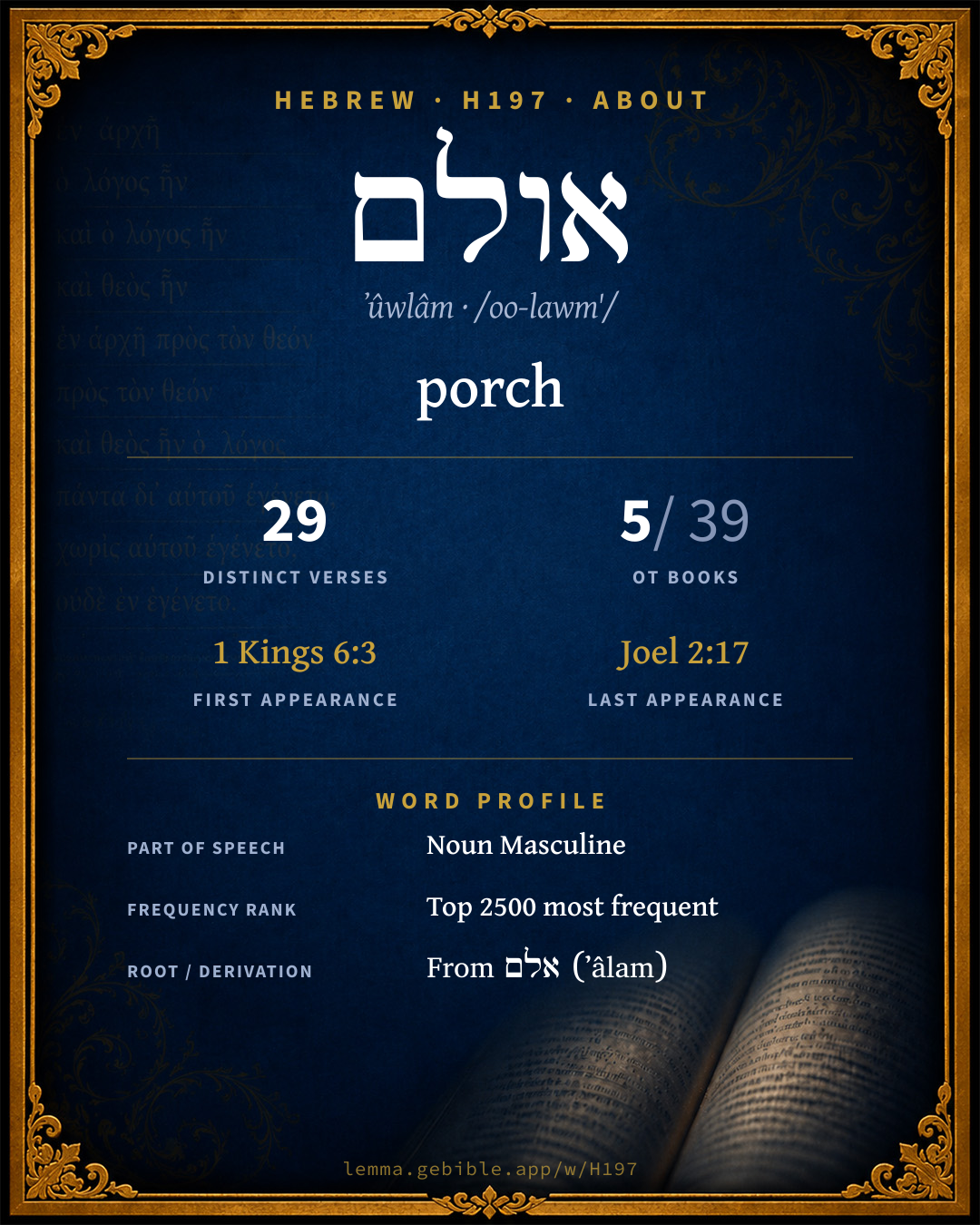
אוּלָם
porch
‘porch’ is one of 4 main senses fuller range ↓
Full lexicon entry — Brown-Driver-Briggs (BDB)
From Brown-Driver-Briggs (BDB)
Where this word appears
See every Construct-state word in the Hebrew Bible →
Grammar key — what these labels mean
Part of speech
- Noun
- A naming word — a person, place, thing, or idea.
Noun type
- Common
- A common noun — a general class of person, place, or thing (“king,” “city,” “water”), not a specific name.
State
- Construct
- A noun bound to a following noun in a possessive / “of” relationship (the construct chain).
- Absolute
- The independent form of a noun, not bound to a following word.
Gender
- Masculine
- Grammatically masculine.
Number
- Singular
- One.
- Plural
- More than one (in Hebrew, generally three or more).
17 distinct verses where H197 appears in the Construct state, across 3 books. Filtered view — show all forms. Click any verse to open its interlinear word-by-word view. Verse text shown in the World English Bible for context — . Each verse’s Hebrew form is shown with its reference; the English is not keyword-highlighted, since the data carries no word-level English alignment. Use “Compare translations” on any verse to read it across multiple English versions. This concordance covers the Hebrew Bible; Septuagint (Greek Old Testament) occurrences are not indexed here.
1 Kings 4 verses
- 1 Kings 7:6 אוּלָ֤ם וְ/אוּלָם֙ n c ms cs conj + n c ms He made the porch of pillars; the length of it was fifty cubits, and the breadth of it thirty cubits; and a porch before them; and pillars and a threshold before them.
- 1 Kings 7:7 וְ/אוּלָ֤ם אֻלָ֥ם conj + n c ms cs n c ms cs He made the porch of the throne where he was to judge, even the porch of judgment: and it was covered with cedar from floor to floor.
- 1 Kings 7:12 וּ/לְ/אֻלָ֥ם conj + prep + n c ms cs The great court round about had three courses of hewn stone, and a course of cedar beams; like as the inner court of the house of Yahweh, and the porch of the house.
- 1 Kings 7:21 לְ/אֻלָ֖ם prep + n c ms cs He set up the pillars at the porch of the temple: and he set up the right pillar, and called the name of it Jachin; and he set up the left pillar, and called the name of it Boaz.
2 Chronicles 2 verses
- 2 Chronicles 15:8 אוּלָ֥ם n c ms cs When Asa heard these words, and the prophecy of Oded the prophet, he took courage, and put away the abominations out of all the land of Judah and Benjamin, and out of the cities which he had taken from the hill-country of Ephraim; and he renewed the altar of Yahweh, that was before the porch of Yahweh.
- 2 Chronicles 29:17 לְ/אוּלָ֣ם prep + n c ms cs Now they began on the first [day] of the first month to sanctify, and on the eighth day of the month came they to the porch of Yahweh; and they sanctified the house of Yahweh in eight days: and on the sixteenth day of the first month they made an end.
Ezekiel 11 verses
- Ezekiel 40:7 אוּלָ֥ם n c ms cs Every lodge was one reed long, and one reed broad; and [the space] between the lodges was five cubits; and the threshold of the gate by the porch of the gate toward the house was one reed.
- Ezekiel 40:8 אֻלָ֥ם n c ms cs He measured also the porch of the gate toward the house, one reed.
- Ezekiel 40:9 אֻלָ֤ם וְ/אֻלָ֥ם n c ms cs conj + n c ms cs Then measured he the porch of the gate, eight cubits; and the posts of it, two cubits; and the porch of the gate was toward the house.
- Ezekiel 40:15 אֻלָ֥ם n c ms cs [From] the forefront of the gate at the entrance to the forefront of the inner porch of the gate were fifty cubits.
- Ezekiel 40:39 וּ/בְ/אֻלָ֣ם conj + prep + n c ms cs In the porch of the gate were two tables on this side, and two tables on that side, to kill thereon the burnt offering and the sin-offering and the trespass-offering.
- Ezekiel 40:40 לְ/אֻלָ֣ם prep + n c ms cs On the [one] side outside, as one goes up to the entry of the gate toward the north, were two tables; and on the other side, which belonged to the porch of the gate, were two tables.
- Ezekiel 40:48 אֻלָ֣ם אֻלָ֔ם n c ms cs n c ms Then he brought me to the porch of the house, and measured each post of the porch, five cubits on this side, and five cubits on that side: and the breadth of the gate was three cubits on this side, and three cubits on that side.
- Ezekiel 41:15 וְ/אֻֽלַמֵּ֖י conj + n c mp cs He measured the length of the building before the separate place which was at the back of it, and the galleries of it on the one side and on the other side, one hundred cubits; and the inner temple, and the porches of the court;
- Ezekiel 44:3 אֻלָ֤ם n c ms cs As for the prince, he shall sit therein as prince to eat bread before Yahweh; he shall enter by the way of the porch of the gate, and shall go out by the way of the same.
- Ezekiel 46:2 אוּלָ֨ם n c ms cs The prince shall enter by the way of the porch of the gate outside, and shall stand by the post of the gate; and the priests shall prepare his burnt-offering and his peace-offerings, and he shall worship at the threshold of the gate: then he shall go forth; but the gate shall not be shut until the evening.
- Ezekiel 46:8 אוּלָ֤ם n c ms cs When the prince shall enter, he shall go in by the way of the porch of the gate, and he shall go forth by the way of it.
About this entry
At a glance — auto-summarized from this page’s data, not written by a person. Every figure links to its source below. This summary describes the numbers; it doesn’t interpret them.
אולם — transliterated ʼûwlâm — is a Hebrew noun carrying the sense “porch.” More than half of its appearances fall in Ezekiel. The Hebrew Bible uses it across 29 verses — moderately common. It is not a single-sense word — see its full sense range. Its English rendering has broadened — “porch” classically, “portico” (Berean Standard Bible) in modern versions; see the renderings breakdown. See the sense tree, 29-verse concordance, and the renderings breakdown below.
Gloss history
Strong's 1890 vs modern scholarship
About this word
Strong's H197 catalogs a Hebrew word from the Hebrew Old Testament.
These counts are not copied from any lexicon or concordance. They are computed here, from the morphology-tagged Hebrew Old Testament. What Lemma adds →
- 29
- distinct verses
- The word appears in 29 distinct verses.
- 5 / 39
- OT books
- The word appears in 5 of 39 Old Testament books.
- #1,041
- by frequency
- Top 2500 most frequent Hebrew words (rank 1,041 of 8,640 Hebrew words by occurrence).
View all 29 occurrences in the concordance →
Most concentrated in
- Ezekiel 15 verses 52%
- 1 Kings 7 verses 24%
- 2 Chronicles 5 verses 17%
By section of the Old Testament
By traditional corpus
Conventional, traditional groupings — biblical authorship is debated, so this is a traditional corpus grouping, not an authorship claim. Each share is this word’s portion of its verses in that division of the Hebrew canon. Each figure is a share of the word’s 29 distinct verses.
- Prophets (Nevi'im) 23 verses · 79%
- Writings (Ketuvim) 6 verses · 21%
How translations render this word
Counts come from each version’s own published word-to-Strong’s tagging or interlinear alignment — an approximate guide to how each version renders this word, not a word-level alignment the data otherwise carries. Because each total is that version’s own tagged count, the per-version totals vary from one another and need not match the appearance or distinct-verse counts above. These counts may also differ from a printed concordance because Lemma counts each distinctly tagged rendering and does not collapse phrase taggings into a single head-word total. This is a fixed set of word-tagged versions (KJV, ASV, BSB, ULT) and does not change with the reading translation you choose elsewhere. Each version’s license is shown beside its name below (and on Sources).
BDB lists this Strong’s number as 4 distinct words (homographs). Each count above pools all of them and is not split by sense — see the Senses section below. A low-frequency rendering may belong to a different one of those words, not the primary meaning.
- King James Version†: Porch 27×, Between the porch 2×
- American Standard Version†: Porch 26×, Between the porch 2×
- Berean Standard Bible†: Portico 26×, Hall 3×
- unfoldingWord Literal Text†: Portico 15×, Porch 10×, Porch of 7×
King James Version Public Domain
Renders H197 across 34† tagged occurrences — most commonly:
Plus 5 renderings that appear only once — usually multi-word phrases or single function words the recovered tagging swept in, not distinct renderings.
American Standard Version Public Domain
Renders H197 across 34† tagged occurrences — most commonly:
Plus 6 renderings that appear only once — usually multi-word phrases or single function words the recovered tagging swept in, not distinct renderings.
Berean Standard Bible Public Domain
Renders H197 across 32† tagged occurrences — most commonly:
Plus 3 renderings that appear only once — usually multi-word phrases or single function words the recovered tagging swept in, not distinct renderings. Not rendered by a distinct English word in 2 further occurrences.
unfoldingWord Literal Text CC BY-SA 4.0
Renders H197 across 36† tagged occurrences — most commonly:
Plus 4 renderings that appear only once — usually multi-word phrases or single function words the recovered tagging swept in, not distinct renderings.
Senses in the full BDB
What do BDB’s symbols mean?
BDB uses these scholarly abbreviations:
| Symbol | Meaning |
|---|---|
| 𝔊 | the Septuagint (the ancient Greek translation, LXX) |
| 𝔙 | the Vulgate (the Latin translation) |
| 𝔖 | the Syriac version (the Peshitta) |
| 𝔗 | the Targum (the Aramaic translation) |
| ψ | the Psalms |
| √ | root (the underlying root or stem) |
| ‖ | parallel passage (a synonymous or contrasted parallel) |
| † | the dagger: every passage where the word occurs is cited |
The 5 senses and sub-senses the full Brown-Driver-Briggs lexicon distinguishes for this word, in lexicon order (not ranked by frequency), with BDB’s own verbatim wording and sub-sense lettering. Shown in Hebrew script with BDB’s own scholarly abbreviations. The condensed entry is in the Lexicon Entry tab. See also the Forms in the corpus table below.
אולם I
- 1. in Solomon’s temple 1 K 7:19; 2 Ch 29:7, א׳ יהוה v 17; 8:12 (altar in front of); א׳ יהוה 15:8 (id.), cf. בֵּין הָאוּלָם וּבֵין הַמִּזְבֵּחַ Ez 8:16 & Jo 2:17; א׳ הַהֵיכָל 1 K 7:21; א׳ הַבַּיִת v 12; תַּבְנִית הָא׳ 1 Ch 28:11. e.g. 1 Kings 7:19
- 2. in Sol.’s palace 1 K 7:8(×2); א׳ הָעַמּוּדִים 1 K 7:6 cf. v 6; א׳ הַכִּסֵּא 7:7 = א׳ הַמִּשְׁפָּט v 7. e.g. 1 Kings 7:8
- 3. in temple of Ezek.’s vision, partic. א׳ הַשַּׁעַר; Ez 40:7, 8, (del. Co vid. 𝔊 𝔖 𝔙) 9(×2), 15, 39, 40; 44:3; 46:2, 8; א׳ הַבַּיִת 40:48 cf. v 48, 49; 41:25, 26; אֻלַמֵּי הֶחָצֵר Ez 41:15 Co sg. ואילמו החיצון v. אֵילָם.—(iii. אוּלָם, adv., v. p. 19.) e.g. Ezekiel 40:7
אולם II m. only geneal.
- 1. 1 Ch 7:16, 17. e.g. 1 Chronicles 7:16
- 2. 1 Ch 8:39, 40. e.g. 1 Chronicles 8:39
אולם III & n.pr.m. v. sub II. אול.
אולם IV and (Jb 17
Senses from the full Brown-Driver-Briggs lexicon (Brown, Driver, Briggs; Oxford 1906 — public domain), digitized via Sefaria, supplemented by the OpenScriptures HebrewLexicon (CC BY 4.0). Full attribution on Sources.
Word origin
I. n.m. 1 K 7:8 porch (cf. אֵילָם)—א׳ abs. 1 K 6:3 +; אֻלָם Ez 40:48, 49; cstr. אוּלָם 1 K 7:6 +; אֻלָם Ez 40:7 + (margin אֻלָּם 1 K 7:7, 12, 21); pl. cstr. אֻלַמֵּי Ez 41:15 (Co sg. c. sf.; in Ez Co reads everywhere אילם vid. אֵילָם infr.)—porch (only K Ch Ez & Jo).
II. n.pr.m. only geneal.
III. n.m. & n.pr.m. v. sub II. אול.
IV. and (Jb 17:10, perhaps for sake of assonance with following כֻּלָּם) אֻלָּם adv. but, but indeed, a strong adversative Jb 2:5; 5:8; 13:3 (where 𝔊 excellently οὐ μὴν δὲ ἀλλά). More usually with וְ, וְאוּלָם Gn 28:19 (cf. Ju 18:29) 48:19 howbeit his younger brother shall be greater than he, Ex 9:16 but in very deed, Nu 14:21 (cf. 1 S 20:3; 25:34) 1 K 20:23 Mic 3:8 Jb 1:11; 11:5; 12:7; 13:4; 14:18; 17:10; 33:1.
— Brown-Driver-Briggs (Oxford 1906, public domain), digitized via Sefaria, supplemented by the OpenScriptures HebrewLexicon (CC BY 4.0). See Sources.
Derived from אלם (ʼâlam) (H481) — to bind.
Jastrow Dictionary
A second Hebrew/Aramaic lexicon for comparison, covering Aramaic and post-biblical (Talmudic, Targumic, Midrashic) usage that the biblical-Hebrew BDB does not. Matched by lemma rather than by Strong’s number, so a lemma may carry more than one Jastrow headword (shown separately below), and the entries cover usage well beyond the Bible.
אוּלָם I
- אלם in front of, opposite, Schr. K. A. T. glossary, a. b. h. conj. אוּלָם) entrance, hall, esp. Ulam, the hall leading to the interior of the Temple. Mid. IV, 7; a. e.
אוּלָם II
- (v. foreg., Οὐλαμμοῦς Euseb. Euseb. Onom.; Neub. Géogr. p. 18; 261) Ulam (Porta) a place in Gilead, and one in Galilee. Y. Snh. X, 28ᵈ
- 2. in Cilicia; v. אַבְלַס
A Dictionary of the Targumim, the Talmud Babli and Yerushalmi, and the Midrashic Literature (Marcus Jastrow; London, Luzac, 1903) — Public Domain. Digitized via Sefaria. Digitized via Sefaria. Full attribution on Sources.
Forms in the corpus
The 29 distinct written forms H197 takes in the Hebrew Bible, most frequent first — each parse links to that state’s occurrences in the concordance. Hebrew forms include their vowel points and cantillation, so a single lemma takes many written forms.
Same root — word family
Other BDB entries built from the same root as H197, grouped by Strong’s listed origin. These share a root / origin per the lexicon — not necessarily a shared meaning. Each links to that word’s own entry.
Derives from
Shares the same root
- אלם ʼêlem H482 in silence
- אלם ʼillêm H483 mute
- אלמה ʼălummâh H485 sheaf
- אלמן ʼalmân H488 widowed
- אלמן ʼalmôn H489 widowhood
Proper names from this root
People and places named from this root — a name, not an additional meaning of the word.
Compare all same-root words → Showing 4 of 8 — not the complete family. 1 of the same-root words is a proper name (a person or place). They share a root, not necessarily a meaning.
Septuagint verse parallels
This word appears in 29 verses that also exist in the Greek Old Testament (Septuagint), out of the 29 Hebrew verses it occurs in. You can read those verses in Greek by switching the Old Testament edition to the Septuagint.
Read these verses in the Septuagint
This is a verse-level parallel only — the same verses exist in both the Hebrew and Greek Old Testaments. No word-level Hebrew↔Greek correspondence is claimed: the data carries no such alignment, so no Greek word is shown as this Hebrew word’s translation. Coverage is not total — the Septuagint omits the deuterocanon and renumbers the Psalms, so some Hebrew verses have no direct Greek parallel.