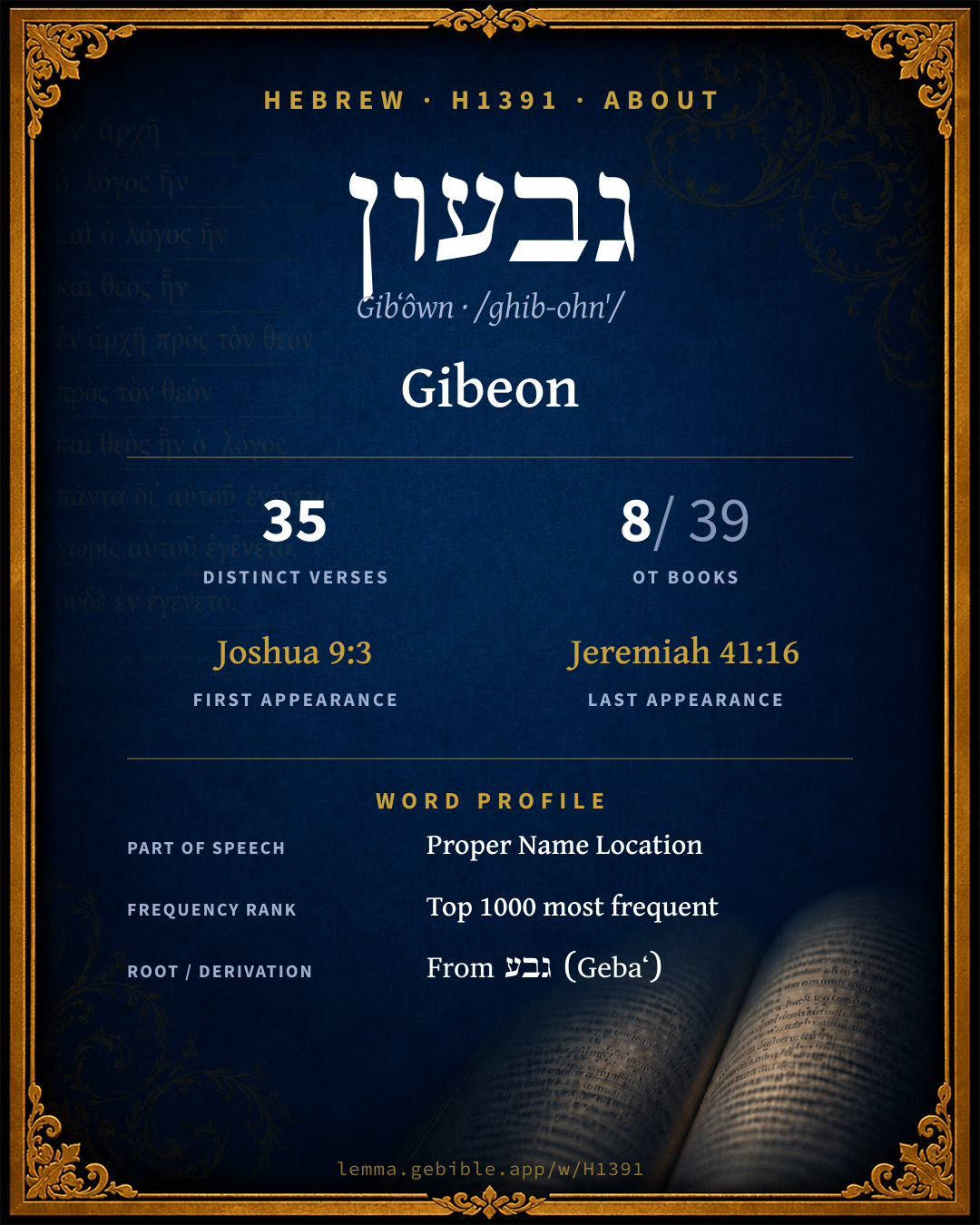
גִּבְעוֹן
Gibeon
BDB lists 2 entries for ‘Gibeon’ fuller range ↓
Full lexicon entry — Brown-Driver-Briggs (BDB)
From Brown-Driver-Briggs (BDB)
Where this word appears
Grammar key — what these labels mean
Part of speech
- Noun
- A naming word — a person, place, thing, or idea.
Noun type
- Proper
- A name of a specific person, place, or people (e.g. Abraham, Zion, Israel).
Every verse where H1391 appears in the Book of Jeremiah — 3 distinct verses. Click any verse to open its interlinear word-by-word view. Verse text shown in the World English Bible for context — . Each verse’s Hebrew form is shown with its reference; the English is not keyword-highlighted, since the data carries no word-level English alignment. Use “Compare translations” on any verse to read it across multiple English versions. This concordance covers the Hebrew Bible; Septuagint (Greek Old Testament) occurrences are not indexed here.
Jeremiah
- Jeremiah 28:1 מִ/גִּבְעוֹן֙ prep + n Proper It happened the same year, in the beginning of the reign of Zedekiah king of Judah, in the fourth year, in the fifth month, that Hananiah the son of Azzur, the prophet, who was of Gibeon, spoke to me in the house of Yahweh, in the presence of the priests and of all the people, saying,
- Jeremiah 41:12 בְּ/גִבְעֽוֹן prep + n Proper then they took all the men, and went to fight with Ishmael the son of Nethaniah, and found him by the great waters that are in Gibeon.
- Jeremiah 41:16 מִ/גִּבְעֽוֹן prep + n Proper Then took Johanan the son of Kareah, and all the captains of the forces who were with him, all the remnant of the people whom he had recovered from Ishmael the son of Nethaniah, from Mizpah, after that he had killed Gedaliah the son of Ahikam, [to wit], the men of war, and the women, and the children, and the eunuchs, whom he had brought back from Gibeon:
About this entry
At a glance — auto-summarized from this page’s data, not written by a person. Every figure links to its source below. This summary describes the numbers; it doesn’t interpret them.
At its core, גבעון (Gibʻôwn) means “Gibeon.” It first appears in Joshua 9:3. Spanning 35 verses in 8 books, it ranks among the moderately common words of the Hebrew Bible. Its uses concentrate in Joshua (37% of all occurrences). Dig into 35-verse concordance and the renderings breakdown below.
Gloss history
Strong's 1890 vs modern scholarship
About this word
Strong's H1391 catalogs a Hebrew word from the Hebrew Old Testament.
These counts are not copied from any lexicon or concordance. They are computed here, from the morphology-tagged Hebrew Old Testament. What Lemma adds →
- 35
- distinct verses
- The word appears in 35 distinct verses.
- 8 / 39
- OT books
- The word appears in 8 of 39 Old Testament books.
- #967
- by frequency
- Top 1000 most frequent Hebrew words (rank 967 of 8,640 Hebrew words by occurrence).
View all 35 occurrences in the concordance →
Most concentrated in
- Joshua 13 verses 37%
- 2 Samuel 6 verses 17%
- 1 Chronicles 5 verses 14%
By section of the Old Testament
By traditional corpus
Conventional, traditional groupings — biblical authorship is debated, so this is a traditional corpus grouping, not an authorship claim. Each share is this word’s portion of its verses in that division of the Hebrew canon. Each figure is a share of the word’s 35 distinct verses.
- Prophets (Nevi'im) 26 verses · 74%
- Writings (Ketuvim) 9 verses · 26%
How translations render this word
Counts come from each version’s own published word-to-Strong’s tagging or interlinear alignment — an approximate guide to how each version renders this word, not a word-level alignment the data otherwise carries. Because each total is that version’s own tagged count, the per-version totals vary from one another and need not match the appearance or distinct-verse counts above. These counts may also differ from a printed concordance because Lemma counts each distinctly tagged rendering and does not collapse phrase taggings into a single head-word total. This is a fixed set of word-tagged versions (KJV, ASV, BSB, ULT) and does not change with the reading translation you choose elsewhere. Each version’s license is shown beside its name below (and on Sources).
- King James Version: Gibeon 28×, Was at gibeon 3×, Is in gibeon 2×
- American Standard Version: Gibeon 27×, Was at gibeon 3×, Is in gibeon 2×
- Berean Standard Bible: Gibeon 34×
- unfoldingWord Literal Text: Gibeon 28×, And 2×, Is in gibeon 2×
King James Version Public Domain
Renders H1391 across 37 tagged occurrences — most commonly:
Plus 4 renderings that appear only once — usually multi-word phrases or single function words the recovered tagging swept in, not distinct renderings.
American Standard Version Public Domain
Renders H1391 across 37 tagged occurrences — most commonly:
Plus 5 renderings that appear only once — usually multi-word phrases or single function words the recovered tagging swept in, not distinct renderings.
Berean Standard Bible Public Domain
Renders H1391 across 37 tagged occurrences — most commonly:
Plus 3 renderings that appear only once — usually multi-word phrases or single function words the recovered tagging swept in, not distinct renderings.
unfoldingWord Literal Text CC BY-SA 4.0
Renders H1391 across 37 tagged occurrences — most commonly:
Plus 3 renderings that appear only once — usually multi-word phrases or single function words the recovered tagging swept in, not distinct renderings.
Senses in BDB
The 2 senses BDB distinguishes for this word, in lexicon order (not ranked by frequency or importance). The full entry — with sub-senses — is in the Lexicon Entry tab.
- Gibeon = "hill city"
- a Levitical city of Benjamin, modern 'el-Jib', which lies 5 miles or 8 kilometers from Jerusalem
Word origin
גִּבְעוֹן n.pr.loc. Levitical city in tribe of Benjamin; cf. also as n.pr.m.
— Brown-Driver-Briggs (Oxford 1906, public domain), digitized via Sefaria, supplemented by the OpenScriptures HebrewLexicon (CC BY 4.0). See Sources.
Derived from גבע (Gebaʻ) (H1387) — Geba.
Forms in the corpus
The 25 distinct written forms H1391 takes in the Hebrew Bible, most frequent first — each parse links to that state’s occurrences in the concordance. Hebrew forms include their vowel points and cantillation, so a single lemma takes many written forms.
| Form | Parsing | Example | Uses |
|---|---|---|---|
| בְּ/גִבְעֽוֹן | Noun, Proper | 1 Chronicles 16:39 | 5 |
| גִבְע֖וֹן | Noun, Proper | 1 Chronicles 9:35 | 3 |
| בְּ/גִבְע֑וֹן | Noun, Proper | 2 Chronicles 1:3 | 2 |
| בְּ/גִבְע֣וֹן | Noun, Proper | Isaiah 28:21 | 2 |
| גִבְע֑וֹן | Noun, Proper | 1 Chronicles 8:29 | 2 |
| גִּבְע֔וֹן | Noun, Proper | Joshua 10:2 | 2 |
| גִּבְע֖וֹן | Noun, Proper | 2 Samuel 2:13 | 2 |
| גִּבְעֽוֹן | Noun, Proper | 2 Samuel 2:24 | 2 |
| בְּ/גִבְע֔וֹן | Noun, Proper | 2 Samuel 20:8 | 1 |
| בְּ/גִבְע֖וֹן | Noun, Proper | 2 Samuel 3:30 | 1 |
| בְּ/גִבְע֗וֹן | Noun, Proper | 1 Kings 3:5 | 1 |
| בְּ/גִבְעוֹן֙ | Noun, Proper | 2 Chronicles 1:13 | 1 |
| גִבְע֜וֹן | Noun, Proper | Joshua 9:3 | 1 |
| גִבְע֨וֹן | Noun, Proper | Joshua 10:6 | 1 |
| גִבְעוֹן֙ | Noun, Proper | Joshua 10:1 | 1 |
| גִּבְע֑וֹן | Noun, Proper | Joshua 10:4 | 1 |
| גִּבְע֣וֹן | Noun, Proper | Joshua 9:17 | 1 |
| גִּבְע֥וֹן | Noun, Proper | Joshua 18:25 | 1 |
| גִּבְעֹ֨נָ/ה֙ | Noun, Proper | 1 Kings 3:4 | 1 |
| גִּבְעֽוֹנָ/ה | Noun, Proper | 2 Samuel 2:12 | 1 |
| וּ/בְ/גִבְע֛וֹן | Noun, Proper | 1 Chronicles 9:35 | 1 |
| וּ/בְ/גִבְע֥וֹן | Noun, Proper | 1 Chronicles 8:29 | 1 |
| מִ/גִּבְע֖וֹן | Noun, Proper | 1 Chronicles 14:16 | 1 |
| מִ/גִּבְעֽוֹן | Noun, Proper | Jeremiah 41:16 | 1 |
| מִ/גִּבְעוֹן֙ | Noun, Proper | Jeremiah 28:1 | 1 |
Same root — word family
Other BDB entries built from the same root as H1391, grouped by Strong’s listed origin. These share a root / origin per the lexicon — not necessarily a shared meaning. Each links to that word’s own entry.
Derives from
Shares the same root
Proper names from this root
People and places named from this root — a name, not an additional meaning of the word.
Compare all same-root words → 2 of the same-root words are proper names (people or places). They share a root, not necessarily a meaning.
Bible dictionary
Public-domain dictionary articles matched to this entry by name (Gibeon). A biblical name can be shared by more than one person or place, so an article may treat several.
Easton's Bible Dictionary · M. G. Easton, 1897
Hill-city, "one of the royal cities, greater than Ai, and all the men thereof were mighty" (Josh. 10:2). Its inhabitants were Hivites (11:19). It lay within the territory of Benjamin, and became a priest-city (18:25; 21:17). Here the tabernacle was set up after the destruction of Nob, and here it remained many years till the temple was built by Solomon. It is represented by the modern el-Jib, to the south-west of Ai, and about 5 1/2 miles north-north-west of Jerusalem.
A deputation of the Gibeonites, with their allies from three other cities (Josh. 9;17), visited the camp at Gilgal, and by false representations induced Joshua to enter into a league with them, although the Israelites had been specially warned against any league with the inhabitants of Canaan (Ex. 23:32; 34:12; Num. 33:55; Deut. 7:2). The deception practised on Joshua was detected three days later; but the oath rashly sworn "by Jehovah God of Israel" was kept, and the lives of the Gibeonites were spared. They were, however, made "bondmen" to the sanctuary (Josh. 9:23).
The most remarkable incident connected with this city was the victory Joshua gained over the kings of Palestine (Josh. 10:16-27). The battle here fought has been regarded as "one of the most important in the history of the world." The kings of southern Canaan entered into a confederacy against Gibeon (because it had entered into a league with Joshua) under the leadership of Adoni-zedec, king of Jerusalem, and marched upon Gibeon with the view of taking possession of it. The Gibeonites entreated Joshua to come to their aid with the utmost speed. His army came suddenly upon that of the Amorite kings as it lay encamped before the city. It was completely routed, and only broken remnants of their great host found refuge in the fenced cities. The five confederate kings who led the army were taken prisoners, and put to death at Makkedah (q.v.). This eventful battle of Beth-horon sealed the fate of all the cities of Southern Palestine. Among the Amarna tablets is a letter from Adoni-zedec (q.v.) to the king of Egypt, written probably at Makkedah after the defeat, showing that the kings contemplated flight into Egypt.
This place is again brought into notice as the scene of a battle between the army of Ish-bosheth under Abner and that of David led by Joab. At the suggestion of Abner, to spare the effusion of blood twelve men on either side were chosen to decide the battle. The issue was unexpected; for each of the men slew his fellow, and thus they all perished. The two armies then engaged in battle, in which Abner and his host were routed and put to flight (2 Sam. 2:12-17). This battle led to a virtual truce between Judah and Israel, Judah, under David, increasing in power; and Israel, under Ish-bosheth, continually losing ground.
Soon after the death of Absalom and David's restoration to his throne his kingdom was visited by a grievous famine, which was found to be a punishment for Saul's violation (2 Sam. 21:2, 5) of the covenant with the Gibeonites (Josh. 9:3-27). The Gibeonites demanded blood for the wrong that had been done to them, and accordingly David gave up to them the two sons of Rizpah (q.v.) and the five sons of Michal, and these the Gibeonites took and hanged or crucified "in the hill before the Lord" (2 Sam. 21:9); and there the bodies hung for six months (21:10), and all the while Rizpah watched over the blackening corpses and "suffered neither the birds of the air to rest on them by day, nor the beasts of the field by night." David afterwards removed the bones of Saul and Jonathan at Jabeshgilead (21:12, 13).
Here, "at the great stone," Amasa was put to death by Joab (2 Sam. 20:5-10). To the altar of burnt-offering which was at Gibeon, Joab (1 Kings 2:28-34), who had taken the side of Adonijah, fled for sanctuary in the beginning of Solomon's reign, and was there also slain by the hand of Benaiah.
Soon after he came to the throne, Solomon paid a visit of state to Gibeon, there to offer sacrifices (1 Kings 3:4; 2 Chr. 1:3). On this occasion the Lord appeared to him in a memorable dream, recorded in 1 Kings 3:5-15; 2 Chr. 1:7-12. When the temple was built "all the men of Israel assembled themselves" to king Solomon, and brought up from Gibeon the tabernacle and "all the holy vessels that were in the tabernacle" to Jerusalem, where they remained till they were carried away by Nebuchadnezzar (2 Kings 24:13).
Smith's Bible Dictionary · William Smith, 1863
(hill city), one of the four, cities of the Hivites, the inhabitants of which made a league with Joshua, (Joshua 9:3-15) and thus escaped the fate of Jericho and Ai. Comp. ch. (Joshua 11:19) Gibeon lay within the territory of Benjamin, ch. (Joshua 18:25) and with its "suburbs" was allotted to the priests, ch. (Joshua 21:17) of whom it became afterwards a principal station. It retains its ancient name almost intact, el-Jib . Its distance from Jerusalem by the main road is about 6 1/2 miles; but there is a more direct road reducing it to five miles.
Hitchcock's Bible Names Dictionary · Roswell D. Hitchcock, 1869
hill; cup; thing lifted up
Classic public-domain reference works; full attribution on Sources.
Septuagint verse parallels
This word appears in 33 verses that also exist in the Greek Old Testament (Septuagint), out of the 35 Hebrew verses it occurs in. You can read those verses in Greek by switching the Old Testament edition to the Septuagint.
Read these verses in the Septuagint
This is a verse-level parallel only — the same verses exist in both the Hebrew and Greek Old Testaments. No word-level Hebrew↔Greek correspondence is claimed: the data carries no such alignment, so no Greek word is shown as this Hebrew word’s translation. Coverage is not total — the Septuagint omits the deuterocanon and renumbers the Psalms, so some Hebrew verses have no direct Greek parallel.