Jeremiah 41:12

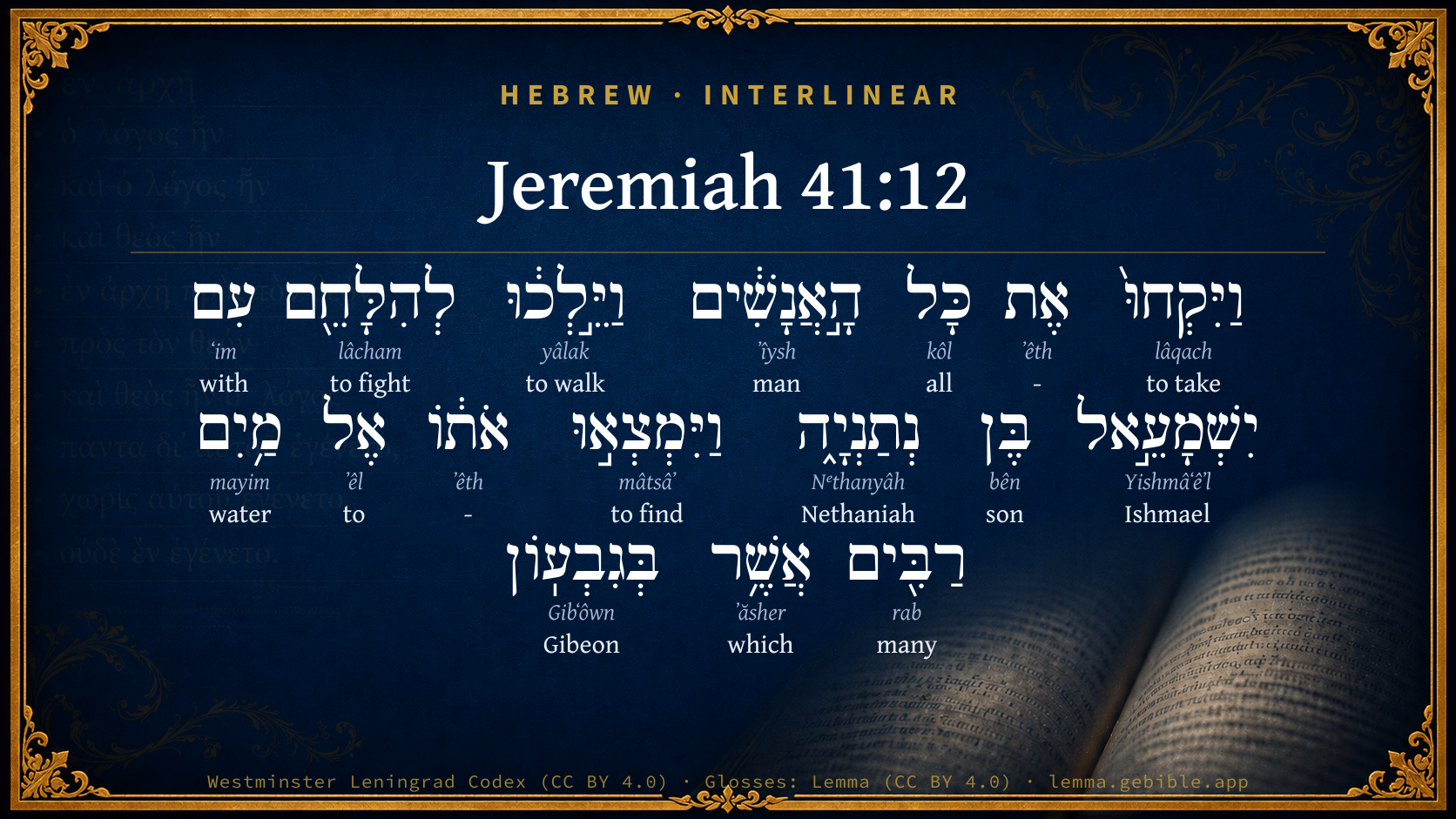
Hebrew (Westminster Leningrad Codex) Jeremiah 41:12 appears in the Hebrew Old Testament. The text above is from the Westminster Leningrad Codex. Each word links to its Strong’s number, a concise gloss, and parsing drawn from the Open Scriptures Hebrew Bible morphology. Click any word for its full Brown-Driver-Briggs (BDB) entry.
Download image
Cite this verse

Jeremiah 41:12 (World English Bible). Public Domain. Lemma interlinear Bible study tool, https://lemma.gebible.app/v/jeremiah/41/12.

Show BibTeX & RIS
BibTeX
RIS
English Translation
then they took all the men, and went to fight with Ishmael the son of Nethaniah, and found him by the great waters that are in Gibeon.
World English Bible · Public Domain
Download a study sheet

One document with this verse’s original text, its word-by-word gloss line, the meaning frame, cross-references with their text, attributed commentary, and full source and license credits — printable, and it pastes into notes with its structure intact.

This verse Autodidact and up

Study sheet (.html) Plain text (.txt)

A passage Seminary Student

Up to 50 verses in one chapter. A passage sheet keeps up to 6 commentary sources and 12 cross-references per verse, in the order this page ranks them, and says so on the sheet whenever that leaves anything out. Ask for a single verse and you get the Autodidact verse sheet above.

Everything on this page stays free to read, with no account — the sheet is a download of what is already on screen, not access to it.

Want to remove ads? Support Godless Engineer
Compare translations 3

The same verse in 3 English versions, stacked beneath the original-language interlinear above. Click any original word for its lexicon entry.

Each is an independent rendering of the whole verse — the interlinear is not word-aligned to these translations.

Highlighted words mark where these versions differ — a whole-verse word diff, not a word-by-word alignment.

  • World English Bible Public Domain
    then they took all the men, and went to fight with Ishmael the son of Nethaniah, and found him by the great waters that are in Gibeon.
  • King James Version Public Domain
    Then they took all the men, and went to fight with Ishmael the son of Nethaniah, and found him by the great waters that are in Gibeon.
  • unfoldingWord Literal Text CC BY-SA 4.0
    So they took all their men and went to fight against Ishmael son of Nethaniah. They found him at the great pool of Gibeon.

unfoldingWord Literal Text — © unfoldingWord, licensed CC BY-SA 4.0. Word-aligned USFM3 via Door43 (git.door43.org/unfoldingWord/en_ult).

Versions to compare (up to 4)

3 of 4 selected

Show all 18 translations

Every available English version of this verse, each an independent rendering of the whole verse.

  • World English Bible Public Domain
    then they took all the men, and went to fight with Ishmael the son of Nethaniah, and found him by the great waters that are in Gibeon.
  • Berean Standard Bible Public Domain
    they took all their men and went to fight Ishmael son of Nethaniah. And they found him near the great pool in Gibeon.
  • Majority Standard Bible Public Domain
    they took all their men and went to fight Ishmael son of Nethaniah. And they found him near the great pool in Gibeon.
  • King James Version Public Domain
    Then they took all the men, and went to fight with Ishmael the son of Nethaniah, and found him by the great waters that are in Gibeon.
  • American Standard Version (1901) Public Domain
    then they took all the men, and went to fight with Ishmael the son of Nethaniah, and found him by the great waters that are in Gibeon.
  • Revised Version (1885) Public Domain
    then they took all the men, and went to fight with Ishmael the son of Nethaniah, and found him by the great waters that are in Gibeon.
  • Geneva Bible (1599) Public Domain
    Then they all tooke their men, and went to fight with Ishmael the sonne of Nethaniah, and founde him by ye great waters that are in Gibeon.
  • Douay-Rheims (1899) Public Domain
    And taking all the men, they went out to fight against Ismahel the son of Nathanias, and they found him by the great waters that are in Gabaon.
  • Young's Literal Translation Public Domain
    and they take all the men, and go to fight with Ishmael son of Nethaniah, and they find him at the great waters that `are' in Gibeon.
  • Literal Standard Version CC BY-SA 4.0
    and they take all the men, and go to fight with Ishmael son of Nethaniah, and they find him at the great waters that [are] in Gibeon.
  • Unlocked Literal Bible CC BY-SA 4.0
    So they took all their men and went to fight against Ishmael son of Nethaniah. They found him at the great pool of Gibeon.
  • unfoldingWord Literal Text CC BY-SA 4.0
    So they took all their men and went to fight against Ishmael son of Nethaniah. They found him at the great pool of Gibeon.
  • Darby Bible Public Domain
    and they took all the men, and went to fight with Ishmael the son of Nethaniah, and found him by the great waters that are at Gibeon.
  • World Messianic Bible Public Domain
    then they took all the men, and went to fight with Ishmael the son of Nethaniah, and found him by the great waters that are in Gibeon.
  • Webster's Bible Public Domain
    Then they took all the men, and went to fight with Ishmael the son of Nethaniah, and found him by the great waters that are in Gibeon.
  • Free Bible Version CC BY-SA 4.0
    So they assembled all their men and went to attack Ishmael. They caught up with him near the large pool in Gibeon.
  • Bible in Basic English Public Domain
    They took their men and went out to make war on Ishmael, the son of Nethaniah, and they came face to face with him by the great waters in Gibeon.
  • JPS Tanakh (1917) Public Domain
    then they took all the men, and went to fight with Ishmael the son of Nethaniah, and found him by the great waters that are in Gibeon.

Literal Standard Version (2020), Covenant Press — licensed CC BY-SA 4.0. Text via the HelloAO Bible API (eBible.org). Unlocked Literal Bible (unfoldingWord) — licensed CC BY-SA 4.0. Text via the HelloAO Bible API (eBible.org). unfoldingWord Literal Text — © unfoldingWord, licensed CC BY-SA 4.0. Word-aligned USFM3 via Door43 (git.door43.org/unfoldingWord/en_ult). Free Bible Version, Dr. Jonathan Gallagher — licensed CC BY-SA 4.0. Text via the HelloAO Bible API (eBible.org).

Word by word

More ways to search: Search by grammar → Find every occurrence → Compare this word →

Practice this passage: Drill this verse → Learn its vocabulary →

נְתַנְיָ֑ה
Nᵉthanyâh
H5418
“Nethaniah”
Noun, Proper
Part of Speech
Noun
Type
Proper
Full BDB Definition

Origin: from H5414 and H3050

TWOT: None

Nethaniah = "given of Jehovah" - son of Elishama of the royal family of Judah and father of Ishmael who murdered Gedaliah - father of Jehudi - a Levite, one of the 4 sons of Asaph the minstrel - a Levite in the reign of king Jehoshaphat of Judah
  1. וַיִּקְחוּ֙ lâqach H3947 “and · to take” Conjunction + Verb, Qal, Sequential Imperfect, 3rd Person, Masculine, Plural
  2. אֶת ʼêth H853 “-” Particle, Direct Object
  3. כָּל kôl H3605 “all of” Noun, Common, Masculine, Singular, Construct
  4. הָ֣אֲנָשִׁ֔ים ʼîysh H376 “the · men” Particle, Definite Article + Noun, Common, Masculine, Plural, Absolute
  5. וַיֵּ֣לְכ֔וּ yâlak H3212 “and · to walk” Conjunction + Verb, Qal, Sequential Imperfect, 3rd Person, Masculine, Plural
  6. לְהִלָּחֵ֖ם lâcham H3898 “to fight” Preposition + Verb, Niphal, Infinitive Construct
  7. עִם ʻim H5973 “with” Preposition
  8. יִשְׁמָעֵ֣אל Yishmâʻêʼl H3458 “Ishmael” Noun, Proper
  9. בֶּן bên H1121 “son of” Noun, Common, Masculine, Singular, Construct
  10. וַיִּמְצְא֣וּ mâtsâʼ H4672 “and · to find” Conjunction + Verb, Qal, Sequential Imperfect, 3rd Person, Masculine, Plural
  11. אֹת֔וֹ ʼêth H853 “- · him” Particle, Direct Object + Suffix, Personal, 3rd Person, Masculine, Singular
  12. אֶל ʼêl H413 “to” Preposition
  13. מַ֥יִם mayim H4325 “water(s)” Noun, Common, Masculine, Plural, Absolute
  14. רַבִּ֖ים rab H7227 “many” Adjective, Adjective, Masculine, Plural, Absolute
  15. אֲשֶׁ֥ר ʼăsher H834 “which” Particle, Relative
  16. בְּגִבְעֽוֹן Gibʻôwn H1391 “in/at · Gibeon” Preposition + Noun, Proper

About this verse

These counts appear in no published source. They are computed here, from the morphology-tagged text and Lemma’s own curated glosses. What Lemma adds →

17
words
16
distinct lemmas
Prophets
section

Notable vocabulary

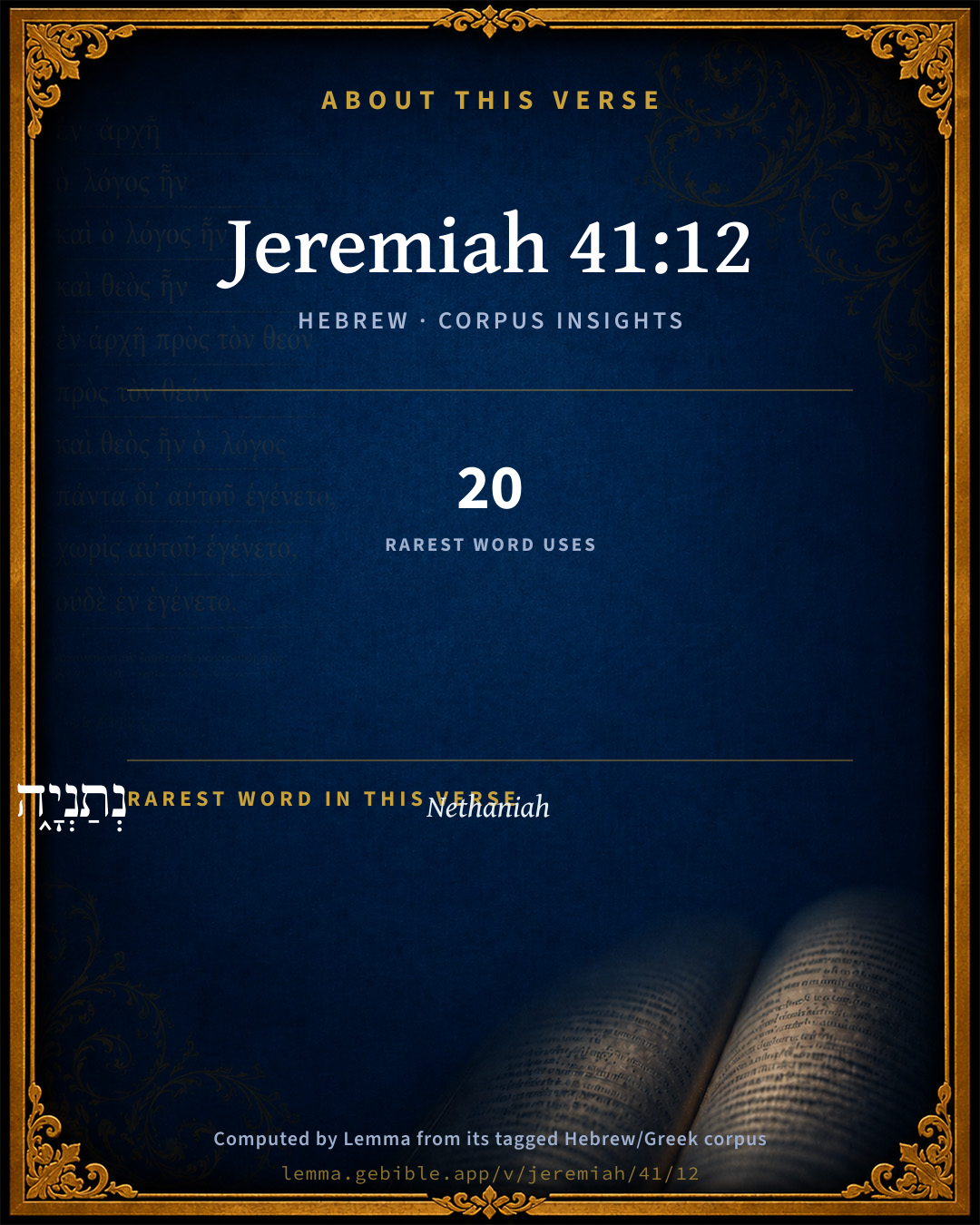
The rarest word here is נְתַנְיָ֑ה Nethaniah H5418 — appearing just 20 times in the whole Hebrew Bible.

Shared distinctive vocabulary

נְתַנְיָ֑ה Nethaniah H5418 occurs in 20 verses of the Hebrew Bible. Also found in:

Grammatical profile

  • 4 verbs
  • 7 nouns
  • 1 adjective
  • 2 prepositions
  • 3 particles

Verb forms

  • וַיִּקְחוּ֙ Qal · Sequential Imperfect
  • וַיֵּ֣לְכ֔וּ Qal · Sequential Imperfect
  • לְהִלָּחֵ֖ם Niphal · Infinitive Construct
  • וַיִּמְצְא֣וּ Qal · Sequential Imperfect

Cross-references

4

Topical passages linked to Jeremiah 41:12 in the Treasury of Scripture Knowledge — connected by theme and wording, ordered by reader-vote popularity; previews shown in the World English Bible.

  • 2 Samuel 2:13 Joab the son of Zeruiah, and the servants of David, went out, and met them by the pool of Gibeon; and they sat down, the one on the one side of the pool, and the other on the other side of the pool.
  • Genesis 14:14–16 When Abram heard that his relative was taken captive, he led forth his trained men, born in his house, three hundred and eighteen, and pursued as far as Dan.
  • 1 Samuel 30:1–8 It happened, when David and his men were come to Ziklag on the third day, that the Amalekites had made a raid on the South, and on Ziklag, and had struck Ziklag, and burned it with fire,
  • 1 Samuel 30:18–20 David recovered all that the Amalekites had taken; and David rescued his two wives.

Cross-references courtesy of OpenBible.info (CC BY 4.0).

Hebrew and Greek witnesses Masoretic Hebrew ↔ Greek Septuagint

The same verse in the two great witnesses to the Old Testament, shown verse-for-verse.

These are two independent witnesses, not word-aligned to each other, and the Septuagint is shown in lemma (dictionary) form.

Hebrew Jeremiah 41:12 Masoretic · Westminster Leningrad Codex

וַיִּקְחוּ֙ אֶת כָּל הָ֣אֲנָשִׁ֔ים וַיֵּ֣לְכ֔וּ לְהִלָּחֵ֖ם עִם יִשְׁמָעֵ֣אל בֶּן נְתַנְיָ֑ה וַיִּמְצְא֣וּ אֹת֔וֹ אֶל מַ֥יִם רַבִּ֖ים אֲשֶׁ֥ר בְּגִבְעֽוֹן

then they took all the men, and went to fight with Ishmael the son of Nethaniah, and found him by the great waters that are in Gibeon.

World English Bible · Public Domain

Greek LXX Structure differs

In the Septuagint, Jeremiah is about an eighth shorter than the Hebrew and arranges its material differently — the Oracles Against the Nations (Hebrew chapters 46–51) appear in the middle of the Greek book, after 25:13. Because the chapter and verse boundaries do not line up, a verse-for-verse comparison with the Hebrew is not shown.

A verse-for-verse comparison isn’t shown here because the chapters and verses don’t line up. Switch to the LXX edition with the MT / LXX toggle above to read the Greek directly.

Hebrew: Westminster Leningrad Codex (CC BY 4.0). Greek: Septuagint (public domain); English from a public-domain English Septuagint. How the Septuagint differs from the Hebrew →

Targum (Aramaic paraphrase)

1

The Targum is the ancient Jewish Aramaic paraphrase of the Hebrew Scriptures — an interpretive translation, not the Hebrew text itself. Onkelos (literal) and Pseudo-Jonathan (expansive) render the Torah, and Jonathan the Prophets. Coverage is partial: where no permissively-licensed English translation exists for a verse, only the Aramaic is shown. This is verse-level text, not a word-by-word alignment to the Hebrew.

  1. Targum Jonathan Prophets (Joshua–Malachi)
    וּדְבָרוּ יַת כָּל גַבְרַיָא וַאֲזַלוּ לְאַגָחָא עַל יִשְׁמָעֵאל בַּר נְתַנְיָה וְאַשְׁכָּחוּ יָתֵיהּ עַל בְּרִיכַת מַיִין סַגִיאִין דִי בְּגִבְעוֹן:

    (no public-domain English translation for this verse)

    Targum Jonathan — Aramaic: “Mikraot Gedolot” (public domain). English: “Sefaria Community Translation” (CC0 1.0 (public-domain dedication)); “London "Chaldee Paraphrase," 1871” (public domain). Text via Sefaria.

Commentary

Notes on Jeremiah 41:12 from classic Christian and Jewish commentators (each source and its license shown beneath its notes). The classic Christian expositions comment on the surrounding passage and are grouped to its opening verse, so a note may address several verses; the Jewish commentaries on the Tanakh (Rashi and others) are per-verse, so they appear only where the commentator wrote on this verse.

Lemma curates 59 commentaries, every one of them public domain or Creative Commons licensed, each selected and text-cleaned for this edition rather than reprinted as found. About our sources →

Trapp's Complete Commentary

John Trapp

Jer 41:12 Then they took all the men, and went to fight with Ishmael the son of Nethaniah, and found him by the great waters that [are] in Gibeon.

Ver. 12. Then they took all the men, and went to fight with Ishmael.] This act of theirs carrieth the commendation of fortitude, of charity, and of piety. Like as did that of Abraham in rescuing Lot; of Gideon and Jehoshaphat in delivering the Israelites from their barbarous and blood-thirsty enemies; of Scanderbeg, Hunniades, Gustavus King of Sweden, &c. Unless Ishmael and Johanan did as Ishmael the Persian King of Selymus, and the Great Turk, who, fighting for the empire of the East, masked their aspiring thoughts under the veil of zeal to their religion. {a} It well appeareth now to the world that neither of them were right, whatever they pretended.

And they found him by the great waters that are in Gibeon.] Where, in David’s days, those youngsters of Helkathhazzurim had sheathed their swords in their fellows’ bowels. {2Sa 2:16}

{a} Turkish History, 515.

John Trapp, A Commentary or Exposition upon All the Books of the Old and New Testament (1647–1656) — public domain. Text from a community e-Sword module.

Jamieson, Fausset & Brown

Robert Jamieson, A. R. Fausset & David Brown

the . . . waters-- (Sa2 2:13); a large reservoir or lake.

in Gibeon--on the road from Mizpah to Ammon: one of the sacerdotal cities of Benjamin, four miles northwest of Jerusalem, now Eljib.

Jamieson, Fausset & Brown — Commentary Critical and Explanatory on the Whole Bible (1871) — public domain (CC PDM 1.0). Text via the HelloAO Bible API.

John Calvin's Commentaries

Here the Prophet informs us, that Ishmael did not attain his wishes; for he had resolved to sell; as it were, the people to the king of Ammon, but he was intercepted in his course. But he says first, that John the son of Kareah had heard the report, and that he, together with other leaders, went to meet him in order to intercept him in his journey. He says also that he collected all the men, even those who had been dispersed. All then they could have got, they enlisted, and went to fight with Ishmael. And the Prophet adds, that they found him at the great waters And I think they were so called because they were either a lake or a pool. I doubt not, then, but that it was a common name. Some say that the waters were then abundant, because there had been constant rains. But this conjecture is not probable. The simpler meaning is, that these waters were thus called, because in that part the abundance of water was not great in comparison with the lake. Ishmael then was found there. It is now added by the Prophet, that the captives rejoiced when they saw John, and immediately came over to his side. he therefore says, —

John Calvin's Commentaries (1540-1563) — public domain. Text from the Calvin Translation Society English edition (1840s-50s) via the Christian Classics Ethereal Library (ccel.org). Calvin's coverage is partial (roughly two-thirds of the Bible); uncommented books and verses are honest gaps, never fabricated. The 19th-century editor's footnotes and remarks are omitted so the notes are faithfully Calvin's own voice.

Ellicott's Commentary for English Readers

(12) By the great waters that are in Gibeon.—Johanan and his friends had been unable to prevent the slaughter of which they had warned Gedaliah (Jer_41:15), but they were not too late to avenge it. Gibeon, retaining its name with little alteration in the modern El-jibe, lay about two miles from Mizpah; so that Ishmael must have halted on thinking himself safe against attack. On the east side of the hill on which it stands there are the remains of a large tank, about 120 feet by 100. It appears as the “pool of Gibeon” in 2Sa_2:13, as the scene of a conflict between Joab and Abner. Josephus (Ant. x. 9-15) places the attack on Ishmael at “the pool in Hebron,” which is mentioned in 2Sa_4:12. This, however, would hardly have been in Ishmael’s route to the country of the Ammonites.

A Bible Commentary for English Readers, edited by Charles John Ellicott (1878–1897) — public domain. Text from a community e-Sword module.

The Cambridge Bible for Schools and Colleges

gen. ed. J. J. S. Perowne

12. Gibeon] See on Jer_28:1. The “great waters” apparently are to be identified with the “pool” of 2Sa_2:13. Gibeon was about a mile N. of Mizpah.

The Cambridge Bible for Schools and Colleges (gen. ed. J. J. S. Perowne; Cambridge University Press, 1878–1918) — public domain. Text from a community e-Sword module.

John Gill's Exposition

Then they took all the men,.... All the soldiers that were under their command; this they did at once, believing the report to be true, as they had reason to do; since they knew of Ishmael's designs, and had given notice and warning of them to Gedaliah, though he would not listen to them:

and went to fight with Ishmael the son of Nethaniah: resolving to give him battle, and to revenge the innocent blood he had shed, and rescue the captives out of his hands he was carrying to the Ammonites:

and found him by the great waters that are in Gibeon; taking this road to the country of Ammon, though it was not quite the direct road; either to avoid the forces of Johanan; or rather for the sake of the hid treasure at Shechem, or Shiloh, or Samaria, the ten men had promised him for their lives. These great waters were the same with the pool at Gibeon, where the servants of Ishbosheth and the servants of David met, and sat one on one side, and the other on the other; and where twelve young men on each side slew one another, and from thence called Helkathhazzurim, Sa2 2:12; and the Targum calls it

"the pool of many waters, which were in Gibeon.''

Josephus (p) calls it a fountain in Hebron; which perhaps should be read Gibeon.

(p) Antiqu. l. 10. c. 9. sect. 5.

John Gill's Exposition of the Whole Bible (1746–1763) — public domain (CC PDM 1.0). Text via the HelloAO Bible API.

Albert Barnes' Notes on the Bible

An open pool still exists at Gibeon, and a large subterranean reservoir fed by a copious natural spring. Gibeon is about two miles north of Mizpah.

Albert Barnes' Notes on the Bible (1834–1885) — public domain. Text from a community e-Sword/MySword module.

Haydock's Catholic Bible Commentary

Gabaon, famous for the battle of Abner, 2 Kings ii. 13.

George Leo Haydock (1774–1849), Haydock's Catholic Family Bible and Commentary, 1859 edition — public domain. Excludes Psalms (Douay-Rheims chapter numbering differs from Protestant) and Deuterocanonical books (Catholic canon only).

Matthew Poole's English Annotations

These

great waters are supposed to be a lake, or some great pool in Gibeon, the very same that is mentioned 2Sa 2:13, where Joab and the servants of David met, the one keeping on one side of the pool, the other on the other side.

Matthew Poole's English Annotations on the Holy Bible (1683–1685) — public domain. Text from a community e-Sword/MySword module.

Whedon's Commentary on the Bible

Daniel D. Whedon

12. The great waters that are in Gibeon — Probably a reservoir or pool. Robinson describes such a pool still existing there fed by a natural spring. Gibeon is about two miles north of Mizpah, and was one of the sacerdotal cities of Benjamin.

Daniel D. Whedon (gen. ed.), Commentary on the Old and New Testaments (1874–1909) — public domain. Text from a community e-Sword module.

The Pulpit Commentary

The great waters.., in Gibeon; i.e. the pool mentioned in 2Sa_2:13. Dr. Thomson (p. 670) speaks of a "pond or small lake" near El-Jib. Ishmael seems to be lingering over his journey to Ammon, in order to find the subterranean stores spoken of in ver. 8.

The Pulpit Commentary (1880–1919), ed. H.D.M. Spence-Jones & Joseph S. Exell — public domain. Text from a community e-Sword module.

Rashi

Rabbi Shlomo Yitzchaki (Rashi)

by the great waters [By the pool of great waters.]

Rashi on the Tanakh — English translations: “The Judaica Press complete Tanach with Rashi, translated by A. J. Rosenberg” (CC BY 4.0); “Pentateuch with Rashi's commentary by M. Rosenbaum and A.M. Silbermann, 1929-1934” (public domain); “The Metsudah Tanach series, Lakewood, N.J” (CC BY 4.0); and “The Book of Joshua, Metsudah Publications, 1997” (CC BY 4.0). Text via Sefaria.

Lesson kit

Teaching starters — assembled from the data on this page, not authored interpretation. Every prompt links to the verse data it draws on. Edit before teaching.

Jeremiah, in the Prophets, opens this verse with 17 words (16 distinct Hebrew lemmas). Its most distinctive word is Nᵉthanyâh (“Nethaniah”). A historical commentator’s framing appears above. Read the whole chapter for the surrounding context.

Discussion questions

  1. The word Nᵉthanyâh carries the sense “Nethaniah.” How does it shape the verse?
  2. How does 2 Kings 25:23, which shares the word «Nethaniah», read alongside this verse?
  3. These translations render this verse differently. What is at stake in choosing one wording over another?
  4. «וַיִּקְחוּ֙» is a Qal Sequential Imperfect verb. How does that grammatical form shape the action described?
  5. Compare how Trapp's Complete Commentary and Jamieson, Fausset & Brown read this verse. Where do they agree or differ?

Things to notice

Reading settings

Reading text

Shown beneath each verse's original-language words.

Old Testament
Old Testament edition

Read the OT as the Masoretic Hebrew (MT) or the Greek Septuagint (LXX).

English shown for the Greek Septuagint (in the Hebrew ↔ Greek comparison).

Comparing translations? Open the Compare panel on any verse page to stack up to four side by side.