
1 Chronicles 9:35

Hebrew (Westminster Leningrad Codex) 1 Chronicles 9:35 appears in the Hebrew Old Testament. The text above is from the Westminster Leningrad Codex. Each word links to its Strong’s number, a concise gloss, and parsing drawn from the Open Scriptures Hebrew Bible morphology. Click any word for its full Brown-Driver-Briggs (BDB) entry.
Download image
Cite this verse

1 Chronicles 9:35 (World English Bible). Public Domain. Lemma interlinear Bible study tool, https://lemma.gebible.app/v/1-chronicles/9/35.

Show BibTeX & RIS
BibTeX
RIS
English Translation
In Gibeon there lived the father of Gibeon, Jeiel, whose wife's name was Maacah:
World English Bible · Public Domain
Download a study sheet

One document with this verse’s original text, its word-by-word gloss line, the meaning frame, cross-references with their text, attributed commentary, and full source and license credits — printable, and it pastes into notes with its structure intact.

This verse Autodidact and up

Study sheet (.html) Plain text (.txt)

A passage Seminary Student

Up to 50 verses in one chapter. A passage sheet keeps up to 6 commentary sources and 12 cross-references per verse, in the order this page ranks them, and says so on the sheet whenever that leaves anything out. Ask for a single verse and you get the Autodidact verse sheet above.

Everything on this page stays free to read, with no account — the sheet is a download of what is already on screen, not access to it.

Want to remove ads? Support Godless Engineer
Compare translations 3

The same verse in 3 English versions, stacked beneath the original-language interlinear above. Click any original word for its lexicon entry.

Each is an independent rendering of the whole verse — the interlinear is not word-aligned to these translations.

Highlighted words mark where these versions differ — a whole-verse word diff, not a word-by-word alignment.

  • World English Bible Public Domain
    In Gibeon there lived the father of Gibeon, Jeiel, whose wife's name was Maacah:
  • King James Version Public Domain
    And in Gibeon dwelt the father of Gibeon, Jehiel, whose wife's name was Maachah:
  • unfoldingWord Literal Text CC BY-SA 4.0
    And they dwelled in Gibeon, the father of Gibeon, Jeiel, and the name of his wife Maakah.

unfoldingWord Literal Text — © unfoldingWord, licensed CC BY-SA 4.0. Word-aligned USFM3 via Door43 (git.door43.org/unfoldingWord/en_ult).

Versions to compare (up to 4)

3 of 4 selected

Show all 18 translations

Every available English version of this verse, each an independent rendering of the whole verse.

  • World English Bible Public Domain
    In Gibeon there lived the father of Gibeon, Jeiel, whose wife's name was Maacah:
  • Berean Standard Bible Public Domain
    Jeiel the father of Gibeon lived in Gibeon. His wife’s name was Maacah.
  • Majority Standard Bible Public Domain
    Jeiel the father of Gibeon lived in Gibeon. His wife’s name was Maacah.
  • King James Version Public Domain
    And in Gibeon dwelt the father of Gibeon, Jehiel, whose wife's name was Maachah:
  • American Standard Version (1901) Public Domain
    And in Gibeon there dwelt the father of Gibeon, Jeiel, whose wife's name was Maacah:
  • Revised Version (1885) Public Domain
    And in Gibeon there dwelt the father of Gibeon, Jeiel, whose wife’s name was Maacah:
  • Geneva Bible (1599) Public Domain
    And in Gibeon dwelt ye father of Gibeon, Ieiel, and the name of his wife was Maachah.
  • Douay-Rheims (1899) Public Domain
    And in Gabaon dwelt Jehiel the father of Gabaon, and the name of hill wife was Maacha:
  • Young's Literal Translation Public Domain
    And in Gibeon dwelt hath the father of Gibeon, Jehiel, and the name of his wife `is' Maachah;
  • Literal Standard Version CC BY-SA 4.0
    And the father of Gibeon, Jehiel, has dwelt in Gibeon, and the name of his wife [is] Maachah;
  • Unlocked Literal Bible CC BY-SA 4.0
    The father of Gibeon, Jeiel, whose wife's name was Maakah, lived in Gibeon.
  • unfoldingWord Literal Text CC BY-SA 4.0
    And they dwelled in Gibeon, the father of Gibeon, Jeiel, and the name of his wife Maakah.
  • Darby Bible Public Domain
    And at Gibeon dwelt the father of Gibeon, Jeiel, and his wife's name was Maachah.
  • World Messianic Bible Public Domain
    Jeiel the father of Gibeon, whose wife’s name was Maacah, lived in Gibeon.
  • Webster's Bible Public Domain
    And in Gibeon dwelt the father of Gibeon, Jehiel, whose wife's name was Maachah:
  • Free Bible Version CC BY-SA 4.0
    Jeiel was the father of Gibeon and he lived in Gibeon. His wife's name was Maacah.
  • Bible in Basic English Public Domain
    And in Gibeon was living the father of Gibeon, Jeiel, whose wife's name was Maacah;
  • JPS Tanakh (1917) Public Domain
    And in Gibeon there dwelt the father of Gibeon, Jeiel, whose wife's name was Maacah;

Literal Standard Version (2020), Covenant Press — licensed CC BY-SA 4.0. Text via the HelloAO Bible API (eBible.org). Unlocked Literal Bible (unfoldingWord) — licensed CC BY-SA 4.0. Text via the HelloAO Bible API (eBible.org). unfoldingWord Literal Text — © unfoldingWord, licensed CC BY-SA 4.0. Word-aligned USFM3 via Door43 (git.door43.org/unfoldingWord/en_ult). Free Bible Version, Dr. Jonathan Gallagher — licensed CC BY-SA 4.0. Text via the HelloAO Bible API (eBible.org).

Word by word

More ways to search: Search by grammar → Find every occurrence → Compare this word →

Practice this passage: Drill this verse → Learn its vocabulary →

יעואל
Yᵉʻîyʼêl
H3273
“Jeiel”
Noun, Proper
Part of Speech
Noun
Type
Proper
Full BDB Definition

Origin: from H3261 and H410

TWOT: None

Jeiel or Jehiel = "God sweeps away" - one of the sons of Adonikam who returned from exile with Ezra - a chief Reubenite of the house of Joel - a Merarite Levite and a gatekeeper to the tabernacle who also played the harp and psaltery in the service before the ark - one of the chiefs of the Levites in the time of king Josiah - one of the sons of Nebo who took a foreign wife in the time of Ezra - a man of Gibeon and ancestor of king Saul - one of the sons of Hotham the Aroerite and one of David's mighty warriors - the scribe of king Uzziah who kept the account of the king's irregular predatory warriors - a Gershonite Levite of the sons of Elizaphan - a Gershonite Levite of the sons of Asaph and forefather of Jahaziel in the time of king Jehoshaphat
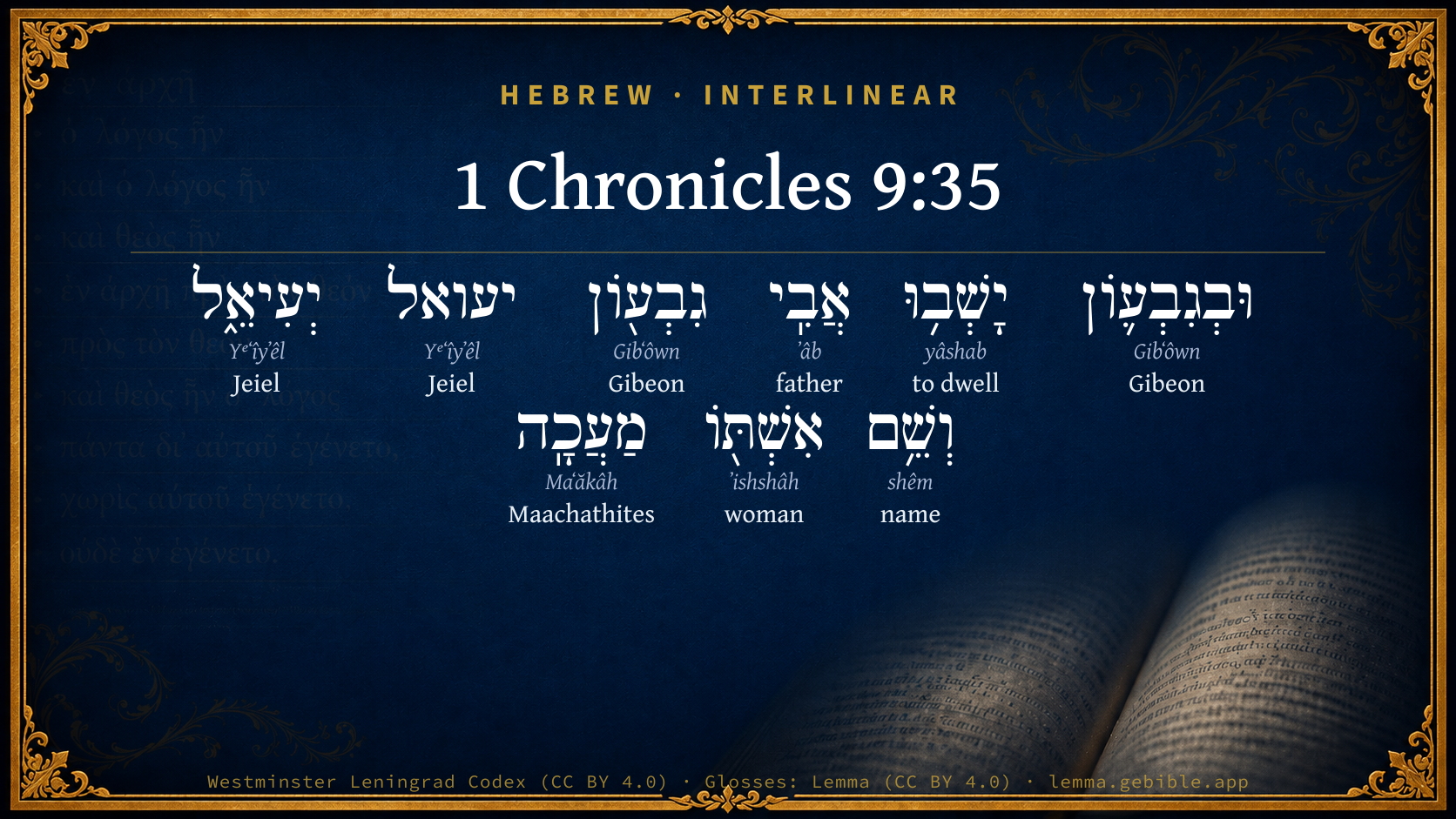
  1. וּבְגִבְע֛וֹן Gibʻôwn H1391 “and · in/at · Gibeon” Conjunction + Preposition + Noun, Proper
  2. יָשְׁב֥וּ yâshab H3427 “to dwell” Verb, Qal, Perfect, 3rd Person, Common, Plural
  3. אֲבִֽי ʼâb H1 “father of” Noun, Common, Masculine, Singular, Construct
  4. גִבְע֖וֹן Gibʻôwn H1391 “Gibeon” Noun, Proper
  5. יְעִיאֵ֑ל Yᵉʻîyʼêl H3273 “Jeiel” Noun, Proper
  6. וְשֵׁ֥ם shêm H8034 “and · name of” Conjunction + Noun, Common, Masculine, Singular, Construct
  7. אִשְׁתּ֖וֹ ʼishshâh H802 “woman · his” Noun, Common, Feminine, Singular, Construct + Suffix, Personal, 3rd Person, Masculine, Singular
  8. מַעֲכָֽה Maʻăkâh H4601 “Maachathites” Noun, Proper

About this verse

These counts appear in no published source. They are computed here, from the morphology-tagged text and Lemma’s own curated glosses. What Lemma adds →

9
words
7
distinct lemmas
Historical
section

Notable vocabulary

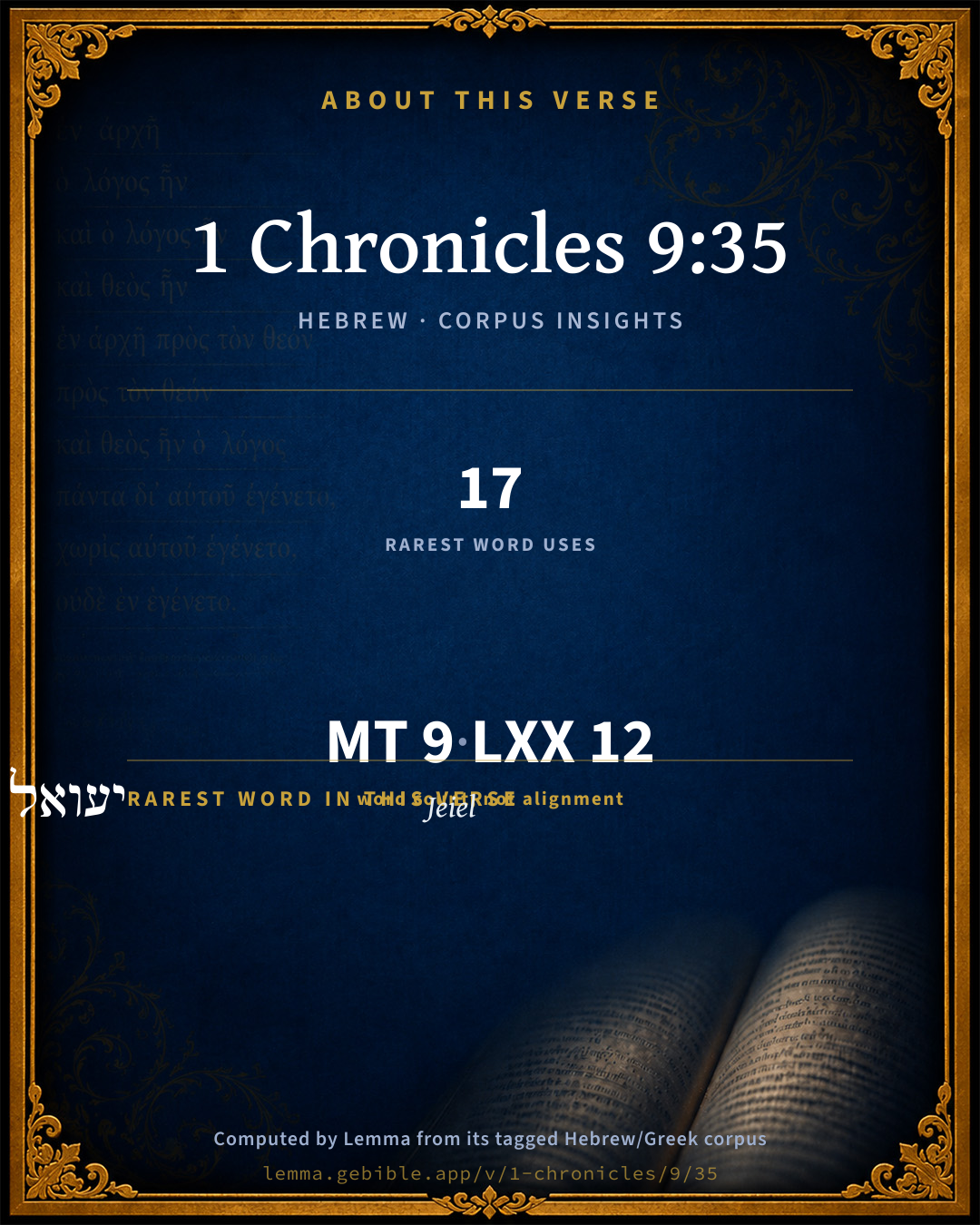
The rarest word here is יעואל Jeiel H3273 — appearing just 17 times in the whole Hebrew Bible.

Shared distinctive vocabulary

יעואל Jeiel H3273 occurs in 12 verses of the Hebrew Bible. Also found in:

Grammatical profile

  • 1 verb
  • 8 nouns

Verb forms

  • יָשְׁב֥וּ Qal · Perfect

Repetition

Words recur within this verse — often emphatic in Hebrew:

  • וּבְגִבְע֛וֹן Gibeon H1391 ×2
  • יעואל Jeiel H3273 ×2

Hebrew & Septuagint length

In English translation the verse runs 14 words from the Hebrew and 15 from the Septuagint (LXX English) — closely comparable.

A rough comparison of the two English renderings, which tokenize alike — not a word-level alignment.

Word counts can differ between the Hebrew and the Greek without any difference in meaning — e.g. the Hebrew direct-object marker אֵת has no separate Greek word, and Greek often adds the article ὁ.

In the original languages it is 9 Hebrew tokens and 12 Greek tokens — but the two are counted differently (Hebrew bundles its prefixes and suffixes into one token; the Greek is in lemma form), so that isn’t a like-for-like length.

Cross-references

4

Topical passages linked to 1 Chronicles 9:35 in the Treasury of Scripture Knowledge — connected by theme and wording, ordered by reader-vote popularity; previews shown in the World English Bible.

  • 1 Chronicles 2:23–24 Geshur and Aram took the towns of Jair from them, with Kenath, and the villages of it, even sixty cities. All these were the sons of Machir the father of Gilead.
  • 1 Chronicles 2:45 The son of Shammai was Maon; and Maon was the father of Beth Zur.
  • 1 Chronicles 2:50–52 These were the sons of Caleb, the son of Hur, the firstborn of Ephrathah: Shobal the father of Kiriath Jearim,
  • 1 Chronicles 8:29–40 In Gibeon there lived the father of Gibeon, [Jeiel], whose wife's name was Maacah;

Cross-references courtesy of OpenBible.info (CC BY 4.0).

Hebrew and Greek witnesses Masoretic Hebrew ↔ Greek Septuagint

The same verse in the two great witnesses to the Old Testament, shown verse-for-verse.

These are two independent witnesses, not word-aligned to each other, and the Septuagint is shown in lemma (dictionary) form.

Hebrew 1 Chronicles 9:35 Masoretic · Westminster Leningrad Codex

וּבְגִבְע֛וֹן יָשְׁב֥וּ אֲבִֽי גִבְע֖וֹן יעואל יְעִיאֵ֑ל וְשֵׁ֥ם אִשְׁתּ֖וֹ מַעֲכָֽה

In Gibeon there lived the father of Gibeon, Jeiel, whose wife's name was Maacah:

World English Bible · Public Domain

Greek LXX 1 Chronicles 9:35 Septuagint · lemma form

καί ἐν γαβαων καταοἰκέω πατήρ γαβαων ιιηλ καί ὄνομα γυνή αὐτός μοωχα

And Jeel the father of Gabaon lived in Gabaon; and his wife's name was Moocha.

LXX2012 (modern English Septuagint) · Public Domain

On this verse, Adam Clarke's Commentary discusses the Septuagint’s reading. Read the note in Commentary ↓

Hebrew: Westminster Leningrad Codex (CC BY 4.0). Greek: Septuagint (public domain); English from LXX2012 (modern English Septuagint) (Public Domain). How the Septuagint differs from the Hebrew →

Commentary

Notes on 1 Chronicles 9:35 from classic Christian and Jewish commentators (each source and its license shown beneath its notes). The classic Christian expositions comment on the surrounding passage and are grouped to its opening verse, so a note may address several verses; the Jewish commentaries on the Tanakh (Rashi and others) are per-verse, so they appear only where the commentator wrote on this verse.

Lemma curates 59 commentaries, every one of them public domain or Creative Commons licensed, each selected and text-cleaned for this edition rather than reprinted as found. About our sources →

Trapp's Complete Commentary

John Trapp

1Ch 9:35 And in Gibeon dwelt the father of Gibeon, Jehiel, whose wife’s name [was] Maachah:

Ver. 35. Saul’s race is here reiterated for some unknown cause, saith Diodate; for a preparation to the ensuing history, say others.

John Trapp, A Commentary or Exposition upon All the Books of the Old and New Testament (1647–1656) — public domain. Text from a community e-Sword module.

The Biblical Illustrator

Joseph S. Exell

1Ch_9:35-44

And in Gibeon dwelt the father of Gibeon.

Pedigree of Saul

In the choice, anointing, and pedigree of Saul, which enter into the history of Israel, notice--

1. The condescension of God.

2. The sovereignty of God.

3. The providence of God. (J. Wolfendale.)

The Biblical Illustrator, edited by Joseph S. Exell (c. 1880s–1900s) — public domain. Text from a community e-Sword module.

Tyndale Open Study Notes

Tyndale Open Resources

9:35-44 The place of Saul’s family in the kingdom has already been established (8:29-40); the repetition of that material provides a transition from the genealogies to the narratives, beginning with the story of Saul’s death (ch 10).

Tyndale Open Study Notes — © Tyndale Open Resources, licensed CC BY-SA 4.0. Text via the HelloAO Bible API.

Geneva Bible (1599)

Geneva Bible translators

Or, Abi Gibeon.

Geneva Bible (1599) marginal notes — public domain. Text via Bolls.life.

Matthew Henry's Commentary

These verses are the very same with Ch1 8:29-38, giving an account of the ancestors of Saul and the posterity of Jonathan. There it is the conclusion of the genealogy of Benjamin; here it is an introduction to the story of Saul. We take the repetition as we find it; but if we admit that there are in the originals, especially in these books, some errors of the transcribers, I should be tempted to think this repetition arose from a blunder. Some one, in copying out these genealogies, having written those words, Ch1 9:34 (These dwelt in Jerusalem), cast his eye on the same words, Ch1 8:28 (These dwelt in Jerusalem), and so went on with what followed there, instead of going on with what followed here; and, when he perceived his mistake, was loth to make a blot in his book, and so let it stand. We have a rule in our law, Redundans non nocet - Redundancies do no harm.

Matthew Henry's Commentary on the Whole Bible (1708–1710) — public domain (CC PDM 1.0). Text via the HelloAO Bible API.

Adam Clarke's Commentary

Verse 35. Whose wife's name was Maachah] Here our translators have departed from the original, for the word is אחתו achotho, his SISTER; but the Vulgate, Septuagint, Syriac, Arabic, and Chaldee, have WIFE; to which may be added 1Ch 8:29, the parallel place. Almost all the early editions, as well as the MS. editions, have the same reading. Of all the Polyglots the Complutensian alone has אשתו ishto, his WIFE. His wife is the reading also of Vatablus's Polyglot, but in the margin he observes that other copies have his sister. There is most certainly a fault somewhere, for Maachah could not be both the sister and wife of Jehiel. Whether, therefore, 1Ch 8:29 has been altered from this, or this altered from that, who can tell? A single letter makes the whole difference: if the word be written with cheth, it is SISTER; if with shin, it is WIFE. The latter is most probably the true reading. It is so in three very ancient MSS. in my own possession.

Adam Clarke's Commentary on the Bible (1810–1826) — public domain. Text from a community e-Sword/MySword module.

Ellicott's Commentary for English Readers

(35-44) A duplicate of 1Ch_8:29-38. The genealogy of Saul seems to be repeated, according to the chronicler’s habit (comp. 1Ch_6:4 et seq. with 1Ch_6:50 et seq.; 1Ch_7:6 et seq. with 1Ch_8:1 et seq.), as a transition or introduction to something else, viz., the account of that king’s final ruin in 1 Chronicles 10. The present list is identical with the former, so far as it extends (1Ch_8:39-40 is wanting here), but is, on the whole, in better preservation, supplying, as we have seen, several omissions in the other copy. Only the name of Ahaz has fallen out (1Ch_9:41). The correspondence of the two lists appears to be too exact to justify an assumption of different original sources; but the chronicler may have found the repetition already existing in the principal document from which he drew his materials.

A Bible Commentary for English Readers, edited by Charles John Ellicott (1878–1897) — public domain. Text from a community e-Sword module.

The Cambridge Bible for Schools and Colleges

gen. ed. J. J. S. Perowne

35–38 (= 1Ch_8:29-32). Benjamites living in Gibeon and in Jerusalem

See notes on 1Ch_8:29 ff. The passage is probably repeated here in ler to serve as an introduction to the story of the death of Saul.

The Cambridge Bible for Schools and Colleges (gen. ed. J. J. S. Perowne; Cambridge University Press, 1878–1918) — public domain. Text from a community e-Sword module.

Albert Barnes' Notes on the Bible

An almost exact repetition of 1Ch 8:29-38; and probably intentionally made by the author. In order to connect the genealogical section of his work with the historical, he re-introduces the genealogy of the person with whose death his historical section opens.

Albert Barnes' Notes on the Bible (1834–1885) — public domain. Text from a community e-Sword/MySword module.

Haydock's Catholic Bible Commentary

And in. These verses are repeated from the last chapter, in order to bring us to the death of Saul, (Menochius) and the reign of David. (Calmet) --- "Tis difficult to account for the repetition, provided they were repeated originally; but if they have been repeated through the blunder of a transcriber, the existence of the same words" before them may be the reason. (Kennicott) --- The father of Gabaon. This is the explanation of Abigabaon, chap. viii. 29. (Haydock) --- Wife. So the former chapter, and all the ancient versions, with some Hebrew manuscripts, read, instead of the printed Hebrew, "sister," (Kennicott) which seems to be corrupted; (Calmet) and the Protestants venture to correct it. (Haydock)

George Leo Haydock (1774–1849), Haydock's Catholic Family Bible and Commentary, 1859 edition — public domain. Excludes Psalms (Douay-Rheims chapter numbering differs from Protestant) and Deuterocanonical books (Catholic canon only).

Matthew Poole's English Annotations

In this and the following verses to the end of this chapter he repeats what he said before, 1Ch 8:29, &c., concerning Saul’s genealogy, that he might make way for the following history; which is a figure called epanalepsis, which is frequent both in sacred and profane writers.

Matthew Poole's English Annotations on the Holy Bible (1683–1685) — public domain. Text from a community e-Sword/MySword module.

Whedon's Commentary on the Bible

Daniel D. Whedon

35-44. This register is substantially identical with that of 1Ch_8:29-38, and is repeated here to form a transition to the account of Saul’s death, which the writer inserts, in chap. x, as an introduction to the history of David’s reign. Keil thinks the two documents were derived from different sources, and thus accounts for their slight differences; while others think the differences have arisen from corruptions in the text, and in some cases, perhaps, by design of the compiler himself.

Daniel D. Whedon (gen. ed.), Commentary on the Old and New Testaments (1874–1909) — public domain. Text from a community e-Sword module.

The Pulpit Commentary

Vers. 35-44. (See last chapter, vers. 29-40.)

The Pulpit Commentary (1880–1919), ed. H.D.M. Spence-Jones & Joseph S. Exell — public domain. Text from a community e-Sword module.

John Wesley's Explanatory Notes

Maachah - In this and the following verses, he repeats Saul's genealogy, that he might make way for the following history.

John Wesley, Explanatory Notes Upon the Whole Bible (1754–1765) — public domain. Text via the GEBible commentary corpus.

unfoldingWord translationNotes

Door43 World Missions Community

General Information:

All of the names here except Maakah are the names of men. Maakah is the name of a woman. (See: How to Translate Names)

Gibeon ... Gibeon

"the man Gibeon ... the town of Gibeon"

translationWords

Zechariah (OT)

unfoldingWord translationNotes — © Distant Shores Media and the Door43 World Missions Community, licensed CC BY-SA 4.0. Source: git.door43.org/Door43/en_tn.

Lesson kit

Teaching starters — assembled from the data on this page, not authored interpretation. Every prompt links to the verse data it draws on. Edit before teaching.

1 Chronicles, in the Historical, opens this verse with 9 words (7 distinct Hebrew lemmas). Its most distinctive word is Yᵉʻîyʼêl (“Jeiel”). A historical commentator’s framing appears above. Read the whole chapter for the surrounding context.

Discussion questions

  1. What does “Jeiel” (Yᵉʻîyʼêl) contribute to the verse as a whole?
  2. 1 Chronicles 5:7 shares the word «Jeiel» with this verse. How do the two illuminate each other?
  3. “Gibeon” occurs 2× in this one verse. What is the effect of the repetition?
  4. These translations render this verse differently. What is at stake in choosing one wording over another?
  5. The verb «יָשְׁב֥וּ» is Qal Perfect. How does its form color the action?
  6. Reading how Trapp's Complete Commentary and The Biblical Illustrator read this verse, where do the two commentators agree and where do they part?

Things to notice

Reading settings

Reading text

Shown beneath each verse's original-language words.

Old Testament
Old Testament edition

Read the OT as the Masoretic Hebrew (MT) or the Greek Septuagint (LXX).

English shown for the Greek Septuagint (in the Hebrew ↔ Greek comparison).

Comparing translations? Open the Compare panel on any verse page to stack up to four side by side.