
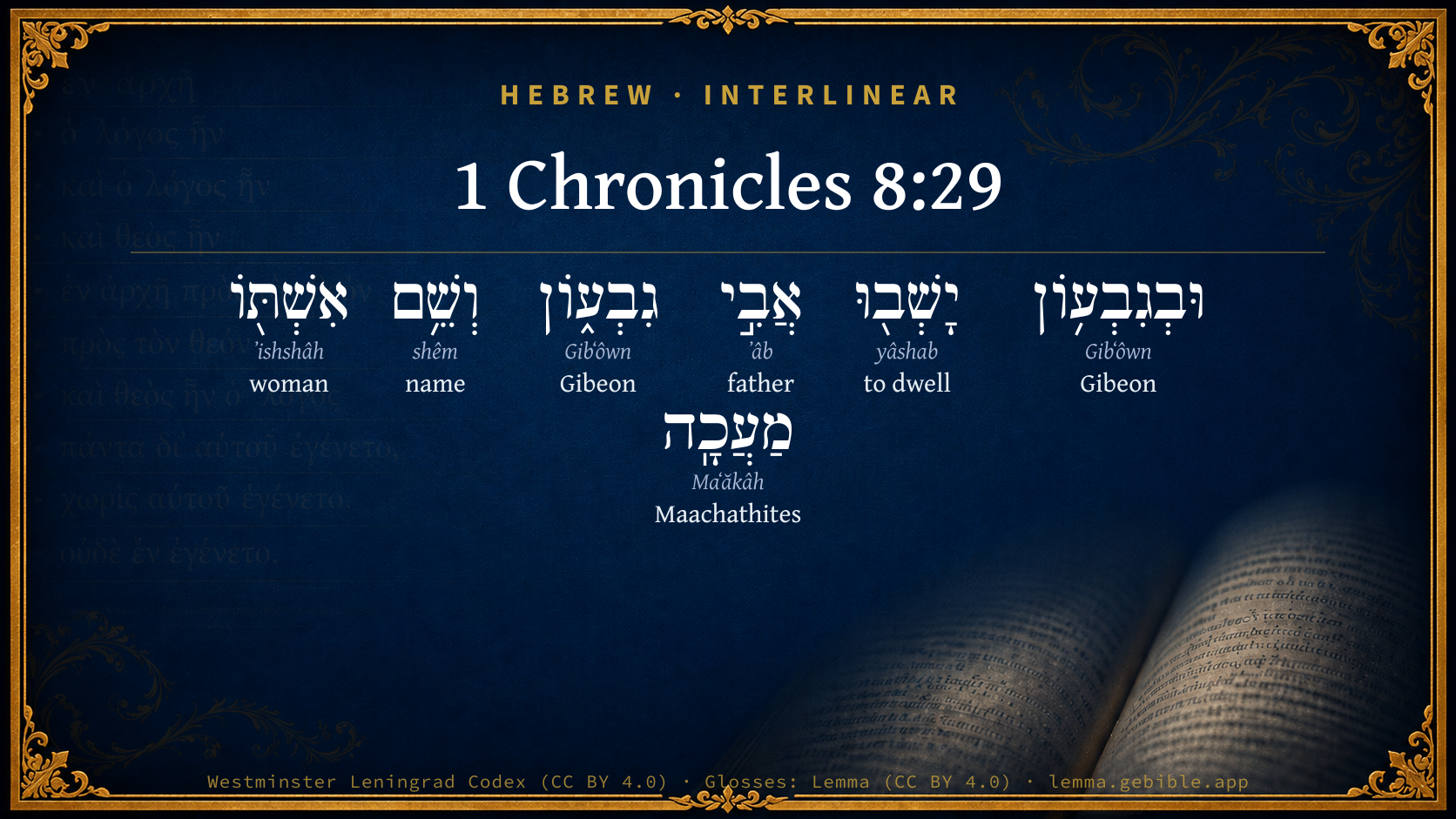
1 Chronicles 8:29

Hebrew (Westminster Leningrad Codex) 1 Chronicles 8:29 appears in the Hebrew Old Testament. The text above is from the Westminster Leningrad Codex. Each word links to its Strong’s number, a concise gloss, and parsing drawn from the Open Scriptures Hebrew Bible morphology. Click any word for its full Brown-Driver-Briggs (BDB) entry.
Download image
Cite this verse

1 Chronicles 8:29 (World English Bible). Public Domain. Lemma interlinear Bible study tool, https://lemma.gebible.app/v/1-chronicles/8/29.

Show BibTeX & RIS
BibTeX
RIS
English Translation
In Gibeon there lived the father of Gibeon, [Jeiel], whose wife's name was Maacah;
World English Bible · Public Domain
Download a study sheet

One document with this verse’s original text, its word-by-word gloss line, the meaning frame, cross-references with their text, attributed commentary, and full source and license credits — printable, and it pastes into notes with its structure intact.

This verse Autodidact and up

Study sheet (.html) Plain text (.txt)

A passage Seminary Student

Up to 50 verses in one chapter. A passage sheet keeps up to 6 commentary sources and 12 cross-references per verse, in the order this page ranks them, and says so on the sheet whenever that leaves anything out. Ask for a single verse and you get the Autodidact verse sheet above.

Everything on this page stays free to read, with no account — the sheet is a download of what is already on screen, not access to it.

Want to remove ads? Support Godless Engineer
Compare translations 3

The same verse in 3 English versions, stacked beneath the original-language interlinear above. Click any original word for its lexicon entry.

Each is an independent rendering of the whole verse — the interlinear is not word-aligned to these translations.

Highlighted words mark where these versions differ — a whole-verse word diff, not a word-by-word alignment.

  • World English Bible Public Domain
    In Gibeon there lived the father of Gibeon, [Jeiel], whose wife's name was Maacah;
  • King James Version Public Domain
    And at Gibeon dwelt the father of Gibeon; whose wife's name was Maachah:
  • unfoldingWord Literal Text CC BY-SA 4.0
    And they dwelled in Gibeon, the father of Gibeon, and the name of his wife Maakah.

unfoldingWord Literal Text — © unfoldingWord, licensed CC BY-SA 4.0. Word-aligned USFM3 via Door43 (git.door43.org/unfoldingWord/en_ult).

Versions to compare (up to 4)

3 of 4 selected

Show all 18 translations

Every available English version of this verse, each an independent rendering of the whole verse.

  • World English Bible Public Domain
    In Gibeon there lived the father of Gibeon, [Jeiel], whose wife's name was Maacah;
  • Berean Standard Bible Public Domain
    Jeiel the father of Gibeon lived in Gibeon. His wife’s name was Maacah,
  • Majority Standard Bible Public Domain
    Jeiel the father of Gibeon lived in Gibeon. His wife’s name was Maacah,
  • King James Version Public Domain
    And at Gibeon dwelt the father of Gibeon; whose wife's name was Maachah:
  • American Standard Version (1901) Public Domain
    And in Gibeon there dwelt the father of Gibeon, `Jeiel', whose wife's name was Maacah;
  • Revised Version (1885) Public Domain
    And in Gibeon there dwelt the father of Gibeon, Jeiel, whose wife’s name was Maacah:
  • Geneva Bible (1599) Public Domain
    And at Gibeon dwelt the father of Gibeon, and the name of his wife was Maachah.
  • Douay-Rheims (1899) Public Domain
    And at Gabaon dwelt Abigabaon, and the name of his wife was Maacha:
  • Young's Literal Translation Public Domain
    And in Gibeon hath the father of Gibeon dwelt, and the name of his wife `is' Maachah;
  • Literal Standard Version CC BY-SA 4.0
    And the father of Gibeon has dwelt in Gibeon, and the name of his wife [is] Maachah;
  • Unlocked Literal Bible CC BY-SA 4.0
    The father of Gibeon, Jeiel, whose wife's name was Maakah, lived in Gibeon.
  • unfoldingWord Literal Text CC BY-SA 4.0
    And they dwelled in Gibeon, the father of Gibeon, and the name of his wife Maakah.
  • Darby Bible Public Domain
    And at Gibeon dwelt the father of Gibeon; and his wife's name was Maachah.
  • World Messianic Bible Public Domain
    The father of Gibeon, whose wife’s name was Maacah, lived in Gibeon
  • Webster's Bible Public Domain
    And at Gibeon dwelt the father of Gibeon; whose wife's name was Maachah:
  • Free Bible Version CC BY-SA 4.0
    Jeiel founded Gibeon and lived there. His wife was called Maacah.
  • Bible in Basic English Public Domain
    And in Gibeon was living the father of Gibeon, Jeiel, whose wife's name was Maacah;
  • JPS Tanakh (1917) Public Domain
    And in Gibeon there dwelt the father of Gibeon, Jeiel, whose wife's name was Maacah;

Literal Standard Version (2020), Covenant Press — licensed CC BY-SA 4.0. Text via the HelloAO Bible API (eBible.org). Unlocked Literal Bible (unfoldingWord) — licensed CC BY-SA 4.0. Text via the HelloAO Bible API (eBible.org). unfoldingWord Literal Text — © unfoldingWord, licensed CC BY-SA 4.0. Word-aligned USFM3 via Door43 (git.door43.org/unfoldingWord/en_ult). Free Bible Version, Dr. Jonathan Gallagher — licensed CC BY-SA 4.0. Text via the HelloAO Bible API (eBible.org).

Word by word

More ways to search: Search by grammar → Find every occurrence → Compare this word →

Practice this passage: Drill this verse → Learn its vocabulary →

מַעֲכָֽה
Maʻăkâh
H4601
“Maachathites”
Noun, Proper
Part of Speech
Noun
Type
Proper
Full BDB Definition

Origin: from H4600

TWOT: None

Maachathites = "pressure (literally she has pressed)" - father of Achish, king of Gath at the beginning of Solomon's reign (noun proper masculine) - father of Hanan, one of David's mighty warriors (noun proper masculine) - a Simeonite, father of Shephatiah, prince of his tribe in the reign of David (noun proper masculine) - son of Nahor by concubine Reumah (noun proper masculine) - daughter of king Talmai of Geshur, wife of David, and mother of Absalom (noun proper feminine) - daughter of Absalom, wife of king Rehoboam of Judah, and mother of king Abijam of Judah (noun proper feminine) - concubine of Caleb the son of Hezron (noun proper feminine) - wife of Machir of the tribe of Manasseh (noun proper feminine) - wife of Jehiel, father of Gibeon (noun proper feminine) - a mercenary people hired to fight David (noun proper)
  1. וּבְגִבְע֥וֹן Gibʻôwn H1391 “and · in/at · Gibeon” Conjunction + Preposition + Noun, Proper
  2. יָשְׁב֖וּ yâshab H3427 “to dwell” Verb, Qal, Perfect, 3rd Person, Common, Plural
  3. אֲבִ֣י ʼâb H1 “father of” Noun, Common, Masculine, Singular, Construct
  4. גִבְע֑וֹן Gibʻôwn H1391 “Gibeon” Noun, Proper
  5. וְשֵׁ֥ם shêm H8034 “and · name of” Conjunction + Noun, Common, Masculine, Singular, Construct
  6. אִשְׁתּ֖וֹ ʼishshâh H802 “woman · his” Noun, Common, Feminine, Singular, Construct + Suffix, Personal, 3rd Person, Masculine, Singular

About this verse

These counts appear in no published source. They are computed here, from the morphology-tagged text and Lemma’s own curated glosses. What Lemma adds →

7
words
6
distinct lemmas
Historical
section

Notable vocabulary

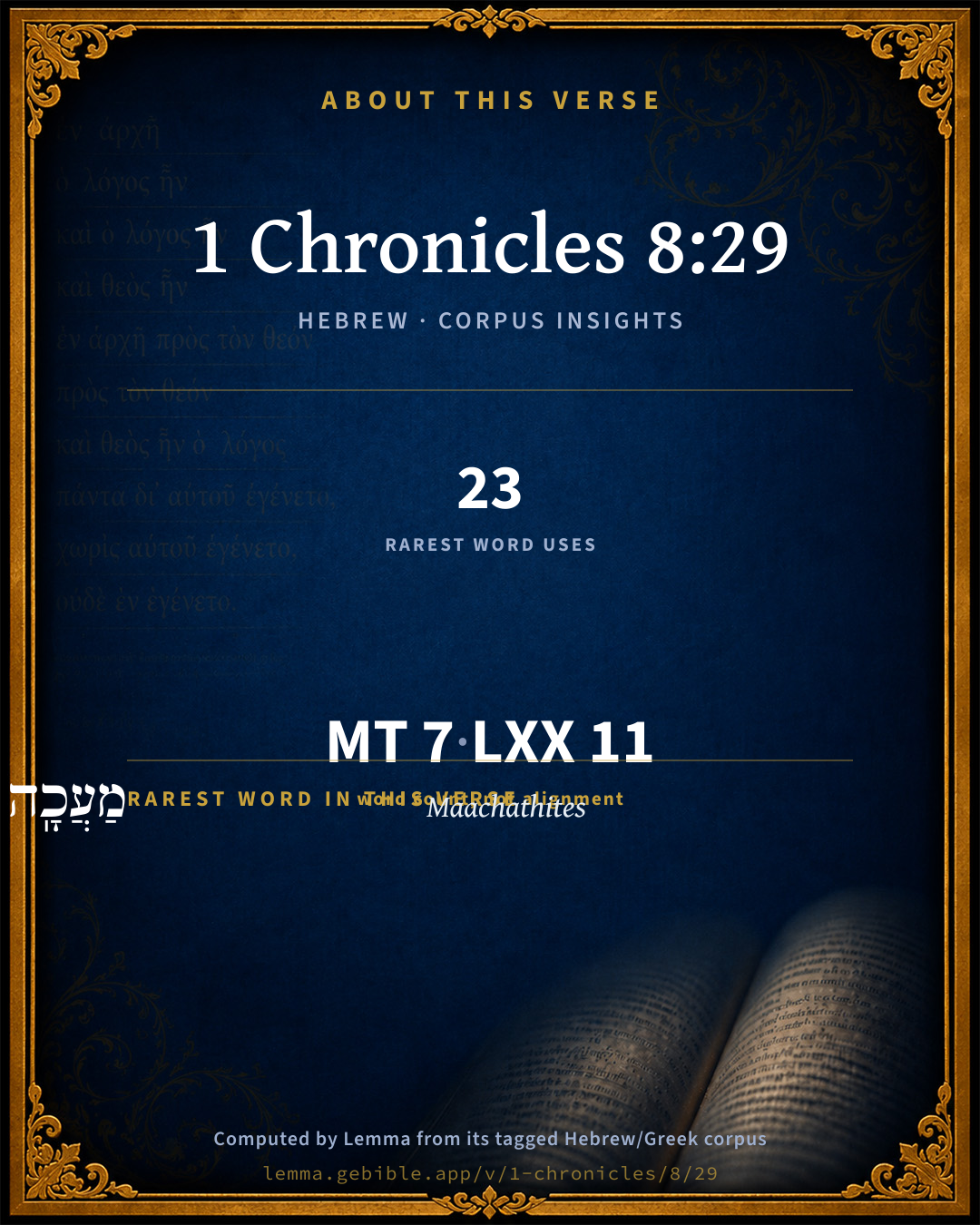
The rarest word here is מַעֲכָֽה Maachathites H4601 — appearing just 23 times in the whole Hebrew Bible.

Shared distinctive vocabulary

מַעֲכָֽה Maachathites H4601 occurs in 23 verses of the Hebrew Bible. Also found in:

Grammatical profile

  • 1 verb
  • 6 nouns

Verb forms

  • יָשְׁב֖וּ Qal · Perfect

Repetition

A word recurs within this verse — often emphatic in Hebrew:

  • וּבְגִבְע֥וֹן Gibeon H1391 ×2

Hebrew & Septuagint length

In English translation the verse runs 14 words from the Hebrew and 14 from the Septuagint (LXX English) — the same length.

A rough comparison of the two English renderings, which tokenize alike — not a word-level alignment.

Word counts can differ between the Hebrew and the Greek without any difference in meaning — e.g. the Hebrew direct-object marker אֵת has no separate Greek word, and Greek often adds the article ὁ.

In the original languages it is 7 Hebrew tokens and 11 Greek tokens — but the two are counted differently (Hebrew bundles its prefixes and suffixes into one token; the Greek is in lemma form), so that isn’t a like-for-like length.

Cross-references

1

Topical passages linked to 1 Chronicles 8:29 in the Treasury of Scripture Knowledge — connected by theme and wording, ordered by reader-vote popularity; previews shown in the World English Bible.

Cross-references courtesy of OpenBible.info (CC BY 4.0).

Hebrew and Greek witnesses Masoretic Hebrew ↔ Greek Septuagint

The same verse in the two great witnesses to the Old Testament, shown verse-for-verse.

These are two independent witnesses, not word-aligned to each other, and the Septuagint is shown in lemma (dictionary) form.

Hebrew 1 Chronicles 8:29 Masoretic · Westminster Leningrad Codex

וּבְגִבְע֥וֹן יָשְׁב֖וּ אֲבִ֣י גִבְע֑וֹן וְשֵׁ֥ם אִשְׁתּ֖וֹ מַעֲכָֽה

In Gibeon there lived the father of Gibeon, [Jeiel], whose wife's name was Maacah;

World English Bible · Public Domain

Greek LXX 1 Chronicles 8:29 Septuagint · lemma form

καί ἐν γαβαων καταοἰκέω πατήρ γαβαων καί ὄνομα γυνή αὐτός μααχα

And the father of Gabaon lived in Gabaon; and his wife's name was Moacha.

LXX2012 (modern English Septuagint) · Public Domain

On this verse, Haydock's Catholic Bible Commentary discusses the Septuagint’s reading. Read the note in Commentary ↓

Hebrew: Westminster Leningrad Codex (CC BY 4.0). Greek: Septuagint (public domain); English from LXX2012 (modern English Septuagint) (Public Domain). How the Septuagint differs from the Hebrew →

Commentary

Notes on 1 Chronicles 8:29 from classic Christian and Jewish commentators (each source and its license shown beneath its notes). The classic Christian expositions comment on the surrounding passage and are grouped to its opening verse, so a note may address several verses; the Jewish commentaries on the Tanakh (Rashi and others) are per-verse, so they appear only where the commentator wrote on this verse.

Lemma curates 59 commentaries, every one of them public domain or Creative Commons licensed, each selected and text-cleaned for this edition rather than reprinted as found. About our sources →

Ellicott's Commentary for English Readers

THE FAMILIES OF GIBEON, ESPECIALLY THE ROYAL HOUSE OF SAUL

(1Ch_8:29-40).

1Ch_8:29-38 recur at 1Ch_9:35-44.

(29) At Gibeon dwelt the father of Gibeon.—His name (Jehiel) has been accidentally omitted. (See 1Ch_9:35.) The verb dwelt is plural, “they dwelt;” a sufficient indication that the “father of Gibeon” merely represents the original population of that place under a collective name. Maachah would be a place in the neighbourhood.

Gibeon.—Now el-Jib, about eight miles north-west of Jerusalem.

A Bible Commentary for English Readers, edited by Charles John Ellicott (1878–1897) — public domain. Text from a community e-Sword module.

Trapp's Complete Commentary

John Trapp

1Ch 8:29 And at Gibeon dwelt the father of Gibeon; whose wife’s name [was] Maachah:

Ver. 29. Whose wife’s name was Maachah.] Who was surely an honour to her husband, with whom she is therefore once and again memorised. See 1Ch 7:15-16.

John Trapp, A Commentary or Exposition upon All the Books of the Old and New Testament (1647–1656) — public domain. Text from a community e-Sword module.

Tyndale Open Study Notes

Tyndale Open Resources

8:29-32 This list gives the militia that resided at Gibeon, although some of them had moved to Jerusalem.

Tyndale Open Study Notes — © Tyndale Open Resources, licensed CC BY-SA 4.0. Text via the HelloAO Bible API.

Adam Clarke's Commentary

Verse 29. And at Gibeon] This passage to the end of the 38th verse is found with a little variety in the names, 1Ch 9:35-44.

The rabbins say that Ezra, having found two books that had these passages with a variety in the names, as they agreed in general, he thought best to insert them both, not being able to discern which was the best.

His general plan was to collate all the copies he had, and to follow the greater number when he found them to agree; those which disagreed from the majority were thrown aside as spurious; and yet, in many cases, probably the rejected copies contained the true text.

If Ezra proceeded as R. Sol. Jarchi says, he had a very imperfect notion of the rules of true criticism; and it is no wonder that he has left so many faults in his text.

Adam Clarke's Commentary on the Bible (1810–1826) — public domain. Text from a community e-Sword/MySword module.

The Cambridge Bible for Schools and Colleges

gen. ed. J. J. S. Perowne

29–32 (= ch. 1Ch_9:35-38). The Genealogy of Jeiel

29. the father of Gibeon] R.V. the father of Giboon Jeiel; cp. 1Ch_9:35, R.V.

The Cambridge Bible for Schools and Colleges (gen. ed. J. J. S. Perowne; Cambridge University Press, 1878–1918) — public domain. Text from a community e-Sword module.

John Gill's Exposition

And the son of Jonathan was Meribbaal,.... The same with Mephibosheth, Sa2 4:4 so Jerubbaal is called Jerubbesheth, Jdg 6:32.

and Meribbaal begat Micah; called his young son in David's time, Sa2 9:12.

John Gill's Exposition of the Whole Bible (1746–1763) — public domain (CC PDM 1.0). Text via the HelloAO Bible API.

Haydock's Catholic Bible Commentary

Dwelt. Literally, "they dwelt." But Hebrew and Septuagint, "in Gabaon, dwelt the father of Gaboan," (Haydock) who was called Jehiel, (chap. ix. 35.) or Abiel, 1 Kings ix. 1. (Calmet) --- The following verses are repeated in the next chapter, (Haydock) and seem to have been originally the same; though now many variations occur, which shew that "every Hebrew letter" has not been preserved. (Kennicott)

George Leo Haydock (1774–1849), Haydock's Catholic Family Bible and Commentary, 1859 edition — public domain. Excludes Psalms (Douay-Rheims chapter numbering differs from Protestant) and Deuterocanonical books (Catholic canon only).

Matthew Poole's English Annotations

The father of Gibeon, i.e. the chief or ruler of the Benjamites dwelling there.

Matthew Poole's English Annotations on the Holy Bible (1683–1685) — public domain. Text from a community e-Sword/MySword module.

The Pulpit Commentary

Vers. 29-40. These verses are occupied with the immediate ancestors and posterity of Saul. And apparently the same account, minus some of its deficiencies, is repeated in the next chapter, vers. 35-44. The two may be taken together here, and the latter will help the interpretation of the former. The fatheri.e, the chiefof Gibeon. (For Gibeon, see Jos_9:3, 7-18 10:2 11:19; Neh_7:25 Neh_3:7) The father of Gibeon (1Ch_9:35) was Jehiel (laeyiy) Chethiv spells with vau; not laeyjiy. (1Ch_15:24) Of Jehiel by this name we do not elsewhere read. And even if it were on other grounds possible to identify the person with the Abiel of 1Sa_9:1 and 1Sa_14:51, it is not possible to identify the names. Compare the similar remarkable omission of the name of the "father of Gibea", (1Ch_2:49) an omission to be filled very possibly by this same name Jehiel.

The Pulpit Commentary (1880–1919), ed. H.D.M. Spence-Jones & Joseph S. Exell — public domain. Text from a community e-Sword module.

Keil & Delitzsch

C. F. Keil & F. Delitzsch

And the son of Jonathan was Meribbaal,.... The same with Mephibosheth, Sa2 4:4 so Jerubbaal is called Jerubbesheth, Jdg 6:32.

and Meribbaal begat Micah; called his young son in David's time, Sa2 9:12.

Keil & Delitzsch — Biblical Commentary on the Old Testament (1861–1891) — public domain (CC PDM 1.0). Text via the HelloAO Bible API. (Old Testament only.)

unfoldingWord translationNotes

Door43 World Missions Community

General Information:

All of the names here except Maakah and Gibeon are the names of men. Maakah is the name of a woman, and Gibeon is the name of a town. (See: How to Translate Names)

The father of Gibeon, Jeiel, whose wife's name was Maakah, lived in Gibeon

Here "father of" refers to Jeiel's status as the leading person in the city of Gibeon. AT: "Jeiel, the leader of Gibeon, lived in Gibeon. His wife's name was Maakah" (See: Idiom)

His firstborn

"Jeiel's first son"

translationWords

Gibeon

firstborn

unfoldingWord translationNotes — © Distant Shores Media and the Door43 World Missions Community, licensed CC BY-SA 4.0. Source: git.door43.org/Door43/en_tn.

Rashi

Rabbi Shlomo Yitzchaki (Rashi)

And in Gibeon dwelt the leader of Gibeon This section until (verse 38): “...all these were the sons of Azel,” is written twice in this Book. Also the section (9:2): “And the first settlers, who were in their inheritance in their cities,” and the section (9:10): “And of the priests: Jedaiah and Jehoirib” are likewise in the Book of Nehemiah, as it is written (11: 3): “And these are the heads of the province.” This is what is explained at the end of Megillath Yerushalmi. Ezra found scrolls: the scroll of מְעוֹנִים, the scroll of זַאַטוּטֵי and the scrolls of הָאַחִים, and they rejected the words of the one and accepted the words of the two. Likewise, they found many genealogical records. When they found three or five, they rejected the minority and accepted the majority. When they found an even number, e.g. “And in Gibeon dwelt the leader of Gibeon,” he had to write it twice because the order of their genealogy is not uniform, and likewise, [in] “the first settlers,” he found an even number, which differed one from the other. [Therefore], it was written twice: here and in his [Ezra’s] book. Now why did he not write both of them here, including those that are in Ezra: “And these are the heads of the province, etc.”? Because he traced the genealogy there until, “And these are the priests and the Levites,” and he traced the genealogy here until Jedaiah, who was after Ezra. Now what purpose would it have to explain and to trace the genealogy here in Chronicles, the generations and the genealogy after Ezra, except for those who were alive during the First Temple period?

Rashi on the Tanakh — English translations: “The Judaica Press complete Tanach with Rashi, translated by A. J. Rosenberg” (CC BY 4.0); “Pentateuch with Rashi's commentary by M. Rosenbaum and A.M. Silbermann, 1929-1934” (public domain); “The Metsudah Tanach series, Lakewood, N.J” (CC BY 4.0); and “The Book of Joshua, Metsudah Publications, 1997” (CC BY 4.0). Text via Sefaria.

Lesson kit

Teaching starters — assembled from the data on this page, not authored interpretation. Every prompt links to the verse data it draws on. Edit before teaching.

1 Chronicles, in the Historical, opens this verse with 7 words (6 distinct Hebrew lemmas). Its most distinctive word is Maʻăkâh (“Maachathites”). A historical commentator’s framing appears above. Read the whole chapter for the surrounding context.

Discussion questions

  1. What does “Maachathites” (Maʻăkâh) contribute to the verse as a whole?
  2. Genesis 22:24 shares the word «Maachathites» with this verse. How do the two illuminate each other?
  3. “Gibeon” occurs 2× in this one verse. What is the effect of the repetition?
  4. These translations render this verse differently; the difference is in the English rendering, not the original. What questions does that raise?
  5. The verb «יָשְׁב֖וּ» is Qal Perfect. How does its form color the action?
  6. Reading how Ellicott's Commentary for English Readers and Trapp's Complete Commentary read this verse, where do the two commentators agree and where do they part?

Things to notice

Reading settings

Reading text

Shown beneath each verse's original-language words.

Old Testament
Old Testament edition

Read the OT as the Masoretic Hebrew (MT) or the Greek Septuagint (LXX).

English shown for the Greek Septuagint (in the Hebrew ↔ Greek comparison).

Comparing translations? Open the Compare panel on any verse page to stack up to four side by side.