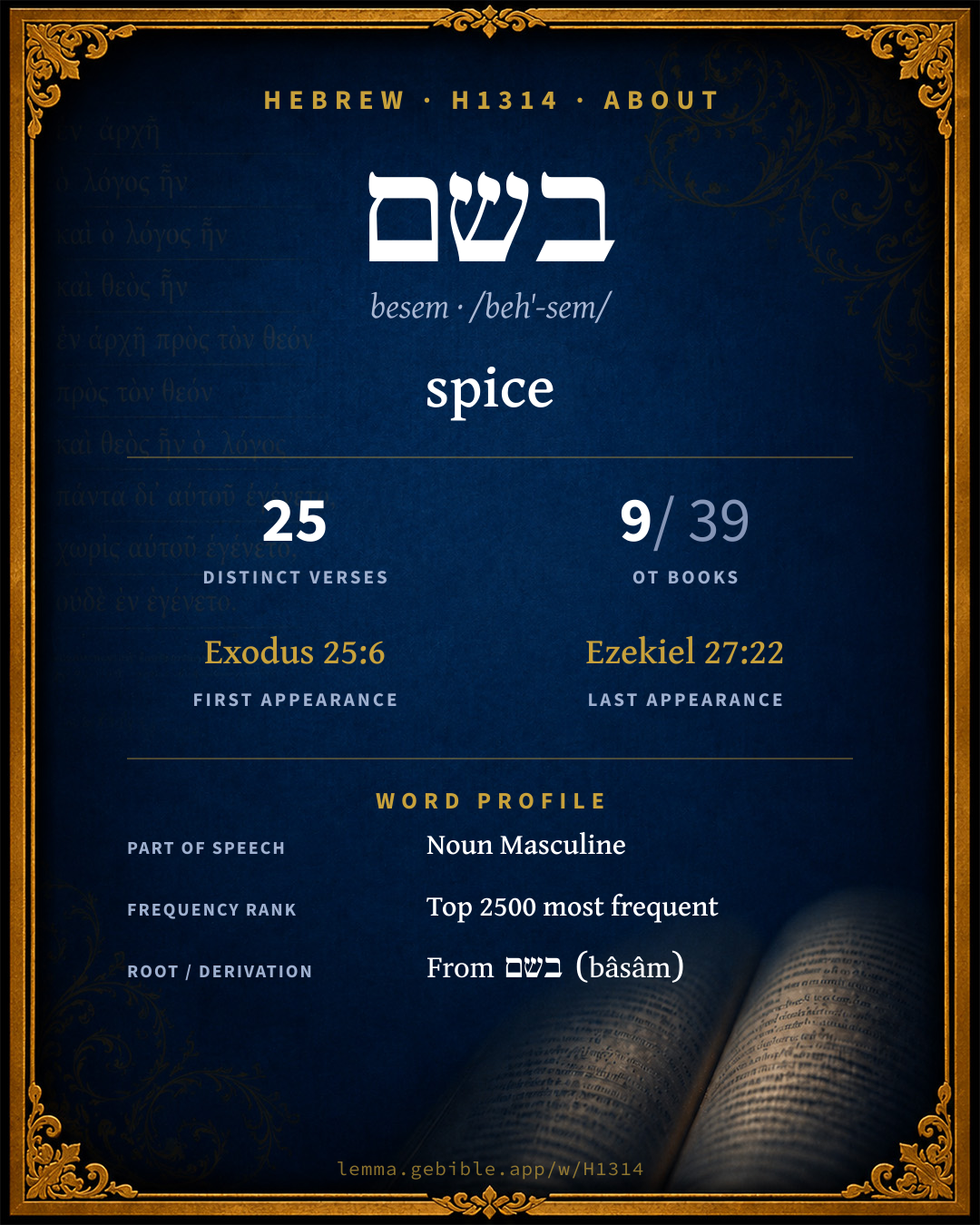
בֶּ֫שֶׂם
spice
also: balsam, balsam tree, perfume fuller range ↓
Full lexicon entry — Brown-Driver-Briggs (BDB)
From Brown-Driver-Briggs (BDB)
Where this word appears
Grammar key — what these labels mean
Part of speech
- Noun
- A naming word — a person, place, thing, or idea.
Noun type
- Common
- A common noun — a general class of person, place, or thing (“king,” “city,” “water”), not a specific name.
State
- Absolute
- The independent form of a noun, not bound to a following word.
- Construct
- A noun bound to a following noun in a possessive / “of” relationship (the construct chain).
Gender
- Masculine
- Grammatically masculine.
Number
- Plural
- More than one (in Hebrew, generally three or more).
- Singular
- One.
Every verse where H1314 appears in the Book of 2 Chronicles — 5 distinct verses. Click any verse to open its interlinear word-by-word view. Verse text shown in the World English Bible for context — . Each verse’s Hebrew form is shown with its reference; the English is not keyword-highlighted, since the data carries no word-level English alignment. Use “Compare translations” on any verse to read it across multiple English versions. This concordance covers the Hebrew Bible; Septuagint (Greek Old Testament) occurrences are not indexed here.
2 Chronicles
- 2 Chronicles 9:1 בְּשָׂמִ֧ים n c mp When the queen of Sheba heard of the fame of Solomon, she came to prove Solomon with hard questions at Jerusalem, with a very great train, and camels that bore spices, and gold in abundance, and precious stones: and when she was come to Solomon, she talked with him of all that was in her heart.
- 2 Chronicles 9:9 וּ/בְשָׂמִ֛ים כַּ/בֹּ֣שֶׂם conj + n c mp prep det + n c ms She gave the king one hundred and twenty talents of gold, and spices in great abundance, and precious stones: neither was there any such spice as the queen of Sheba gave to king Solomon.
- 2 Chronicles 9:24 וּ/בְשָׂמִ֔ים conj + n c mp They brought every man his tribute, vessels of silver, and vessels of gold, and clothing, armor, and spices, horses, and mules, a rate year by year.
- 2 Chronicles 16:14 בְּשָׂמִ֣ים n c mp They buried him in his own tombs, which he had hewn out for himself in the city of David, and laid him in the bed which was filled with sweet odors and various kinds [of spices] prepared by the perfumers' are: and they made a very great burning for him.
- 2 Chronicles 32:27 וְ/לִ/בְשָׂמִים֙ conj + prep + n c mp Hezekiah had exceeding much riches and honor: and he provided him treasuries for silver, and for gold, and for precious stones, and for spices, and for shields, and for all manner of goodly vessels;
About this entry
At a glance — auto-summarized from this page’s data, not written by a person. Every figure links to its source below. This summary describes the numbers; it doesn’t interpret them.
בשם — transliterated besem — is a Hebrew noun carrying the sense “spice.” Debuting at Exodus 25:6, it then recurs through the corpus. The Hebrew Bible uses it across 25 verses — uncommon. Alongside “spice” the lexicon also lists “balsam”, “balsam tree”, and “perfume” — part of its full sense range. It shares a root with בשם, שבם and בשמת. Each statement above links to its evidence; the full detail follows below.
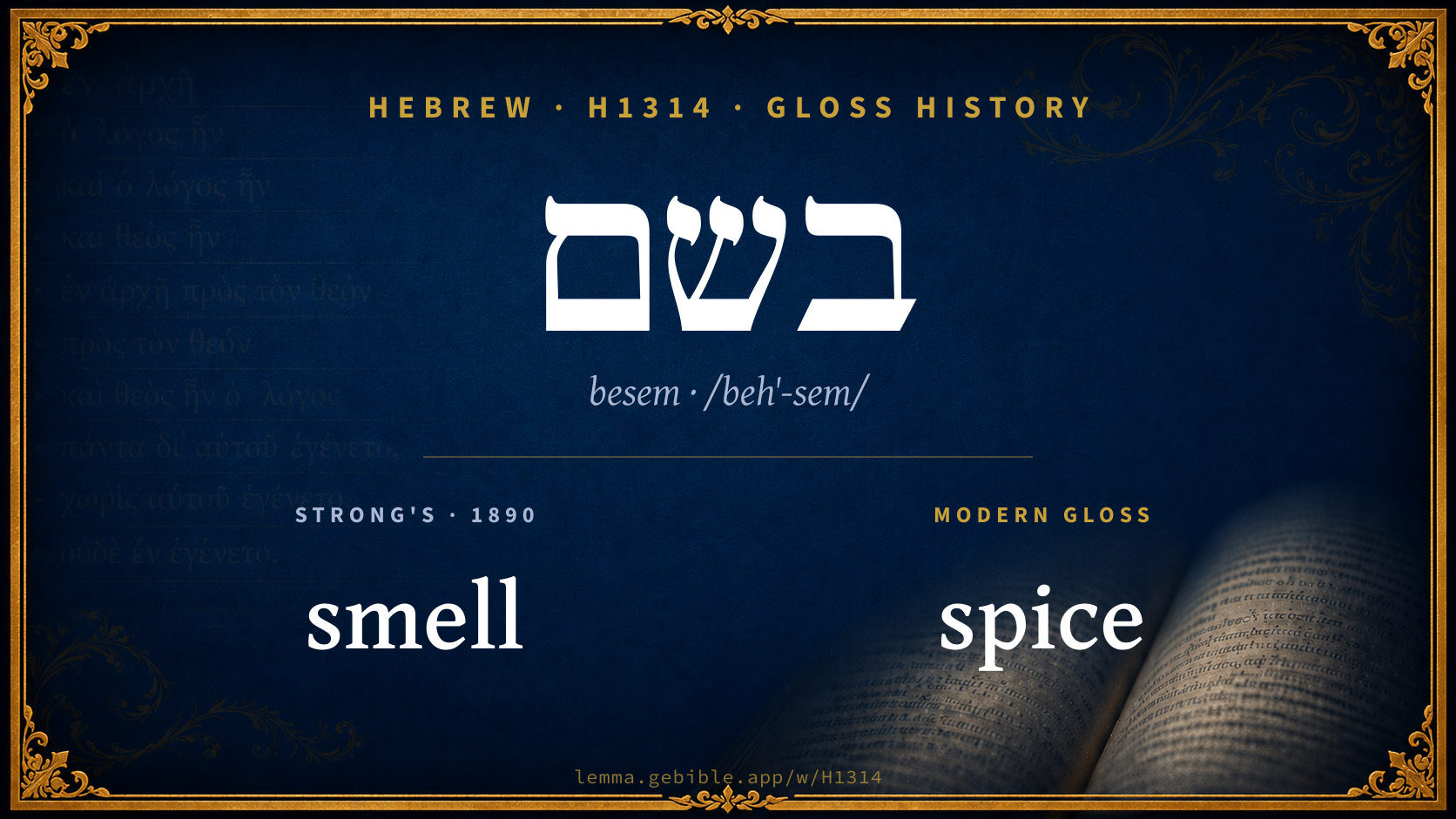
Gloss history
Strong's 1890 vs modern scholarship
About this word
Strong's H1314 catalogs a Hebrew word from the Hebrew Old Testament.
These counts are not copied from any lexicon or concordance. They are computed here, from the morphology-tagged Hebrew Old Testament. What Lemma adds →
- 25
- distinct verses
- The word appears in 25 distinct verses.
- 9 / 39
- OT books
- The word appears in 9 of 39 Old Testament books.
- #1,160
- by frequency
- Top 2500 most frequent Hebrew words (rank 1,160 of 8,640 Hebrew words by occurrence).
View all 25 occurrences in the concordance →
Most concentrated in
- Song of Solomon 6 verses 24%
- 2 Chronicles 5 verses 20%
- Exodus 4 verses 16%
By section of the Old Testament
By traditional corpus
Conventional, traditional groupings — biblical authorship is debated, so this is a traditional corpus grouping, not an authorship claim. Each share is this word’s portion of its verses in that division of the Hebrew canon. Each figure is a share of the word’s 25 distinct verses.
- Writings (Ketuvim) 14 verses · 56%
- Prophets (Nevi'im) 7 verses · 28%
- Torah (Pentateuch) 4 verses · 16%
How translations render this word
Counts come from each version’s own published word-to-Strong’s tagging or interlinear alignment — an approximate guide to how each version renders this word, not a word-level alignment the data otherwise carries. Because each total is that version’s own tagged count, the per-version totals vary from one another and need not match the appearance or distinct-verse counts above. These counts may also differ from a printed concordance because Lemma counts each distinctly tagged rendering and does not collapse phrase taggings into a single head-word total. This is a fixed set of word-tagged versions (KJV, ASV, BSB, ULT) and does not change with the reading translation you choose elsewhere. Each version’s license is shown beside its name below (and on Sources).
- King James Version: Spices 20×, Shekels and of sweet 2×, Sweet odours 2×
- American Standard Version: Spices 20×, Sweet odors 2×
- Berean Standard Bible: Spices 22×, Fragrant 2×
- unfoldingWord Literal Text: Spices 21×, Spice 4×, Fragrance 2×
King James Version Public Domain
Renders H1314 across 29 tagged occurrences — most commonly:
Plus 5 renderings that appear only once — usually multi-word phrases or single function words the recovered tagging swept in, not distinct renderings.
American Standard Version Public Domain
Renders H1314 across 29 tagged occurrences — most commonly:
Plus 7 renderings that appear only once — usually multi-word phrases or single function words the recovered tagging swept in, not distinct renderings.
Berean Standard Bible Public Domain
Renders H1314 across 29 tagged occurrences — most commonly:
Plus 5 renderings that appear only once — usually multi-word phrases or single function words the recovered tagging swept in, not distinct renderings.
unfoldingWord Literal Text CC BY-SA 4.0
Renders H1314 across 32 tagged occurrences — most commonly:
Plus 3 renderings that appear only once — usually multi-word phrases or single function words the recovered tagging swept in, not distinct renderings.
Senses in the full BDB
What do BDB’s symbols mean?
BDB uses these scholarly abbreviations:
| Symbol | Meaning |
|---|---|
| 𝔊 | the Septuagint (the ancient Greek translation, LXX) |
| 𝔙 | the Vulgate (the Latin translation) |
| 𝔖 | the Syriac version (the Peshitta) |
| 𝔗 | the Targum (the Aramaic translation) |
| ψ | the Psalms |
| √ | root (the underlying root or stem) |
| ‖ | parallel passage (a synonymous or contrasted parallel) |
| † | the dagger: every passage where the word occurs is cited |
The 2 senses and sub-senses the full Brown-Driver-Briggs lexicon distinguishes for this word, in lexicon order (not ranked by frequency), with BDB’s own verbatim wording and sub-sense lettering. Shown in Hebrew script with BDB’s own scholarly abbreviations. The condensed entry is in the Lexicon Entry tab. See also the Forms in the corpus table below.
- 1. spice, perfume, sweet odour Is 3:24; קִנְּמָן־בֶּשֶׂם Ex 30:23 (ב׳ perhaps so pointed to distinguish it from) קְנֵה־בֹשֶׂם v 23;—with this cf. Aramaic ܩܢܝܐ ܕܒܣܡܐ, קני בוסמא;—spices as costly, token of wealth 2 K 20:13 = Is 39:2 cf. 2 Ch 32:27; royal gifts 1 K 10:2, 10, 25 = 2 Ch 9:1, 19, 24; cf. sg. 1 K 10:10 = 2 Ch 9:9; as article of commerce Ez 27:22; burnt at burial 2 Ch 16:14; appointed for ingredient of the anointing oil Ex 25:6; 35:8 cf. v 28 (all P), cf. 1 Ch 9:30 (Palm. v. supr.); stored in temple 1 Ch 9:29; used for purifying the women of Ahasuerus Est 2:12; e.g. Isaiah 3:24
- 2. elsewhere only Ct 4:10, 14 spices, v 16 balsam-juice, gathered Ct 5:1; balsam-tree הָרֵי ב׳ Ct 8:14; beds of balsam עֲרֻגוֹת בּ׳ Ct 6:2; cf. עֲרוּגֵת בּ׳ Ct 5:13 sim. of lover’s cheeks. e.g. Song of Solomon 4:10
Senses from the full Brown-Driver-Briggs lexicon (Brown, Driver, Briggs; Oxford 1906 — public domain), digitized via Sefaria, supplemented by the OpenScriptures HebrewLexicon (CC BY 4.0). Full attribution on Sources.
Word origin
n.m. 1 K 10:10 spice, balsam, balsamtree (Arabic بَشَامٌ, Aramaic בּוּסְמָא, ܒܶܣܡܳܐ, Gk. βάλσαμον; cf. Löw53)—ב׳ Is 3:24 +, בֶּ֫שֶׂם Ex 30:23 v. infr., בְּשָׂמִי Ct 5:1 (as if from בָּשָׂם); pl. בְּשָׂמִים Ex 25:6 + 18 times, בְּשָׂמָיו Ct 4:16;—
— Brown-Driver-Briggs (Oxford 1906, public domain), digitized via Sefaria, supplemented by the OpenScriptures HebrewLexicon (CC BY 4.0). See Sources.
Derived from בשם (bâsâm) (H1313) — spice.
Jastrow Dictionary
A second Hebrew/Aramaic lexicon for comparison, covering Aramaic and post-biblical (Talmudic, Targumic, Midrashic) usage that the biblical-Hebrew BDB does not. Matched by lemma rather than by Strong’s number, so a lemma may carry more than one Jastrow headword (shown separately below), and the entries cover usage well beyond the Bible.
בָּסֵם
- (√בס, בש, cmp. בָּשַׁל, to boil, ripen, be warm, ferment) to be sweet, pleasant, pleasing. Lam. R. to I, 9 יערב לך ויִבְסַם לך may (the sacrifice) be sweet unto thee (Moloch), may it be pleasing unto thee. Gen. R. s. 85 יערב לכם יבושם וכ׳ (Yalk. Gen. 144, Josh. 35 יבסם) may (the wine you drank) be sweet to you, may it well agree with you.—Denom. בּוֹסֶם.
- , בִּישֵּׂם to make a person look well, esp. (denom. of בּוֹסֶם) to perfume with oil &c. Ex. R. s. 23 a bride מקשטין אותה ומְבַסְּמִין אותה is adorned and made handsome (her toilet is attended to).—Part. pass. מְבוּסָּם, f. מְבוּסֶּמֶת, מְבוּשּׂ׳ perfumed, sweet &c. Num. R. s. 20 מקושטת ומב׳ in full toilet. Tosef. Ber. VI (V), 5 it is not becoming for a scholar שיצא מבוסם to go out with perfumed oil on his head; Ber. 43ᵇ מבוש׳. B. Bath. VI, 3 יין מב׳ sweet wine (guaranteed as not sour). [Pesik. R. s. 21 בישם העולם; Ruth. R. beg. ביסם, read בִּיסֵּס, v. בָּסַס.]
- ; Nithpa. נִתְבַּסֵּם, נִתְבַּשֵּׂ׳
- 1. to perfume one’s self with oil &c. Gen. R. s. 17. &c. Gen. R. s. 17.
- 2. to become exhilarated, to feel the wine. Koh. R. to XI, 9 אכל ושתה ונת׳ he ate and drank and felt well.
- 3. trnsf. to grow better, improve. Gen. R. s. 67, end נִתְבַּסְּמָה דעתו עליו his character grew better (play on בשמת Gen. XXVI, 34).—[Gen. R. s. 66 נתבשם העולם, v. בָּסַס.] e.g. Genesis 26:34
בָּשַׂם
- &c., v. בָּסַם &c.
בֹּשֶׂם
- , pl. בְּשָׂמִים (b. h., preced.) spices, perfumes, esp. those used for blessings at the exit of the Sabbath. Ber. VIII, 5 sq.; a. fr.
שָׁם
- (b. h.) there, thither. Macc. II, 7 אינו יוצא מִשָּׁם לעולם he dare not go away from there (the city of refuge) all his life time; שם תהא דירתו שם וכ׳ there he must live, there he must die &c.; Tosef. ib. III (II), 5. Macc. 4ᵃ שנפל שם which fell thereinto. Ber. V, 4 אם אין שם כהן וכ׳ if no priest besides him is present; a. v. fr.—Cant. R. to VIII, 9 שָׁמָּה, v. רגָּז.—לְשָׁם thither. Ex. R. s. 18; a. fr.
שֵׁם I
- (b. h.) pr. n. m. Shem, son of Noah. Meg. 9ᵇ (ref. to Gen. IX, 27) דבריו … באהלי שם let the speech of Japheth (Greek) dwell in the tents of Shem; v. יָפְיוּת. Gen. R. s. 63, v. עֵבֶר I. Snh. 69ᵇ. Ex. R. s. 18 the Lord said, חייב אני לשם אביהם וכ׳ I am indebted to their (the Assyrians’) father Shem, because he and Japheth took their cloaks and covered with it &c.; a. fr. e.g. Genesis 9:27
שֵׁם II
- v. שׁוּם a. mark, name, title, nature, denomination. Pes. III, 3 לא תקרא לה שם וכ׳ she must not name it (declare it to be Ḥallah) until it is baked. Ter. III, 5 האומר … קרא שם if one says, the priest’s portion of this pile is in it …, he has named it (designated it as T’rumah). Gen. R. s. 25 (ref. to Gen. V, 29) לא השם הוא המדרש … הוא השם וכ׳ the name (נח) and the interpretation (ינחמנו) do not correspond; it ought to be either &c. Ber. II, 8 ליטול … השם, v. נָטַל. Macc. I, 2 לא השם המביאו וכ׳ the title (the legal text) under which the false witness is doomed to lashes, is not the one under which he is bound to pay indemnity. Kinn. I, 3 משם אחד sacrificial birds of the same denomination (intended for the same class of cases), opp. משני שמות of different denominations. Sabb. XII, 3 משם אחד two letters of the alphabet of the same name (אא, בב &c.), opp. משתי שמות two different letters (אב &c.). Ib. שם קטן משם גדול וכ׳ a small name or word as a part (or abbreviation) of a larger one, as שם as a part of שמעון, of שמואל &c. Ib. 103ᵇ שתי אותיות והן שם אחד two identical letters which represent a word, (as שש, which may stand for שֵׁשׁ or שָׂשׂ) &c. Shebu. 3ᵇ, a. fr. לא מן השם הוא זה וכ׳ this comes not under this title (this is not the real reason), but it is because &c. Ker. III, 4 אינו מן השם the offence is not of the same class. Macc. 4ᵇ, a. fr. (על חבירו) מוציא שם רע who spreads an evil report about his neighbor (injures his reputation). Ber. 17ᵃ גדל בשם טוב וכ׳ who has grown up with a good name, and departed life with a good name; a. v. fr.—Esp. הַשֵּׁם or שֵׁם the Divine Name, the Tetragrammaton, contradist. to כינוי attribute; in gen. the Lord. Snh. VII, 5 המגדף … שיפרש השם the blasphemer is not punishable, unless he uses the Name explicitly. Ib. 8 המקלל … בַּשֵּׁם he that curses his father or his mother is not punishable, unless he curses them with the Name. Ib. 56ᵃ בידך את השם בכינוי (not בכינויים) if he curses God by using a divine attribute. Ib. עד שיברך שם בשם unless he curses God and pronounces the Name. Yoma III, 8; IV, 2; VI, 2 (בשם) אנא השם I pray, O Lord (pronouncing the Tetragrammaton). Ib. כשהיו שומעים שם המפורש שהוא יוצא וכ׳ when they heard the Tetragrammaton pronounced &c., v. פָּרַשׁ. Ib. IV, 1 אחד … לַשֵּׁם on one of the lots was written ‘unto the Lord’; של שם the lot bearing the inscription ‘unto the Lord’; a. v. fr.; v. שָׁמַיִם.—Especial uses: כְּשֵׁם שֶׁ־ the same as, as well as. Ber. IX, 5 חייב אדם … כשם שמברך וכ׳ a man is bound to bless God for what is evil as well as he blesses for what is good. Ib. 62ᵃ כשם שנפרעין וכ׳ as well as the dead are called to account &c., v. סַפְדָּן. Sot. V, 1 כשם שהמים … כך וכ׳ as the waters test her, so do they test him. Ib. כשם שאסורה וכ׳, v. בָּעַל; a. v. fr.—בְּשֵׁם, מִשֵּׁם in the name of, in behalf of. Meg. 15ᵃ כל האומר דכר בשם אומרו וכ׳ he who relates a thing in the name of him who said it (gives credit to authority), brings redemption into the world. Peah II, 4 מִשְּׁמוֹ in his own name (as his individual opinion). Y. Taan. I, 64ᵃ הלכה … שאמר משם וכ׳ the rule follows the opinion of …, who said in behalf of &c.; a. v. fr.—לְשֵׁם for the purpose of, for the sake of, as; with reference to. Gitt. 24ᵇ כתב רחמנא לה לִשְׁמָהּ the text (Deut. XXIV, 3) says, ‘unto her’, that means, that it must be written especially for her. Yeb. 47ᵇ, v. שׁוּם II.—Snh. 99ᵇ העוסק בתורה לשמה who studies the Law for its own sake (for no selfish ends). Pes. 50ᵇ לעולם יעסוק … אע"פ שלא לשמה … בא לשמה by all means let a man engage in the study of the Law and in good deeds, even if not for their own sake, for through the work for a selfish purpose he will arrive at the stage of doing good for its own sake. Ib. 13ᵇ, a. e. שחטן לִשְׁמָן וכ׳ if he slaughtered them as such (as festive sacrifices) &c.; זרק דמן שלא לשמן if he sprinkled their blood, having in mind another purpose (another class of sacrifices). Gen. R. s. 25 לשם קרבנו נקרא he was named (נח) with reference to his sacrifice (ניחח, Gen. VIII, 21); לשם נחת וכ׳ he was named (נח) with reference to the rest of the ark (ותנח, Gen. VIII, 4); Yalk. ib. 42 על שם וכ׳; a. v. fr.—עַל שֵׁם (abbrev. ע"ש) with reference to, because. Y. Taan. II, beg. 65ᵃ על שם ואנכי וכ׳ as a reference to (what Abraham said,) ‘and I am but dust and ashes’ (Gen. XVIII, 27). Gen. R. s. 23, v. טְבַרְיָא; a. fr.; v. שׁוּם II.—Pl. שֵׁמוֹת, constr. שְׁמוֹת. Kinn. l. c. Gen. R. s. 26 כל הש׳ הללו וכ׳ all these names indicate rebellion &c., v. מַרְדּוּת I. B. Mets. 114ᵇ עובר בכל הש׳ הללו is guilty under all these titles (texts). Shebu. 35ᵃ יש ש׳ שנמחקין ויש ש׳ וכ׳ there are divine names which may be erased, and such as may not be erased. Y. R. Hash. I, 56ᵈ bot. שְׁ׳ המלאכים, v. מַלְאָךְ; a. fr. e.g. Genesis 5:29
שֵׁם
- Targ. Y. II, Ex. XXXI, 2. Targ. Ps. CXLVII, 4. Targ. O. Gen. VI, 4; a. fr.—Sot. 49ᵃ יהא שְׁמֵיה רבא (abbrev. יה"ש"ר), v. אֲגַדְתָּא. Ab. I, 13, v. נְגַד. Yoma 83ᵇ, v. דּוּק. Ber. 7ᵇ, v. גְּרַם I. Sabb. 8ᵇ (in Hebr. dict.) שמיה הילוך comes under the category of ‘walking’; לא שמיה תשמיש does not come under the category of ‘use.’ Ḥull. 48ᵃ משמיה רר׳ וכ׳ in behalf of &c.; Y. Taan. I, 64ᵃ bot. מן שמיה. Sabb. 145ᵇ שְׁמָאִי my name, v. מָתָא; a. v. fr.—Y. Orl. I, 61ᵃ bot. אית בני נש שְׁמוֹן בריכה וכ׳ there are persons whose name is B’rikah (meaning blessing), as one says, come thou, blessed of the Lord.—Pl. שְׁמָהָן, שְׁמָהָתָא; שְׁמַיָּיא, שְׁמֵי. Targ. Gen. II, 20. Ib. XXVI, 18. Targ. O. Num. I, 5 שְׁמָהַת constr.; Y. שְׁמָהָיַית; a. fr.—Gitt. 11ᵇ שמהתא … בשְׁמָהָתַיְיהוּ other names which Jews frequently adopt for their own, v. נְסַק. Meg. 14ᵇ סניין שְׁמַיְיהוּ, v. סְנֵי; a. fr.
A Dictionary of the Targumim, the Talmud Babli and Yerushalmi, and the Midrashic Literature (Marcus Jastrow; London, Luzac, 1903) — Public Domain. Digitized via Sefaria. Digitized via Sefaria. Full attribution on Sources.
Forms in the corpus
The 22 distinct written forms H1314 takes in the Hebrew Bible, most frequent first — each parse links to that state’s occurrences in the concordance. Hebrew forms include their vowel points and cantillation, so a single lemma takes many written forms.
Same root — word family
Other BDB entries built from the same root as H1314, grouped by Strong’s listed origin. These share a root / origin per the lexicon — not necessarily a shared meaning. Each links to that word’s own entry.
Derives from
Proper names from this root
People and places named from this root — a name, not an additional meaning of the word.
- שבם Sᵉbâm H7643 Shibmah
- בשמת Bosmath H1315 Bashemath
- יבשם Yibsâm H3005 Jibsam
- מבשם Mibsâm H4017 Mibsam
Compare all same-root words → Showing 4 of 6 — not the complete family. 4 of the same-root words are proper names (people or places). They share a root, not necessarily a meaning.
Septuagint verse parallels
This word appears in 23 verses that also exist in the Greek Old Testament (Septuagint), out of the 25 Hebrew verses it occurs in. You can read those verses in Greek by switching the Old Testament edition to the Septuagint.
Read these verses in the Septuagint
- Exodus 30:23
- 1 Kings 10:2
- 2 Kings 20:13
- 1 Chronicles 9:29
- 2 Chronicles 9:1
- Esther 2:12
- Song of Solomon 4:10
- Isaiah 3:24
- Ezekiel 27:22
This is a verse-level parallel only — the same verses exist in both the Hebrew and Greek Old Testaments. No word-level Hebrew↔Greek correspondence is claimed: the data carries no such alignment, so no Greek word is shown as this Hebrew word’s translation. Coverage is not total — the Septuagint omits the deuterocanon and renumbers the Psalms, so some Hebrew verses have no direct Greek parallel.