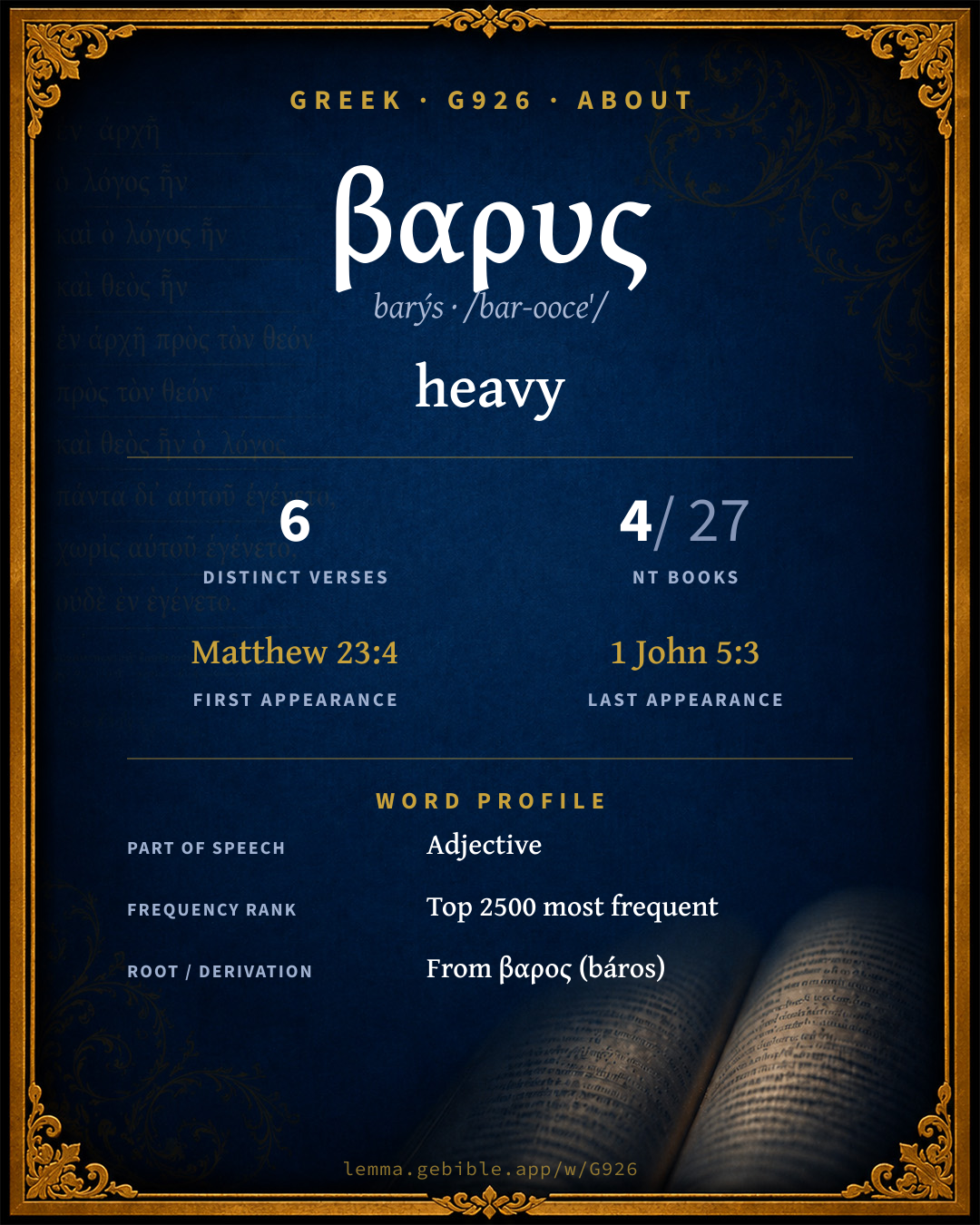
βαρύς
heavy
‘heavy’ is one of 2 main senses fuller range ↓
Full lexicon entry — Thayer's Greek Lexicon
From Thayer's Greek Lexicon
Where this word appears
See every Accusative-case word in the Greek New Testament →
Grammar key — what these labels mean
Part of speech
- Adjective
- A word that describes or qualifies a noun.
Case
- Accusative
- The case of the direct object and of extent.
- Nominative
- The case of the subject (and the predicate nominative).
Gender
- Neuter
- Grammatically neuter.
- Feminine
- Grammatically feminine.
- Masculine
- Grammatically masculine.
Number
- Plural
- More than one.
Degree
- Comparative
- Expresses a greater degree (“greater,” “more”).
3 distinct verses where G926 appears in the Accusative case, across 2 books. Filtered view — show all forms. Click any verse to open its interlinear word-by-word view. Verse text shown in the World English Bible for context — . Each verse’s Greek form is shown with its reference; the English is not keyword-highlighted, since the data carries no word-level English alignment. Use “Compare translations” on any verse to read it across multiple English versions. This concordance covers the Greek New Testament; Septuagint (Greek Old Testament) occurrences of this word are not indexed here.
Matthew 2 verses
- Matthew 23:4 βαρέα adj acc pl neut For they bind heavy burdens that are grievous to be borne, and lay them on men's shoulders; but they themselves will not lift a finger to help them.
- Matthew 23:23 βαρύτερα adj acc pl neut comp "Woe to you, scribes and Pharisees, hypocrites! For you tithe mint, dill, and cumin, and have left undone the weightier matters of the law: justice, mercy, and faith. But you ought to have done these, and not to have left the other undone.
Acts 1 verse
About this entry
At a glance — auto-summarized from this page’s data, not written by a person. Every figure links to its source below. This summary describes the numbers; it doesn’t interpret them.
“heavy” is the headline sense of the Greek adjective βαρυς (barýs). First canonically at Matthew 23:4, it enters the text early. With 6 verses in 4 books, it is an uncommon word in the Greek New Testament. It concentrates in Matthew, which alone accounts for 33% of its uses. Lexicons map it across 2 senses. See the sense tree, 6-verse concordance, and the renderings breakdown below.
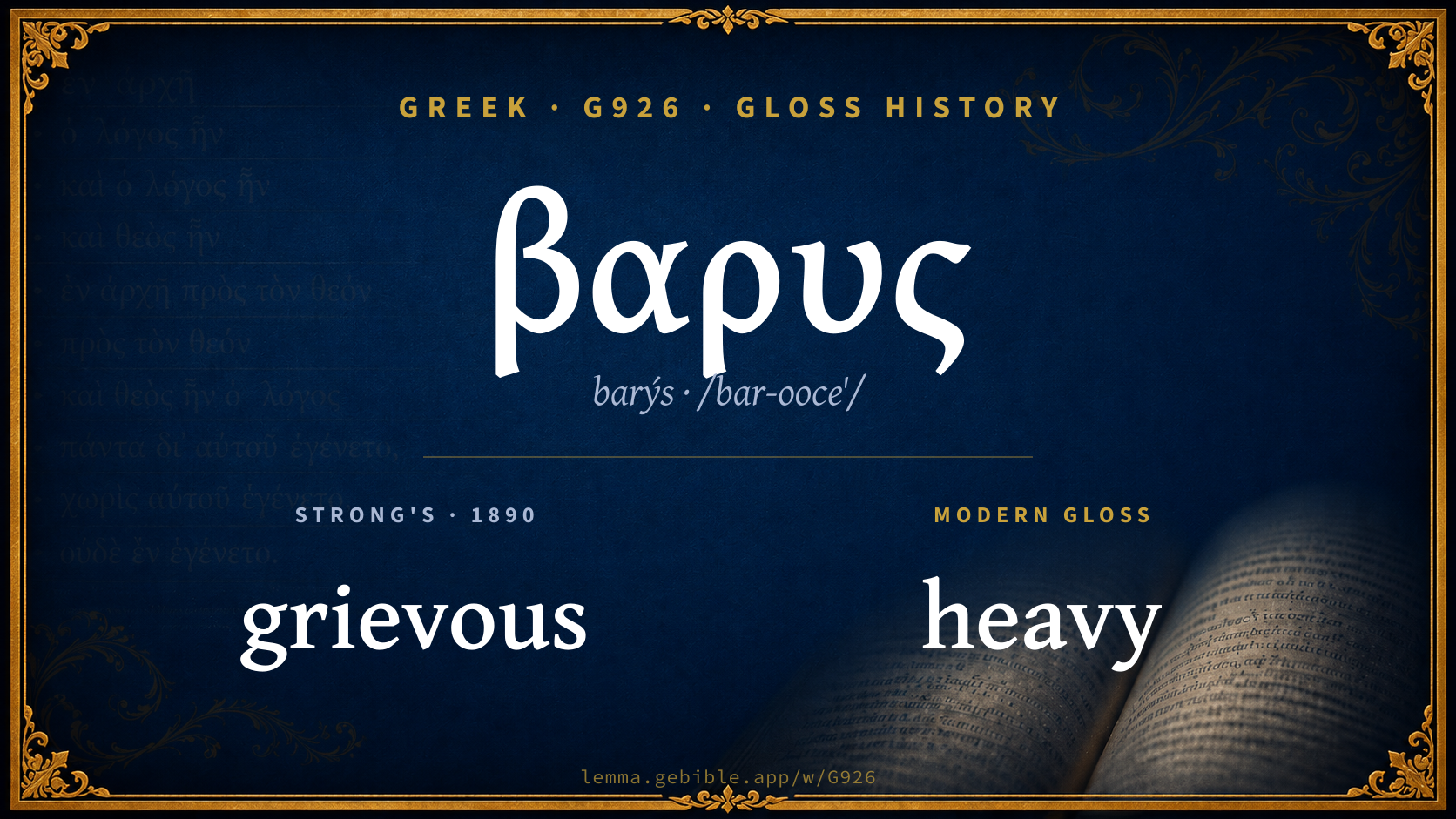
Gloss history
Strong's 1890 vs modern scholarship
About this word
Strong's G926 catalogs a Greek word from the Greek New Testament.
These counts are not copied from any lexicon or concordance. They are computed here, from the morphology-tagged Greek New Testament. What Lemma adds →
- 6
- distinct verses
- The word appears in 6 distinct verses.
- 4 / 27
- NT books
- The word appears in 4 of 27 New Testament books.
- #1,476
- by frequency
- Top 2500 most frequent Greek words (rank 1,476 of 5,347 Greek words by occurrence).
View all 6 occurrences in the concordance →
Most concentrated in
- Matthew 2 verses 33%
- Acts 2 verses 33%
- 2 Corinthians 1 verse 17%
By section of the New Testament
By traditional corpus
Conventional, traditional groupings — biblical authorship is debated, so this is a traditional corpus grouping, not an authorship claim. Some books belong to more than one corpus (Luke is in both the Gospels and the Lukan corpus, and so on), so these shares overlap and need not total 100%. Each figure is a share of the word’s 6 distinct verses.
- Gospels 2 verses · 33%
- Lukan (Luke–Acts) 2 verses · 33%
- Johannine 1 verse · 17%
- Pauline corpus 1 verse · 17%
- General (Catholic) Epistles 1 verse · 17%
How translations render this word
Counts come from each version’s own published word-to-Strong’s tagging or interlinear alignment — an approximate guide to how each version renders this word, not a word-level alignment the data otherwise carries. Because each total is that version’s own tagged count, the per-version totals vary from one another and need not match the appearance or distinct-verse counts above. These counts may also differ from a printed concordance because Lemma counts each distinctly tagged rendering and does not collapse phrase taggings into a single head-word total. This is a fixed set of word-tagged versions (KJV, ASV, BSB, ULT) and does not change with the reading translation you choose elsewhere. Each version’s license is shown beside its name below (and on Sources).
- King James Version: Grievous 2×
- American Standard Version: Grievous 3×
- Berean Standard Bible: Burdensome 1×, Heavy 1×, Savage 1×
- unfoldingWord Literal Text: Are weighty 1×, Burdensome 1×, Heavy 1×
King James Version Public Domain
Renders G926 across 6 tagged occurrences — most commonly:
Plus 4 renderings that appear only once — usually multi-word phrases or single function words the recovered tagging swept in, not distinct renderings.
American Standard Version Public Domain
Renders G926 across 6 tagged occurrences — most commonly:
Plus 3 renderings that appear only once — usually multi-word phrases or single function words the recovered tagging swept in, not distinct renderings.
Berean Standard Bible Public Domain
Renders G926 across 6 tagged occurrences — most commonly:
unfoldingWord Literal Text CC BY-SA 4.0
Renders G926 across 7 tagged occurrences — most commonly:
Senses in Thayer's
The 2 senses Thayer's distinguishes for this word, in lexicon order (not ranked by frequency or importance). The full entry — with sub-senses — is in the Lexicon Entry tab.
- heavy in weight
- metaph.
Word origin
Derived from βαρος (báros) (G922) — heaviness.
From the same as G922 ; weighty that is (figuratively) burdensome grave : - grievous heavy weightier.
— Strong’s Exhaustive Concordance (1890), public domain.
Forms in the corpus
The 4 distinct written forms G926 takes in the Greek New Testament, most frequent first — each parse links to that case’s occurrences in the concordance.
| Form | Parsing | Example | Uses |
|---|---|---|---|
| βαρέα baréa | Adjective, Accusative, Plural, Neuter | Matthew 23:4 | 2 |
| βαρεῖαι bareîai | Adjective, Nominative, Plural, Feminine | 2 Corinthians 10:10 | 2 |
| βαρεῖς bareîs | Adjective, Nominative, Plural, Masculine | Acts 20:29 | 1 |
| βαρύτερα barýtera | Adjective, Accusative, Plural, Neuter, Comparative | Matthew 23:23 | 1 |
Same root — word family
Other Thayer's entries built from the same root as G926, grouped by Strong’s listed origin. These share a root / origin per the lexicon — not necessarily a shared meaning. Each links to that word’s own entry.
Derives from
Derived from this word
- βαρεω baréō G916 to burden
- βαρεως baréōs G917 heavily
- βαρυνω barýnō G925 to overcharge
- βαρυτιμος barýtimos G927 precious
Compare all same-root words → Showing 4 of 6 — not the complete family. They share a root, not necessarily a meaning.
Septuagint usage
The same Greek word βαρυς appears 29 times in the Greek Old Testament (Septuagint), across 28 verses in 14 books.
- 29
- LXX occurrences
- Tagged occurrences of this Greek word in the Septuagint.
- 28
- verses
- Distinct Septuagint verses containing this word.
- 14 / 39
- OT books
- The word appears in 14 of the 39 Old Testament books.
Sample Septuagint occurrences
- Genesis 48:17 βαρύς
- Exodus 17:12 βαρύς
- Numbers 11:14 βαρύς
- Judges 20:34 βαρύς
- 1 Samuel 4:18 βαρύς
- 1 Kings 3:9 βαρύς
- 2 Kings 6:14 βαρύς
- 2 Chronicles 9:1 βαρύς
- Ezra 15:18 βαρύς
- Job 6:3 βαρύς
- Psalms 34:18 βαρύς
- Proverbs 27:3 βαρύς
Septuagint occurrences (same lexeme)
Every verse where the same Strong’s number (G926) appears in the Greek Septuagint. Verse text shown in the World English Bible for context; the Greek form is the matched word — the English is not keyword-highlighted.
- Genesis 48:17 βαρύς When Joseph saw that his father laid his right hand on the head of Ephraim, it displeased him. He held up his father's hand, to remove it from Ephraim's head to Manasseh's head.
- Exodus 17:12 βαρύς But Moses' hands were heavy; and they took a stone, and put it under him, and he sat on it. Aaron and Hur held up his hands, the one on the one side, and the other on the other side. His hands were steady until sunset.
- Exodus 18:18 βαρύς You will surely wear away, both you, and this people that is with you; for the thing is too heavy for you. You are not able to perform it yourself alone.
- Numbers 11:14 βαρύς I am not able to bear all this people alone, because it is too heavy for me.
- Numbers 20:20 βαρύς He said, You shall not pass through. Edom came out against him with much people, and with a strong hand.
- Judges 20:34 βαρύς There came over against Gibeah ten thousand chosen men out of all Israel, and the battle was sore; but they didn't know that evil was close on them.
- 1 Samuel 4:18 βαρύς It happened, when he made mention of the ark of God, that [Eli] fell from off his seat backward by the side of the gate; and his neck broke, and he died: for he was an old man, and heavy. He had judged Israel forty years.
- 1 Samuel 5:11 βαρύς They sent therefore and gathered together all the lords of the Philistines, and they said, Send away the ark of the God of Israel, and let it go again to its own place, that it not kill us and our people. For there was a deadly confusion throughout all the city; the hand of God was very heavy there.
- 1 Kings 3:9 βαρύς Give your servant therefore an understanding heart to judge your people, that I may discern between good and evil; for who is able to judge this your great people?
- 1 Kings 10:2 βαρύς She came to Jerusalem with a very great train, with camels that bore spices, and very much gold, and precious stones; and when she was come to Solomon, she talked with him of all that was in her heart.
- 1 Kings 12:4 βαρύς Your father made our yoke grievous: now therefore make you the grievous service of your father, and his heavy yoke which he put on us, lighter, and we will serve you.
- 1 Kings 12:11 βαρύς Now whereas my father did lade you with a heavy yoke, I will add to your yoke: my father chastised you with whips, but I will chastise you with scorpions.
- 2 Kings 6:14 βαρύς Therefore sent he there horses, and chariots, and a great host: and they came by night, and surrounded the city.
- 2 Kings 18:17 βαρύς The king of Assyria sent Tartan and Rabsaris and Rabshakeh from Lachish to king Hezekiah with a great army to Jerusalem. They went up and came to Jerusalem. When they were come up, they came and stood by the conduit of the upper pool, which is in the highway of the fuller's field.
- 2 Chronicles 9:1 βαρύς When the queen of Sheba heard of the fame of Solomon, she came to prove Solomon with hard questions at Jerusalem, with a very great train, and camels that bore spices, and gold in abundance, and precious stones: and when she was come to Solomon, she talked with him of all that was in her heart.
- 2 Chronicles 10:4 βαρύς Your father made our yoke grievous: now therefore make you the grievous service of your father, and his heavy yoke which he put on us, lighter, and we will serve you.
- 2 Chronicles 10:11 βαρύς Now whereas my father did lade you with a heavy yoke, I will add to your yoke: my father chastised you with whips, but I [will chastise you] with scorpions.
- 2 Chronicles 25:19 βαρύς You say, Behold, you have struck Edom; and your heart lifts you up to boast: abide now at home; why should you meddle to [your] hurt, that you should fall, even you, and Judah with you?
- Ezra 15:18 βαρύς
- Job 6:3 βαρύς For now it would be heavier than the sand of the seas, Therefore have my words been rash.
- Job 15:10 βαρύς With us are both the gray-headed and the very aged men, Much elder than your father.
- Job 23:2 βαρύς "Even today is my complaint rebellious. His hand is heavy in spite of my groaning.
- Job 33:7 βαρύς Behold, my terror shall not make you afraid, Neither shall my pressure be heavy on you.
- Psalms 34:18 βαρύς Yahweh is near to those who have a broken heart, And saves those who have a crushed spirit.
- Psalms 37:5 βαρύς Commit your way to Yahweh. Trust also in him, and he will do this:
- Proverbs 27:3 βαρύς A stone is heavy, And sand is a burden; But a fool's provocation is heavier than both.
- Daniel 2:11 βαρύς It is a rare thing that the king requires, and there is no other who can show it before the king, except the gods, whose dwelling is not with flesh.
- Nahum 3:3 βαρύς the horseman mounting, and the flashing sword, the glittering spear, and a multitude of slain, and a great heap of corpses, and there is no end of the bodies. They stumble on their bodies,
These are occurrences of the same Greek lexeme (G926) in the Septuagint — not a translation of any one Hebrew word. The store carries no word-level Hebrew↔Greek alignment, so no Hebrew original is asserted here. Counts come from the recovered LXX Strong's tagging — high-frequency vocabulary is well covered, while rare or late forms may be untagged — so they reflect tagged occurrences and may slightly undercount.