
Job 15:10

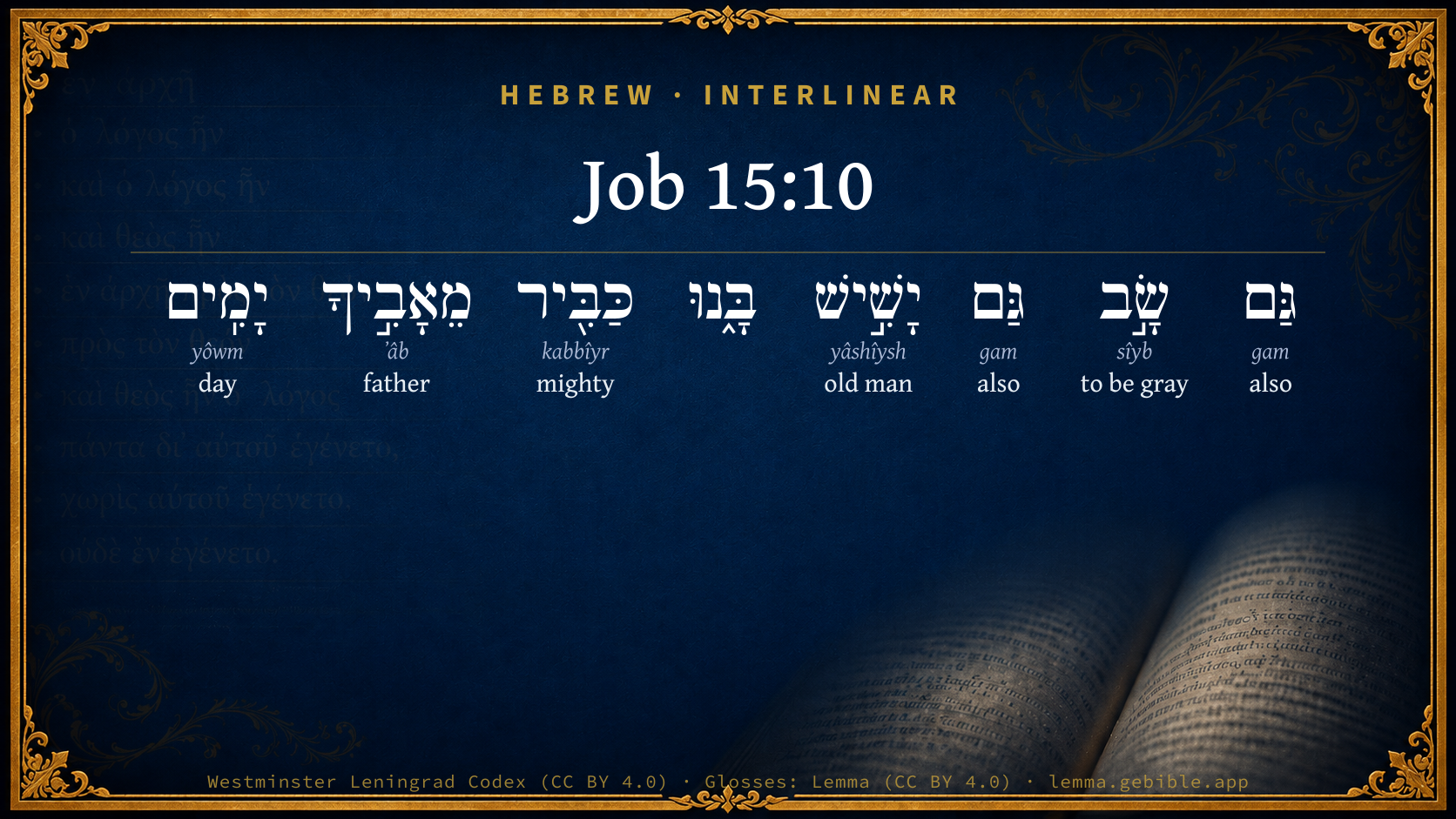
Hebrew (Westminster Leningrad Codex) Job 15:10 appears in the Hebrew Old Testament. The text above is from the Westminster Leningrad Codex. Each word links to its Strong’s number, a concise gloss, and parsing drawn from the Open Scriptures Hebrew Bible morphology. Click any word for its full Brown-Driver-Briggs (BDB) entry.
Download image
Cite this verse

Job 15:10 (World English Bible). Public Domain. Lemma interlinear Bible study tool, https://lemma.gebible.app/v/job/15/10.

Show BibTeX & RIS
BibTeX
RIS
English Translation
With us are both the gray-headed and the very aged men, Much elder than your father.
World English Bible · Public Domain
Download a study sheet

One document with this verse’s original text, its word-by-word gloss line, the meaning frame, cross-references with their text, attributed commentary, and full source and license credits — printable, and it pastes into notes with its structure intact.

This verse Autodidact and up

Study sheet (.html) Plain text (.txt)

A passage Seminary Student

Up to 50 verses in one chapter. A passage sheet keeps up to 6 commentary sources and 12 cross-references per verse, in the order this page ranks them, and says so on the sheet whenever that leaves anything out. Ask for a single verse and you get the Autodidact verse sheet above.

Everything on this page stays free to read, with no account — the sheet is a download of what is already on screen, not access to it.

Want to remove ads? Support Godless Engineer
Compare translations 3

The same verse in 3 English versions, stacked beneath the original-language interlinear above. Click any original word for its lexicon entry.

Each is an independent rendering of the whole verse — the interlinear is not word-aligned to these translations.

Highlighted words mark where these versions differ — a whole-verse word diff, not a word-by-word alignment.

  • World English Bible Public Domain
    With us are both the gray-headed and the very aged men, Much elder than your father.
  • King James Version Public Domain
    With us are both the grayheaded and very aged men, much elder than thy father.
  • unfoldingWord Literal Text CC BY-SA 4.0
    Both the gray-haired and the aged with us, greater than your father days.

unfoldingWord Literal Text — © unfoldingWord, licensed CC BY-SA 4.0. Word-aligned USFM3 via Door43 (git.door43.org/unfoldingWord/en_ult).

Versions to compare (up to 4)

3 of 4 selected

Show all 18 translations

Every available English version of this verse, each an independent rendering of the whole verse.

  • World English Bible Public Domain
    With us are both the gray-headed and the very aged men, Much elder than your father.
  • Berean Standard Bible Public Domain
    Both the gray-haired and the aged are on our side—men much older than your father.
  • Majority Standard Bible Public Domain
    Both the gray-haired and the aged are on our side—men much older than your father.
  • King James Version Public Domain
    With us are both the grayheaded and very aged men, much elder than thy father.
  • American Standard Version (1901) Public Domain
    With us are both the gray-headed and the very aged men, Much elder than thy father.
  • Revised Version (1885) Public Domain
    With us are both the grayheaded and the very aged men, much elder than thy father.
  • Geneva Bible (1599) Public Domain
    With vs are both auncient and very aged men, farre older then thy father.
  • Douay-Rheims (1899) Public Domain
    There are with us also aged and ancient men, much elder than thy fathers.
  • Young's Literal Translation Public Domain
    Both the gray-headed And the very aged `are' among us -- Greater than thy father `in' days.
  • Literal Standard Version CC BY-SA 4.0
    Both the gray-headed || And the very aged [are] among us—Greater than your father [in] days.
  • Unlocked Literal Bible CC BY-SA 4.0
    With us are both the gray-headed and the very aged men who are much older than your father.
  • unfoldingWord Literal Text CC BY-SA 4.0
    Both the gray-haired and the aged with us, greater than your father days.
  • Darby Bible Public Domain
    Both the greyheaded and the aged are with us, older than thy father.
  • World Messianic Bible Public Domain
    With us are both the gray-headed and the very aged men, much older than your father.
  • Webster's Bible Public Domain
    With us are both the gray headed and very aged men, much older than thy father.
  • Free Bible Version CC BY-SA 4.0
    We have among us old, gray-haired people much older than your father!
  • Bible in Basic English Public Domain
    With us are men who are grey-haired and full of years, much older than your father.
  • JPS Tanakh (1917) Public Domain
    With us are both the gray-headed and the very aged men, much older than thy father.

Literal Standard Version (2020), Covenant Press — licensed CC BY-SA 4.0. Text via the HelloAO Bible API (eBible.org). Unlocked Literal Bible (unfoldingWord) — licensed CC BY-SA 4.0. Text via the HelloAO Bible API (eBible.org). unfoldingWord Literal Text — © unfoldingWord, licensed CC BY-SA 4.0. Word-aligned USFM3 via Door43 (git.door43.org/unfoldingWord/en_ult). Free Bible Version, Dr. Jonathan Gallagher — licensed CC BY-SA 4.0. Text via the HelloAO Bible API (eBible.org).

Word by word

More ways to search: Search by grammar → Find every occurrence → Compare this word →

Practice this passage: Drill this verse → Learn its vocabulary →

About this verse

These counts appear in no published source. They are computed here, from the morphology-tagged text and Lemma’s own curated glosses. What Lemma adds →

8
words
6
distinct lemmas
Wisdom
section

Notable vocabulary

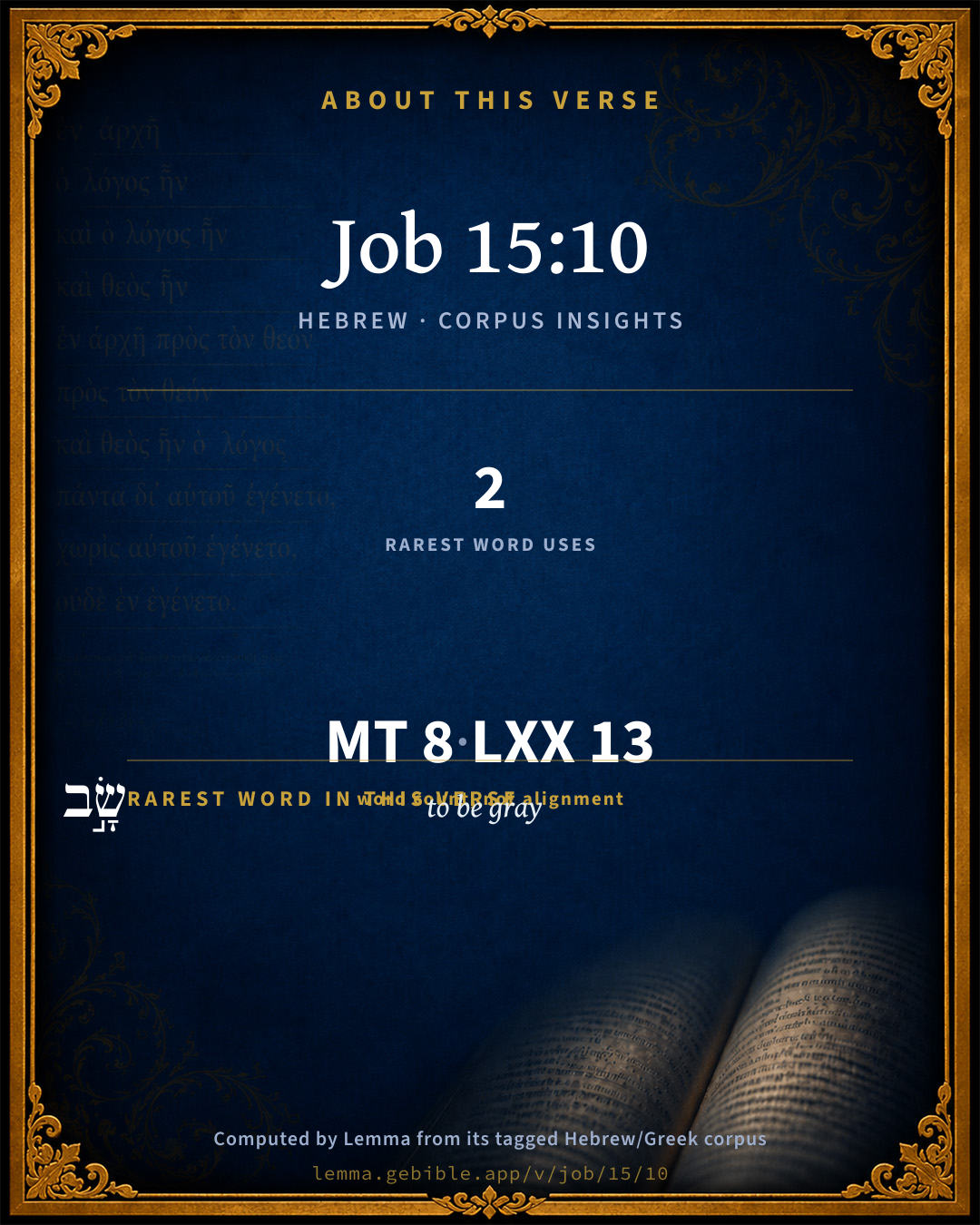
The rarest word here is שָׂ֣ב to be gray H7867 — appearing just 2 times in the whole Hebrew Bible.

Shared distinctive vocabulary

שָׂ֣ב to be gray H7867 occurs in 2 verses of the Hebrew Bible. Also found in:

Grammatical profile

  • 1 verb
  • 2 nouns
  • 2 adjectives
  • 1 preposition
  • 2 particles

Verb forms

  • שָׂ֣ב Qal · Participle Active

Repetition

A word recurs within this verse — often emphatic in Hebrew:

  • גַּם also H1571 ×2

Hebrew & Septuagint length

In English translation the verse runs 16 words from the Hebrew and 18 from the Septuagint (LXX English) — closely comparable.

A rough comparison of the two English renderings, which tokenize alike — not a word-level alignment.

Word counts can differ between the Hebrew and the Greek without any difference in meaning — e.g. the Hebrew direct-object marker אֵת has no separate Greek word, and Greek often adds the article ὁ.

In the original languages it is 8 Hebrew tokens and 13 Greek tokens — but the two are counted differently (Hebrew bundles its prefixes and suffixes into one token; the Greek is in lemma form), so that isn’t a like-for-like length.

Cross-references

6

Topical passages linked to Job 15:10 in the Treasury of Scripture Knowledge — connected by theme and wording, ordered by reader-vote popularity; previews shown in the World English Bible.

  • Job 32:6–7 Elihu the son of Barachel the Buzite answered, "I am young, and you are very old; Therefore I held back, and didn't dare show you my opinion.
  • Job 8:8–10 "Please inquire of past generations, Find out about the learning of their fathers.
  • Job 12:12 With aged men is wisdom, In length of days understanding.
  • Deuteronomy 32:7 Remember the days of old, Consider the years of many generations: Ask your father, and he will show you; Your elders, and they will tell you.
  • Job 12:20 He removes the speech of those who are trusted, And takes away the understanding of the elders.
  • Proverbs 16:31 Gray hair is a crown of glory. It is attained by a life of righteousness.

Cross-references courtesy of OpenBible.info (CC BY 4.0).

Hebrew and Greek witnesses Masoretic Hebrew ↔ Greek Septuagint

The same verse in the two great witnesses to the Old Testament, shown verse-for-verse.

These are two independent witnesses, not word-aligned to each other, and the Septuagint is shown in lemma (dictionary) form.

Hebrew Job 15:10 Masoretic · Westminster Leningrad Codex

גַּם שָׂ֣ב גַּם יָשִׁ֣ישׁ בָּ֑נוּ כַּבִּ֖יר מֵאָבִ֣יךָ יָמִֽים

With us are both the gray-headed and the very aged men, Much elder than your father.

World English Bible · Public Domain

Greek LXX Job 15:10 Septuagint · lemma form

καί γέ πρεσβύτης καί γέ παλαιός ἐν ἐγώ βαρύς ὁ πατήρ σύ ἡμέρα

Truly among us are both the old and very aged man, more advanced in days than your father.

LXX2012 (modern English Septuagint) · Public Domain

On this verse, Haydock's Catholic Bible Commentary discusses the Septuagint’s reading. Read the note in Commentary ↓

Hebrew: Westminster Leningrad Codex (CC BY 4.0). Greek: Septuagint (public domain); English from LXX2012 (modern English Septuagint) (Public Domain). How the Septuagint differs from the Hebrew →

Commentary

Notes on Job 15:10 from classic Christian and Jewish commentators (each source and its license shown beneath its notes). The classic Christian expositions comment on the surrounding passage and are grouped to its opening verse, so a note may address several verses; the Jewish commentaries on the Tanakh (Rashi and others) are per-verse, so they appear only where the commentator wrote on this verse.

Lemma curates 59 commentaries, every one of them public domain or Creative Commons licensed, each selected and text-cleaned for this edition rather than reprinted as found. About our sources →

Trapp's Complete Commentary

John Trapp

Job 15:10 With us [are] both the grayheaded and very aged men, much elder than thy father.

Ver. 10. With us are the grayheaded, &c.] Job had said, Job 12:12, "With the ancient is wisdom; and in length of days is understanding." This, though modestly spoken, yet was very ill taken; and is here replied unto with a great deal of heat. Sed ita solent importuni homines, &c., saith Mercer here; but such is the course and custom of unreasonable men, to take everything in the worst way, and to deal rather by reproaches than by reasons; as Eccius, Sanderus, Genebrardus, the whole generation of Jesuits, of whom Aurelius, the Sorbonist, saith, and truly, that they are a sort of men, qui nihil magis habent quam arrogantiam Theologicam: nihil minus possident quam Theologicam sclentiam; Arrogant and yet ignorant; for, while they think they know all things, they know nothing at all as they ought to know, 1Co 8:2. As for antiquity, here so stifity pleaded, it must have no more authority than what it can maintain. Papists boast much of it, as once the Gibeonites did of old shoes and mouldy bread. But antiquity, severed from verity, is of no value; for, as Cyprian saith well, Consuetudo mala, vetustas erroris est. And our Saviour saith not, I am custom, but, "I am the way, the truth," &c. And God saith, by the prophet Ezekiel, "Walk ye not in the statutes of your fathers, neither observe their judgments," &c., but, "walk in my statutes, and keep my judgments, and do them," Eze 20:18-19. {See Trapp on "Job 8:8"} {See Trapp on "Job 8:9"} {See Trapp on "Job 8:10"} {See Trapp on "Job 12:12"}

John Trapp, A Commentary or Exposition upon All the Books of the Old and New Testament (1647–1656) — public domain. Text from a community e-Sword module.

The Biblical Illustrator

Joseph S. Exell

Job_15:10

The grey-headed and very aged men.

Grey-headed and aged men

I. Old age presents social contrasts. Some are rich and some are poor. Some have all their wants anticipated and supplied; others are beset with difficulties, which seem to thicken with advancing years.

II. Old age presents physical contrasts. There is an old man, fresh and ruddy, renewing his youth like the eagle. There is another who answers to Solomons melancholy description. The cause of this diversity may frequently be found in the past life. The sins of youth bite sore in age.

III. Old age presents intellectual contrasts. In most cases age brings its mental as well as its bodily infirmities. The imagination grows dull, the understanding loses its vigour, the power of originating and sustaining thought fails. There is no intellectual sympathy with living thought, nor power of appreciating it. There are instances of intellectual power remaining unimpaired to the last, so that the latest efforts of their possessors have been among their best. Plato continued writing until he was over eighty. Dryden produced his noblest poem when he was near seventy. We generally speak of old age as pregnant with experience; but great men are not always wise, neither do the aged understand judgment. Some old people are as foolish as if they had walked through the world with their eyes and ears shut. There are contrasts of temper as well as of intellect. Old age is often fretful. It would seem as if infancy had come again, with all its peevishness, and none of its charms.

IV. Old age presents spiritual contrasts. The hoary head is sometimes a crown of glory. But there are old sinners as well as old saints. Some men are a terrible curse to society. And a sinful old age is often a miserable old age. This is especially the case where the besetting sin is covetousness. One lesson for all. If you live to be old, your old age will be very much what you are pleased to make it. Your moral and spiritual character rests with yourselves. (William Walters.)

The old faith and the new experience

The Catholic doctrine has not yet been struck out that will fuse in one commanding law the immemorial convictions of the race and the widening visions of the living soul. The agitation of the Church today is caused by the presence within her of Eliphaz and Job--Eliphaz standing for the fathers and their faith, Job passing through a fever crisis of experience and finding no remedy in the old interpretations. The Church is apt to say, Here is moral disease, sin; we have nothing for that but rebuke and aversion. Is it wonderful that the tried life, conscious of integrity, rises in indignant revolt? The taunt of sin, scepticism, rationalism, or self-will is too ready a weapon, a sword worn always by the side or carried in the hand. (R. A. Watson.)

The aged that linger in the world

Sometimes the sun seems to hang for a half hour in the horizon, only just to show how glorious it can be. The day is done, the fervour of the shining is over, and the sun hangs golden--nay redder than gold--in the west, making everything look unspeakably beautiful with its rich effulgence, which it sheds on every side. So God seems to let some people, when their duty in this world is done, hang in the west that men may look at them and see how beautiful they are. There are some hanging in the west now. (H. W. Beecher.)

The Biblical Illustrator, edited by Joseph S. Exell (c. 1880s–1900s) — public domain. Text from a community e-Sword module.

Jamieson, Fausset & Brown

Robert Jamieson, A. R. Fausset & David Brown

On our side, thinking with us are the aged. Job had admitted that wisdom is with them (Job 12:12). Eliphaz seems to have been himself older than Job; perhaps the other two were also (Job 32:6). Job, in Job 30:1, does not refer to his three friends; it therefore forms no objection. The Arabs are proud of fulness of years.

Jamieson, Fausset & Brown — Commentary Critical and Explanatory on the Whole Bible (1871) — public domain (CC PDM 1.0). Text via the HelloAO Bible API.

Adam Clarke's Commentary

Verse 10. With us are both the gray-headed] One copy of the Chaldee Targum paraphrases the verse thus: "Truly Eliphaz the hoary-headed, and Bildad the long-lived, are among us; and Zophar, who in age surpasseth thy father." It is very likely that Eliphaz refers to himself and his friends in this verse, and not either to the old men of their tribes, or to the masters by whom they themselves were instructed. Eliphaz seems to have been the eldest of these sages; and, therefore, he takes the lead in each part of this dramatic poem.

Adam Clarke's Commentary on the Bible (1810–1826) — public domain. Text from a community e-Sword/MySword module.

The Cambridge Bible for Schools and Colleges

gen. ed. J. J. S. Perowne

10. This verse should probably read,

Among us is one both grayheaded and very aged,

One older in days than thy father.

Eliphaz with a dignified indirectness in which, however, a certain personal feeling is displayed, alludes to himself. Others take the words “grayheaded” and “very aged” as collectives—among us are both the grayheaded and the very aged; in which case “among us” must mean “belonging to our tribes.” But in reproving Job’s demeanour a reference to persons absent seems out of place.

The Cambridge Bible for Schools and Colleges (gen. ed. J. J. S. Perowne; Cambridge University Press, 1878–1918) — public domain. Text from a community e-Sword module.

John Gill's Exposition

With us are both the grayheaded,.... The grayheaded man, or one that is so, it is in the singular number; gray hairs are a sign of old age, and an emblem of wisdom, see Job 12:12; to which words Eliphaz may be thought to refer; Job there suggesting as if wisdom was with him, being an ancient man:

and very aged men; or "man" rather; Mr. Broughton renders it, and "all gray", as if the other word only signifies one that has a mixture of gray hairs on him, but this one all whose hairs are turned gray:

much elder than thy father; or "greater", as the same learned man renders it; and so Aben Ezra and Bar Tzemach say in the Arabic language the word signifies, and may design a third person. Ben Gersom thinks that Eliphaz was older than Job, and that his other two friends were younger than he, or Zophar only was younger than he; one of the Targums paraphrases the words thus,

"but Eliphaz who is gray, and Bildad who is aged, are with us, and Zophar who is greater in days than thy father;''

it appears that they were very old men by what Elihu says, Job 32:6; though it may be Eliphaz may not barely have respect to themselves and their age, but to their ancestors, their fathers, from whom they had their knowledge, when they were but of yesterday, and knew little, and so pleads antiquity on their side; and it has been observed that Teman, from whence Eliphaz was, was famous for wisdom, and wise men in it, at least it was so in later times; and if so early, the observation would be more pertinent, and the sense might be thought to be, that we have at Teman men as ancient and as wise as at Uz, in the schools of the one as in the schools of the other, and so have the opportunity of gaining as much wisdom and knowledge as Job: or it may be the meaning only is this, that we have on our side the question as many ancient and learned men, or more, than Job can pretend to; and thus, as before, antiquity is pleaded; but is not a sure rule to go by, at least by trusting to it men may be led aside; for though truth is the good old way, and is the oldest way, yet error is almost as old as truth; it follows so close upon the heels of it, that it is difficult, in some cases, to discern which is first, though truth always is: there is the old way which wicked men have trodden; and a pretence to antiquity, if not carefully observed, may lead into it, see Jer 6:16, Job 22:15.

John Gill's Exposition of the Whole Bible (1746–1763) — public domain (CC PDM 1.0). Text via the HelloAO Bible API.

Albert Barnes' Notes on the Bible

With us are both the gray headed - That is, some of us who are here are much older than thy father; or we express the sentiments of such aged men. Job had admitted Job 12:12, that with the aged was wisdom, and in length of days understanding; and Eliphaz here urges that on that principle he and his friends had a claim to be heard. It would seem from this, that Job was very far from being regarded as an old man, and would probably be esteemed as in middle life. The Targum (Chaldee) refers this to Eliphaz himself and his two friends. “Truly Eliphaz, who is hoary-headed (דסיב) and Bildad, the long-lived (דקשיש) are with us, and Zophar, who is older than thy father.” But it is not certain that he meant to confine the remark to them. It seems to me probable that this whole discussion occurred in the presence of others, and perhaps was a public contest. It is clear, I think, that Elihu was present, and heard it all (see Job 32:4), and it would accord well with Oriental habits to suppose that this was a trim of skill, which many were permitted to witness, and which was continued for a considerable time. Eliphaz may, therefore, have meant to say that among his friends who had assembled to hear this debate, there were not a few who coincided with him in sentiment, who were much more aged than Job, and who had had much longer experience in the world.

Albert Barnes' Notes on the Bible (1834–1885) — public domain. Text from a community e-Sword/MySword module.

Haydock's Catholic Bible Commentary

Fathers. Hebrew and Septuagint, "father." (Haydock) --- Eliphaz always speaks first, and hints that he was as old, perhaps older, than Job; who had rather found fault with the youth of Sophar, chap. xii. 12. He also boasts that they, or their country, furnished master of great wisdom and experience than even Job’s father. (Calmet)

George Leo Haydock (1774–1849), Haydock's Catholic Family Bible and Commentary, 1859 edition — public domain. Excludes Psalms (Douay-Rheims chapter numbering differs from Protestant) and Deuterocanonical books (Catholic canon only).

Matthew Poole's English Annotations

With us, i.e. among us; either,

1. Some of us, who seem to have been very ancient from Job 32:7. Or,

2. Some others with whom we have conversed, and who are of our opinion in this matter. And this they oppose to that passage of Job’s, Job 12:12.

Matthew Poole's English Annotations on the Holy Bible (1683–1685) — public domain. Text from a community e-Sword/MySword module.

Whedon's Commentary on the Bible

Daniel D. Whedon

10. The grayheaded — He probably refers to himself. The Targum applies the term gray-haired to Eliphaz; aged, to Bildad; and older, or greater in days, to Zophar.

Daniel D. Whedon (gen. ed.), Commentary on the Old and New Testaments (1874–1909) — public domain. Text from a community e-Sword module.

The Pulpit Commentary

With us are both the greyheaded and very aged men. "With us" seems to mean "of our party," or "on our side." Eliphaz claims that all the greybeards of the time, as well as all the ancient men of past times (comp. Job_8:8, and below, ver. 18), are on his side. and think as he does. Much elder than thy father. Men, i.e. "not merely of the preceding, but of much more distant generations His Latin to be supported by the voice of antiquity was, no doubt, in strict accordance with fact.

The Pulpit Commentary (1880–1919), ed. H.D.M. Spence-Jones & Joseph S. Exell — public domain. Text from a community e-Sword module.

unfoldingWord translationNotes

Door43 World Missions Community

With us are both the gray-headed and the very aged men

Eliphaz speaks of him and the other men having learned wisdom from older men and wisdom that had been passed down from men of previous generations as if these older men were physically present with them. AT: "We acquired wisdom from old gray-haired people, from people who were born before your father was" (See: Metaphor)

Are the consolations of God ... gentle toward you?

This rhetorical question is an accusation, with the implicit answer to the question being "yes." This question may be written as a statement. AT: "You must think that the consolations of God are too small for you, the words that are gentle toward you"

consolations

"comforts" or "sympathies"

translationWords

word

unfoldingWord translationNotes — © Distant Shores Media and the Door43 World Missions Community, licensed CC BY-SA 4.0. Source: git.door43.org/Door43/en_tn.

Rashi

Rabbi Shlomo Yitzchaki (Rashi)

more of more days than you father.

Rashi on the Tanakh — English translations: “The Judaica Press complete Tanach with Rashi, translated by A. J. Rosenberg” (CC BY 4.0); “Pentateuch with Rashi's commentary by M. Rosenbaum and A.M. Silbermann, 1929-1934” (public domain); “The Metsudah Tanach series, Lakewood, N.J” (CC BY 4.0); and “The Book of Joshua, Metsudah Publications, 1997” (CC BY 4.0). Text via Sefaria.

Lesson kit

Teaching starters — assembled from the data on this page, not authored interpretation. Every prompt links to the verse data it draws on. Edit before teaching.

Job, in the Wisdom, opens this verse with 8 words (6 distinct Hebrew lemmas). Its most distinctive word is sîyb (“to be gray”). A historical commentator’s framing appears above. Read the whole chapter for the surrounding context.

Discussion questions

  1. The word sîyb carries the sense “to be gray.” How does it shape the verse?
  2. 1 Samuel 12:2 shares the word «to be gray» with this verse. How do the two illuminate each other?
  3. “also” occurs 2× in this one verse. What is the effect of the repetition?
  4. These translations render this verse differently; the difference is in the English rendering, not the original. What questions does that raise?
  5. The verb «שָׂ֣ב» is Qal Participle Active. How does its form color the action?
  6. Reading how Trapp's Complete Commentary and The Biblical Illustrator read this verse, where do the two commentators agree and where do they part?

Things to notice

Reading settings

Reading text

Shown beneath each verse's original-language words.

Old Testament
Old Testament edition

Read the OT as the Masoretic Hebrew (MT) or the Greek Septuagint (LXX).

English shown for the Greek Septuagint (in the Hebrew ↔ Greek comparison).

Comparing translations? Open the Compare panel on any verse page to stack up to four side by side.