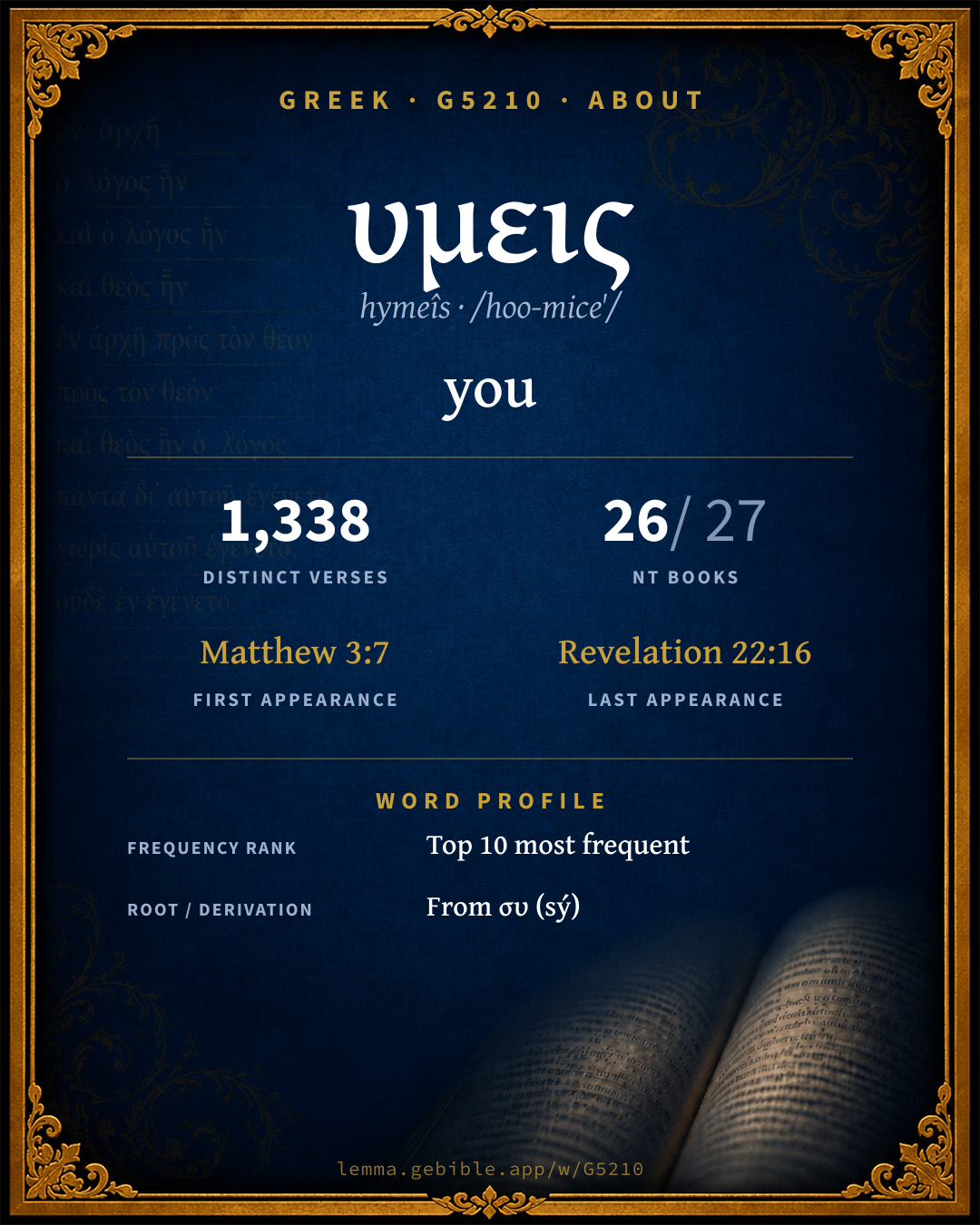
ὑμείς
you
Full lexicon entry — Thayer's Greek Lexicon
From Thayer's Greek Lexicon
Where this word appears
See every Dative-case word in the Greek New Testament →
Grammar key — what these labels mean
Part of speech
- Personal pronoun
- Stands in for a person already named (“I,” “you,” “he”).
Case
- Dative
- The case of the indirect object, means, or location — “to / for / with / in.”
- Genitive
- The case of source, possession, or “of” — answers “whose / from what.”
- Accusative
- The case of the direct object and of extent.
- Nominative
- The case of the subject (and the predicate nominative).
Person
- 2nd person
- The one addressed (“you”).
Number
- Plural
- More than one.
21 verses where G5210 appears in the Nominative case in the Book of Luke. Filtered view — show all forms. Click any verse to open its interlinear word-by-word view. Verse text shown in the World English Bible for context — . Each verse’s Greek form is shown with its reference; the English is not keyword-highlighted, since the data carries no word-level English alignment. Use “Compare translations” on any verse to read it across multiple English versions. This concordance covers the Greek New Testament; Septuagint (Greek Old Testament) occurrences of this word are not indexed here.
Luke
- Luke 6:31 ὑμῖν ὑμεῖς pron 2 dat pl pron 2 nom pl "As you would like people to do to you, do exactly so to them.
- Luke 9:13 ὑμεῖς pron 2 nom pl But he said to them, "You give them something to eat." They said, "We have no more than five loaves and two fish, unless we should go and buy food for all these people."
- Luke 9:20 ὑμεῖς pron 2 nom pl He said to them, "But who do you say that I am?" Peter answered, "The Christ of God."
- Luke 9:44 ὑμεῖς ὑμῶν pron 2 nom pl pron 2 gen pl "Let these words sink into your ears, for the Son of Man will be delivered up into the hands of men."
- Luke 10:24 ὑμῖν ὑμεῖς pron 2 dat pl pron 2 nom pl for I tell you that many prophets and kings desired to see the things which you see, and didn't see them, and to hear the things which you hear, and didn't hear them."
- Luke 11:13 ὑμεῖς ὑμῶν pron 2 nom pl pron 2 gen pl If you then, being evil, know how to give good gifts to your children, how much more will your heavenly Father give the Holy Spirit to those who ask him?"
- Luke 11:39 ὑμεῖς ὑμῶν pron 2 nom pl pron 2 gen pl The Lord said to him, "Now you Pharisees cleanse the outside of the cup and of the platter, but your inward part is full of extortion and wickedness.
- Luke 11:48 ὑμῶν ὑμεῖς pron 2 gen pl pron 2 nom pl So you testify and consent to the works of your fathers. For they killed them, and you build their tombs.
- Luke 12:24 ὑμεῖς pron 2 nom pl Consider the ravens: they don't sow, they don't reap, they have no warehouse or barn, and God feeds them. How much more valuable are you than birds!
- Luke 12:29 ὑμεῖς pron 2 nom pl Don't seek what you will eat or what you will drink; neither be anxious.
- Luke 12:36 ὑμεῖς pron 2 nom pl Be like men watching for their lord, when he returns from the marriage feast; that, when he comes and knocks, they may immediately open to him.
- Luke 12:40 ὑμεῖς pron 2 nom pl Therefore be ready also, for the Son of Man is coming in an hour that you don't expect him."
- Luke 16:15 ὑμεῖς ὑμῶν pron 2 nom pl pron 2 gen pl He said to them, "You are those who justify yourselves in the sight of men, but God knows your hearts. For that which is exalted among men is an abomination in the sight of God.
- Luke 17:10 ὑμεῖς ὑμῖν pron 2 nom pl pron 2 dat pl Even so you also, when you have done all the things that are commanded you, say, 'We are unworthy servants. We have done our duty.'"
- Luke 19:46 ὑμεῖς pron 2 nom pl saying to them, "It is written, 'My house is a house of prayer,' but you have made it a 'den of robbers'!"
- Luke 21:31 ὑμεῖς pron 2 nom pl Even so you also, when you see these things happening, know that the Kingdom of God is near.
- Luke 22:26 ὑμεῖς ὑμῖν pron 2 nom pl pron 2 dat pl But not so with you. But one who is the greater among you, let him become as the younger, and one who is governing, as one who serves.
- Luke 22:28 ὑμεῖς pron 2 nom pl But you are those who have continued with me in my trials.
- Luke 22:70 ὑμεῖς pron 2 nom pl They all said, "Are you then the Son of God?" He said to them, "You say it, because I AM."
- Luke 24:48 ὑμεῖς pron 2 nom pl You are witnesses of these things.
- Luke 24:49 ὑμᾶς ὑμεῖς pron 2 acc pl pron 2 nom pl Behold, I send forth the promise of my Father on you. But wait in the city of Jerusalem until you are clothed with power from on high."
About this entry
At a glance — auto-summarized from this page’s data, not written by a person. Every figure links to its source below. This summary describes the numbers; it doesn’t interpret them.
υμεις (hymeîs) is a Greek word most often rendered “you.” It first appears in Matthew 3:7. It turns up in 1,338 verses across 26 books, one of the most common footprint. From the same root come συ, σε and σοι. For the data behind this summary, explore the sense tree and the renderings breakdown below.
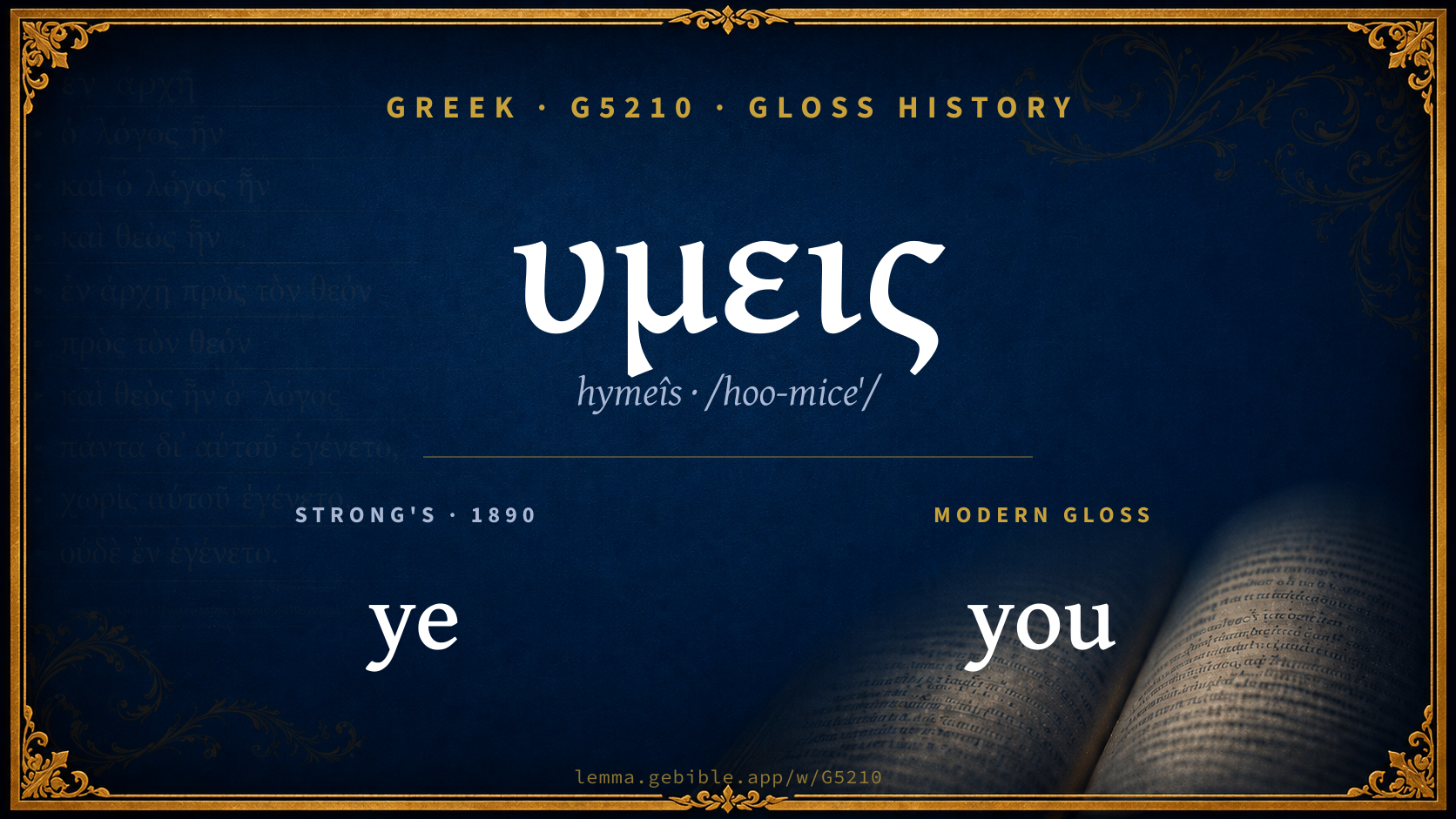
Gloss history
Strong's 1890 vs modern scholarship
About this word
Strong's G5210 catalogs a Greek word from the Greek New Testament.
These counts are not copied from any lexicon or concordance. They are computed here, from the morphology-tagged Greek New Testament. What Lemma adds →
- 1,338
- distinct verses
- The word appears in 1,338 distinct verses.
- 26 / 27
- NT books
- The word appears in 26 of 27 New Testament books.
- #8
- by frequency
- Top 10 most frequent Greek words (rank 8 of 5,347 Greek words by occurrence).
View all 1,338 occurrences in the concordance →
By section of the New Testament
By traditional corpus
Conventional, traditional groupings — biblical authorship is debated, so this is a traditional corpus grouping, not an authorship claim. Some books belong to more than one corpus (Luke is in both the Gospels and the Lukan corpus, and so on), so these shares overlap and need not total 100%. Each figure is a share of the word’s 1,338 distinct verses.
- Gospels 566 verses · 42%
- Pauline corpus 525 verses · 39%
- Lukan (Luke–Acts) 256 verses · 19%
- Johannine 194 verses · 14%
- General (Catholic) Epistles 121 verses · 9%
- Hebrews 28 verses · 2%
- Revelation 9 verses · 1%
How translations render this word
Counts come from each version’s own published word-to-Strong’s tagging or interlinear alignment — an approximate guide to how each version renders this word, not a word-level alignment the data otherwise carries. Because each total is that version’s own tagged count, the per-version totals vary from one another and need not match the appearance or distinct-verse counts above. These counts may also differ from a printed concordance because Lemma counts each distinctly tagged rendering and does not collapse phrase taggings into a single head-word total. This is a fixed set of word-tagged versions (KJV, ASV, BSB, ULT) and does not change with the reading translation you choose elsewhere. Each version’s license is shown beside its name below (and on Sources).
- King James Version: Ye 229×, Do ye 3×, Thither ye 2×
- American Standard Version: Ye 220×, Do ye 4×
King James Version Public Domain
Renders G5210 across 242 tagged occurrences — most commonly:
Plus 8 renderings that appear only once — usually multi-word phrases or single function words the recovered tagging swept in, not distinct renderings.
American Standard Version Public Domain
Renders G5210 across 237 tagged occurrences — most commonly:
Plus 13 renderings that appear only once — usually multi-word phrases or single function words the recovered tagging swept in, not distinct renderings.
Senses in Thayer's
The 1 sense Thayer's distinguishes for this word, in lexicon order (not ranked by frequency or importance). The full entry — with sub-senses — is in the Lexicon Entry tab.
- you
Word origin
Derived from συ (sý) (G4771) — you.
Irregular plural of G4771 ; you (as subject of verb): - ye (yourselves) you.
— Strong’s Exhaustive Concordance (1890), public domain.
Forms in the corpus
The 5 distinct written forms G5210 takes in the Greek New Testament, most frequent first — each parse links to that case’s occurrences in the concordance.
| Form | Parsing | Example | Uses |
|---|---|---|---|
| ὑμῖν hymîn | Personal pronoun, 2nd person, Dative, Plural | Matthew 3:7 | 601 |
| ὑμῶν hymō̂n | Personal pronoun, 2nd person, Genitive, Plural | Matthew 5:11 | 560 |
| ὑμᾶς hymâs | Personal pronoun, 2nd person, Accusative, Plural | Matthew 3:11 | 432 |
| ὑμεῖς hymeîs | Personal pronoun, 2nd person, Nominative, Plural | Matthew 5:48 | 230 |
| Ὑμεῖς Hymeîs | Personal pronoun, 2nd person, Nominative, Plural | Matthew 5:13 | 5 |
Same root — word family
Other Thayer's entries built from the same root as G5210, grouped by Strong’s listed origin. These share a root / origin per the lexicon — not necessarily a shared meaning. Each links to that word’s own entry.
Derives from
Shares the same root
Derived from this word
Compare all same-root words → Showing 4 of 10 — not the complete family. They share a root, not necessarily a meaning.
Septuagint usage
The same Greek word υμεις appears 3 times in the Greek Old Testament (Septuagint), across 3 verses in 1 book.
- 3
- LXX occurrences
- Tagged occurrences of this Greek word in the Septuagint.
- 3
- verses
- Distinct Septuagint verses containing this word.
- 1 / 39
- OT books
- The word appears in 1 of the 39 Old Testament books.
Sample Septuagint occurrences
- Jeremiah 41:17 ὑμεῖς
Septuagint occurrences (same lexeme)
Every verse where the same Strong’s number (G5210) appears in the Greek Septuagint. Verse text shown in the World English Bible for context; the Greek form is the matched word — the English is not keyword-highlighted.
- Jeremiah 41:17 ὑμεῖς and they departed, and lived in Geruth Chimham, which is by Bethlehem, to go to enter into Egypt,
- Jeremiah 51:2 ὑμεῖς I will send to Babylon strangers, who shall winnow her; and they shall empty her land: for in the day of trouble they shall be against her round about.
- Jeremiah 51:25 ὑμεῖς Behold, I am against you, destroying mountain, says Yahweh, which destroy all the earth; and I will stretch out my hand on you, and roll you down from the rocks, and will make you a burnt mountain.
These are occurrences of the same Greek lexeme (G5210) in the Septuagint — not a translation of any one Hebrew word. The store carries no word-level Hebrew↔Greek alignment, so no Hebrew original is asserted here. Counts come from the recovered LXX Strong's tagging — high-frequency vocabulary is well covered, while rare or late forms may be untagged — so they reflect tagged occurrences and may slightly undercount.