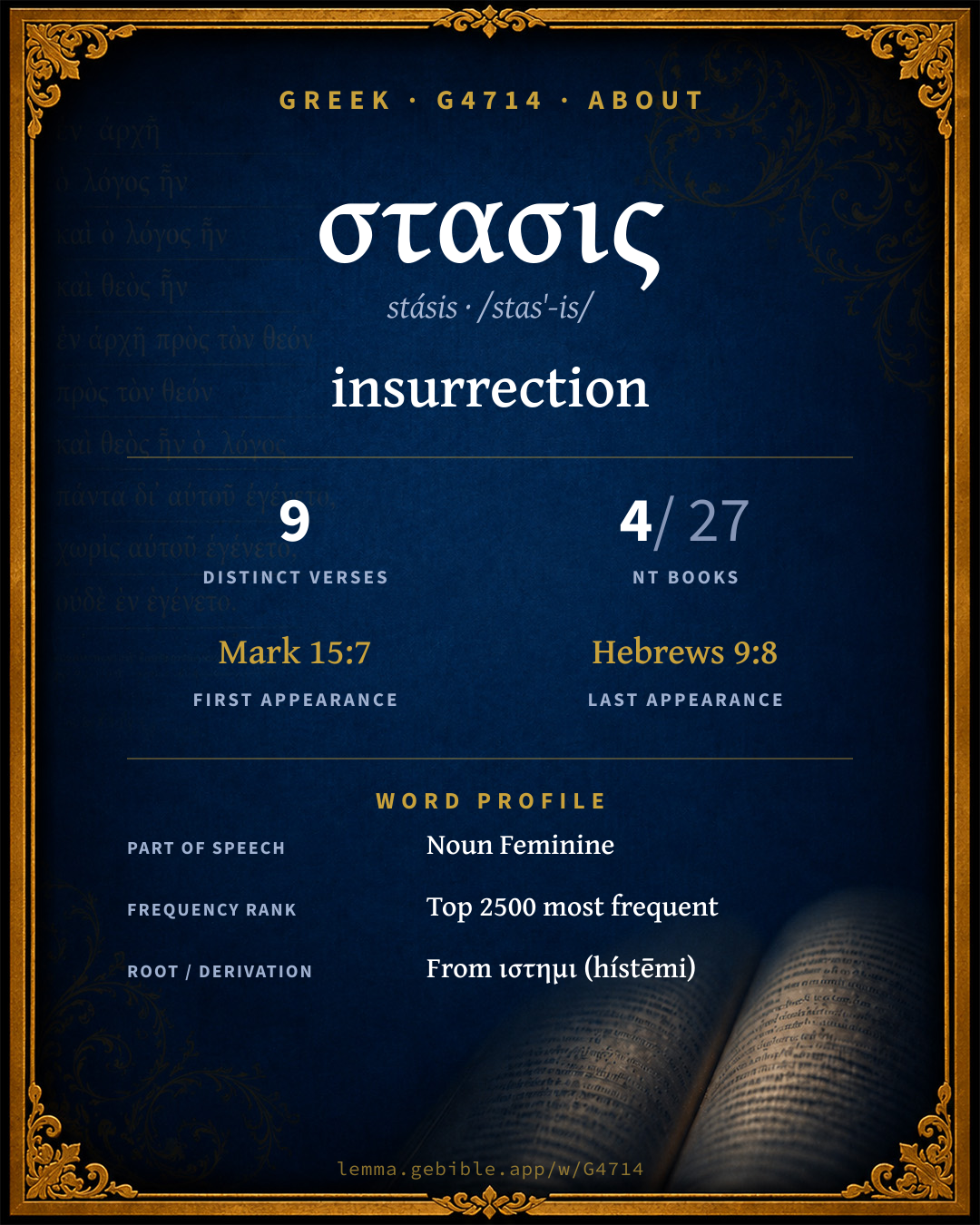
στάσις
insurrection
‘insurrection’ is one of 3 main senses fuller range ↓
Full lexicon entry — Thayer's Greek Lexicon
From Thayer's Greek Lexicon
Where this word appears
Grammar key — what these labels mean
Part of speech
- Noun
- A naming word — a person, place, thing, or idea.
Case
- Accusative
- The case of the direct object and of extent.
- Genitive
- The case of source, possession, or “of” — answers “whose / from what.”
- Dative
- The case of the indirect object, means, or location — “to / for / with / in.”
- Nominative
- The case of the subject (and the predicate nominative).
Gender
- Feminine
- Grammatically feminine.
Number
- Singular
- One.
- Plural
- More than one.
Every verse where G4714 appears in the Book of Mark — 1 distinct verse. Click any verse to open its interlinear word-by-word view. Verse text shown in the World English Bible for context — . Each verse’s Greek form is shown with its reference; the English is not keyword-highlighted, since the data carries no word-level English alignment. Use “Compare translations” on any verse to read it across multiple English versions. This concordance covers the Greek New Testament; Septuagint (Greek Old Testament) occurrences of this word are not indexed here.
Mark
About this entry
At a glance — auto-summarized from this page’s data, not written by a person. Every figure links to its source below. This summary describes the numbers; it doesn’t interpret them.
στασις — transliterated stásis — is a Greek noun carrying the sense “insurrection.” More than half of its appearances fall in Acts. The Greek New Testament uses it across 9 verses — uncommon. Debuting at Mark 15:7, it then recurs through the corpus. Thayer's distinguishes 3 senses for it. Each statement above links to its evidence; the full detail follows below.
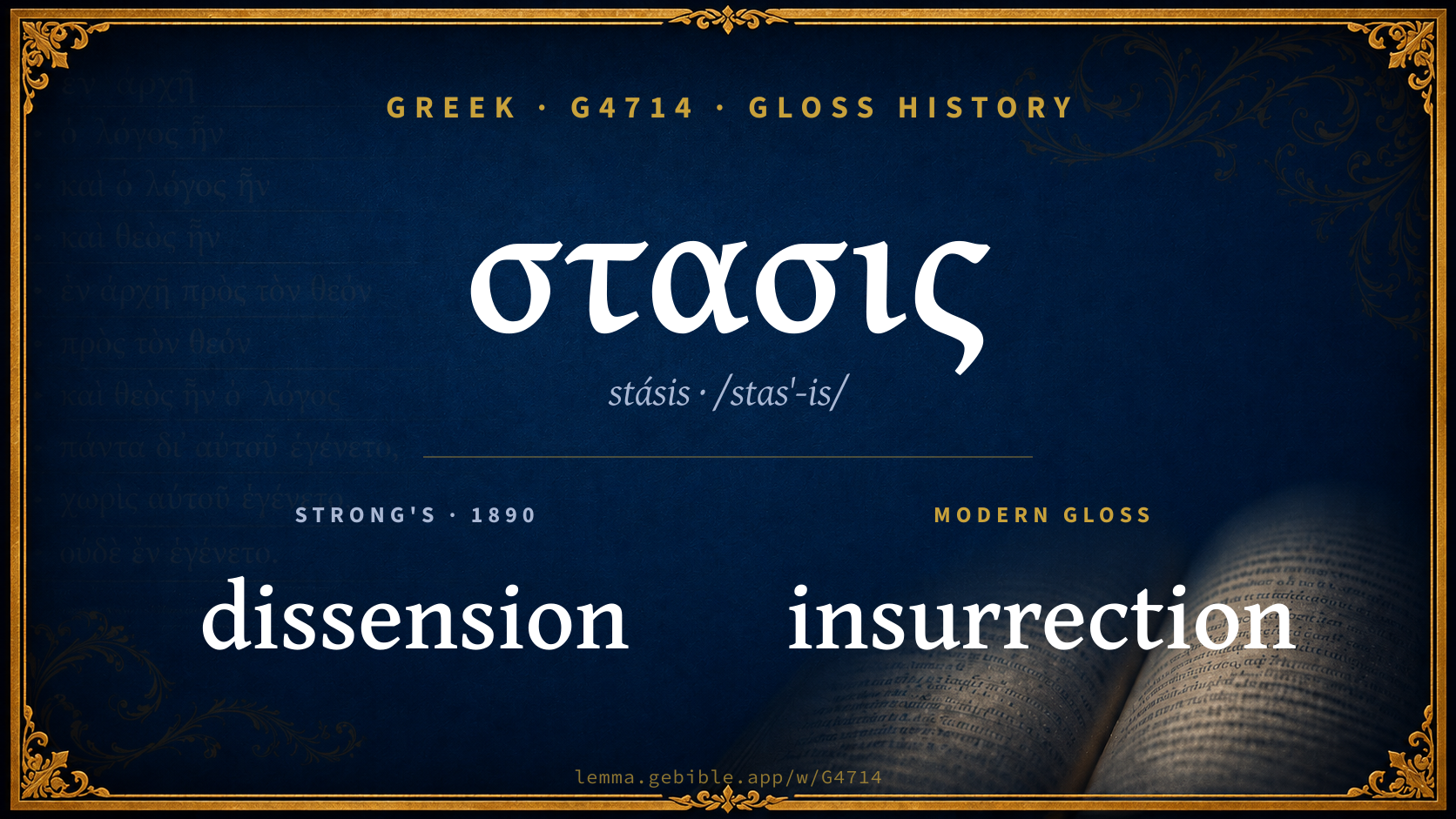
Gloss history
Strong's 1890 vs modern scholarship
About this word
Strong's G4714 catalogs a Greek word from the Greek New Testament.
These counts are not copied from any lexicon or concordance. They are computed here, from the morphology-tagged Greek New Testament. What Lemma adds →
- 9
- distinct verses
- The word appears in 9 distinct verses.
- 4 / 27
- NT books
- The word appears in 4 of 27 New Testament books.
- #1,140
- by frequency
- Top 2500 most frequent Greek words (rank 1,140 of 5,347 Greek words by occurrence).
View all 9 occurrences in the concordance →
By section of the New Testament
By traditional corpus
Conventional, traditional groupings — biblical authorship is debated, so this is a traditional corpus grouping, not an authorship claim. Some books belong to more than one corpus (Luke is in both the Gospels and the Lukan corpus, and so on), so these shares overlap and need not total 100%. Each figure is a share of the word’s 9 distinct verses.
- Lukan (Luke–Acts) 7 verses · 78%
- Gospels 3 verses · 33%
- Hebrews 1 verse · 11%
How translations render this word
Counts come from each version’s own published word-to-Strong’s tagging or interlinear alignment — an approximate guide to how each version renders this word, not a word-level alignment the data otherwise carries. Because each total is that version’s own tagged count, the per-version totals vary from one another and need not match the appearance or distinct-verse counts above. These counts may also differ from a printed concordance because Lemma counts each distinctly tagged rendering and does not collapse phrase taggings into a single head-word total. This is a fixed set of word-tagged versions (KJV, ASV, BSB, ULT) and does not change with the reading translation you choose elsewhere. Each version’s license is shown beside its name below (and on Sources).
- King James Version: Dissension 3×, Sedition 3×
- American Standard Version: Dissension 3×, Insurrection 3×
- Berean Standard Bible: Insurrection 3×, Dispute 2×
- unfoldingWord Literal Text: Rebellion 3×, Argument 2×
King James Version Public Domain
Renders G4714 across 9 tagged occurrences — most commonly:
Plus 3 renderings that appear only once — usually multi-word phrases or single function words the recovered tagging swept in, not distinct renderings.
American Standard Version Public Domain
Renders G4714 across 9 tagged occurrences — most commonly:
Plus 3 renderings that appear only once — usually multi-word phrases or single function words the recovered tagging swept in, not distinct renderings.
Berean Standard Bible Public Domain
Renders G4714 across 9 tagged occurrences — most commonly:
Plus 4 renderings that appear only once — usually multi-word phrases or single function words the recovered tagging swept in, not distinct renderings.
unfoldingWord Literal Text CC BY-SA 4.0
Renders G4714 across 9 tagged occurrences — most commonly:
Plus 4 renderings that appear only once — usually multi-word phrases or single function words the recovered tagging swept in, not distinct renderings.
Senses in Thayer's
The 3 senses Thayer's distinguishes for this word, in lexicon order (not ranked by frequency or importance). The full entry — with sub-senses — is in the Lexicon Entry tab.
- a standing, station, state
- an insurrection
- strife, insurrection
Word origin
Derived from ιστημι (hístēmi) (G2476) — to stand.
From the base of G2476 ; a standing (properly the act) that is (by analogy) position ( existence ); by implication a popular uprising ; figuratively controversy : - dissension insurrection X standing uproar.
— Strong’s Exhaustive Concordance (1890), public domain.
Forms in the corpus
The 5 distinct written forms G4714 takes in the Greek New Testament, most frequent first — each parse links to that case’s occurrences in the concordance.
| Form | Parsing | Example | Uses |
|---|---|---|---|
| στάσεως stáseōs | Noun, Genitive, Singular, Feminine | Acts 15:2 | 3 |
| στάσιν stásin | Noun, Accusative, Singular, Feminine | Luke 23:19 | 3 |
| στάσει stásei | Noun, Dative, Singular, Feminine | Mark 15:7 | 1 |
| στάσεις stáseis | Noun, Accusative, Plural, Feminine | Acts 24:5 | 1 |
| στάσις stásis | Noun, Nominative, Singular, Feminine | Acts 23:7 | 1 |
Same root — word family
Other Thayer's entries built from the same root as G4714, grouped by Strong’s listed origin. These share a root / origin per the lexicon — not necessarily a shared meaning. Each links to that word’s own entry.
Derives from
Shares the same root
- σθενοω sthenóō G4599 to strengthen
- σταδιον stádion G4712 furlong
- σταμνος stámnos G4713 jar
- σταυρος staurós G4716 cross
- σταχυς stáchys G4719 ear of grain
- στελλω stéllō G4724 to set
- στενος stenós G4728 narrow
- στερεος stereós G4731 strong
- στηθος stēthos G4738 breast
- στηκω stḗkō G4739 to stand firm
- στηριζω stērízō G4741 to establish
- στοα stoá G4745 portico
- στυλος stŷlos G4769 pillar
Compare all same-root words → Showing 4 of 15 — not the complete family. They share a root, not necessarily a meaning.
Septuagint usage
The same Greek word στασις appears 21 times in the Greek Old Testament (Septuagint), across 21 verses in 12 books.
- 21
- LXX occurrences
- Tagged occurrences of this Greek word in the Septuagint.
- 21
- verses
- Distinct Septuagint verses containing this word.
- 12 / 39
- OT books
- The word appears in 12 of the 39 Old Testament books.
Sample Septuagint occurrences
- Deuteronomy 28:65 στάσις
- Joshua 10:13 στάσις
- Judges 9:6 στάσις
- 1 Kings 10:5 στάσις
- 1 Chronicles 28:2 στάσις
- 2 Chronicles 9:4 στάσις
- Ezra 18:7 στάσις
- Proverbs 17:14 στάσις
- Isaiah 22:19 στάσις
- Ezekiel 1:28 στάσις
- Daniel 6:8 στάσις
- Nahum 3:11 στάσις
Septuagint occurrences (same lexeme)
Every verse where the same Strong’s number (G4714) appears in the Greek Septuagint. Verse text shown in the World English Bible for context; the Greek form is the matched word — the English is not keyword-highlighted.
- Deuteronomy 28:65 στάσις Among these nations shall you find no ease, and there shall be no rest for the sole of your foot: but Yahweh will give you there a trembling heart, and failing of eyes, and pining of soul;
- Joshua 10:13 στάσις The sun stood still, and the moon stayed, Until the nation had avenged themselves of their enemies. Isn't this written in the book of Jashar? The sun stayed in the midst of the sky, and didn't hurry to go down about a whole day.
- Judges 9:6 στάσις All the men of Shechem assembled themselves together, and all the house of Millo, and went and made Abimelech king, by the oak of the pillar that was in Shechem.
- 1 Kings 10:5 στάσις and the food of his table, and the sitting of his servants, and the attendance of his ministers, and their clothing, and his cup bearers, and his ascent by which he went up to the house of Yahweh; there was no more spirit in her.
- 1 Chronicles 28:2 στάσις Then David the king stood up on his feet, and said, Hear me, my brothers, and my people: as for me, it was in my heart to build a house of rest for the ark of the covenant of Yahweh, and for the footstool of our God; and I had made ready for the building.
- 2 Chronicles 9:4 στάσις and the food of his table, and the sitting of his servants, and the attendance of his ministers, and their clothing, his cup bearers also, and their clothing, and his ascent by which he went up to the house of Yahweh; there was no more spirit in her.
- 2 Chronicles 23:13 στάσις and she looked, and, behold, the king stood by his pillar at the entrance, and the captains and the trumpets by the king; and all the people of the land rejoiced, and blew trumpets; the singers also [played] on instruments of music, and led the singing of praise. Then Athaliah tore her clothes, and said, Treason! treason!
- 2 Chronicles 24:13 στάσις So the workmen worked, and the work of repairing went forward in their hands, and they set up the house of God in its state, and strengthened it.
- 2 Chronicles 30:16 στάσις They stood in their place after their order, according to the law of Moses the man of God: the priests sprinkled the blood [which they received] of the hand of the Levites.
- 2 Chronicles 35:10 στάσις So the service was prepared, and the priests stood in their place, and the Levites by their divisions, according to the king's commandment.
- 2 Chronicles 35:15 στάσις The singers the sons of Asaph were in their place, according to the commandment of David, and Asaph, and Heman, and Jeduthun the king's seer; and the porters were at every gate: they didn't need to depart from their service; for their brothers the Levites prepared for them.
- Ezra 18:7 στάσις
- Ezra 19:3 στάσις
- Ezra 19:6 στάσις
- Ezra 23:11 στάσις
- Proverbs 17:14 στάσις The beginning of strife is like breaching a dam, Therefore stop contention before quarreling breaks out.
- Isaiah 22:19 στάσις I will thrust you from your office; and from your station shall you be pulled down.
- Ezekiel 1:28 στάσις As the appearance of the bow that is in the cloud in the day of rain, so was the appearance of the brightness round about. This was the appearance of the likeness of the glory of Yahweh. When I saw it, I fell on my face, and I heard a voice of one that spoke.
- Daniel 6:8 στάσις Now, O king, establish the interdict, and sign the writing, that it not be changed, according to the law of the Medes and Persians, which doesn't alter.
- Daniel 8:17 στάσις So he came near where I stood; and when he came, I was frightened, and fell on my face: but he said to me, Understand, son of man; for the vision belongs to the time of the end.
- Nahum 3:11 στάσις You also will be drunken. You will be hidden. You also will seek a stronghold because of the enemy.
These are occurrences of the same Greek lexeme (G4714) in the Septuagint — not a translation of any one Hebrew word. The store carries no word-level Hebrew↔Greek alignment, so no Hebrew original is asserted here. Counts come from the recovered LXX Strong's tagging — high-frequency vocabulary is well covered, while rare or late forms may be untagged — so they reflect tagged occurrences and may slightly undercount.