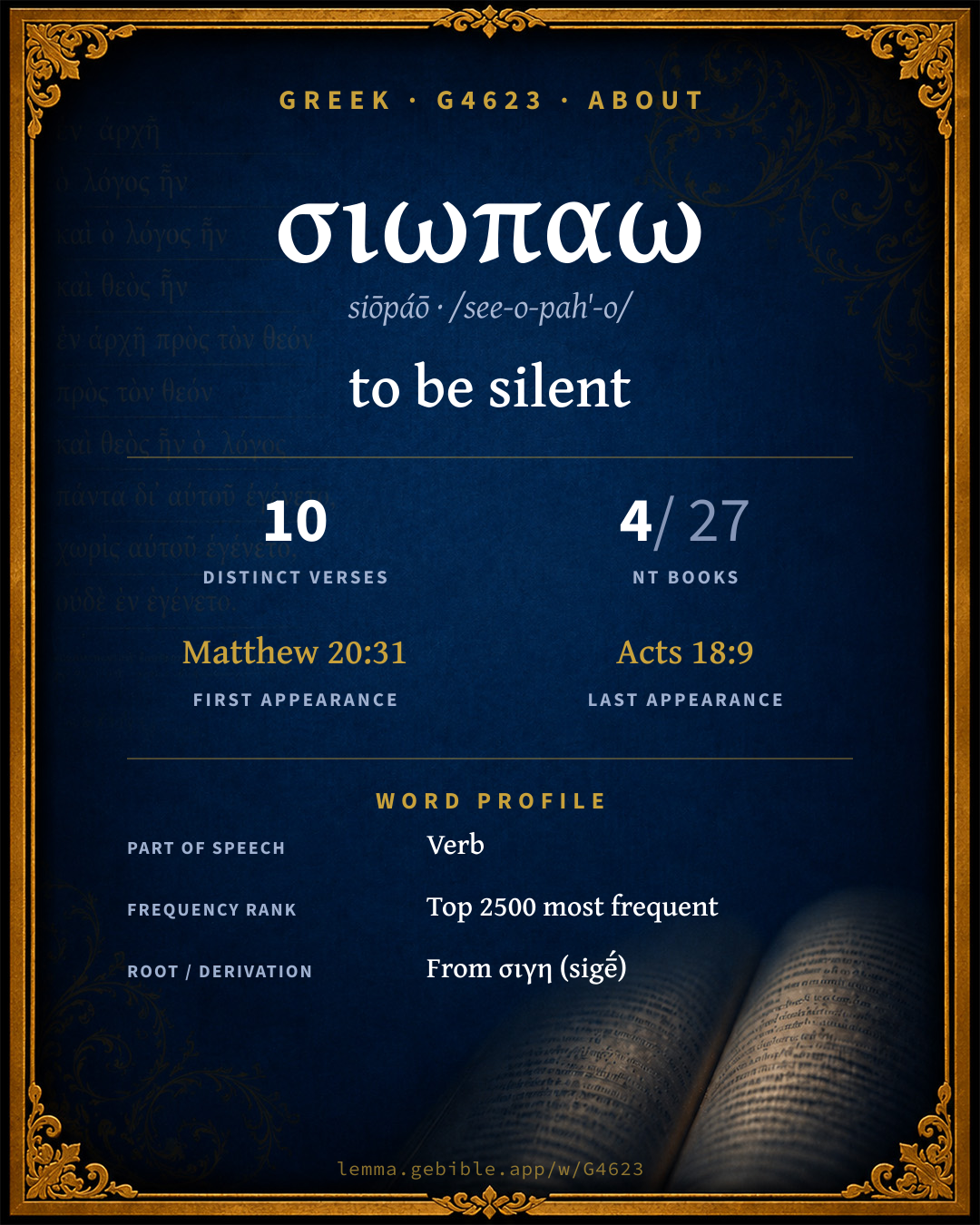
σιωπάω
to be silent
‘to be silent’ is one of 2 main senses fuller range ↓
Full lexicon entry — Thayer's Greek Lexicon
From Thayer's Greek Lexicon
Where this word appears
See every Imperfect-tense verb in the Greek New Testament →
Grammar key — what these labels mean
Part of speech
- Verb
- An action or state-of-being word.
Tense
- Imperfect
- Continuous or repeated action in past time (“was writing”).
- Aorist
- Action viewed as a simple whole, without regard to duration — often past (perfective aspect).
- Future
- Action expected in future time.
- Present
- Ongoing or general action in present time (imperfective aspect).
Voice
- Active
- The subject performs the action.
Mood
- Indicative
- States a fact or asks a factual question (the mood of reality).
- Subjunctive
- Expresses probability, purpose, or possibility (the mood of contingency).
- Imperative
- Expresses a command or request.
- Participle
- A verbal adjective (“writing,” “having written”).
Case
- Nominative
- The case of the subject (and the predicate nominative).
Person
- 3rd person
- The one spoken about (“he / she / it / they”).
- 2nd person
- The one addressed (“you”).
Gender
- Masculine
- Grammatically masculine.
Number
- Plural
- More than one.
- Singular
- One.
1 distinct verse where G4623 appears in the Future tense, across 1 book. Filtered view — show all forms. Click any verse to open its interlinear word-by-word view. Verse text shown in the World English Bible for context — . Each verse’s Greek form is shown with its reference; the English is not keyword-highlighted, since the data carries no word-level English alignment. Use “Compare translations” on any verse to read it across multiple English versions. This concordance covers the Greek New Testament; Septuagint (Greek Old Testament) occurrences of this word are not indexed here.
Luke 1 verse
About this entry
At a glance — auto-summarized from this page’s data, not written by a person. Every figure links to its source below. This summary describes the numbers; it doesn’t interpret them.
σιωπαω (siōpáō) is a Greek verb most often rendered “to be silent.” It clusters heavily in Mark, which alone accounts for 50% of its uses. With 10 verses in 4 books, it is an uncommon word in the Greek New Testament. Debuting at Matthew 20:31, it then recurs through the corpus. Its lexical range runs to 2 senses. For the data behind this summary, explore the sense tree and the renderings breakdown below.
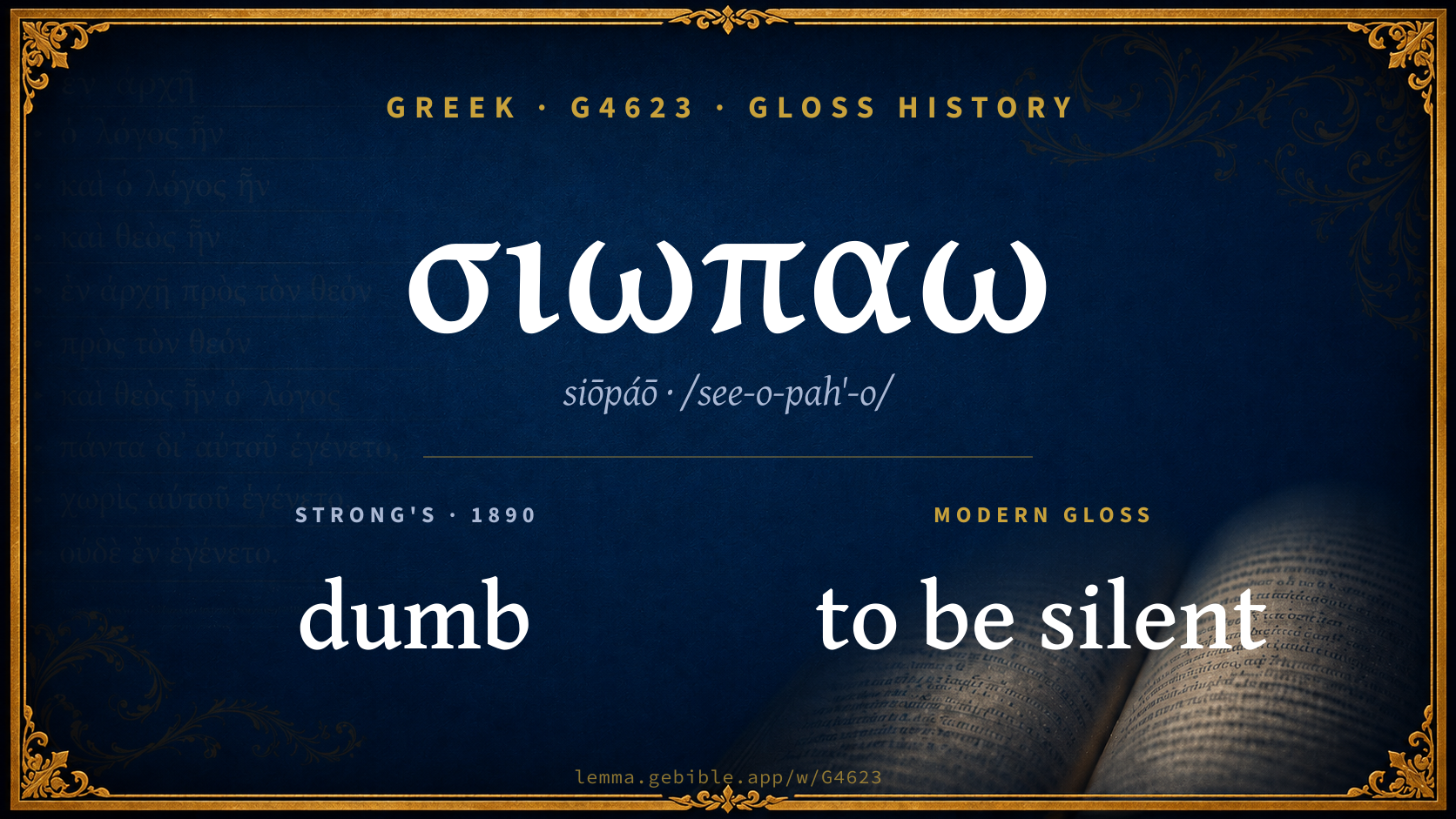
Gloss history
Strong's 1890 vs modern scholarship
About this word
Strong's G4623 catalogs a Greek word from the Greek New Testament.
These counts are not copied from any lexicon or concordance. They are computed here, from the morphology-tagged Greek New Testament. What Lemma adds →
- 10
- distinct verses
- The word appears in 10 distinct verses.
- 4 / 27
- NT books
- The word appears in 4 of 27 New Testament books.
- #1,056
- by frequency
- Top 2500 most frequent Greek words (rank 1,056 of 5,347 Greek words by occurrence).
View all 10 occurrences in the concordance →
By section of the New Testament
By traditional corpus
Conventional, traditional groupings — biblical authorship is debated, so this is a traditional corpus grouping, not an authorship claim. Some books belong to more than one corpus (Luke is in both the Gospels and the Lukan corpus, and so on), so these shares overlap and need not total 100%. Each figure is a share of the word’s 10 distinct verses.
- Gospels 9 verses · 90%
- Lukan (Luke–Acts) 3 verses · 30%
How translations render this word
Counts come from each version’s own published word-to-Strong’s tagging or interlinear alignment — an approximate guide to how each version renders this word, not a word-level alignment the data otherwise carries. Because each total is that version’s own tagged count, the per-version totals vary from one another and need not match the appearance or distinct-verse counts above. These counts may also differ from a printed concordance because Lemma counts each distinctly tagged rendering and does not collapse phrase taggings into a single head-word total. This is a fixed set of word-tagged versions (KJV, ASV, BSB, ULT) and does not change with the reading translation you choose elsewhere. Each version’s license is shown beside its name below (and on Sources).
- King James Version: He should hold his peace 2×, Peace 2×, They held their peace 2×
- American Standard Version: Peace 3×
- Berean Standard Bible: Be silent 3×, Remained silent 2×, They were silent 2×
- unfoldingWord Literal Text: Be silent 2×, Was silent 2×, Were silent 2×
King James Version Public Domain
Renders G4623 across 12 tagged occurrences — most commonly:
Plus 6 renderings that appear only once — usually multi-word phrases or single function words the recovered tagging swept in, not distinct renderings.
American Standard Version Public Domain
Renders G4623 across 13 tagged occurrences — most commonly:
Plus 10 renderings that appear only once — usually multi-word phrases or single function words the recovered tagging swept in, not distinct renderings.
Berean Standard Bible Public Domain
Renders G4623 across 10 tagged occurrences — most commonly:
Plus 3 renderings that appear only once — usually multi-word phrases or single function words the recovered tagging swept in, not distinct renderings.
unfoldingWord Literal Text CC BY-SA 4.0
Renders G4623 across 11 tagged occurrences — most commonly:
Plus 5 renderings that appear only once — usually multi-word phrases or single function words the recovered tagging swept in, not distinct renderings.
Senses in Thayer's
The 2 senses Thayer's distinguishes for this word, in lexicon order (not ranked by frequency or importance). The full entry — with sub-senses — is in the Lexicon Entry tab.
- to be silent, hold one's peace
- metaph. of a calm, quiet sea
Word origin
Derived from σιγη (sigḗ) (G4602) — silence.
From σιωπη siō pē ( silence that is a hush ; properly muteness that is involuntary stillness or inability ot speak; and thus differing from G4602 which is rather a voluntary refusal or indisposition to speak although the terms are often used synonymously); to be dumb (but not deaf also like G2974 properly); figuratively to be calm (as quiet water): - dumb (hold) peace.
— Strong’s Exhaustive Concordance (1890), public domain.
Forms in the corpus
The 8 distinct written forms G4623 takes in the Greek New Testament, most frequent first — each parse links to that tense’s occurrences in the concordance.
| Form | Parsing | Example | Uses |
|---|---|---|---|
| ἐσιώπα esiṓpa | Verb, Imperfect, Active, Indicative, 3rd person, Singular | Matthew 26:63 | 2 |
| ἐσιώπων esiṓpōn | Verb, Imperfect, Active, Indicative, 3rd person, Plural | Mark 3:4 | 2 |
| σιωπήσουσιν siōpḗsousin | Verb, Future, Active, Indicative, 3rd person, Plural | Luke 19:40 | 1 |
| σιωπήσωσιν siōpḗsōsin | Verb, Aorist, Active, Subjunctive, 3rd person, Plural | Matthew 20:31 | 1 |
| σιωπήσῃ siōpḗsē | Verb, Aorist, Active, Subjunctive, 3rd person, Singular | Mark 10:48 | 1 |
| σιωπήσῃς siōpḗsēs | Verb, Aorist, Active, Subjunctive, 2nd person, Singular | Acts 18:9 | 1 |
| σιωπῶν siōpō̂n | Verb, Present, Active, Participle, Nominative, Singular, Masculine | Luke 1:20 | 1 |
| σιώπα siṓpa | Verb, Present, Active, Imperative, 2nd person, Singular | Mark 4:39 | 1 |
Same root — word family
Other Thayer's entries built from the same root as G4623, grouped by Strong’s listed origin. These share a root / origin per the lexicon — not necessarily a shared meaning. Each links to that word’s own entry.
Derives from
Shares the same root
Compare all same-root words → They share a root, not necessarily a meaning.
Septuagint usage
The same Greek word σιωπαω appears 28 times in the Greek Old Testament (Septuagint), across 26 verses in 13 books.
- 28
- LXX occurrences
- Tagged occurrences of this Greek word in the Septuagint.
- 26
- verses
- Distinct Septuagint verses containing this word.
- 13 / 39
- OT books
- The word appears in 13 of the 39 Old Testament books.
Sample Septuagint occurrences
- Numbers 30:15 σιωπάω
- Deuteronomy 27:9 σιωπάω
- Judges 3:19 σιωπάω
- 1 Kings 22:3 σιωπάω
- 2 Kings 2:3 σιωπάω
- 2 Chronicles 25:16 σιωπάω
- Ezra 18:11 σιωπάω
- Job 16:6 σιωπάω
- Isaiah 36:21 σιωπάω
- Jeremiah 4:19 σιωπάω
- Lamentations 2:10 σιωπάω
- Daniel 10:15 σιωπάω
Septuagint occurrences (same lexeme)
Every verse where the same Strong’s number (G4623) appears in the Greek Septuagint. Verse text shown in the World English Bible for context; the Greek form is the matched word — the English is not keyword-highlighted.
- Numbers 30:15 σιωπάω But if he shall make them null and void after that he has heard them, then he shall bear her iniquity.
- Deuteronomy 27:9 σιωπάω Moses and the priests the Levites spoke to all Israel, saying, Keep silence, and listen, Israel: this day you are become the people of Yahweh your God.
- Judges 3:19 σιωπάω But he himself turned back from the quarries that were by Gilgal, and said, I have a secret errand to you, king. He said, Keep silence. All who stood by him went out from him.
- 1 Kings 22:3 σιωπάω The king of Israel said to his servants, "You know that Ramoth-gilead is ours, and we are still, and don't take it out of the hand of the king of Syria?"
- 2 Kings 2:3 σιωπάω The sons of the prophets who were at Bethel came forth to Elisha, and said to him, "Do you know that Yahweh will take away your master from your head today?" He said, "Yes, I know it; hold your peace."
- 2 Kings 2:5 σιωπάω The sons of the prophets who were at Jericho came near to Elisha, and said to him, "Do you know that Yahweh will take away your master from your head today?" He answered, "Yes, I know it. Hold your peace."
- 2 Kings 7:9 σιωπάω Then they said one to another, We aren't doing right. This day is a day of good news, and we hold our peace: if we wait until the morning light, punishment will overtake us; now therefore come, let us go and tell the king's household.
- 2 Chronicles 25:16 σιωπάω It happened, as he talked with him, that [the king] said to him, Have we made you of the king's counsel? Stop! Why should you be struck down? Then the prophet stopped, and said, I know that God has determined to destroy you, because you have done this, and have not listened to my counsel.
- Ezra 18:11 σιωπάω
- Job 16:6 σιωπάω "Though I speak, my grief is not subsided. Though I forbear, what am I eased?
- Job 18:3 σιωπάω Why are we counted as animals, Which have become unclean in your sight?
- Job 29:21 σιωπάω "Men listened to me, waited, And kept silence for my counsel.
- Job 30:27 σιωπάω My heart is troubled, and doesn't rest. Days of affliction have come on me.
- Job 41:4 σιωπάω Will he make a covenant with you, That you should take him for a servant forever?
- Isaiah 36:21 σιωπάω But they held their peace, and answered him not a word; for the king's commandment was, saying, Don't answer him.
- Isaiah 42:14 σιωπάω I have long time held my peace; I have been still, and refrained myself: [now] will I cry out like a travailing woman; I will gasp and pant together.
- Isaiah 62:1 σιωπάω For Zion's sake will I not hold my peace, and for Jerusalem's sake I will not rest, until her righteousness go forth as brightness, and her salvation as a lamp that burns.
- Isaiah 62:6 σιωπάω I have set watchmen on your walls, Jerusalem; they shall never hold their peace day nor night: you who call on Yahweh, take no rest,
- Isaiah 64:11 σιωπάω Our holy and our beautiful house, where our fathers praised you, is burned with fire; and all our pleasant places are laid waste.
- Isaiah 65:6 σιωπάω Behold, it is written before me: I will not keep silence, but will recompense, yes, I will recompense into their bosom,
- Jeremiah 4:19 σιωπάω My anguish, my anguish! I am pained at my very heart; my heart is disquieted in me; I can't hold my peace; because you have heard, O my soul, the sound of the trumpet, the alarm of war.
- Lamentations 2:10 σιωπάω The elders of the daughter of Zion sit on the ground, they keep silence; They have cast up dust on their heads; they have girded themselves with sackcloth: The virgins of Jerusalem hang down their heads to the ground.
- Lamentations 2:18 σιωπάω Their heart cried to the Lord: wall of the daughter of Zion, let tears run down like a river day and night; Give yourself no respite; don't let the apple of your eye cease.
- Lamentations 3:28 σιωπάω Let him sit alone and keep silence, because he has laid it on him.
- Daniel 10:15 σιωπάω and when he had spoken to me according to these words, I set my face toward the ground, and was mute.
- Amos 5:13 σιωπάω Therefore he who is prudent shall keep silence in such a time; For it is an evil time.
These are occurrences of the same Greek lexeme (G4623) in the Septuagint — not a translation of any one Hebrew word. The store carries no word-level Hebrew↔Greek alignment, so no Hebrew original is asserted here. Counts come from the recovered LXX Strong's tagging — high-frequency vocabulary is well covered, while rare or late forms may be untagged — so they reflect tagged occurrences and may slightly undercount.