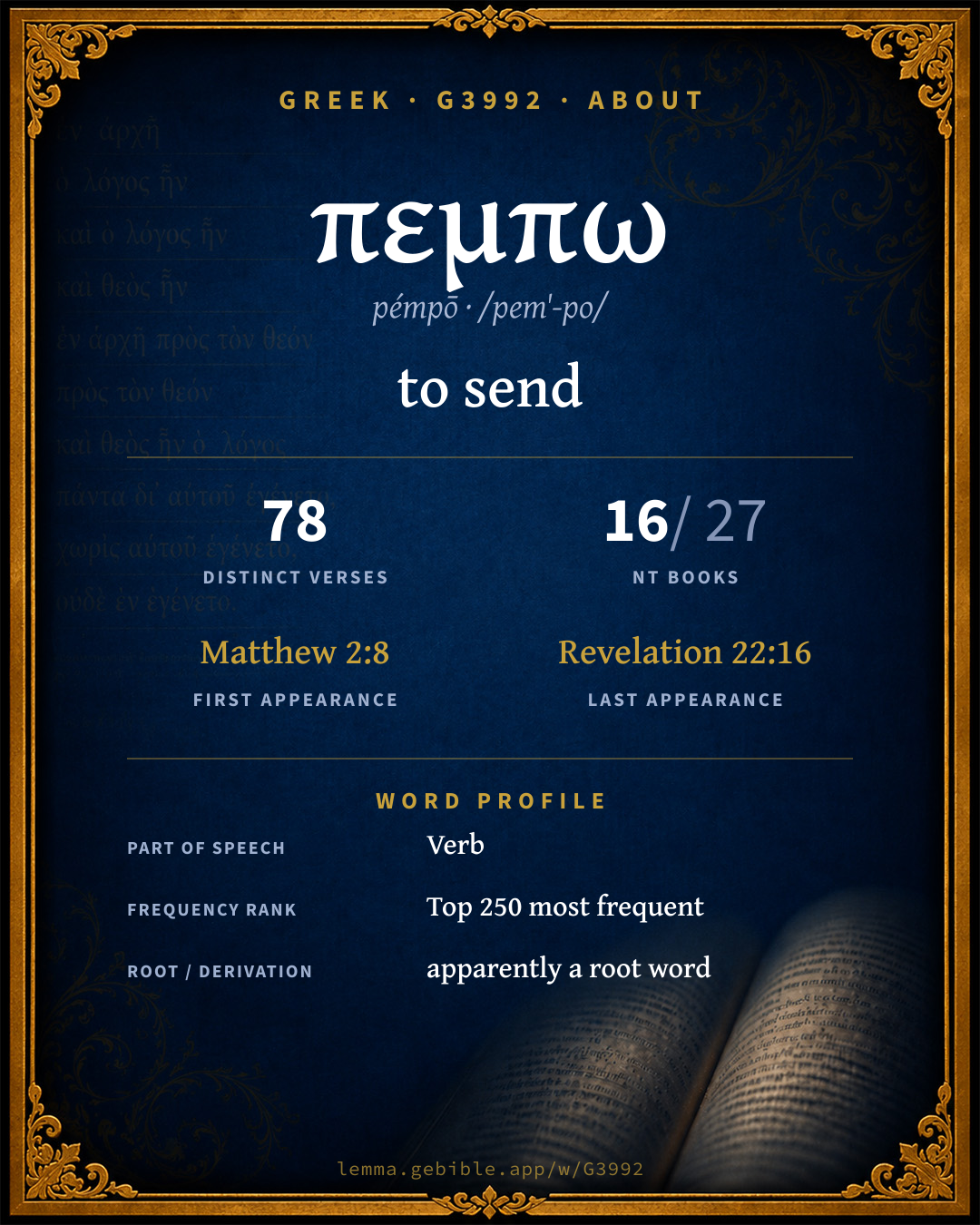
πέμπω
to send
‘to send’ is one of 2 main senses fuller range ↓
Full lexicon entry — Thayer's Greek Lexicon
From Thayer's Greek Lexicon
Where this word appears
See every Aorist-tense verb in the Greek New Testament →
Grammar key — what these labels mean
Part of speech
- Verb
- An action or state-of-being word.
Tense
- Aorist
- Action viewed as a simple whole, without regard to duration — often past (perfective aspect).
- Future
- Action expected in future time.
- Present
- Ongoing or general action in present time (imperfective aspect).
Voice
- Active
- The subject performs the action.
- Passive
- The subject receives the action.
Mood
- Participle
- A verbal adjective (“writing,” “having written”).
- Indicative
- States a fact or asks a factual question (the mood of reality).
- Infinitive
- A verbal noun (“to write”), unmarked for person or number.
- Imperative
- Expresses a command or request.
- Subjunctive
- Expresses probability, purpose, or possibility (the mood of contingency).
Case
- Nominative
- The case of the subject (and the predicate nominative).
- Genitive
- The case of source, possession, or “of” — answers “whose / from what.”
- Accusative
- The case of the direct object and of extent.
- Dative
- The case of the indirect object, means, or location — “to / for / with / in.”
Person
- 1st person
- The speaker (“I / we”).
- 2nd person
- The one addressed (“you”).
- 3rd person
- The one spoken about (“he / she / it / they”).
Gender
- Masculine
- Grammatically masculine.
Number
- Singular
- One.
- Plural
- More than one.
9 verses where G3992 appears in the Aorist tense in the Book of Luke. Filtered view — show all forms. Click any verse to open its interlinear word-by-word view. Verse text shown in the World English Bible for context — . Each verse’s Greek form is shown with its reference; the English is not keyword-highlighted, since the data carries no word-level English alignment. Use “Compare translations” on any verse to read it across multiple English versions. This concordance covers the Greek New Testament; Septuagint (Greek Old Testament) occurrences of this word are not indexed here.
Luke
- Luke 4:26 ἐπέμφθη aor pass ind 3sg Elijah was sent to none of them, except to Zarephath, in the land of Sidon, to a woman who was a widow.
- Luke 7:6 ἔπεμψεν aor act ind 3sg Jesus went with them. When he was now not far from the house, the centurion sent friends to him, saying to him, "Lord, don't trouble yourself, for I am not worthy for you to come under my roof.
- Luke 7:10 πεμφθέντες aor pass ptcp nom pl masc Those who were sent, returning to the house, found that the servant who had been sick was well.
- Luke 7:19 ἔπεμψεν aor act ind 3sg John, calling to himself two of his disciples, sent them to Jesus, saying, "Are you the one who is coming, or should we look for another?"
- Luke 15:15 ἔπεμψεν aor act ind 3sg He went and joined himself to one of the citizens of that country, and he sent him into his fields to feed pigs.
- Luke 16:24 πέμψον aor act impv 2sg He cried and said, 'Father Abraham, have mercy on me, and send Lazarus, that he may dip the tip of his finger in water, and cool my tongue! For I am in anguish in this flame.'
- Luke 16:27 πέμψῃς aor act subj 2sg "He said, 'I ask you therefore, father, that you would send him to my father's house;
- Luke 20:11 πέμψαι aor act inf He sent yet another servant, and they also beat him, and treated him shamefully, and sent him away empty.
- Luke 20:12 πέμψαι aor act inf He sent yet a third, and they also wounded him, and threw him out.
About this entry
At a glance — auto-summarized from this page’s data, not written by a person. Every figure links to its source below. This summary describes the numbers; it doesn’t interpret them.
πεμπω (pémpō) is a Greek verb most often rendered “to send.” Its English rendering has broadened — “sent” classically, “having sent” (unfoldingWord Literal Text) in modern versions; see the renderings breakdown. The Greek New Testament uses it across 78 verses — moderately common. John dominates its distribution — 31 of 78 verses. Ranging over 2 senses, it is not a single-sense word. For the data behind this summary, explore the sense tree and the renderings breakdown below.
Gloss history
Strong's 1890 vs modern scholarship
About this word
Strong's G3992 catalogs a Greek word from the Greek New Testament.
These counts are not copied from any lexicon or concordance. They are computed here, from the morphology-tagged Greek New Testament. What Lemma adds →
- 78
- distinct verses
- The word appears in 78 distinct verses.
- 16 / 27
- NT books
- The word appears in 16 of 27 New Testament books.
- #214
- by frequency
- Top 250 most frequent Greek words (rank 214 of 5,347 Greek words by occurrence).
View all 78 occurrences in the concordance →
By section of the New Testament
By traditional corpus
Conventional, traditional groupings — biblical authorship is debated, so this is a traditional corpus grouping, not an authorship claim. Some books belong to more than one corpus (Luke is in both the Gospels and the Lukan corpus, and so on), so these shares overlap and need not total 100%. Each figure is a share of the word’s 78 distinct verses.
- Gospels 46 verses · 59%
- Johannine 36 verses · 46%
- Lukan (Luke–Acts) 21 verses · 27%
- Pauline corpus 15 verses · 19%
- Revelation 5 verses · 6%
- General (Catholic) Epistles 1 verse · 1%
How translations render this word
Counts come from each version’s own published word-to-Strong’s tagging or interlinear alignment — an approximate guide to how each version renders this word, not a word-level alignment the data otherwise carries. Because each total is that version’s own tagged count, the per-version totals vary from one another and need not match the appearance or distinct-verse counts above. These counts may also differ from a printed concordance because Lemma counts each distinctly tagged rendering and does not collapse phrase taggings into a single head-word total. This is a fixed set of word-tagged versions (KJV, ASV, BSB, ULT) and does not change with the reading translation you choose elsewhere. Each version’s license is shown beside its name below (and on Sources).
- King James Version: Sent 23×, Send 14×, He sent 7×
- American Standard Version: Sent 28×, Send 12×, He sent 8×
- Berean Standard Bible: Sent 33×, Send 14×, He sent 4×
- unfoldingWord Literal Text: Having sent 32×, Send 12×, I sent 5×
King James Version Public Domain
Renders G3992 across 82 tagged occurrences — most commonly:
Plus 12 renderings that appear only once — usually multi-word phrases or single function words the recovered tagging swept in, not distinct renderings.
American Standard Version Public Domain
Renders G3992 across 80 tagged occurrences — most commonly:
Plus 16 renderings that appear only once — usually multi-word phrases or single function words the recovered tagging swept in, not distinct renderings.
Berean Standard Bible Public Domain
Renders G3992 across 79 tagged occurrences — most commonly:
Plus 11 renderings that appear only once — usually multi-word phrases or single function words the recovered tagging swept in, not distinct renderings.
unfoldingWord Literal Text CC BY-SA 4.0
Renders G3992 across 80 tagged occurrences — most commonly:
Plus 20 renderings that appear only once — usually multi-word phrases or single function words the recovered tagging swept in, not distinct renderings.
Senses in Thayer's
The 2 senses Thayer's distinguishes for this word, in lexicon order (not ranked by frequency or importance). The full entry — with sub-senses — is in the Lexicon Entry tab.
- to bid a thing to be carried to one
- to send (thrust or insert) a thing into another
Word origin
Origin: apparently a root word
Apparently a primary verb; to dispatch (from the subjective view or point of departure whereas ἵημι hiē mi [as a stronger form of εἶμι eimi] refers rather to the objective point or terminus ad quem and G4724 denotes properly the orderly motion involved) especially on a temporary errand; also to transmit bestow or wield : - send thrust in.
— Strong’s Exhaustive Concordance (1890), public domain.
Forms in the corpus
The 25 distinct written forms G3992 takes in the Greek New Testament, most frequent first — each parse links to that tense’s occurrences in the concordance.
Septuagint usage
The same Greek word πεμπω appears 5 times in the Greek Old Testament (Septuagint), across 5 verses in 3 books.
- 5
- LXX occurrences
- Tagged occurrences of this Greek word in the Septuagint.
- 5
- verses
- Distinct Septuagint verses containing this word.
- 3 / 39
- OT books
- The word appears in 3 of the 39 Old Testament books.
Sample Septuagint occurrences
- Genesis 27:42 πέμπω
- Ezra 4:14 πέμπω
- Esther 8:5 πέμπω
Septuagint occurrences (same lexeme)
Every verse where the same Strong’s number (G3992) appears in the Greek Septuagint. Verse text shown in the World English Bible for context; the Greek form is the matched word — the English is not keyword-highlighted.
- Genesis 27:42 πέμπω The words of Esau, her elder son, were told to Rebekah. She sent and called Jacob her younger son, and said to him, "Behold, your brother Esau comforts himself about you by planning to kill you.
- Ezra 4:14 πέμπω Now because we eat the salt of the palace, and it is not appropriate for us to see the king's dishonor, therefore have we sent and informed the king;
- Ezra 5:17 πέμπω Now therefore, if it seem good to the king, let there be search made in the king's treasure-house, which is there at Babylon, whether it be so, that a decree was made of Cyrus the king to build this house of God at Jerusalem; and let the king send his pleasure to us concerning this matter.
- Ezra 12:5 πέμπω
- Esther 8:5 πέμπω She said, If it please the king, and if I have found favor in his sight, and the thing seem right before the king, and I be pleasing in his eyes, let it be written to reverse the letters devised by Haman, the son of Hammedatha the Agagite, which he wrote to destroy the Jews who are in all the king's provinces:
These are occurrences of the same Greek lexeme (G3992) in the Septuagint — not a translation of any one Hebrew word. The store carries no word-level Hebrew↔Greek alignment, so no Hebrew original is asserted here. Counts come from the recovered LXX Strong's tagging — high-frequency vocabulary is well covered, while rare or late forms may be untagged — so they reflect tagged occurrences and may slightly undercount.