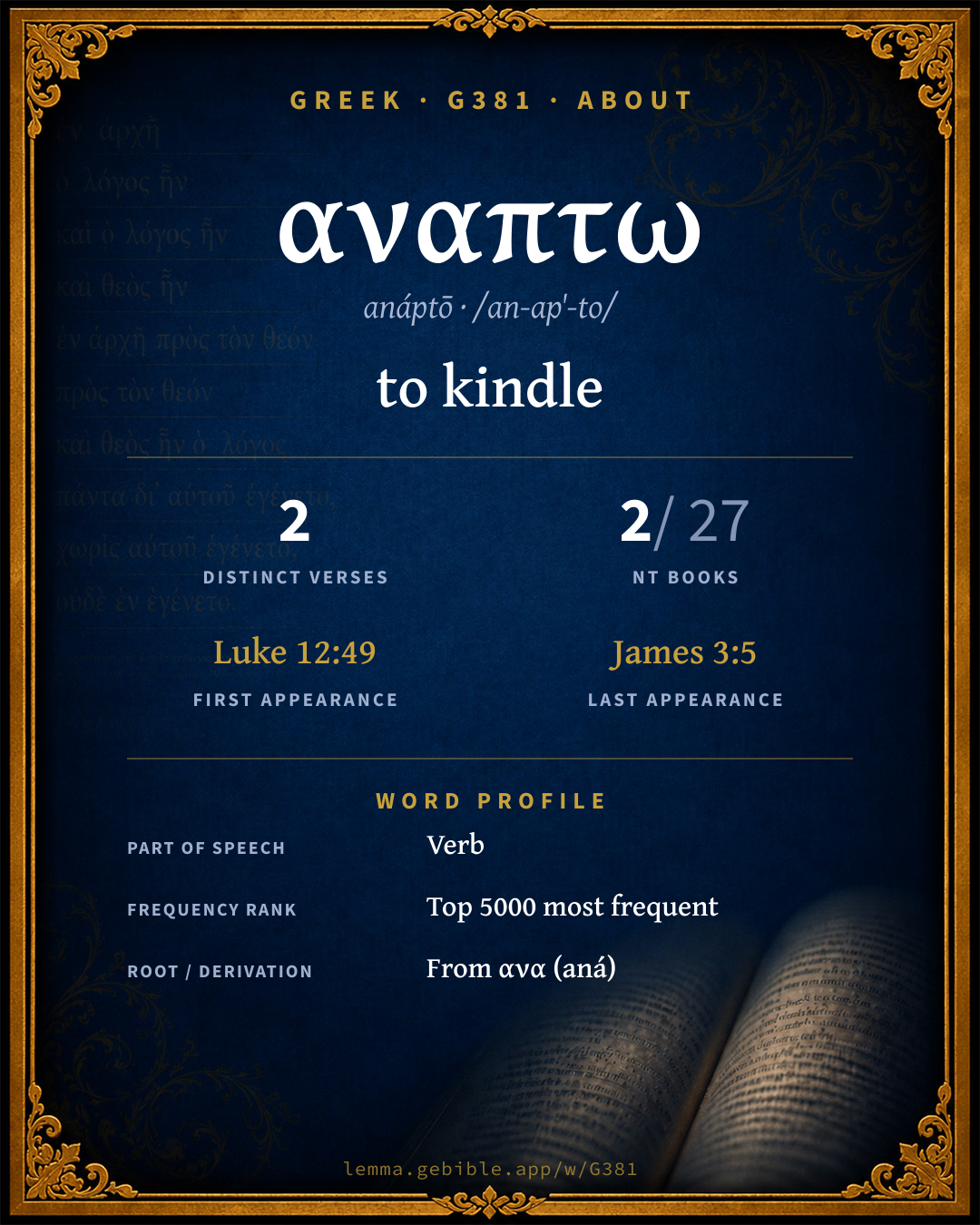
ἀνάπτω
to kindle
Full lexicon entry — Thayer's Greek Lexicon
From Thayer's Greek Lexicon
Where this word appears
See every Aorist-tense verb in the Greek New Testament →
Grammar key — what these labels mean
Part of speech
- Verb
- An action or state-of-being word.
Tense
- Aorist
- Action viewed as a simple whole, without regard to duration — often past (perfective aspect).
- Present
- Ongoing or general action in present time (imperfective aspect).
Voice
- Passive
- The subject receives the action.
- Active
- The subject performs the action.
Mood
- Indicative
- States a fact or asks a factual question (the mood of reality).
Person
- 3rd person
- The one spoken about (“he / she / it / they”).
Number
- Singular
- One.
Grammatical forms
- Verb, Aorist, Passive, Indicative, 3rd person, Singular 1 time (50%)
- Verb, Present, Active, Indicative, 3rd person, Singular 1 time (50%)
Parsed forms decoded from the imported morphology (Robinson–Tischendorf, public domain), counted across 2 parsed occurrences — not distinct verses.
Every verse where G381 appears — 2 distinct verses across 2 books. Click any verse to open its interlinear word-by-word view. Verse text shown in the World English Bible for context — . Each verse’s Greek form is shown with its reference; the English is not keyword-highlighted, since the data carries no word-level English alignment. Use “Compare translations” on any verse to read it across multiple English versions. This concordance covers the Greek New Testament; Septuagint (Greek Old Testament) occurrences of this word are not indexed here.
Luke 1 verse
James 1 verse
About this entry
At a glance — auto-summarized from this page’s data, not written by a person. Every figure links to its source below. This summary describes the numbers; it doesn’t interpret them.
αναπτω (anáptō) is a Greek verb most often rendered “to kindle.” A scarce word — 2 verses in all of the Greek New Testament. It clusters heavily in Luke, which alone accounts for 50% of its uses. Scripture first uses it in Luke 12:49. It clusters with ανα, αναβαινω and αναβαλλομαι under a shared root. The sections below give every sense, occurrence, and version rendering.
Gloss history
Strong's 1890 vs modern scholarship
About this word
Strong's G381 catalogs a Greek word from the Greek New Testament.
These counts are not copied from any lexicon or concordance. They are computed here, from the morphology-tagged Greek New Testament. What Lemma adds →
- 2
- distinct verses
- The word appears in 2 distinct verses.
- 2 / 27
- NT books
- The word appears in 2 of 27 New Testament books.
- #2,678
- by frequency
- Top 5000 most frequent Greek words (rank 2,678 of 5,347 Greek words by occurrence).
View all 2 occurrences in the concordance →
By traditional corpus
Conventional, traditional groupings — biblical authorship is debated, so this is a traditional corpus grouping, not an authorship claim. Some books belong to more than one corpus (Luke is in both the Gospels and the Lukan corpus, and so on), so these shares overlap and need not total 100%. Each figure is a share of the word’s 2 distinct verses.
- Gospels 1 verse · 50%
- Lukan (Luke–Acts) 1 verse · 50%
- General (Catholic) Epistles 1 verse · 50%
How translations render this word
Counts come from each version’s own published word-to-Strong’s tagging or interlinear alignment — an approximate guide to how each version renders this word, not a word-level alignment the data otherwise carries. Because each total is that version’s own tagged count, the per-version totals vary from one another and need not match the appearance or distinct-verse counts above. These counts may also differ from a printed concordance because Lemma counts each distinctly tagged rendering and does not collapse phrase taggings into a single head-word total. This is a fixed set of word-tagged versions (KJV, ASV, BSB, ULT) and does not change with the reading translation you choose elsewhere. Each version’s license is shown beside its name below (and on Sources).
- King James Version: Be 1×, Kindled 1×, Kindleth 1×
- American Standard Version: Is 1×, Is kindled 1×, Kindled 1×
- Berean Standard Bible: Sets 1×, Were already kindled 1×
- unfoldingWord Literal Text: Forest 1×, Kindled 1×, Were 1×
King James Version Public Domain
Renders G381 across 4 tagged occurrences — most commonly:
American Standard Version Public Domain
Renders G381 across 4 tagged occurrences — most commonly:
Berean Standard Bible Public Domain
Renders G381 across 2 tagged occurrences — most commonly:
unfoldingWord Literal Text CC BY-SA 4.0
Renders G381 across 3 tagged occurrences — most commonly:
Senses in Thayer's
The 1 sense Thayer's distinguishes for this word, in lexicon order (not ranked by frequency or importance). The full entry — with sub-senses — is in the Lexicon Entry tab.
- to light up, kindle
Word origin
Derived from ανα (aná) (G303) — among.
Forms in the corpus
The 2 distinct written forms G381 takes in the Greek New Testament, most frequent first — each parse links to that tense’s occurrences in the concordance.
| Form | Parsing | Example | Uses |
|---|---|---|---|
| ἀνάπτει anáptei | Verb, Present, Active, Indicative, 3rd person, Singular | James 3:5 | 1 |
| ἀνήφθη anḗphthē | Verb, Aorist, Passive, Indicative, 3rd person, Singular | Luke 12:49 | 1 |
Same root — word family
Other Thayer's entries built from the same root as G381, grouped by Strong’s listed origin. These share a root / origin per the lexicon — not necessarily a shared meaning. Each links to that word’s own entry.
Derives from
Shares the same root
- αναβαινω anabaínō G305 to ascend
- αναβαλλομαι anabállomai G306 to delay
- αναβιβαζω anabibázō G307 to draw up
- αναβλεπω anablépō G308 to look up
- αναβοαω anaboáō G310 to cry out
- αναγγελλω anangéllō G312 to announce
- αναγενναω anagennáō G313 to be born again
- αναγινωσκω anaginṓskō G314 to recognize
- αναγκη anánkē G318 necessity
- αναγνωριζομαι anagnōrízomai G319 to recognize
- αναγω anágō G321 to lead up
- αναδεικνυμι anadeíknymi G322 to proclaim
- αναδεχομαι anadéchomai G324 to take up
- αναδιδωμι anadídōmi G325 to give forth
- αναζαω anazáō G326 to live again
- αναζητεω anazētéō G327 to search out
- αναζωννυμι anazṓnnymi G328 to gird up
- αναζωπυρεω anazōpyréō G329 to inflame
- αναθαλλω anathállō G330 to sprout up
- αναθεωρεω anatheōréō G333 to observe
- αναιρεω anairéō G337 to take away
- ανακαθιζω anakathízō G339 to sit up
- ανακαινιζω anakainízō G340 to renew
- ανακαινοω anakainóō G341 to make new
+51 more words share this root (not shown).
Compare all same-root words → Showing 4 of 77 — not the complete family. They share a root, not necessarily a meaning.
Septuagint usage
The same Greek word αναπτω appears 18 times in the Greek Old Testament (Septuagint), across 18 verses in 8 books.
- 18
- LXX occurrences
- Tagged occurrences of this Greek word in the Septuagint.
- 18
- verses
- Distinct Septuagint verses containing this word.
- 8 / 39
- OT books
- The word appears in 8 of the 39 Old Testament books.
Sample Septuagint occurrences
- 2 Chronicles 13:11 ἀναἅπτω
- Psalms 17:9 ἀναἅπτω
- Jeremiah 9:11 ἀναἅπτω
- Lamentations 2:3 ἀναἅπτω
- Ezekiel 21:3 ἀναἅπτω
- Joel 1:19 ἀναἅπτω
- Amos 1:14 ἀναἅπτω
- Malachi 1:10 ἀναἅπτω
Septuagint occurrences (same lexeme)
Every verse where the same Strong’s number (G381) appears in the Greek Septuagint. Verse text shown in the World English Bible for context; the Greek form is the matched word — the English is not keyword-highlighted.
- 2 Chronicles 13:11 ἀναἅπτω and they burn to Yahweh every morning and every evening burnt offerings and sweet incense: the show bread also [set they] in order on the pure table; and the lampstand of gold with the lamps of it, to burn every evening: for we keep the charge of Yahweh our God; but you have forsaken him.
- Psalms 17:9 ἀναἅπτω From the wicked who oppress me, My deadly enemies, who surround me.
- Psalms 77:21 ἀναἅπτω
- Jeremiah 9:11 ἀναἅπτω I will make Jerusalem heaps, a dwelling-place of jackals; and I will make the cities of Judah a desolation, without inhabitant.
- Jeremiah 11:16 ἀναἅπτω Yahweh called your name, A green olive tree, beautiful with goodly fruit: with the noise of a great tumult he has kindled fire on it, and the branches of it are broken.
- Jeremiah 17:27 ἀναἅπτω But if you will not listen to me to make the Sabbath day holy, and not to bear a burden and enter in at the gates of Jerusalem on the Sabbath day; then will I kindle a fire in the gates of it, and it shall devour the palaces of Jerusalem, and it shall not be quenched.
- Jeremiah 21:12 ἀναἅπτω House of David, thus says Yahweh, Execute justice in the morning, and deliver him who is robbed out of the hand of the oppressor, lest my wrath go forth like fire, and burn so that none can quench it, because of the evil of your doings.
- Jeremiah 21:14 ἀναἅπτω I will punish you according to the fruit of your doings, says Yahweh; and I will kindle a fire in her forest, and it shall devour all that is round about her.
- Jeremiah 27:32 ἀναἅπτω
- Lamentations 2:3 ἀναἅπτω He has cut off in fierce anger all the horn of Israel; He has drawn back his right hand from before the enemy: He has burned up Jacob like a flaming fire, which devours round about.
- Lamentations 4:11 ἀναἅπτω Yahweh has accomplished his wrath, he has poured out his fierce anger; He has kindled a fire in Zion, which has devoured the foundations of it.
- Lamentations 4:15 ἀναἅπτω Depart you, they cried to them, Unclean! depart, depart, don't touch! When they fled away and wandered, men said among the nations, They shall no more sojourn [here].
- Ezekiel 21:3 ἀναἅπτω and tell the land of Israel, Thus says Yahweh: Behold, I am against you, and will draw forth my sword out of its sheath, and will cut off from you the righteous and the wicked.
- Joel 1:19 ἀναἅπτω Yahweh, I cry to you, For the fire has devoured the pastures of the wilderness, And the flame has burned all the trees of the field.
- Joel 2:3 ἀναἅπτω A fire devours before them, And behind them, a flame burns. The land is as the garden of Eden before them, And behind them, a desolate wilderness. Yes, and no one has escaped them.
- Amos 1:14 ἀναἅπτω But I will kindle a fire in the wall of Rabbah, And it will devour its palaces, With shouting in the day of battle, With a tempest in the day of the whirlwind;
- Malachi 1:10 ἀναἅπτω "Oh that there were one among you who would shut the doors, that you might not kindle fire on my altar in vain! I have no pleasure in you," says Yahweh of hosts, "neither will I accept an offering at your hand.
- Malachi 3:19 ἀναἅπτω
These are occurrences of the same Greek lexeme (G381) in the Septuagint — not a translation of any one Hebrew word. The store carries no word-level Hebrew↔Greek alignment, so no Hebrew original is asserted here. Counts come from the recovered LXX Strong's tagging — high-frequency vocabulary is well covered, while rare or late forms may be untagged — so they reflect tagged occurrences and may slightly undercount.