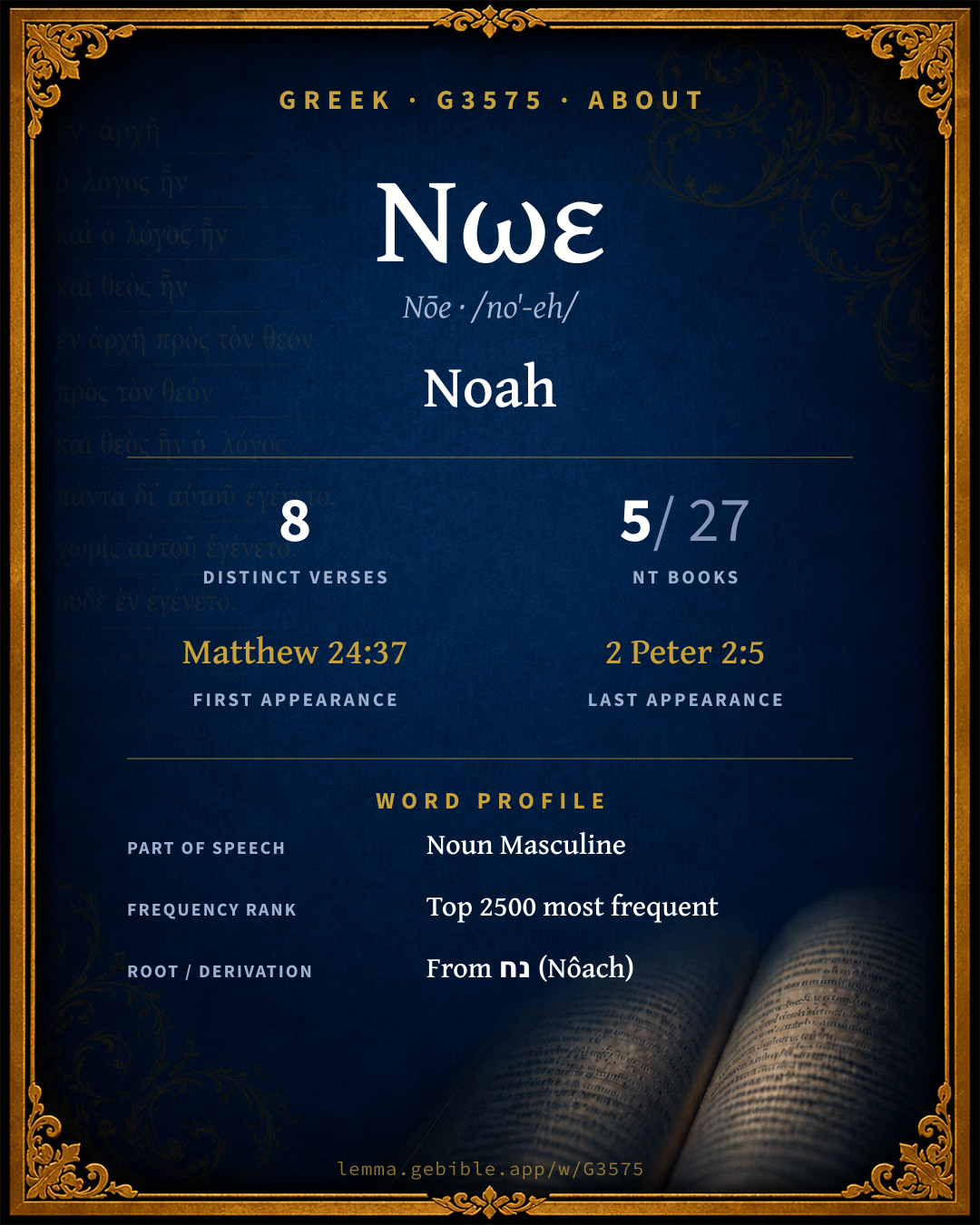
Νῶε
Noah
Thayer's lists 2 entries for ‘Noah’ fuller range ↓
Full lexicon entry — Thayer's Greek Lexicon
From Thayer's Greek Lexicon
Where this word appears
Every verse where G3575 appears in the Book of Matthew — 2 distinct verses. Click any verse to open its interlinear word-by-word view. Verse text shown in the World English Bible for context — . Each verse’s Greek form is shown with its reference; the English is not keyword-highlighted, since the data carries no word-level English alignment. Use “Compare translations” on any verse to read it across multiple English versions. This concordance covers the Greek New Testament; Septuagint (Greek Old Testament) occurrences of this word are not indexed here.
Matthew
About this entry
At a glance — auto-summarized from this page’s data, not written by a person. Every figure links to its source below. This summary describes the numbers; it doesn’t interpret them.
Νωε (Nōe) is a Greek name most often rendered “Noah.” Scripture first uses it in Matthew 24:37. Spanning 8 verses in 5 books, it ranks among the uncommon words of the Greek New Testament. Luke dominates its distribution — 3 of 8 verses. The sections below give every occurrence and version rendering.
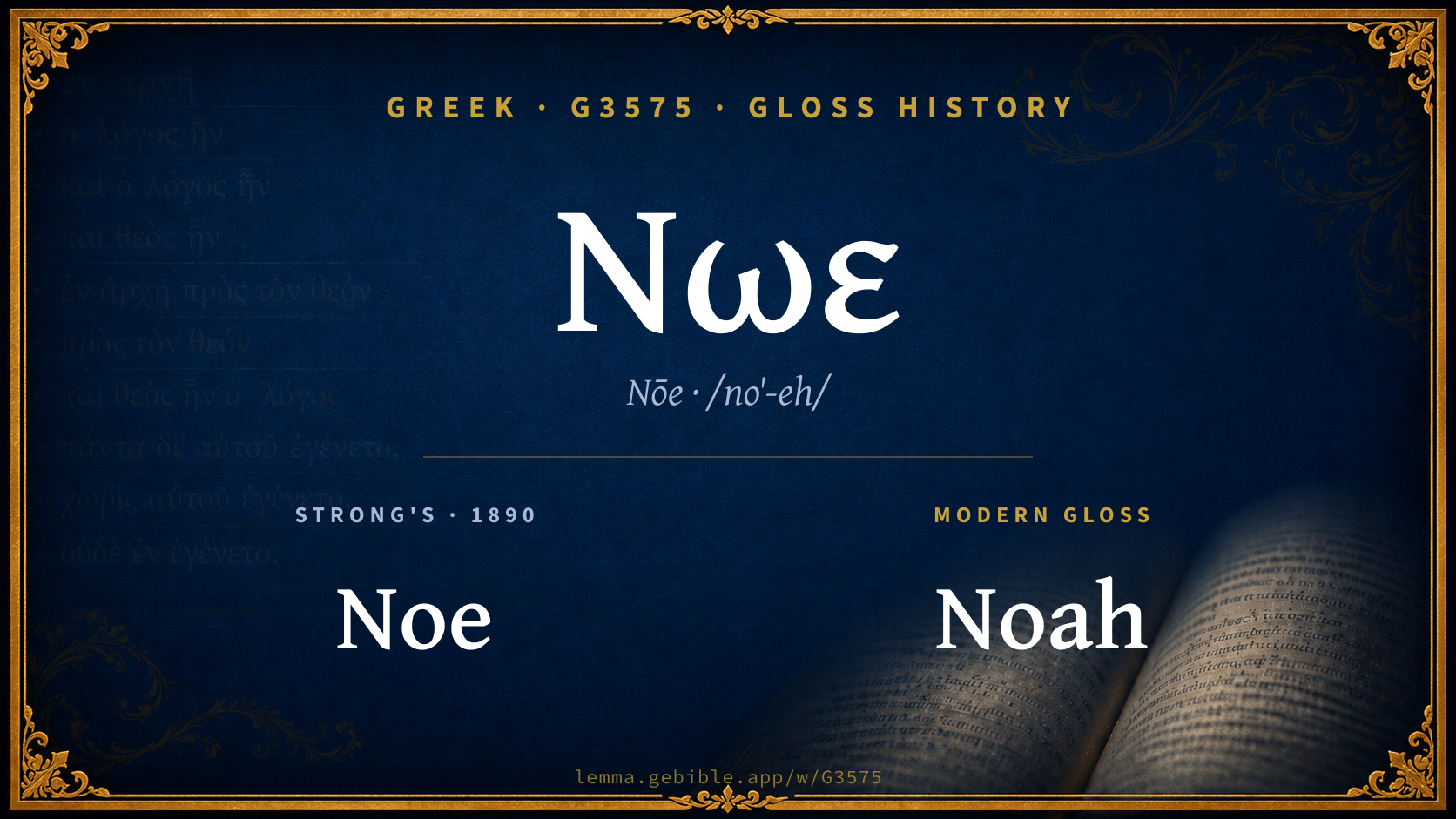
Gloss history
Strong's 1890 vs modern scholarship
About this word
Strong's G3575 catalogs a Greek word from the Greek New Testament.
These counts are not copied from any lexicon or concordance. They are computed here, from the morphology-tagged Greek New Testament. What Lemma adds →
- 8
- distinct verses
- The word appears in 8 distinct verses.
- 5 / 27
- NT books
- The word appears in 5 of 27 New Testament books.
- #1,240
- by frequency
- Top 2500 most frequent Greek words (rank 1,240 of 5,347 Greek words by occurrence).
View all 8 occurrences in the concordance →
By section of the New Testament
By traditional corpus
Conventional, traditional groupings — biblical authorship is debated, so this is a traditional corpus grouping, not an authorship claim. Some books belong to more than one corpus (Luke is in both the Gospels and the Lukan corpus, and so on), so these shares overlap and need not total 100%. Each figure is a share of the word’s 8 distinct verses.
- Gospels 5 verses · 63%
- Lukan (Luke–Acts) 3 verses · 38%
- General (Catholic) Epistles 2 verses · 25%
- Hebrews 1 verse · 13%
How translations render this word
Counts come from each version’s own published word-to-Strong’s tagging or interlinear alignment — an approximate guide to how each version renders this word, not a word-level alignment the data otherwise carries. Because each total is that version’s own tagged count, the per-version totals vary from one another and need not match the appearance or distinct-verse counts above. These counts may also differ from a printed concordance because Lemma counts each distinctly tagged rendering and does not collapse phrase taggings into a single head-word total. This is a fixed set of word-tagged versions (KJV, ASV, BSB, ULT) and does not change with the reading translation you choose elsewhere. Each version’s license is shown beside its name below (and on Sources).
- King James Version: Noe 4×, Noah 3×
- American Standard Version: Noah 7×
- Berean Standard Bible: Noah 8×
- unfoldingWord Literal Text: Noah 8×
King James Version Public Domain
Renders G3575 across 8 tagged occurrences — most commonly:
Plus 1 rendering that appears only once — usually multi-word phrases or single function words the recovered tagging swept in, not distinct renderings.
American Standard Version Public Domain
Renders G3575 across 8 tagged occurrences — most commonly:
Plus 1 rendering that appears only once — usually multi-word phrases or single function words the recovered tagging swept in, not distinct renderings.
Berean Standard Bible Public Domain
Renders G3575 across 8 tagged occurrences — most commonly:
unfoldingWord Literal Text CC BY-SA 4.0
Renders G3575 across 8 tagged occurrences — most commonly:
Senses in Thayer's
The 2 senses Thayer's distinguishes for this word, in lexicon order (not ranked by frequency or importance). The full entry — with sub-senses — is in the Lexicon Entry tab.
- Noah = "rest"
- the tenth in descent from Adam, second father of the human family
Word origin
Derived from נח (Nôach) (H5146) — Noah.
Of hebrew origin [ H5146 ]; Noe (that is Noach ) a patriarch : - Noe.
— Strong’s Exhaustive Concordance (1890), public domain.
Bible dictionary
Public-domain dictionary articles matched to this entry by name (Noah). A biblical name can be shared by more than one person or place, so an article may treat several.
Easton's Bible Dictionary · M. G. Easton, 1897
Rest, (Heb. Noah) the grandson of Methuselah (Gen. 5:25-29), who was for two hundred and fifty years contemporary with Adam, and the son of Lamech, who was about fifty years old at the time of Adam's death. This patriarch is rightly regarded as the connecting link between the old and the new world. He is the second great progenitor of the human family.
The words of his father Lamech at his birth (Gen. 5:29) have been regarded as in a sense prophetical, designating Noah as a type of Him who is the true "rest and comfort" of men under the burden of life (Matt. 11:28).
He lived five hundred years, and then there were born unto him three sons, Shem, Ham, and Japheth (Gen. 5:32). He was a "just man and perfect in his generation," and "walked with God" (comp. Ezek. 14:14, 20). But now the descendants of Cain and of Seth began to intermarry, and then there sprang up a race distinguished for their ungodliness. Men became more and more corrupt, and God determined to sweep the earth of its wicked population (Gen. 6:7). But with Noah God entered into a covenant, with a promise of deliverance from the threatened deluge (18). He was accordingly commanded to build an ark (6:14-16) for the saving of himself and his house. An interval of one hundred and twenty years elapsed while the ark was being built (6:3), during which Noah bore constant testimony against the unbelief and wickedness of that generation (1 Pet. 3:18-20; 2 Pet. 2:5).
When the ark of "gopher-wood" (mentioned only here) was at length completed according to the command of the Lord, the living creatures that were to be preserved entered into it; and then Noah and his wife and sons and daughters-in-law entered it, and the "Lord shut him in" (Gen. 7:16). The judgment-threatened now fell on the guilty world, "the world that then was, being overflowed with water, perished" (2 Pet. 3:6). The ark floated on the waters for one hundred and fifty days, and then rested on the mountains of Ararat (Gen. 8:3, 4); but not for a considerable time after this was divine permission given him to leave the ark, so that he and his family were a whole year shut up within it (Gen. 6-14).
On leaving the ark Noah's first act was to erect an altar, the first of which there is any mention, and offer the sacrifices of adoring thanks and praise to God, who entered into a covenant with him, the first covenant between God and man, granting him possession of the earth by a new and special charter, which remains in force to the present time (Gen. 8:21-9:17). As a sign and witness of this covenant, the rainbow was adopted and set apart by God, as a sure pledge that never again would the earth be destroyed by a flood.
But, alas! Noah after this fell into grievous sin (Gen. 9:21); and the conduct of Ham on this sad occasion led to the memorable prediction regarding his three sons and their descendants. Noah "lived after the flood three hundred and fifty years, and he died" (28:29). (See DELUGE).
Noah, motion, (Heb. No'ah) one of the five daughters of Zelophehad (Num. 26:33; 27:1; 36:11; Josh. 17:3).
Smith's Bible Dictionary · William Smith, 1863
(motion), one of the five daughters of Zelophehad. (Numbers 26:33; 27:1; 36:11; Joshua 17:3) (B.C. 1450.)
(rest), the tenth in descent from Adam, in the line of Seth was the son of Lamech and grandson of Methuselah. (B.C. 2948-1998.) We hear nothing of Noah till he is 500 years old when It is said he begat three sons, Shem, Ham and Japheth. In consequence of the grievous and hopeless wickedness of the world at this time, God resolved to destroy it. Of Noah's life during this age of almost universal apostasy we are told but little. It is merely said that he was a righteous man and perfect in his generations (i.e. among his contemporaries), and that he, like Enoch, walked with God. St. Peter calls him "a preacher of righteousness." (2 Peter 2:5) Besides this we are merely told that he had three: sons each of whom had married a wife; that he built the ark in accordance with divine direction; end that he was 600 years old when the flood came. (Genesis 6:7) The ark .--The precise meaning of the Hebrew word (tebah) is uncertain. The word occurs only in Genesis and in (Exodus 2:3) In all probability it is to the old Egyptian that we are to look for its original form. Bunsen, in his vocabulary gives tba, "a chest," tpt, "a boat," and in the Coptic version of (Exodus 2:3,5) thebi is the rendering of tebah . This "chest" or "boat" was to be made of gopher (i.e. cypress) wood, a kind of timber which both for its lightness and its durability was employed by the Phoenicians for building their vessels. The planks of the ark, after being put together were to be protected by a coating of pitch, or rather bitumen, both inside and outside, to make it water-tight, and perhaps also as a protection against the attacks of marine animals. The ark was to consist of a number of "nests" or small compartments, with a view, no doubt, to the convenient distribution of the different animals and their food. These were to be arranged in three tiers, one above another; "with lower, second and third (stories) shalt thou make it." Means were also to be provided for letting light into the ark. There was to be a door this was to be placed in the side of the ark. Of the shape of the ark nothing is said, but its dimensions are given. It was to be 300 cubits in length, 50 in breadth and 30 in height. Taking 21 inches for the cubit, the ark would be 525 feet in length, 87 feet 6 inches in breadth and 52 feet 6 inches in height. This is very considerably larger than the largest British man-of-war, but not as large as some modern ships. It should be remembered that this huge structure was only intended to float on the water, and was not in the proper sense of the word a ship. It had neither mast, sail nor rudder it was in fact nothing but an enormous floating house, or rather oblong box. The inmates of the ark were Noah and his wife and his three sons with their wives. Noah was directed to take also animals of all kinds into the ark with him, that they might be preserved alive. (The method of speaking of the animals that were taken into the ark "clean" and "unclean," implies that only those which were useful to man were preserved, and that no wild animals were taken into the ark; so that there is no difficulty from the great number of different species of animal life existing in the word.--ED.) The flood .--The ark was finished, and all its living freight was gathered into it as a place of safety. Jehovah shut him in, says the chronicler, speaking of Noah; and then there ensued a solemn pause of seven days before the threatened destruction was let loose. At last the before the threatened destruction was flood came; the waters were upon the earth. A very simple but very powerful and impressive description is given of the appalling catastrophe. The waters of the flood increased for a period of 190 days (40+150, comparing) (Genesis 7:12) and Genesis7:24 And then "God remembered Noah" and made a wind to pass over the earth, so that the waters were assuaged. The ark rested on the seventeenth day of the seventh month on the mountains of Ararat. After this the waters gradually decreased till the first day of the tenth month, when the tops of the mountains were seen but Noah and his family did not disembark till they had been in the ark a year and a month and twenty days. Whether the flood was universal or partial has given rise to much controversy; but there can be no doubt that it was universal, so far as man was concerned: we mean that it extended to all the then known world . The literal truth of the narrative obliges us to believe that the whole human race, except eight persons, perished by the flood. The language of the book of Genesis does not compel us to suppose that the whole surface of the globe was actually covered with water, if the evidence of geology requires us to adopt the hypothesis of a partial deluge. It is natural to suppose it that the writer, when he speaks of "all flesh," "all in whose nostrils was the breath of life" refers only to his own locality. This sort of language is common enough in the Bible when only a small part of the globe is intended. Thus, for instance, it is said that "all countries came into Egypt to Joseph to buy corn and that" a decree went out from Caesar Augustus that all the world should be taxed." The truth of the biblical narrative is confirmed by the numerous traditions of other nations, which have preserved the memory of a great and destructive flood, from which but a small part of mankind escaped. They seem to point back to a common centre whence they were carried by the different families of man as they wandered east and west. The traditions which come nearest to the biblical account are those of the nations of western Asia. Foremost among these is the Chaldean. Other notices of a flood may be found in the Phoenician mythology. There is a medal of Apamea in Phrygia, struck as late as the time of Septimius Severus, in which the Phrygian deluge is commemorated. This medal represents a kind of a square vessel floating in the water. Through an opening in it are seen two persons, a man and a woman. Upon the top of this chest or ark is perched a bird, whilst another flies toward it carrying a branch between its feet. Before the vessel are represented the same pair as having just, quitted it and got upon the dry land. Singularly enough, too, on some specimens of this medal the letters NO or NOE have been found on the vessel, as in the cut on p. 454. (Tayler Lewis deduces the partial extent of the flood from the very face of the Hebrew text." "Earth," where if speaks of "all the earth," often is, and here should be, translated "land," the home of the race, from which there appears to have been little inclination to wander. Even after the flood God had to compel them to disperse. "Under the whole heavens" simply includes the horizon reaching around "all the land" the visible horizon. We still use the words in the same sense and so does the Bible. Nearly all commentators now agree on the partial extent of the deluge. If is probable also that the crimes and violence of the previous age had greatly diminished the population, and that they would have utterly exterminated the race had not God in this way saved out some good seed from their destruction. So that the flood, by appearing to destroy the race, really saved the world from destruction .--ED.) (The scene of the deluge--Hugh Miller, in his "Testimony of the Rocks," argues that there is a remarkable portion of the globe, chiefly on the Asiatic continent, though it extends into Europe, and which is nearly equal to all Europe in extent, whose rivers (some of them the Volga, Oural, Sihon, Kour and the Amoo, of great size) do not fall into the ocean, but, on the contrary are all turned inward, losing themselves in the eastern part of the tract, in the lakes of a rainless district in the western parts into such seas as the Caspian and the Aral. In this region there are extensive districts still under the level of the ocean. Vast plains white with salt and charged with sea-shells, show that the Caspian Sea was at no distant period greatly more extensive than it is now. With the well-known facts, then, before us regarding this depressed Asiatic region, let us suppose that the human family, still amounting to several millions, though greatly reduced by exterminating wars and exhausting vices, were congregated in that tract of country which, extending eastward from the modern Ararat to far beyond the Sea of Aral, includes the original Caucasian centre of the race. Let us suppose that, the hour of judgment having arrived, the land began gradually to sink (as the tract in the Run of Cutch sank in the year 1819) equably for forty days at the rate of about 400 feet per day a rate not twice greater than that at which the tide rises in the Straits of Magellan, and which would have rendered itself apparent as but a persistent inward flowing of the sea. The depression, which, by extending to the Euxine Sea and the Persian Gulf on the one hand and the Gulf of Finland on the other, would open up by three separate channels the "fountains of the great deep," and which included an area of 2000 miles each way, would, at the end of the fortieth day, be sunk in its centre to the depth of 16,000 feet,--sufficient to bury the loftiest mountains of the district; and yet, having a gradient of declination of but sixteen feet per mile, the contour of its hills and plains would remain apparently what they had been before, and the doomed inhabitants would, but the water rising along the mountain sides, and one refuge after another swept away. -ED.) After the Flood .--Noah's great act after he left the ark was to build an altar and to offer sacrifices. This is the first altar of which we read in Scripture, and the first burnt sacrifice. Then follows the blessing of God upon Noah and his sons. Noah is clearly the head of a new human family, the representative of the whole race. It is as such that God makes his covenant with him; and hence selects a natural phenomenon as the sign of that covenant. The bow in the cloud, seen by every nation under heaven, is an unfailing witness to the truth of God. Noah now for the rest of his life betook himself to agricultural pursuits. It is particularly noticed that he planted a vineyard. Whether in ignorance of its properties or otherwise we are not informed, but he drank of the juice of the grape till he became intoxicated and shamefully exposed himself in his own tent. One of sons, Ham, mocked openly at his father's disgrace. The others, with dutiful care and reverence, endeavored to hide it. When he recovered from the effects of his intoxication, he declared that a curse should rest upon the sons of Ham. With the curse on his youngest son was joined a blessing on the other two. After this prophetic blessing we hear no more of the patriarch but the sum of his years, 950.
Hitchcock's Bible Names Dictionary · Roswell D. Hitchcock, 1869
that quavers or totters (Zelophehad's daughter)
Classic public-domain reference works; full attribution on Sources.
Septuagint usage
The same Greek word Νωε appears 48 times in the Greek Old Testament (Septuagint), across 41 verses in 4 books.
- 48
- LXX occurrences
- Tagged occurrences of this Greek word in the Septuagint.
- 41
- verses
- Distinct Septuagint verses containing this word.
- 4 / 39
- OT books
- The word appears in 4 of the 39 Old Testament books.
Sample Septuagint occurrences
- Genesis 5:29 νωε
- 1 Chronicles 1:4 νωε
- Isaiah 54:9 νωε
- Ezekiel 14:14 νωε
Septuagint occurrences (same lexeme)
Every verse where the same Strong’s number (G3575) appears in the Greek Septuagint. Verse text shown in the World English Bible for context; the Greek form is the matched word — the English is not keyword-highlighted.
- Genesis 5:29 νωε and he named him Noah, saying, "This same will comfort us in our work and in the toil of our hands, because of the ground which Yahweh has cursed."
- Genesis 5:30 νωε Lamech lived after he became the father of Noah five hundred ninety-five years, and became the father of sons and daughters.
- Genesis 5:32 νωε Noah was five hundred years old, and Noah became the father of Shem, Ham, and Japheth.
- Genesis 6:8 νωε But Noah found favor in Yahweh's eyes.
- Genesis 6:9 νωε This is the history of the generations of Noah. Noah was a righteous man, blameless among the people of his time. Noah walked with God.
- Genesis 6:10 νωε Noah became the father of three sons: Shem, Ham, and Japheth.
- Genesis 6:13 νωε God said to Noah, "The end of all flesh has come before me, for the earth is filled with violence through them. Behold, I will destroy them with the earth.
- Genesis 6:22 νωε Thus Noah did. According to all that God commanded him, so he did.
- Genesis 7:1 νωε Yahweh said to Noah, "Come with all of your household into the ark, for I have seen your righteousness before me in this generation.
- Genesis 7:5 νωε Noah did everything that Yahweh commanded him.
- Genesis 7:6 νωε Noah was six hundred years old when the flood of waters came on the earth.
- Genesis 7:7 νωε Noah went into the ark with his sons, his wife, and his sons' wives, because of the waters of the flood.
- Genesis 7:9 νωε went by pairs to Noah into the ark, male and female, as God commanded Noah.
- Genesis 7:11 νωε In the six hundredth year of Noah's life, in the second month, on the seventeenth day of the month, on the same day all the fountains of the great deep were burst open, and the sky's windows were opened.
- Genesis 7:13 νωε In the same day Noah, and Shem, Ham, and Japheth, the sons of Noah, and Noah's wife, and the three wives of his sons with them, entered into the ark;
- Genesis 7:15 νωε They went to Noah into the ark, by pairs of all flesh with the breath of life in them.
- Genesis 7:16 νωε Those who went in, went in male and female of all flesh, as God commanded him; and Yahweh shut him in.
- Genesis 7:23 νωε Every living thing was destroyed that was on the surface of the ground, including man, cattle, creeping things, and birds of the sky. They were destroyed from the earth. Only Noah was left, and those who were with him in the ark.
- Genesis 8:1 νωε God remembered Noah, all the animals, and all the cattle that were with him in the ark; and God made a wind to pass over the earth. The waters subsided.
- Genesis 8:6 νωε It happened at the end of forty days, that Noah opened the window of the ark which he had made,
- Genesis 8:11 νωε The dove came back to him at evening, and, behold, in her mouth was an olive leaf plucked off. So Noah knew that the waters were abated from off the earth.
- Genesis 8:13 νωε It happened in the six hundred first year, in the first month, the first day of the month, the waters were dried up from off the earth. Noah removed the covering of the ark, and looked. He saw that the surface of the ground was dried.
- Genesis 8:15 νωε God spoke to Noah, saying,
- Genesis 8:18 νωε Noah went forth, with his sons, his wife, and his sons' wives with him.
- Genesis 8:20 νωε Noah built an altar to Yahweh, and took of every clean animal, and of every clean bird, and offered burnt offerings on the altar.
- Genesis 9:1 νωε God blessed Noah and his sons, and said to them, "Be fruitful, and multiply, and replenish the earth.
- Genesis 9:8 νωε God spoke to Noah, and to his sons with him, saying,
- Genesis 9:12 νωε God said, "This is the token of the covenant which I make between me and you and every living creature that is with you, for perpetual generations:
- Genesis 9:17 νωε God said to Noah, "This is the token of the covenant which I have established between me and all flesh that is on the earth."
- Genesis 9:18 νωε The sons of Noah who went forth from the ark were Shem, Ham, and Japheth. Ham is the father of Canaan.
- Genesis 9:19 νωε These three were the sons of Noah, and from these, the whole earth was populated.
- Genesis 9:20 νωε Noah began to be a farmer, and planted a vineyard.
- Genesis 9:24 νωε Noah awoke from his wine, and knew what his youngest son had done to him.
- Genesis 9:28 νωε Noah lived three hundred fifty years after the flood.
- Genesis 9:29 νωε All the days of Noah were nine hundred fifty years, then he died.
- Genesis 10:1 νωε Now this is the history of the generations of the sons of Noah and of Shem, Ham, and Japheth. Sons were born to them after the flood.
- Genesis 10:32 νωε These are the families of the sons of Noah, after their generations, in their nations. Of these were the nations divided in the earth after the flood.
- 1 Chronicles 1:4 νωε Noah, Shem, Ham, and Japheth.
- Isaiah 54:9 νωε For this is [as] the waters of Noah to me; for as I have sworn that the waters of Noah shall no more go over the earth, so have I sworn that I will not be angry with you, nor rebuke you.
- Ezekiel 14:14 νωε though these three men, Noah, Daniel, and Job, were in it, they should deliver but their own souls by their righteousness, says the Lord Yahweh.
- Ezekiel 14:20 νωε though Noah, Daniel, and Job, were in it, as I live, says the Lord Yahweh, they should deliver neither son nor daughter; they should but deliver their own souls by their righteousness.
These are occurrences of the same Greek lexeme (G3575) in the Septuagint — not a translation of any one Hebrew word. The store carries no word-level Hebrew↔Greek alignment, so no Hebrew original is asserted here. Counts come from the recovered LXX Strong's tagging — high-frequency vocabulary is well covered, while rare or late forms may be untagged — so they reflect tagged occurrences and may slightly undercount.