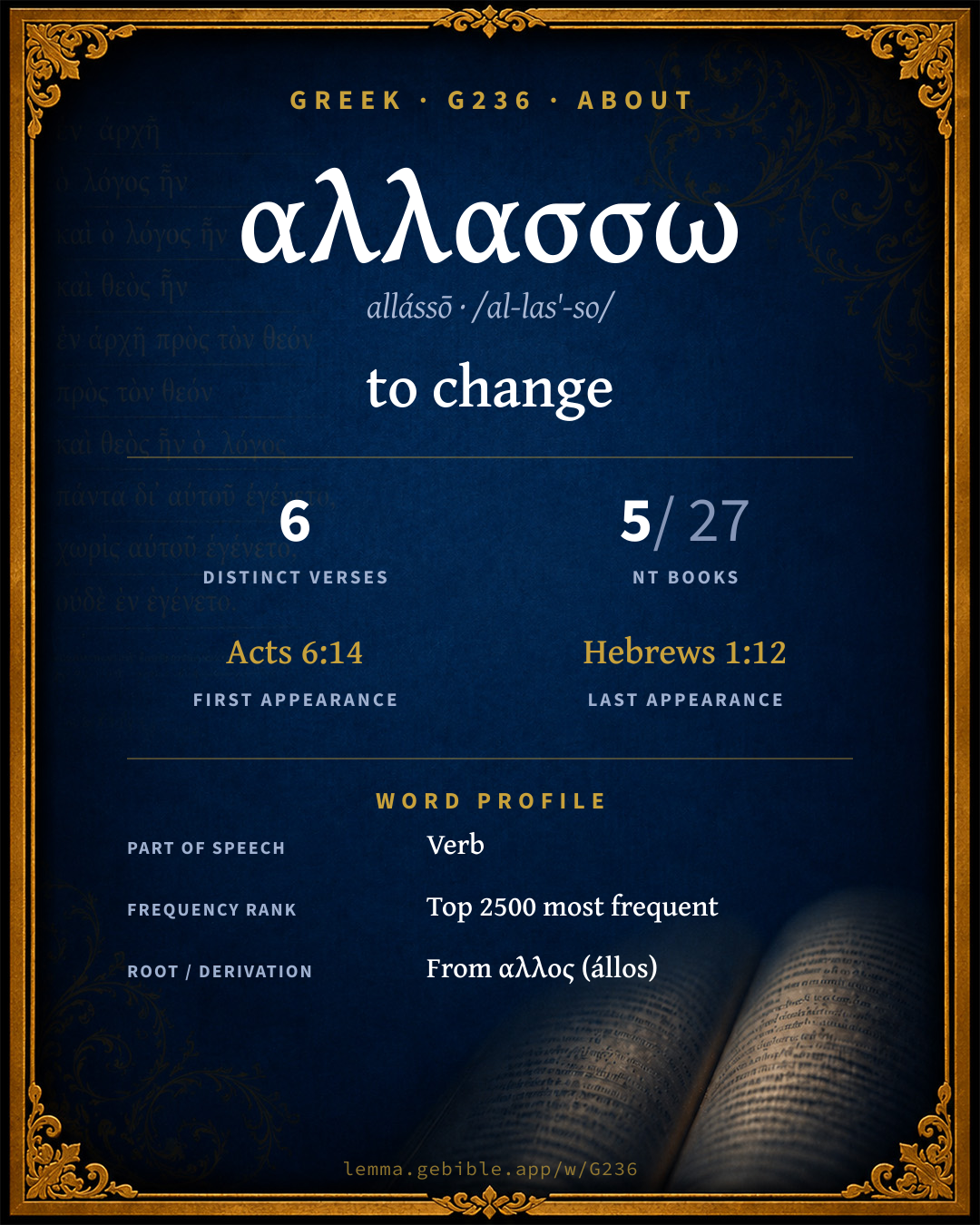
ἀλλάσσω
to change
Full lexicon entry — Thayer's Greek Lexicon
From Thayer's Greek Lexicon
Where this word appears
Grammar key — what these labels mean
Part of speech
- Verb
- An action or state-of-being word.
Tense
- Future
- Action expected in future time.
- Aorist
- Action viewed as a simple whole, without regard to duration — often past (perfective aspect).
Voice
- Passive
- The subject receives the action.
- Active
- The subject performs the action.
Mood
- Indicative
- States a fact or asks a factual question (the mood of reality).
- Infinitive
- A verbal noun (“to write”), unmarked for person or number.
Person
- 1st person
- The speaker (“I / we”).
- 3rd person
- The one spoken about (“he / she / it / they”).
- 2nd person
- The one addressed (“you”).
Number
- Plural
- More than one.
- Singular
- One.
Every verse where G236 appears in the Book of Hebrews — 1 distinct verse. Click any verse to open its interlinear word-by-word view. Verse text shown in the World English Bible for context — . Each verse’s Greek form is shown with its reference; the English is not keyword-highlighted, since the data carries no word-level English alignment. Use “Compare translations” on any verse to read it across multiple English versions. This concordance covers the Greek New Testament; Septuagint (Greek Old Testament) occurrences of this word are not indexed here.
Hebrews
About this entry
At a glance — auto-summarized from this page’s data, not written by a person. Every figure links to its source below. This summary describes the numbers; it doesn’t interpret them.
αλλασσω (allássō) is a Greek verb most often rendered “to change.” It first appears in Acts 6:14. The Greek New Testament uses it across 6 verses — uncommon. 1 Corinthians dominates its distribution — 2 of 6 verses. Sharing its root, it stands alongside αλλος, αλλα and αλλαχοθεν. The sections below give every sense, occurrence, and version rendering.
Gloss history
Strong's 1890 vs modern scholarship
About this word
Strong's G236 catalogs a Greek word from the Greek New Testament.
These counts are not copied from any lexicon or concordance. They are computed here, from the morphology-tagged Greek New Testament. What Lemma adds →
- 6
- distinct verses
- The word appears in 6 distinct verses.
- 5 / 27
- NT books
- The word appears in 5 of 27 New Testament books.
- #1,358
- by frequency
- Top 2500 most frequent Greek words (rank 1,358 of 5,347 Greek words by occurrence).
View all 6 occurrences in the concordance →
Most concentrated in
- 1 Corinthians 2 verses 33%
- Acts 1 verse 17%
- Romans 1 verse 17%
By section of the New Testament
By traditional corpus
Conventional, traditional groupings — biblical authorship is debated, so this is a traditional corpus grouping, not an authorship claim. Some books belong to more than one corpus (Luke is in both the Gospels and the Lukan corpus, and so on), so these shares overlap and need not total 100%. Each figure is a share of the word’s 6 distinct verses.
- Pauline corpus 4 verses · 67%
- Lukan (Luke–Acts) 1 verse · 17%
- Hebrews 1 verse · 17%
How translations render this word
Counts come from each version’s own published word-to-Strong’s tagging or interlinear alignment — an approximate guide to how each version renders this word, not a word-level alignment the data otherwise carries. Because each total is that version’s own tagged count, the per-version totals vary from one another and need not match the appearance or distinct-verse counts above. These counts may also differ from a printed concordance because Lemma counts each distinctly tagged rendering and does not collapse phrase taggings into a single head-word total. This is a fixed set of word-tagged versions (KJV, ASV, BSB, ULT) and does not change with the reading translation you choose elsewhere. Each version’s license is shown beside its name below (and on Sources).
- King James Version: Be changed 1×, Change 1×, Changed 1×
- American Standard Version: Be changed 1×, Change 1×, Changed 1×
- Berean Standard Bible: Change 2×
- unfoldingWord Literal Text: Change 2×
King James Version Public Domain
Renders G236 across 7 tagged occurrences — most commonly:
American Standard Version Public Domain
Renders G236 across 7 tagged occurrences — most commonly:
Berean Standard Bible Public Domain
Renders G236 across 6 tagged occurrences — most commonly:
Plus 4 renderings that appear only once — usually multi-word phrases or single function words the recovered tagging swept in, not distinct renderings.
unfoldingWord Literal Text CC BY-SA 4.0
Renders G236 across 7 tagged occurrences — most commonly:
Plus 5 renderings that appear only once — usually multi-word phrases or single function words the recovered tagging swept in, not distinct renderings.
Senses in Thayer's
The 1 sense Thayer's distinguishes for this word, in lexicon order (not ranked by frequency or importance). The full entry — with sub-senses — is in the Lexicon Entry tab.
- to change, to exchange one thing for another, to transform
Word origin
Derived from αλλος (állos) (G243) — another.
From G243 ; to make different : - change.
— Strong’s Exhaustive Concordance (1890), public domain.
Forms in the corpus
The 6 distinct written forms G236 takes in the Greek New Testament, most frequent first — each parse links to that tense’s occurrences in the concordance.
| Form | Parsing | Example | Uses |
|---|---|---|---|
| ἀλλαγησόμεθα allagēsómetha | Verb, Future, Passive, Indicative, 1st person, Plural | 1 Corinthians 15:51 | 2 |
| ἀλλάξαι alláxai | Verb, Aorist, Active, Infinitive | Galatians 4:20 | 1 |
| ἀλλάξει alláxei | Verb, Future, Active, Indicative, 3rd person, Singular | Acts 6:14 | 1 |
| ἀλλάξεις alláxeis | Verb, Future, Active, Indicative, 2nd person, Singular | Hebrews 1:12 | 1 |
| ἀλλαγήσονται allagḗsontai | Verb, Future, Passive, Indicative, 3rd person, Plural | Hebrews 1:12 | 1 |
| ἤλλαξαν ḗllaxan | Verb, Aorist, Active, Indicative, 3rd person, Plural | Romans 1:23 | 1 |
Same root — word family
Other Thayer's entries built from the same root as G236, grouped by Strong’s listed origin. These share a root / origin per the lexicon — not necessarily a shared meaning. Each links to that word’s own entry.
Derives from
Shares the same root
- αλλα allá G235 but
- αλλαχοθεν allachóthen G237 from another place
- αλληγορεω allēgoréō G238 to speak allegorically
- αλληλων allḗlōn G240 one another
- αλλογενης allogenḗs G241 foreigner
- αλλοτριος allótrios G245 foreign
- αλλοφυλος allóphylos G246 foreign
- αλλως állōs G247 otherwise
Compare all same-root words → Showing 4 of 10 — not the complete family. They share a root, not necessarily a meaning.
Septuagint usage
The same Greek word αλλασσω appears 32 times in the Greek Old Testament (Septuagint), across 25 verses in 11 books.
- 32
- LXX occurrences
- Tagged occurrences of this Greek word in the Septuagint.
- 25
- verses
- Distinct Septuagint verses containing this word.
- 11 / 39
- OT books
- The word appears in 11 of the 39 Old Testament books.
Sample Septuagint occurrences
- Genesis 31:7 ἀλλάσσω
- Exodus 13:13 ἀλλάσσω
- Leviticus 27:10 ἀλλάσσω
- Judges 14:13 ἀλλάσσω
- 2 Samuel 12:20 ἀλλάσσω
- 1 Kings 5:28 ἀλλάσσω
- 2 Kings 5:5 ἀλλάσσω
- Ezra 6:11 ἀλλάσσω
- Psalms 101:27 ἀλλάσσω
- Isaiah 24:5 ἀλλάσσω
- Jeremiah 2:11 ἀλλάσσω
Septuagint occurrences (same lexeme)
Every verse where the same Strong’s number (G236) appears in the Greek Septuagint. Verse text shown in the World English Bible for context; the Greek form is the matched word — the English is not keyword-highlighted.
- Genesis 31:7 ἀλλάσσω Your father has deceived me, and changed my wages ten times, but God didn't allow him to hurt me.
- Genesis 35:2 ἀλλάσσω Then Jacob said to his household, and to all who were with him, "Put away the foreign gods that are among you, purify yourselves, change your garments.
- Genesis 41:14 ἀλλάσσω Then Pharaoh sent and called Joseph, and they brought him hastily out of the dungeon. He shaved himself, changed his clothing, and came in to Pharaoh.
- Exodus 13:13 ἀλλάσσω Every firstborn of a donkey you shall redeem with a lamb; and if you will not redeem it, then you shall break its neck; and you shall redeem all the firstborn of man among your sons.
- Leviticus 27:10 ἀλλάσσω He shall not alter it, nor change it, a good for a bad, or a bad for a good: and if he shall at all change animal for animal, then both it and that for which it is changed shall be holy.
- Leviticus 27:27 ἀλλάσσω If it is an unclean animal, then he shall buy it back according to your valuation, and shall add to it the fifth part of it: or if it isn't redeemed, then it shall be sold according to your valuation.
- Leviticus 27:33 ἀλλάσσω He shall not search whether it is good or bad, neither shall he change it: and if he changes it at all, then both it and that for which it is changed shall be holy. It shall not be redeemed.'"
- Judges 14:13 ἀλλάσσω but if you can't declare it to me, then shall you give me thirty linen garments and thirty changes of clothing. They said to him, Put forth your riddle, that we may hear it.
- 2 Samuel 12:20 ἀλλάσσω Then David arose from the earth, and washed, and anointed himself, and changed his clothing; and he came into the house of Yahweh, and worshiped: then he came to his own house; and when he required, they set bread before him, and he ate.
- 1 Kings 5:28 ἀλλάσσω
- 1 Kings 21:25 ἀλλάσσω (But there was none like Ahab, who did sell himself to do that which was evil in the sight of Yahweh, whom Jezebel his wife stirred up.
- 2 Kings 5:5 ἀλλάσσω The king of Syria said, Go now, and I will send a letter to the king of Israel. He departed, and took with him ten talents of silver, and six thousand [pieces] of gold, and ten changes of clothing.
- 2 Kings 5:22 ἀλλάσσω He said, All is well. My master has sent me, saying, Behold, even now there are come to me from the hill-country of Ephraim two young men of the sons of the prophets; please give them a talent of silver, and two changes of clothing.
- 2 Kings 5:23 ἀλλάσσω Naaman said, Be pleased to take two talents. He urged him, and bound two talents of silver in two bags, with two changes of clothing, and laid them on two of his servants; and they bore them before him.
- Ezra 6:11 ἀλλάσσω Also I have made a decree, that whoever shall alter this word, let a beam be pulled out from his house, and let him be lifted up and fastened thereon; and let his house be made a dunghill for this:
- Ezra 6:12 ἀλλάσσω and the God who has caused his name to dwell there overthrow all kings and peoples who shall put forth their hand to alter [the same], to destroy this house of God which is at Jerusalem. I Darius have made a decree; let it be done with all diligence.
- Ezra 19:26 ἀλλάσσω
- Psalms 101:27 ἀλλάσσω
- Psalms 105:20 ἀλλάσσω The king sent and freed him; Even the ruler of peoples, and let him go free.
- Isaiah 24:5 ἀλλάσσω The earth also is polluted under the inhabitants of it; because they have transgressed the laws, violated the statutes, broken the everlasting covenant.
- Isaiah 40:31 ἀλλάσσω but those who wait for Yahweh shall renew their strength; they shall mount up with wings as eagles; they shall run, and not be weary; they shall walk, and not faint.
- Isaiah 41:1 ἀλλάσσω Keep silence before me, islands; and let the peoples renew their strength: let them come near; then let them speak; let us come near together to judgment.
- Jeremiah 2:11 ἀλλάσσω Has a nation changed [its] gods, which yet are no gods? but my people have changed their glory for that which does not profit.
- Jeremiah 13:23 ἀλλάσσω Can the Ethiopian change his skin, or the leopard his spots? then may you also do good, who are accustomed to do evil.
- Jeremiah 52:33 ἀλλάσσω and changed his prison garments. [Jehoiachin] ate bread before him continually all the days of his life:
These are occurrences of the same Greek lexeme (G236) in the Septuagint — not a translation of any one Hebrew word. The store carries no word-level Hebrew↔Greek alignment, so no Hebrew original is asserted here. Counts come from the recovered LXX Strong's tagging — high-frequency vocabulary is well covered, while rare or late forms may be untagged — so they reflect tagged occurrences and may slightly undercount.