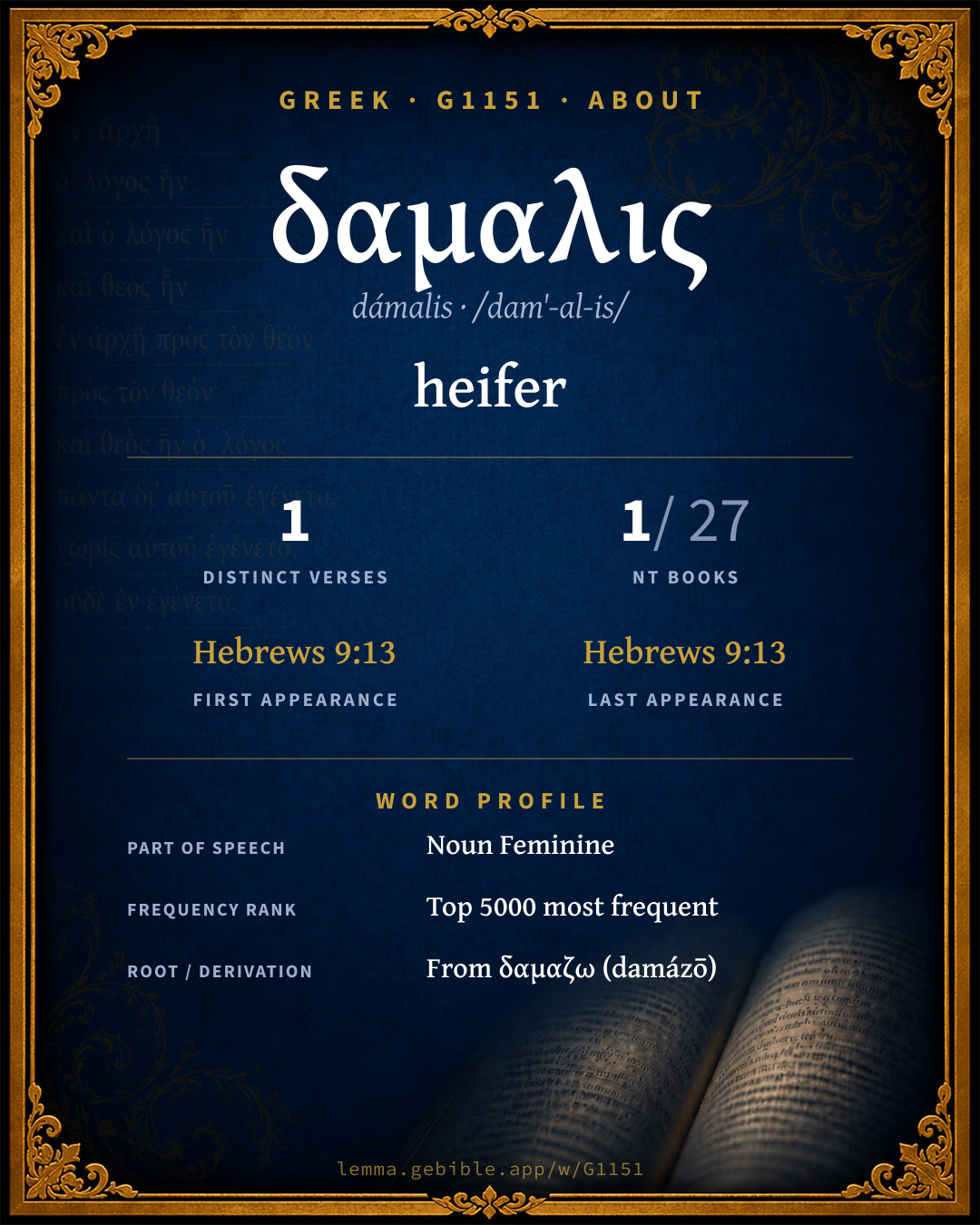
δάμαλις
heifer
Full lexicon entry — Thayer's Greek Lexicon
From Thayer's Greek Lexicon
Where this word appears
Grammar key — what these labels mean
Part of speech
- Noun
- A naming word — a person, place, thing, or idea.
Case
- Genitive
- The case of source, possession, or “of” — answers “whose / from what.”
Gender
- Feminine
- Grammatically feminine.
Number
- Singular
- One.
Every verse where G1151 appears — 1 distinct verse across 1 book. Click any verse to open its interlinear word-by-word view. Verse text shown in the World English Bible for context — . Each verse’s Greek form is shown with its reference; the English is not keyword-highlighted, since the data carries no word-level English alignment. Use “Compare translations” on any verse to read it across multiple English versions. This concordance covers the Greek New Testament; Septuagint (Greek Old Testament) occurrences of this word are not indexed here.
Hebrews 1 verse
About this entry
At a glance — auto-summarized from this page’s data, not written by a person. Every figure links to its source below. This summary describes the numbers; it doesn’t interpret them.
At its core, δαμαλις (dámalis) means “heifer.” A scarce word — 1 verse in all of the Greek New Testament. Its uses cluster heavily in Hebrews (100% of all occurrences). It occurs only once, in Hebrews 9:13. Sharing its root, it stands alongside δαμαζω, ζημια and Δαμαρις. Each statement above links to its evidence; the full detail follows below.
Gloss history
Strong's 1890 vs modern scholarship
About this word
Strong's G1151 catalogs a Greek word from the Greek New Testament.
These counts are not copied from any lexicon or concordance. They are computed here, from the morphology-tagged Greek New Testament. What Lemma adds →
- 1
- distinct verses
- The word appears in 1 distinct verse.
- 1 / 27
- NT books
- The word appears in 1 of 27 New Testament books.
- #3,503
- by frequency
- Top 5000 most frequent Greek words (rank 3,503 of 5,347 Greek words by occurrence).
View all 1 occurrence in the concordance →
Most concentrated in
- Hebrews 1 verse 100%
By section of the New Testament
By traditional corpus
Conventional, traditional groupings — biblical authorship is debated, so this is a traditional corpus grouping, not an authorship claim. Some books belong to more than one corpus (Luke is in both the Gospels and the Lukan corpus, and so on), so these shares overlap and need not total 100%. Each figure is a share of the word’s 1 distinct verse.
- Hebrews 1 verse · 100%
How translations render this word
Counts come from each version’s own published word-to-Strong’s tagging or interlinear alignment — an approximate guide to how each version renders this word, not a word-level alignment the data otherwise carries. Because each total is that version’s own tagged count, the per-version totals vary from one another and need not match the appearance or distinct-verse counts above. These counts may also differ from a printed concordance because Lemma counts each distinctly tagged rendering and does not collapse phrase taggings into a single head-word total. This is a fixed set of word-tagged versions (KJV, ASV, BSB, ULT) and does not change with the reading translation you choose elsewhere. Each version’s license is shown beside its name below (and on Sources).
- King James Version: Heifer 1×
- American Standard Version: Heifer 1×
- Berean Standard Bible: Heifer 1×
- unfoldingWord Literal Text: Heifer 1×
King James Version Public Domain
Renders G1151 across 1 tagged occurrence — most commonly:
American Standard Version Public Domain
Renders G1151 across 1 tagged occurrence — most commonly:
Berean Standard Bible Public Domain
Renders G1151 across 1 tagged occurrence — most commonly:
unfoldingWord Literal Text CC BY-SA 4.0
Renders G1151 across 1 tagged occurrence — most commonly:
Senses in Thayer's
The 1 sense Thayer's distinguishes for this word, in lexicon order (not ranked by frequency or importance). The full entry — with sub-senses — is in the Lexicon Entry tab.
- of the red heifer with whose ashes, by the Mosaic law, those were to be sprinkled who had become defiled
Word origin
Derived from δαμαζω (damázō) (G1150) — to tame.
Probably from the base of G1150 ; a heifer (as tame ): - heifer.
— Strong’s Exhaustive Concordance (1890), public domain.
Same root — word family
Other Thayer's entries built from the same root as G1151, grouped by Strong’s listed origin. These share a root / origin per the lexicon — not necessarily a shared meaning. Each links to that word’s own entry.
Derives from
Shares the same root
Proper names from this root
People and places named from this root — a name, not an additional meaning of the word.
Compare all same-root words → 1 of the same-root words is a proper name (a person or place). They share a root, not necessarily a meaning.
Septuagint usage
The same Greek word δαμαλις appears 38 times in the Greek Old Testament (Septuagint), across 37 verses in 13 books.
- 38
- LXX occurrences
- Tagged occurrences of this Greek word in the Septuagint.
- 37
- verses
- Distinct Septuagint verses containing this word.
- 13 / 39
- OT books
- The word appears in 13 of the 39 Old Testament books.
Sample Septuagint occurrences
- Genesis 15:9 δάμαλις
- Numbers 7:17 δάμαλις
- Deuteronomy 21:3 δάμαλις
- Judges 14:18 δάμαλις
- 1 Samuel 16:2 δάμαλις
- 1 Kings 12:28 δάμαλις
- 2 Kings 10:29 δάμαλις
- Psalms 67:31 δάμαλις
- Isaiah 5:18 δάμαλις
- Jeremiah 26:20 δάμαλις
- Hosea 4:16 δάμαλις
- Joel 1:17 δάμαλις
Septuagint occurrences (same lexeme)
Every verse where the same Strong’s number (G1151) appears in the Greek Septuagint. Verse text shown in the World English Bible for context; the Greek form is the matched word — the English is not keyword-highlighted.
- Genesis 15:9 δάμαλις He said to him, "Take me a heifer three years old, a female goat three years old, a ram three years old, a turtle-dove, and a young pigeon."
- Numbers 7:17 δάμαλις and for the sacrifice of peace offerings, two oxen, five rams, five male goats, and five male lambs a year old. This was the offering of Nahshon the son of Amminadab.
- Numbers 7:23 δάμαλις and for the sacrifice of peace offerings, two oxen, five rams, five male goats, five male lambs a year old. This was the offering of Nethanel the son of Zuar.
- Numbers 7:29 δάμαλις and for the sacrifice of peace offerings, two oxen, five rams, five male goats, and five male lambs a year old. This was the offering of Eliab the son of Helon.
- Numbers 7:35 δάμαλις and for the sacrifice of peace offerings, two oxen, five rams, five male goats, and five male lambs a year old. This was the offering of Elizur the son of Shedeur.
- Numbers 7:41 δάμαλις and for the sacrifice of peace offerings, two oxen, five rams, five male goats, and five male lambs a year old: this was the offering of Shelumiel the son of Zurishaddai.
- Numbers 7:47 δάμαλις and for the sacrifice of peace offerings, two oxen, five rams, five male goats, and five male lambs a year old. This was the offering of Eliasaph the son of Deuel.
- Numbers 7:53 δάμαλις and for the sacrifice of peace offerings, two oxen, five rams, five male goats, and five male lambs a year old. This was the offering of Elishama the son of Ammihud.
- Numbers 7:59 δάμαλις and for the sacrifice of peace offerings, two oxen, five rams, five male goats, and five male lambs a year old. This was the offering of Gamaliel the son of Pedahzur.
- Numbers 7:65 δάμαλις and for the sacrifice of peace offerings, two oxen, five rams, five male goats, and five male lambs a year old. This was the offering of Abidan the son of Gideoni.
- Numbers 7:71 δάμαλις and for the sacrifice of peace offerings, two oxen, five rams, five male goats, and five male lambs a year old. This was the offering of Ahiezer the son of Ammishaddai.
- Numbers 7:77 δάμαλις and for the sacrifice of peace offerings, two oxen, five rams, five male goats, and five male lambs a year old. This was the offering of Pagiel the son of Ochran.
- Numbers 7:83 δάμαλις and for the sacrifice of peace offerings, two oxen, five rams, five male goats, and five male lambs a year old. This was the offering of Ahira the son of Enan.
- Numbers 7:88 δάμαλις and all the oxen for the sacrifice of peace offerings twenty-four bulls, the rams sixty, the male goats sixty, the male lambs a year old sixty. This was the dedication of the altar, after it was anointed.
- Numbers 19:2 δάμαλις This is the statute of the law which Yahweh has commanded, saying, Speak to the children of Israel, that they bring you a red heifer without spot, in which is no blemish, [and] on which never came yoke.
- Numbers 19:6 δάμαλις and the priest shall take cedar-wood, and hyssop, and scarlet, and cast it into the midst of the burning of the heifer.
- Numbers 19:9 δάμαλις A man who is clean shall gather up the ashes of the heifer, and lay them up outside of the camp in a clean place; and it shall be kept for the congregation of the children of Israel for a water for impurity: it is a sin-offering.
- Numbers 19:10 δάμαλις He who gathers the ashes of the heifer shall wash his clothes, and be unclean until the even: and it shall be to the children of Israel, and to the stranger who lives as a foreigner among them, for a statute forever.
- Deuteronomy 21:3 δάμαλις and it shall be, that the city which is nearest to the slain man, even the elders of that city shall take a heifer of the herd, which hasn't been worked with, and which has not drawn in the yoke;
- Deuteronomy 21:4 δάμαλις and the elders of that city shall bring down the heifer to a valley with running water, which is neither plowed nor sown, and shall break the heifer's neck there in the valley.
- Deuteronomy 21:6 δάμαλις All the elders of that city, who are nearest to the slain man, shall wash their hands over the heifer whose neck was broken in the valley;
- Judges 14:18 δάμαλις The men of the city said to him on the seventh day before the sun went down, What is sweeter than honey? and what is stronger than a lion? He said to them, If you hadn't plowed with my heifer, You wouldn't have found out my riddle.
- 1 Samuel 16:2 δάμαλις Samuel said, How can I go? if Saul hear it, he will kill me. Yahweh said, Take a heifer with you, and say, I am come to sacrifice to Yahweh.
- 1 Samuel 28:24 δάμαλις The woman had a fattened calf in the house; and she hurried, and killed it; and she took flour, and kneaded it, and did bake unleavened bread of it:
- 1 Kings 12:28 δάμαλις Whereupon the king took counsel, and made two calves of gold; and he said to them, It is too much for you to go up to Jerusalem: see your gods, Israel, which brought you up out of the land of Egypt.
- 1 Kings 12:32 δάμαλις Jeroboam ordained a feast in the eighth month, on the fifteenth day of the month, like the feast that is in Judah, and he went up to the altar; so did he in Bethel, sacrificing to the calves that he had made: and he placed in Bethel the priests of the high places that he had made.
- 2 Kings 10:29 δάμαλις However from the sins of Jeroboam the son of Nebat, with which he made Israel to sin, Jehu didn't depart from after them, [to wit], the golden calves that were in Bethel, and that were in Dan.
- 2 Kings 17:16 δάμαλις They forsook all the commandments of Yahweh their God, and made them molten images, even two calves, and made an Asherah, and worshiped all the host of the sky, and served Baal.
- Psalms 67:31 δάμαλις
- Isaiah 5:18 δάμαλις Woe to those who draw iniquity with cords of falsehood, And wickedness as with cart rope;
- Isaiah 7:21 δάμαλις It shall happen in that day that a man shall keep alive a young cow, and two sheep;
- Isaiah 15:5 δάμαλις My heart cries out for Moab; her nobles [flee] to Zoar, to Eglath Shelishiyah: for by the ascent of Luhith with weeping they go up; for in the way of Horonaim they raise up a cry of destruction.
- Jeremiah 26:20 δάμαλις There was also a man who prophesied in the name of Yahweh, Uriah the son of Shemaiah of Kiriath Jearim; and he prophesied against this city and against this land according to all the words of Jeremiah:
- Hosea 4:16 δάμαλις For Israel has behaved extremely stubbornly, like a stubborn heifer. Then how will Yahweh feed them like a lamb in a meadow.
- Hosea 10:11 δάμαλις Ephraim is a trained heifer that loves to thresh; So I will put a yoke on her beautiful neck. I will set a rider on Ephraim. Judah will plow. Jacob will break his clods.
- Joel 1:17 δάμαλις The seeds rot under their clods. The granaries are laid desolate. The barns are broken down, for the grain has withered.
- Amos 4:1 δάμαλις Listen to this word, you cows of Bashan, who are on the mountain of Samaria, who oppress the poor, who crush the needy, who tell their lords, "Bring, and let us drink."
These are occurrences of the same Greek lexeme (G1151) in the Septuagint — not a translation of any one Hebrew word. The store carries no word-level Hebrew↔Greek alignment, so no Hebrew original is asserted here. Counts come from the recovered LXX Strong's tagging — high-frequency vocabulary is well covered, while rare or late forms may be untagged — so they reflect tagged occurrences and may slightly undercount.